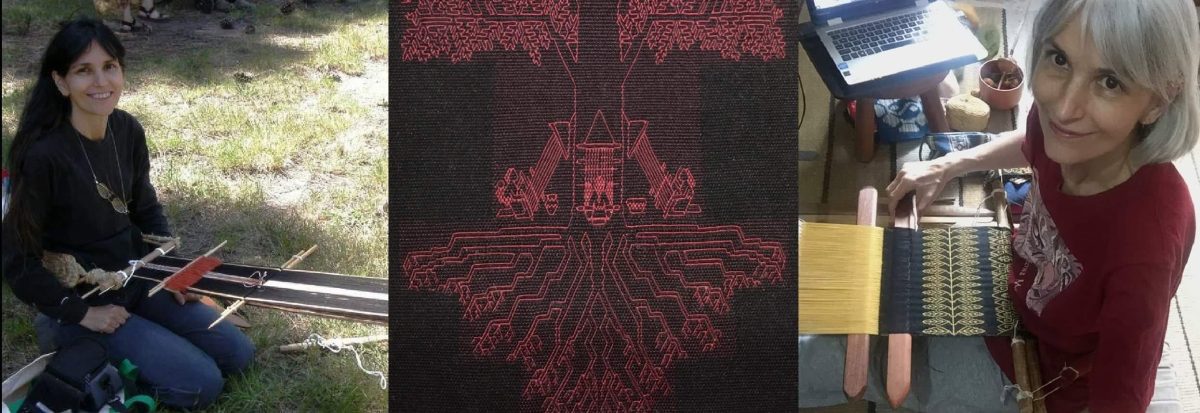
Backstrap Weaving – Different Paths

Facebook is fond of showing me memories from past years and the latest one to show up is from November 2017 when I was at my brother’s home in Australia working on weaving the samples for my Complementary-warp Pattern Book. Sometimes, the will is there to start a new book but for some reason it is just so very hard to get the project off the ground. At times, I have started by laying out the table of contents in a Word doc and that has been enough to kick me into further action. In the case of Complementary-warp Pattern Book it was the act of sitting down with this lovely blank Andean Pebble Weave warp stretched out before me that started the ball rolling.

There would soon be four horses galloping along the length of that warp…four horses called “Eldy’s Mustangs” by their creator, my weaving friend, Deanna Johnson. I love the simplicity of this set-up. Another warp that I set up for this book would have angels dancing among snowflakes, candy canes and Christmas trees. I think that just the colors  that I had chosen would have provided a hint of what was to come.

And this next one was set up to display different kinds of maze-like and geometric patterns.

Watch and learn….Of course, I was focused on the way my teachers’ fingers were moving among the threads while picking colors to form the patterns. The body movements when using such narrow warps are very subtle.

All three warps are set up for the two-heddle pebble weave method that I favor when I weave this structure on my backstrap loom. The pencils that you see in the warp are holding what I call the “permanent picking cross”. In the twenty-four years that I have been traveling here and there to study these structures with my indigenous teachers, one of the most important things that I have brought home with me time and time again is the fact that there is no one correct way to do things. There are many different paths that can be taken in order to arrive at the same place. I am so glad that I have been exposed to four very different methods that can be used to weave the Andean Pebble Weave structure.

The set-up that you see in these photos was the one that was taught to me by my very first teachers back in 1996. The mother and daughter who sat with me day after day as I wrestled around with those two sets of heddles came from Ayacucho in Peru. They happened to be living in Huancayo at the time.

I would like to say that they sat by patiently as I made a mess of their carefully prepared warp but it isn’t so. They were perplexed and annoyed by the fact that I was pulling away so violently at the heddles. My warp threads were breaking with all the friction and abrasion. I was not aware at that time of the role my body needed to play in the operation of the loom. The body needs to move and make subtle changes to the tension on the warp which makes the smooth operation of the heddles possible. Several movements need to be coordinated and when you finally find yourself picking up and slipping into the rhythm, it’s almost like a dance. Until then, you are brutish and clumsy and the result is heddles clogged with fluff, broken warp threads and annoyed teachers!

I didn’t understand that there was much to be learned about basic backstrap loom operation before I could hope to learn about the patterning technique. Fortunately it all started to come together eventually.

You can see my teacher picking out her pattern while working close to the cross sticks. This is the method used by weavers in Ayacucho. The two sets of heddles hold the regularly repeating pebble sheds….those that create the little spots, or pebbles, in the fabric.

(If you also find yourself seated at a nicely prepared warp but are unable to progress because of heddles clogged with fluff, you might consider taking a look at the video class that I prepared back in 2016…Operating a Backstrap Loom. It’s available as a dvd or as streamed content from Taproot Video.)

My weaving teacher here in lowland Bolivia uses this pebble weave structure on the large vertical frame loom that is used by the Guaraní people to weave hammocks. Angela uses three sets of heddles…one set holds the threads from one of the two pebble sheds. A second holds all the dark threads and the third all the light threads. The threads for the second pebble shed lie on a shed rod or in one large loop depending on the width of the piece being woven. The Guaraní weavers have a very interesting way of making their string heddles. You can see how they are sort of chained together.

Angela was only working on very narrow commissioned pieces when I studied with her and so I have included here a picture (courtesy of Aude Rossignol) of another Guaraní weaver who is using the full width of her loom for a hammock in pebble weave. You can see the advantage of those loose chained heddles on such a wide piece. If the heddles were suspended on a rod, it would not be possible to just pull on the rod and achieve a good shed clear across that wide warp. This is a fixed tension loom and so using the body to make tension adjustments as one does with a backstrap loom is not an option. Instead, the weavers pull on groups of chained heddles working their slowly way from one side of the loom (in this case from right to left) to the other and inserting the sword as they go.

Picture courtesy of Aude Rossignol.

My weaving teachers in the central Bolivian highlands use yet another method when they weave narrow bands to create the same Andean Pebble Weave structure…

The only name that I can think of for this kind of loom is “body-tensioned”. Maxima’s index finger is one “beam” and her big toe is the other. Her left index finger is permanently in this position to maintain and adjust tension on the warp. All loom operation and pick-up is done with the other hand. There’s no backstrap. The warp is set up with one pebble shed in heddles and the other pebble shed in one large loop. Max makes a picking cross with these two sheds and from there picks the colors to form her pebble weave patterns. And, you should see the speed with which she does so!

The last time I visited Max and the other ladies in the co-op, I demonstrated a new pattern for them using a warp that was tied to my waist in the manner to which I am accustomed. I could see Max studying me and I could almost see from the expression on her face that she approved of this set-up which gave me two free hands with which to operate the loom…a definite advantage when working with the rather sticky handspun wool thread. All the ladies kicked off a sandal and started winding warps using their fingers and toes as warping stakes. Max took a length of yarn and tied hers to her waist. She had decided to try out this “new” method that I was using which involved tying the warp to her body rather than just suspending it on one finger. To my surprise she was immediately mocked by all the other ladies for wanting to do things the “gringa” way!

Max, Antonia and some of the other ladies learned to read my pattern charts. You can see a picture of Antonia showing off the band she wove using patterns from the book I had left behind. Don’t we all love to learn new patterns?

The fourth way is the way that is used by some of the backstrap weavers that I have observed in the Cusco area of Peru in my travels. We were also privileged to have two ladies from Chinchero come to Santa Cruz Bolivia, where I live, to attend a small conference that was held here back in 2011. Only a handful of people from the general public applied to attend and it was wonderful to be able to spend so much quality time with these weavers over the three days that we had together. My Guaraní teacher, Angela, was also invited to demonstrate.

The warp being used by the Chinchero weaver in this picture is set up with all the threads of color A in heddles and all the threads in color B held on a shed rod. She uses two swords to hold what I call a “temporary picking cross” in which all the threads from both layers of warp are raised at the same time and held on swords. She can weave a variety of complementary-warp structures using this method. Some of the patterns that Chinchero weavers use are a complex combination of more than one structure which means that there is no real advantage to storing the pebble sheds in heddles. Some parts of a large motif can be woven using the two-two-two pebble arrangement of warp floats while other parts of the very same motif can be based on a two-one-two-one arrangement.

This two-sword method is he one that I teach in my Complementary-warp Pick-up Book. In my Andean Pebble Weave on Inkle Looms book I teach both this and a modified version of the two-heddle method. In fact, I teach three methods in that book.

You might have guessed that my favorite method for the backstrap loom is the first one that I showed with its two sets of heddles. For me, it has many advantages. I won’t go into them but, if you have ever taken one of my Andean Pebble Weave classes on a backstrap loom, you may recall my talking very enthusiastically about a thing called the “saver cord”. On the inkle loom, I guess I prefer the two-sword method of the three different methods I teach on that kind of loom.

Mary Spanos has woven with me on several occasions when I have been visiting the USA. She loves the backstrap loom and recently showed me her latest project….

This is a Japanese sashiko pattern that is charted in my Complementary-warp Pattern Book. Julia Weldon translated the traditional stitched pattern to the Andean Pebble Weave structure and kindly contributed it to the collection. Mary is weaving it beautifully into this band. I particularly like the way that she has chosen to use a lavender and white strip of plain Andean Pebble Weave as a border stripe instead of a solid color.

And, here’s another band by Mary using a series of fish patterns from the same book alongside some of her own creation…

Carlos is also using a backstrap loom and the two-heddle method to weave a wide piece of fabric to be made into a shoulder bag. The same book mentioned above has charts for three bee motifs. The center bee on this piece is included and is Carlos’ own creation.

Lausanne also learned the two-heddle method using a backstrap loom with me on one of my visits and you can see her here weaving a hatband for her husband with, yet again, a pattern that is charted in the Complementary-warp Pattern Book (from a pre-columbian textile fragment). This is one of my favorites…one of some cheeky viscachas rocking to and fro…

Here it is on the hat….

Annette Giles is using the two-sword/temporary picking cross method to weave the Andean Pebble Weave hummingbirds. Yes, they’re from that book again.

And, here are some initial results from Carol Berry from one of the very first Zoom classes I gave on Andean Pebble Weave on Inkle Looms…

So…… enough pebble weave! How about some double weave?

Nancy Ayton is using her inkle loom to weave warp-faced double weave bands and is creating her own fabulous patterns. Don’t you love the elf?! That’s just one of Nancy’s original designs on this band.  The band includes some motifs from my book Warp-faced Double Weave on Inkle Looms.

I think I will weave the elf on a set of Christmas tree hanging ornaments like the ones I made last year.

On Maureen Farndell’s warp-faced double weave band you can see the motif that I adapted from Bedouin textiles and charted in the book. It’s lovely the way she has connected the motifs and turned them into one continuous pattern along the length of the band.

As for me, I am plodding along with another silk ikat sample. This one is a study of take-up  and the number of warp-ends and picks I need to create a square. Hopefully the information on take-up will help if I later decide to try and tie some curved shapes into a warp. I do hope so because the study sample pattern I have chosen is just plain boring to weave! It’s rare for me to sit at my loom and think “Urgh, I just couldn’t be bothered”! But sometimes you just have to slog through this sampling process. Hopefully, when it comes time to write my next post, it will be off the loom and I will be on to something else with all the valuable information I have gathered from this sample.

Until then….stay safe and well.


Backstrap Weaving – A Bit of This and That

I’ve been spending a couple of weeks finishing things off, sampling, researching, soaking up some online inspiration and planning while I build up to getting into some meatier projects.

First I added the loops to my cuffs so that I could call them well and truly finished. I made simple three-strand braids from some of my hand spun wool, threaded them through the bands and knotted them on the other side. These slip over the buttons that have been sewn to the other end and secure the cuffs nicely around my wrist.

Next, I decided that I really needed to add a Finnweave cuff to the collection. It was fun planning and weaving this small Finnweave project after the larger one that I had recently completed. I used rows of curl patterns that are often found on Huichol double weave pieces and designed a pattern that I thought had a Mexican flavor to sit between them.

You can see the difference in the gold color in my Finnweave cuff and the cowl on the left. So much of the gold color came out when I wet-finished the fabric for the cowl! Not a bit of black came out and my Color Catcher cloth turned a deep gold color, almost orange. The cuff fabric in 20/2 cotton was light enough to allow me to turn a hem at the two ends without adding too much bulk. I used two black plastic snaps to secure it.

Apparently there is some golden yellow inspiration out on the streets these last weeks. I haven’t been out to see them, but the Bolivia 360 page on Facebook tells me that the yellow tajibos have been blooming. This is one of their photos…

So all three of the latest cuffs are finished and are ready for an outing one of these days!

I would love to also make a cuff from my three-color pebble weave sample in 8/2 tencel on the left but it is just that little bit too wide for any of my ribbon crimps and too thick to hem. It can sit in the sample drawer until I come up with an idea for it.

Next on the list was a return to something I had been playing around with back in early 2015. Back then, I was in one of my ikat phases and wanted to create shapes in ikat and fill them with pick-up patterns. I was heading in the direction of creating curved shapes in ikat to fill with pick-up and was working with 8/2 cotton at the time. I wove a wall hanging with angular shapes…two bird figures that I had seen in a book on a large piece of pre-columbian cloth…I ended up making three pieces in this series of birds. They currently live in my closet. Hopefully one day they will hang on my walls.

That project of angular shapes was followed by ikat circles which I also wanted to fill with pebble weave pick-up. It was successful except for the fact that I had forgotten to account for take-up. when I first tied the shapes into the warp. When I wove the cloth, I ended up with shapes that were certainly curved, but not quite circles. 

Now I am taking the same idea to my 60/2 silk and starting off once again with the somewhat safer angular shapes in order to ease myself back into this. But, I am not making anything nearly as large as a wall hanging! In fact, I thought that I might make this practice piece into a wrist cuff at first but decided that something a bit wider would be more helpful as a sample for future projects.

I used some red silk as the base color, tied it with ikat tape and dyed it black. I really shouldn’t take photos late at night as they are always pretty awful, but I wanted to get a quick picture of this so that it could go into the tub to soak overnight and be ready for dyeing the following afternoon.

I should mention that tying red warp with pink ikat tape is not fun! The colors are too similar and it was very hard to tell if the tape was reaching all the way to the margins of the pattern.

The pattern is a very simple one…horizontal and vertical bars that are supposed to look as if they are interwoven as warp and weft. I may have mentioned in other posts about ikat that I find creating straight horizontal lines particularly challenging. My bundles were pretty small. I find it much easier to wrap a thick bundle rather than a thin one.

Here it is on the loom with some of the shapes filled with Andean Pebble Weave pick-up….

I had by-passed my folders of charts and gone straight to the shelf and taken down my own pattern books to leaf through and choose a pattern.  I used one from one of my pattern books after having modified it to suit these small strips of weaving. I wanted a fairly busy Andean Pebble Weave pattern but not one  that had horizontal lines because I didn’t feel like fussing with the necessary modifications while weaving with this fine silk.

So far, the threads are behaving quite well. I think the interwoven effect would be more pronounced if there was less space between the vertical and horizontal bars. I was concerned that if I left too little space and if the shapes blurred along their upper and lower edges, one shape might end up merging with the next. You watch….next time I’ll leave less space and that is precisely what will happen!

I don’t often look at my own books because I have folders and folders of pattern charts with all the patterns that are found in my books along with so many  more that haven’t yet been published. And so, it was kind of fun looking through my Complementary-warp Pattern Book and remembering the time when I was putting this book together. I spent something like six weeks at my brother’s home in Australia drawing charts and weaving the samples. That visit to Australia was supposed to be about visiting family and then popping over to Bali to take a workshop on weft ikat. You may remember my tale about being five hours into the six-hour flight to Denpasar when a volcano on the island of Bali erupted. That forced us to turn back and all flights from Australia to Bali got canceled for a week or so after that. Of course, the workshop went ahead without me.

And so I  stayed in Sydney with my family instead and  work on the book continued.

Starting the collection of sample bands.

The book was finished something like four months later and it has been wonderful seeing these patterns being woven around the world ever since….

By Gonit Poratin Israel (right) using a backstrap loom and one of her students using the frame of a rigid heddle loom.

Frances Lewis used the fish charts from the Rivers and Oceans set to weave a band of fish, but using tablets instead of heddles. She filled in some of the fish outlines with her own pattern ideas.

Julie B liked the set of four cats in the animal section. I love weaving these too and wove them into a silk wrist cuff along with some of the paw prints that are also charted in this book. There are three different kinds of paw prints in the book.

Wendy made this beautiful hat band for her fisherman husband using the fish and other watery patterns from the Oceans and Rivers set…

Bees get a section all of their own in the book as there are four of them to choose from. Here is Carlos’ backstrap-woven bee piece…

Carlos was one of the designers who made a contribution to this  book. You can see his own bee design (below) flanked by some of the patterns from the Borders and Dividers set.

Original patterns contributed by Maja Burger, Laura McCarty and Carlos Vargas.

Nora included one of the bees and its hive in her band of patterns from the Garden-themed set…

I chose some patterns from this book (along with a couple from another one of my books) for the Christmas tree hangers that I made last year…

Could this be my favorite among my books? I’m not sure. I certainly had fun sitting down and looking through it while planning my latest ikat experiment and there are certainly some nice memories associated with weaving the samples (despite the disappointment of the failed Bali trip).

I guess one of the things I like the most about this book is the fact that there were so many contributions from people who had bought my earlier instructional books and then gone on to create their own awesome original patterns. Within the book itself, it’s impossible to pick favorites from the one hundred options. Julia transferred Sashiko sewing patterns to the Andean Pebble Weave structure. I love those. They are charted in the Geometric set.

I have woven my slightly adapted version of Maja’s weaving woman quite a few times. Yes, she might be my  favorite….my current favorite in any case! She appears on the cover of the book. The cheeky viscachas (Andean chinchilla-like animals) also appear on the cover. I charted this pattern from a pre-columbian textile fragment. 

I hope that if you own this book, you may now feel inspired to take it out and browse through the patterns as I have done. And, if you don’t yet own it, perhaps you will put it on your Christmas Wish List. Complementary-warp Pattern Book. And, if you haven’t learned how to weave Andean Pebble Weave yet, both my Andean Pebble Weave on Inkle Looms and Complementary-warp Pick-up (for inkle and any other kind of loom that allows you to weave warp-faced bands) books show you how.

Our national election here in Bolivia is this Sunday. I hope it passes peacefully. I have re-stocked my pantry in case it doesn’t but let’s hope that there isn’t a repeat of last year’s upheaval.

Take care and stay safe, please.


Backstrap Weaving – The View from my Window


My makeshift photo/video studio at my living room window.

For those who visit my blog to see weaving, there is some in this post, but there’s also a bit of rambling. Forgive me. These are strange times! If you just want to see weaving, and there’s some great eye candy to be enjoyed, you should scroll on for a little bit.

Since I set up my little “video studio”  to shoot the clips for my book on double weave, I have become much more aware of the view I have from my windows. I usually have blinds on these windows and they are always drawn in an attempt to keep out the heat and dust. Now, with everything wide open I see that a good quarantine activity might be washing windows! While hunched over the camera, I feel a little like James Stewart in the Hitchcock movie “Rear Window”. I see little slices of  life through the various windows in the condo. Then again, I wonder who in turn might be observing me and wondering “What is the gringa up to now?”

Filming has been interesting. I have to straddle the tripod, sort of semi-squat, lean to one side to see, and reach around and weave all while trying to keep my head near the camera and in good range of the microphone. My leg muscles start to scream! So, when you buy my book and watch the videos, you will see that one of the clips has an ant merrily making its way in and out of shot. I did many, many takes for many reasons but I decided that the ant could stay. It amused me. I can say that no ants were disturbed or harmed in the making of my movies! 😉

I now know that  one of the neighbors on the second floor in the next building has a Tonkinese cat. Mine now lives with a friend. I had to re-home her because I was traveling so much. She turned 17 on April 1st! I usually visit her twice a week but visits are off for now. Now my friend sweetly sends me videos of her. I see the neighbor’s cat sitting on the window ledge. Like many of us, I suppose it’s wishing it could go out and wander around. I see other neighbors sweeping, cleaning, shaking their table cloths out the window and putting me to shame. I have been wholly devoted to the book these last weeks…heck, months! Everything could do with a good cleaning.

In my last post I remarked on the absence of familiar sounds during the current lock-down. Now there is a new sound of which I had not previously been aware…the rustling of fallen leaves. I live in the tropics. There is no apparent change from summer to fall. We have a sort of winter with slightly milder temperatures but that is all. We have a wet season. All remains lush and green. Today we sit at 93 degrees. However, now I am aware that there are some trees that actually lose their leaves in what is our fall season. The cleaners aren’t coming in every day to sweep up the leaves and they blow about and rustle along the cobbles.

Certain smells are absent too…the “interesting” aromas from the big street market down the road that the wind sometimes blows over is happily missing. The market has been shut down. And that most typical Santa Cruz fragrance…the churrasco! (barbecue) which seemed to be in the air at almost any time, even at 11pm when I would go out sometimes to enjoy the cool air, is no longer around. However, a new aroma is in the air. I noticed talk in one of the Santa Cruz Facebook groups of the disinfecting effect of burning eucalyptus leaves. Someone here burns them every afternoon. I can close my eyes and imagine I am back in Australia on cool autumn evening when people in the neighborhood would rake eucalyptus leaves into piles and burn them.

Because this is what I actually see from my bedroom window, I often play a little mind game when I am seated at my loom. I sit on a firm foam cushion on the floor with my loom attached to the base of my bed. From there I can’t see out my window.

While sitting there, I imagine that I could be anywhere in the world. It wouldn’t matter where I was, because at that moment I have chosen to sit on the floor and be completely focused on my weaving. The foothills of the Himalayas could be outside my window. The Mediterranean Sea could be out there sparkling in the sun. Or it could be the Straits of Magellan stretching away to Tierra del Fuego in the magical low, soft light that is so peculiar to that far end of the world… or any number of fantastic scenes that I have been lucky enough to experience in the places I have chosen to live and travel. I once woke up to this magical scene of snow on a train trip from San Jose to Seattle. I was lucky to be in the last carriage to get this view. It’s a bit harder imagining this to be outside my bedroom window because it is so darn hot!

Depending on the time of year, the evening golden moment has the light of the setting sun bouncing off one of the building’s terracotta walls and filling my room with a warm glow as I weave. In winter when the sun is in a certain position, soft late afternoon rays skim the surface of the fabric on my loom.

I have been missing my backstrap loom and my little spot on my bedroom floor! Yes, I have been weaving, but on an inkle loom because the title of my new book is Warp-faced Double Weave on Inkle Looms. The book is finished! But there is still work to be done. One file has gone to the printer for the making of the spiral-bound books. The other has gone to Taproot Video so that it can be uploaded to the website. All that takes time and I will let you all know as soon as the book is ready for purchase. As usual, it will be offered as a PDF as well as a book.

I am now ready to return to what might be an over-ambitious plan for my next ikat experiment. I have to put the cochineal aside for another day as I was never able to get hold of the alum. I still have synthetic dyes that I can use with my silk but that part of the process is still a long way off. I now have to figure out how to go about tying the pattern that I have sketched into a silk warp.

I have been weaving a lot of double-weave samples lately. Here’s one of the double-weave patterns from the new book which was created by Marilyn Romatka in one of my workshops. It’s amazing how this figure which is undeniably a llama, and a very elegant one at that, has been designed with so few threads. It is stunning in its simplicity and I am so happy that Marilyn allowed me to include it in the book…

I am left with a large box full of the woven samples for the book. I often just wove one figure, photographed it for the book and moved on. This means I have a lot of small pieces that could be used as key fobs and bracelets. The llama band will be a key fob.

Here’s another example of a very simple pattern. Both bands were woven using the same thread for warp. The one on the right uses a finer material for weft and I wove it with a much heavier beat. There is also quite a difference in feel and visible texture between the two. The one on the left has been washed and pressed while the one on the right is fresh off the loom. Both will become bracelets. There is a nice section in my book on different ways to finish double-weave bands depending on their intended use.

There is one thing to be said for deadlines…they force you to come to a halt! Although there is no real deadline in self-publishing, I would always have the trips away from home in the spring and the fall… the trips I called my “weaving safaris”… that would bring my weaving and writing projects to a necessary halt. This year has been different…no travel… and I have had to really force myself to stop the book project! How many times can I fiddle and adjust and enhance?! When do the changes I make stop being improvements and actually start to muddy things up? So, yes, it’s done…the files are in other hands and I am beyond the point of no return! Phew!

I will finish by showing you what my weaving friends around the word have been creating. I don’t step out to see the world. The world comes to me 🙂 These projects bring me so much joy!

My friend Emerald in Sydney has had her job put on hold and has not wasted any time getting back into her backstrap weaving. She has woven one of the two weaving figures from my Complementary-warp Pattern Book. The figure was first designed by Maja Bürger in Germany and she allowed me to make some changes so that I could have two versions in the book. This is how Emerald has her backstrap loom set up at home… When I stayed and wove with her in Australia, she was a sit-on-the-floor weaver but has now created a different set-up sitting in a chair.

Nora Dereli is welcoming spring with my Garden set of patterns from the same book linked above. This set includes, birds, blooms and butterflies and there’s another set which has bee patterns. Nora uses the Windhaven Accordion loom.

And, here’s yet another Andean Pebble Weave/ complementary-warp project and a different kind of loom with patterns from the same book, Complementary-warp Pattern Book….Gonit Porat teaches weaving in her studio in Israel. This is the work of one of her students, Michal. The warp is tensioned on the frame of a rigid heddle loom. There are four lovely horse figures in the Animals set which were designed and contributed by my friend Deanna Johnson.

This band is from Linda who is enjoying using 5/2 cotton on her inkle loom. The pattern is from my More Andean Pebble Weave Patterns book.

Maria Leticia Galve in Buenos Aires, Argentina sent me this picture of her work. I am particularly happy to see the patterns on the left which are from my very first book, Andean Pebble Weave, that I published ten years ago! The other beautiful knot-work pattern is in More Andean Pebble Weave Patterns. That book has several knot-work patterns, some of which I adapted from Louise Ström’s tablet-woven designs.Deanna, who designed the horses that you see in Michal’s work, has been test-driving a new band loom and wove this beautiful piece using a pattern from my Complementary-warp Pick-up book. This book has instructions as well as 42 pattern charts.

Facebook keeps reminding me of where I was and what I was doing at this time last year. Here I am at Deanna’s with Yan having so much fun with both of them as I sit at Yan’s foot-tensioned loom. My grey-hair transformation was in full swing and I was getting used to the odd looks people were giving me.

And here we are in April 2020. I have a lot of awesome places, people and experiences to ponder as I gaze out of my bedroom window (and get some Vitamin D at the same time!). News of the book release will be coming soon.


Backstrap Weaving – Mess or Success

I feel like I am back at square one with my ikat experiments in terms of not being able to predict what the end result will be…..Mess or Success??… 

But then, I suppose it depends on how you define success. My experiments have been about trying to create images using the ikat technique with little or no shift in the warps threads to blur the image. I know that many people consider blurring the very characteristic that makes ikat so attractive. Quite often you can’t even notice the blurring unless you are examining the images closely. It is the overall effect that is important…the bird’s eye view rather than the ant’s view. Other times the blurring is very noticeable as if that was the very thing at which the weaver was aiming. One example of this is the fabric that you can see below from Uzbekistan. Soft blurred edges are what make these patterns so attractive.

Ikat fabric from Uzbekistan at the Santa Fe International Folk Art Market

My most recent experiments have been with silk. The first one, which you can see and read about in past posts, gave me images with barely any shift at all. I was so pleased! The silk I used was given to me and I have no idea of its origin. It was something like 5/2 cotton in size and somewhat “hairy”. That kind of smooth well-defined motif was what I had been after. I wanted something sharp and crisp like the the bold geometric patterns seen on ponchos woven by the Mapuche people of central Argentina and Chile. You can see an example of a Mapuche poncho below.

For my second experiment I followed exactly the same procedures, the only difference being that I used a finer and more slick kind of silk…I am guessing that it was something like 8/2 cotton in size. I got slightly more shift but have no real idea about how to account for that. I can only guess that the finer slicker silk made the difference.

Now to experiment number 3….same silk, same procedure, different kind of dye. I started with a multi-color warp in tones, of green, blue, grey and gold.

Here’s the warp stretched on the makeshift frame that I use when I wrap the warp threads with ikat tape. I have a small table with shelves that is made up of open bars. There are no solid surfaces and it turns out that it makes a very nice frame on which to hold my warp under tension while I do the wrapping.

My tools are a charcoal pencil with which I draw the pattern onto the warp threads, a paint brush with stiff bristles that I use to erase mistakes in my drawing, scissors to cut the tape and to remove incorrectly placed wrapping, a sharpener and of course the ikat tape itself.

My pattern has a kind of yin-yang thing going on in the center although the colors will not reflect the yin-yang concept. I was hoping for an illusion of slight “curviness” but I don’t think I managed to pull that off.

After a the blue dye bath, this is what I had. I looked carefully at the pink wrappings searching for dark spots which tell me that the dye leaked under the tape. I didn’t find any….not  that anything can be done at this point if the dye had in fact managed to get in.  I think my wrapping technique is getting pretty good!

Here is the warp back under tension on my backstrap loom. The scissors sit nearby ready to be used to cut off some of the wrappings. What I notice is that I need to work on getting my lines straight. You can see that the vertical line that is made up of ten separate wraps at the far right of the pattern is quite straight. The matching one on the far left certainly is not! How did I not see that? Those were the last wraps that went on and possibly I was tired and careless at that point. I have found that I need to take lots of breaks when I am doing this kind of work because it is indeed easy to get a bit careless when you are not feeling fresh any more. Oh well, nothing can be done about that at this stage.

Here is the woven motif. You can see that the warp threads shifted more than I would have liked them to. For me, calling this a success would mean being able to account for the fact that the threads shifted more in this experiment than they had in my second experiment.The only thing different about this project was the brand of dye and I hardly think that that could have had any effect. Standing back and looking at it with the eye of a bird in the sky, I  have to admit that I am very pleased with it. The ant’s eye view is less pleasing to me 🙂

I decided that there was enough fabric to be able to fold the piece in half and make a pouch. So I decided to play with the amount of unwoven warp that was left and add some figures using supplementary weft. I changed to a finer ground weft so that I could add a second supplemental weft without thickening the fabric.  I added a couple of the little paisley motifs that I had designed to use on a silk scarf some time ago. That scarf had been woven in 60/2 silk and the paisley motifs had been fine and delicate. How different the motifs look on this heavier silk! I wanted them to sort of match the shapes in the center of the ikat image. And then I designed a swirl for the small amount of space that remained.

My paisley patterns in supplementary weft on a silk scarf I wove in 60/2 silk.

I did end up folding the fabric and sewing it into a pouch. I even remembered to put in a lining before sewing the pouch. Lining always seems to come to me as an afterthought. I have yet to decide on whether I should edge it with a plain blue tubular band. That would hide the turns of pale blue supplementary weft that can be seen on the selvedges. And, I need to add a zipper.

I am heading towards using finer silk for my next ikat experiments. I have a cone of 30/2 silk that a friend gave me. It is not ready-to-dye and needs to go through a process of preparation. Thank goodness for my online weaving friends who are always willing to help when I need information and tips for such things. I have ready-to-dye 60/2 silk but I don’t feel ready to leap into that kind of fineness for ikat yet!

So, the 30/2 silk needs to be skeined and prepared.

While thinking about all that, I decided to slip in a small project…a silk ribbon on which to hang the awesome macrame seahorse that a talented young macrame artist in Australia made.

She is on Instagram as one_mile_smile_creations if you would like to check out her work. I think my little seahorse is actually her profile picture. I thought that the seahorse was a nice piece to buy from her as I was at that time visiting a part of Australia where she lives that is known as the Sapphire Coast. 

The silk ribbon has various fish and ocean motifs with seaweed, currents, ripples and bubbles. These patterns are charted in my Complementary-warp Pattern Book and several of them were contributed by my online weaving friends.

Perhaps I am just trying to put off winding those skeins of 30/2 silk and fiddling around with the preparation process…I don’t know…but I saw that still had enough of the multi-color naturally dyed silk that I have been using in these recent ikat projects to squeeze out one more project. This time I decided to create a slightly longer warp and weave it using very fine silk as the weft in the hope that the resulting fabric might have just enough drape to allow me to use it as a cowl. I won’t know until it is done and wet finished. It might stand up like a piece of cardboard!

So, here is the warp I wound with the scraps of silk that remain….

Instead of winding stripes of random widths, I wove twelve-end sections in each color. I have been wrapping sections of twelve ends in ikat tape so far and so it will be interesting to see how this warp will look with each ikat section being a solid color rather than a mix of various tones.

Here it is out of ts black dye bath. I didn’t challenge myself with curves or horizontal lines this time but I did create a pattern that is quite a bit bigger than the other three experiments. I think it will make a really nice cowl if it works out. If it doesn’t, oh well, I get another pouch! If the fabric does turn out to have enough drape, I will need to come up with a way to secure it at the back once it is around my neck. I have plenty of time to figure that out. I don’t see any dark spots under the tape on first examination. I think my wrapping was successful.

The big unwrapping ceremony is on standby while I finish another tiny tape on my backstrap loom. This time I am making a silk ribbon on which to hang the Koru pendant that I got in New Zealand. I chose a a pattern of curls to match the Koru curls that represent the unfurling leaves of the New Zealand silver fern. The pendant is one-and-a-half inches across at its widest point. The silk ribbon is tiny! 

I will leave you here with a picture from Gonit Porat in Israel. Gonit learned to do Andean Pebble Weave using the instructional and pattern e-books (PDFs) that I sell on Taproot Video.  I love being able to make connections like this with weavers on the other side of the world via my books. Gonit does amazing and inspiring work using eco dyeing and tablet weaving techniques as well as pick-up by hand. She teaches in her studio in Israel and this is the work of one of her students, Tal. This Andean Pebble Weave warp is tensioned on the frame of a rigid heddle loom. 

For me, this picture represents a little piece of heaven. Thank you, Gonit, for allowing me to show it here and for providing me with a beautiful image with which to finish my blog post. (If you are interested in buying one of my instructional ebooks but unsure about where to start, please read this page which gives you information on each book in terms of the audience, kind of loom and skill level at which it is aimed.)


Backstrap Weaving – The View from my iPod

I love the little pouch I made for my iPod. With it hanging around my neck, I can quickly and easily take pictures anywhere I go. And, it also gives me access to Instagram, which I love.

Backstrap weaving with camera at the ready  with my new silver hair streak..

Using the iPod as a principal camera does have certain limitations, though. The battery life is pathetically short and the zoom is pretty useless. I will probably go back to also carting my larger camera around on my next trip away.

However, the iPod did enable me to take some nice shots during my trip away and so I can now show and tell you that Ohio has the cutest story-book clouds….

And that I learned yet again on my second visit that Vermont has epic sunsets…

While Kentucky has awesome hiking trails and vistas…

And that strolling through Charlotte airport is like strolling though a park! Someone had the brilliant idea to plant trees and place rockers under them. That, with the natural light streaming in through the high glass walls creates a very unique airport experience…

It is so convenient to be able to grab my camera from its little pouch around my neck and snap a quick shot along my warp with the backstrap still in place around my hips…

You might recognize this warp from the cover of my dvd Operating a Backstrap Loom.

I had created it just for the cover shot and then put it away in a drawer. When I was traveling it seemed like the perfect thing to take along and weave on with its bright colors and small amount of pick-up…..reaxing but ot oo demanding with its small amount of pick-up.  Finding just the right spot outside is sometimes tricky and I found myself moving around this tree, like the hands of a clock, chasing the shade.

I met young Mira who added an extra bit of sunshine to my day with a warp she had created from her own handspun and naturally dyed wool…

After playing with the warp and making some adjustments, she  showed me the bark berry baskets she makes. She made this one into a backpack. It’s lined and she sewed on the leather trim herself. It’s gorgeous! On other baskets she has used tablet-woven trims.

There were so many cool people at this campground doing all kinds of fibery things.

Knitting ”softwear” engineer Alisdair Post-Quinn was there. I got to hang out with him one morning on one of the porches while I wove a band with interlocking Andean hooks attached to my toe. Alisdair was starting a new piece in double knitting. He showed me the pattern he had created and it was also all about hooks in positive and negative space, looked very Central Asian and was absolutely stunning!

There are several relaxing ”hang-out” spots such as this throughout the campground which are great places to sit and  and talk to whomever happens to come by. There was even a convenient post for attaching a backstrap loom at this one.

There were folks making felted vessels, painting on silk, weaving rag rugs, making chain mail, doing Sashiko embroidery, double knitting, tapestry weaving, quilting, making long and short bows, plasma cutting, basket making, flute making…and these were just the activities that I managed to get around and see. There were a whole lot of other fiber and fiber-related things going on as well at this five-day event known as Fiber College of Maine. Classes ran for two days, one day and half days and there were several ”taster” activities offered by the hour. I was drawn to the pottery taster but knew that I wouldn’t be able to carry my creation home.

The entire campground is a wonderland of creativity from the plasma-cut fire places to the whimsical outhouses.

I was quite taken with the sleeping quarters which are provided for visiting artist-in-residence that stands within the weaving studio building…a tent structure within the building which has been covered with antique doilies. It was like a little fairy land inside.

From there I moved on to visit with Janie. We messed around with ñawi awapa tubular bands and played with various finishing techniques used by weavers in Peru and Bolivia.

Janie was busy preparing for a show of her tied and dyed silk scarves…

Between weaving and silk dyeing, we managed to have an awesome day out hiking in Kentucky in the Red River Gorge. It was a day of beautiful views and just enough challenge for me whose legs had not been hiking for a long, long time!

And then, I bounced over east again to Vermont to stay with Lausanne and Brian in their little cottage in the woods…

Fall was in the air and we harvested potatoes but I was just that little bit too early to see the leaf colors that I had enjoyed on the Columbus Day weekend on my last visit.

We wove, went to the Harvest Festival at which Lausanne performed on her fiddle, cruised thrift stores and did some short local hikes.

Lausanne put together a beautiful wool warp for her backstrap loom. Yes, wool has its challenges but working with it is so worth it. Once you get used to its hairiness and adapt your shed opening techniques to suit, it all becomes so much less intimidating.

She chose  figures from the aquatic set in my latest book of patterns Complementary-warp Pattern Book starting with some little fish in among the currents and progressing to one of the four larger fish that are charted in the book.

Online weaving friend, Lizze Ruffell, has been enjoying my Complementary-warp Pick-up book….

My last afternoon with Lausanne was spent taking a gentle walk on a perfect fall day to a lovely lookout spot where we could enjoy views of the Adirondacks and Lake Champlain.

I then moved on and visited with my good friends Claudia, Janet and David in Maryland. It’s been nine years since we met online via Weavolution and there is always much to catch up on. It was tough having to limit the visit to just two days. But, we didn’t muck around. Claudia suggested reviving my limited knitting skills and I was all for it. Perhaps it was the encounter with Alisdair that reminded me of the amazing things that can be created with yarn and two simple pointed sticks. And so…I knitted! I learned the long-tail cast-on and used circular needles for the first time…exciting! Claudia sent me home with a whole kit of interchangeable needles and a half-finished simple cowl.

My warm-up sample.

I think that wearing colored cowls near my face will be nice way to brighten things up a bit when I complete my transition to silver hair. There’s still a loooong way to go on that! I also ordered silk so that I can weave some silk button-up ones too.

And I also visited Leslie.

Leslie had been to Convergence where she took my friend Marilyn’s class. I immediately recognized the bow-loom-woven double bracelet that Marilyn teaches people to weave. Marilyn also presents this class on dvd or via streaming on the Taproot Video website.


And, the other thing that the iPod has been good for is…. those dreadful selfies. They are too hard to do with my big camera and I would like to record my transition to silver hair. I promise I won’t bore you with these pictures in every blog post but I figure that if I put a picture or two ”out there” I am less likely to chicken out and go back to dyeing.

Now, I am back in Bolivia and giving myself a few days to clean house, do laundry and re-stock the fridge before jumping back in my loom. First, I will finish the red warp that I took away. It’s going to be a backstrap. And then, I will decide on whether I want to start with the silk cowls, some ikat, linked warp, or perhaps a light gauze cotton piece using some fine handspun cotton that I found in the closet. I think I bought it in Guatemala back in 2008. It has been doubled and rolled into a ball and I have been winding the singles back into separate balls.

I am wallowing in time…exciting! There’s lots of weaving to do and, of course, there is a book or two to work on as well.