Backstrap Weaving – Mind Blown

An example of the Bromelia Hieronymil plant from which the fibers with the local name garabatá are extracted.
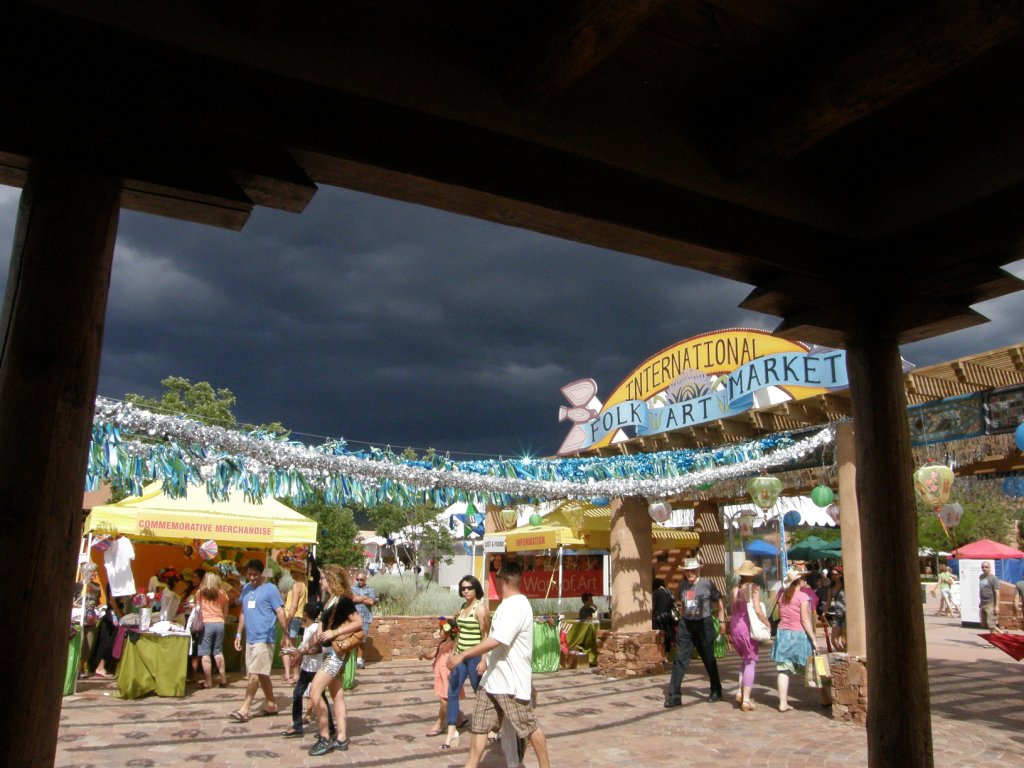
Chatting with one of the ladies representing the Ayoreo people and their work at the International Folk Art Market in Santa Fe, New Mexico many years ago. The group has been invited many times to attend the Market.
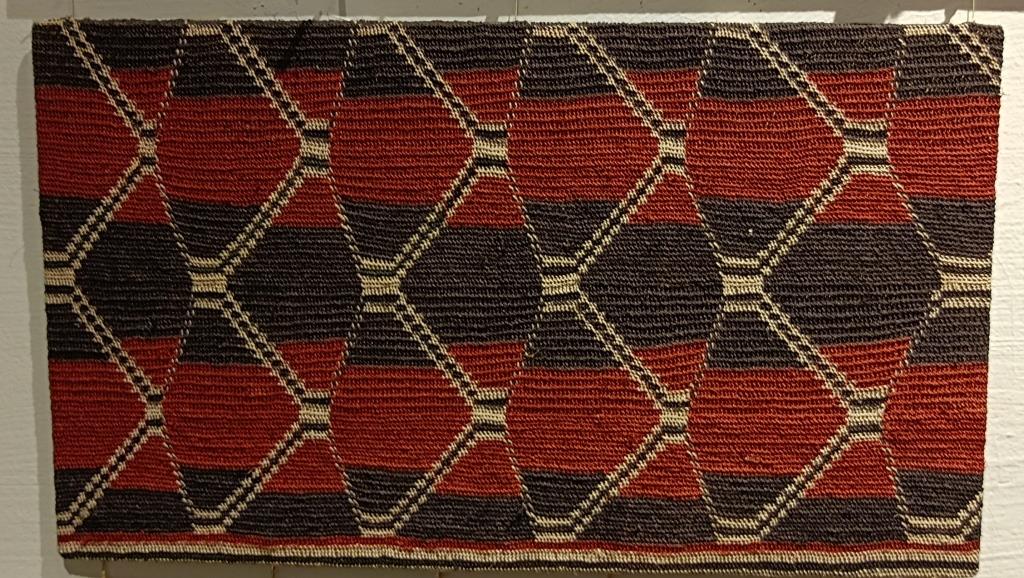
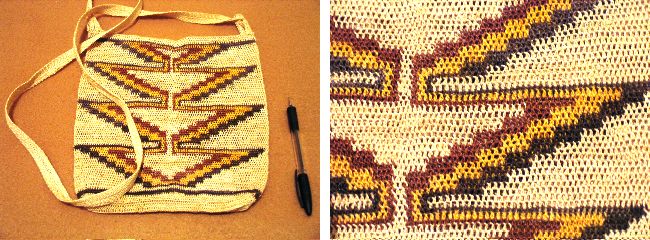
An example of one of the bags on display at the Arte Campo Museum here in Santa Cruz where I live.
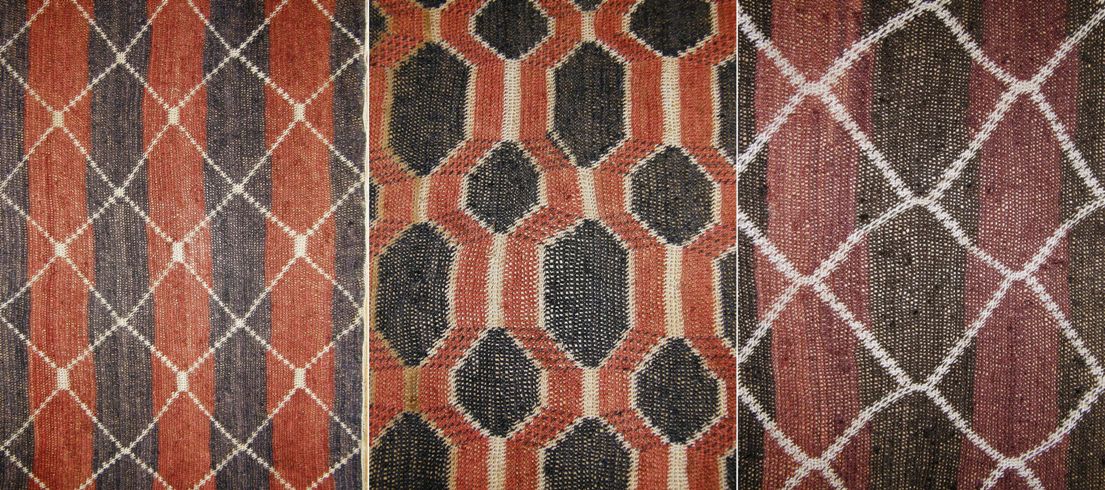
The three pieces that I had owned.
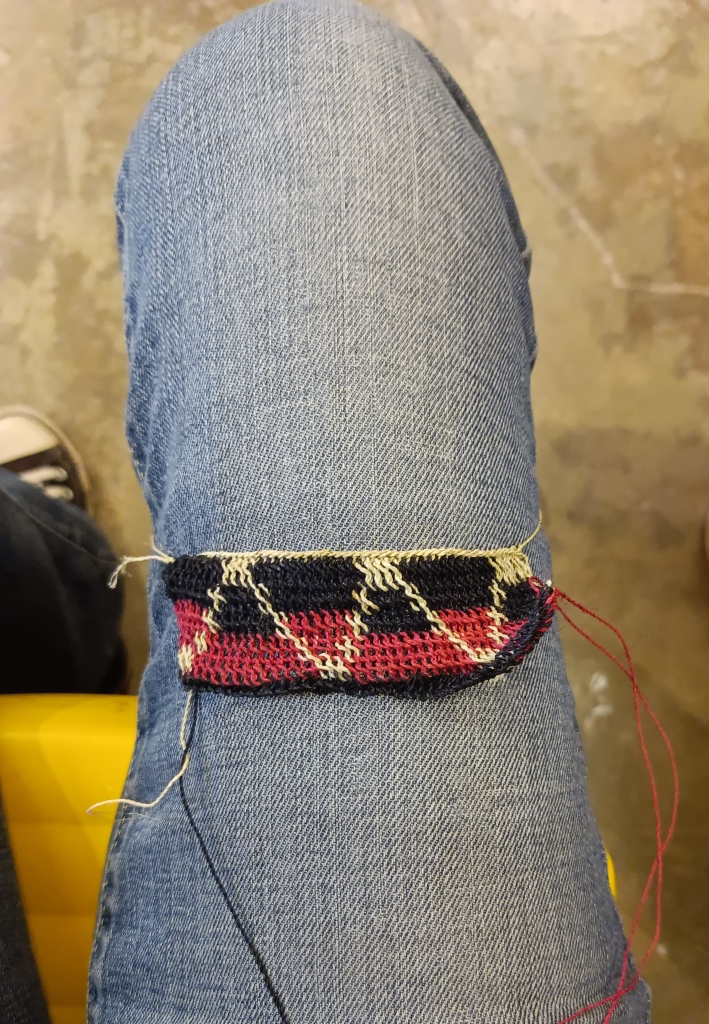
First I explored the museum and took notes and photos, dreaming of the wonderful patterns I was going to be able to create.
The pieces are worked while tied to the leg. Luckily I had chosen not to wear a skirt that day which is my usual attire in the tropical heat.
The younger ones reviewing footage on phones and iPads.
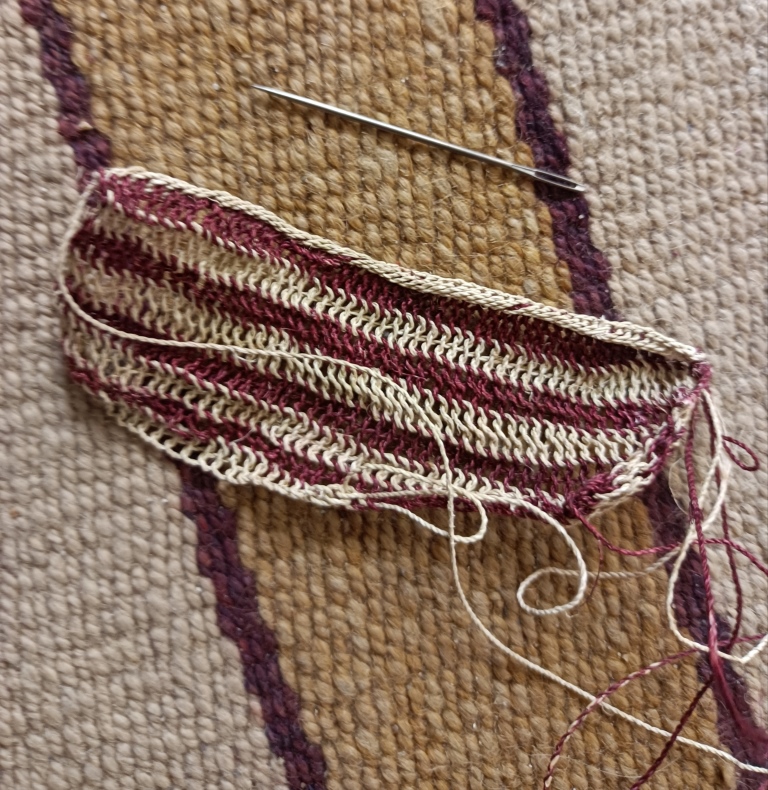
You can see my squashed and uneven brown row and then my much nicer white one in progress.
And now you can all get a closer look at it. Perhaps you’ll find that you already know how to do it.

Was I equally enthralled when I bought those three pieces twenty-four years ago? I wasn’t. I certainly admired them but then eventually gave them away. The difference has been having just that tiny introduction to the technique and that tiny amount of interaction with Teresa, our teacher.

Here again is the young lady I met in Santa Fe showing how she twists and plies the fiber. Of course, looking back at this photo now, my eye is captured by her wrist cuff.

Backstrap Weaving – Hooray Santa Fe!

??????????????????????????????????????????????????????????????The last part of my US summer trip was spent in Santa Fe, New Mexico.

It had been a dream of mine for some time to visit the city’s annual International Folk Art Market and this year everything just fell beautifully into place.

My friend Annie and I had talked about the vague possibility of this visit months and months ago. Neither of us knew back then whether it really would happen. I couldn’t think of a better person with whom to visit the market.

Even when weaver friend Wendy visited me in Bolivia back in May and I found out that, by coincidence,  she was also planning on going, it was still pretty iffy.

And then, when Marilyn, whom I met at ANWG in June, said that she too was going, I knew that it just HAD to happen.

I had met textile artist DY Begay at the Tinkuy in Cusco in 2010 and again last year at the weaving Encuentro. She now lives in Santa Fe and extended an invitation to come visit. And that is how it all came to be.

santa fe downtown collageI arrived a few days before the market and had a chance to stroll around the downtown area. When I arrived at Santa Fe airport I was surprised to see the adobe airport building…hmmm, a little over the top, I thought at the time.

However, after taking a look around and seeing the downtown area, where even the parking stations are adobe and getting a feel for the place,  it all just felt so very right. I love the smooth curviness of the structures and how the colors change from pink to gold as the sun moves across the sky. And that sky! …the deep blue of dry desert air that would suddenly be covered by enormous black thunderheads that brought refreshing afternoon deluges.

???????????????????????????????And it was hot… but not Santa Cruz hot…the low humidity made the high temperatures quite tolerable. Yet, after a full day of strolling the market, it was a relief to sit down in a shady spot and wait for the rain to start. Below you can see Annie and Wendy at the end of day one.

There were thousands of people at the market yet I just knew that I would run into Wendy and Marilyn there. I had already bumped into Wendy by chance at the Travelers’ Market and Marilyn in the plaza downtown and at the pre market procession. It was like we were all magnets drawn to each other.

???????????????????????????????Another person I met by chance was double weave expert Jennifer Moore who was helping out Nilda Callañaupa at the CTTC booth. She and I then arranged to spend a day together while I showed her how to set up a backstrap loom for double weave pick-up. I got to see all her amazing double weave samples, the ingenious things she has made and the limits to which she has pushed this structure. It was impossible to pick favorites from the array of samples she showed me but here are just two of the many things that caught my eye…(these are Jennifer’s pictures).

I loved the completely seamless bag Jennifer created for the Checkers pieces.Even the bnarrw sleeve for the drawstring was created on the loom. The twill double weave pick-up is gorgeous.
I loved the completely seamless bag Jennifer created for the Checkers pieces. I believe that the checkerboard was woven as a double width piece….woven folded and then opened to its full width once off the loom. Even the narrow sleeve on the bag for the drawstring was created on the loom. The twill double weave pick-up is gorgeous.

??????????????????????Jennifer and I then went on to spend a magical final evening going to the opera, La Traviata, with DY and DY’s neighbor Alana, who had offered us the tickets.

I had no idea what to expect and it was amazing!

Santa Fe has an outdoor theater. It’s covered but has open sides. The sets are minimal and the backdrop is the beautiful Santa Fe sky which changes colors as evening fades into night. Desert nights get rather cold! The theater ushers certainly knew about that as they were all dressed in long handwoven ponchos.

And, speaking of cold, here I am back in Santa Cruz in the one cold wave that hits here per year. I just happened to arrive back the day before it hit…48 degrees…this is not normal. I managed to get in one day at the loom in shorts before the long pants and socks had to come out. Well, it IS winter after all.

back at my backstrap loomThis is where I was at with my weaving when I left Janet’s place in northern California. You can see that I had just started some warp wrapping having been inspired by the saddle bag, from Afghanistan, (we think) that Janet had bought. However, after going on with that for half the afternoon, (bags still unpacked in the living room!) I decided that I didn’t like it. I think that I need to practice the wrapping using wool, which fluffs out and fills space, before trying it with the unforgiving cotton.

So, the other half of the afternoon was spent unweaving and unwrapping (not so much fun) and then….unpacking  (even less fun).

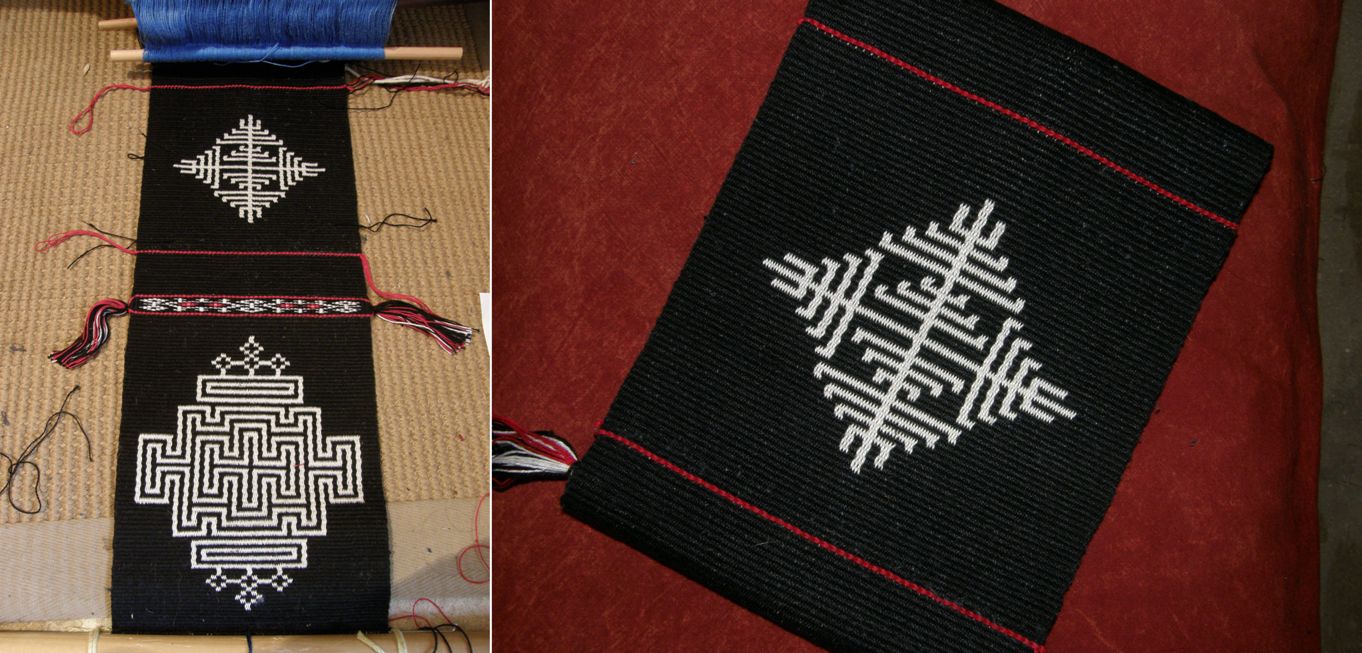
Then I got back on track. Janet’s saddle bag inspired the wrapped design above the main motif. Bhutanese motifs form the basis of the rest. This had me calling the project “Tales from the Sub-continent”.

sub continent bag projectHowever, now something from Central Asia is about to creep into the mix because of bands that I saw at the Folk Art Market. I am so happy to be able to add something from that event as that means that this project will comprise a few pieces of inspiration from my summer trip. That’s one of the best souvenirs I could have.

It’s off the loom and is going to be a bag. You can see how it will be folded on the right…that’s the back.

As for the Central Asian influence, you might remember that I went to the Central Asian ikat exhibit, Colors of the Oasis, at the Textile Museum in Washington DC in 2010. The ikat pieces were stunning. In fact, I had to go twice beacuse it was too much to take in.

I was interested at that time in the bands that edged some of the coats. As the exhibit was focused on the ikat patterning and process, no one at the museum could tell me anything about those bands. They looked like they had been card woven but someone also suggested that they had been braided using finger loops. You simply could not get close enough to see anything helpful.

uzbek ikat folk art market santa feHowever, at the Folk Art Market we got to touch all the gorgeous ikat patterned coats from Uzbekistan and look as closely as we pleased at the edging bands. Yes, there were wefts, they were woven, and one of the representatives did confirm that they were tablet woven.

So, here is where I am at….

tablet weaving a strap

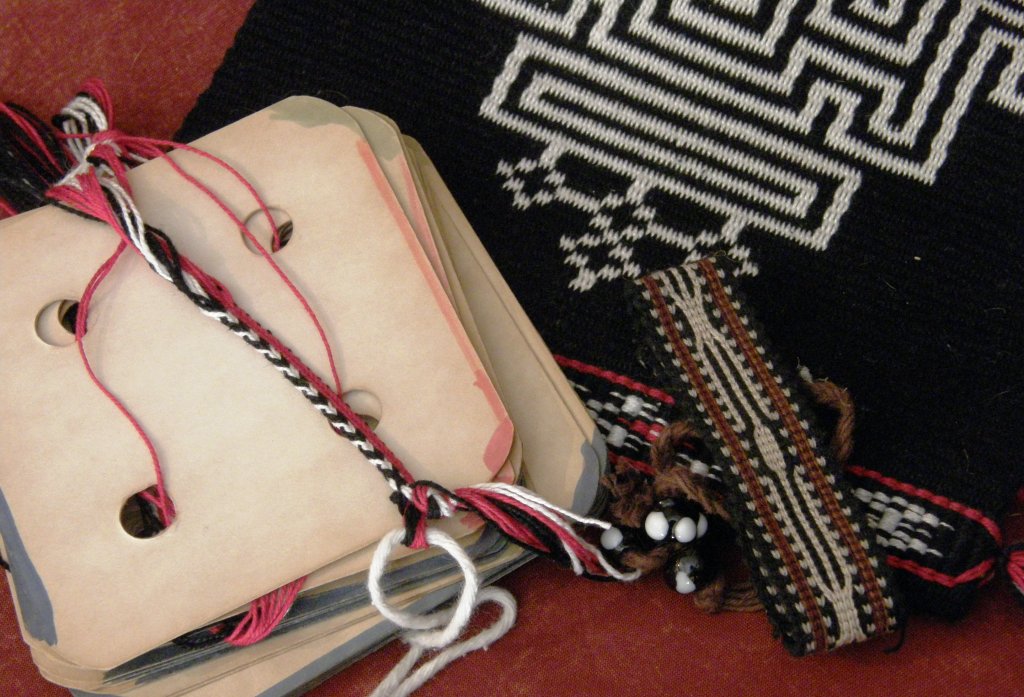
red and green card weaveI dug out my tablets. These are the ones that my dear friend Gladys Miller gave me way back in 1995.

They pre-date my Navajo-style weaving activity and my first backstrap learning trip to Peru.

Gladys sent me back to Chile with these tablets and Rachel Brown’s book. Later I got more books and made the piece at left. After that, I had my Navajo loom built and immersed myself in tapestry weaving.

Then came the first trip up north to Peru….and the rest is history!

So, I made a wee sample to see if I could remember the basics of threading. I want the strap of my bag to be the same design as the bands that edge the Central Asian ikat robes. Most of the bands are very similar in design and very simple.

It is interesting that on page 71 of  the Snows’ Step by Step Tablet Weaving, there is a picture of a Russian apron band that looks almost exactly the same. I was lucky to be able to buy a wristlet at the market (you can see it sitting on my weaving above) as an inexpensive example of the weave.

ikat robe at folk art marketI know that you will all be looking at the price tag on the above piece and sighing. Let’s all go to the market together next year! I only bought one other thing. It was another sample type thing to study…Guatemalan gauze, white on white on a miniature loom.

It was fun to see how the tablet woven bands are also being used as tubes for bag straps. I would say that they were sewn into tubes after being woven and stuffed with something. Mine, however, will be flat.

???????????????????????????????I did include a tubular band on my current bag project as an edging. I so enjoy weaving and sewing those tubular bands and they make such nice finishes. Using a tubular band to edge enabled me to cover and stabilize the cut raw edge that was created when I cut the flap into a rounded shape to make it more attractive.

???????????????????????????????Speaking of tubular bands, DY and I had some weaving time together at her place. DY had learned to make the ñawi awapa with me at the Tinkuy but had not put it into practice since then. Of course, all she needed was a little refresher and soon she was  on her way. It would be great to see her incorporate something like this in one of her tapestries.

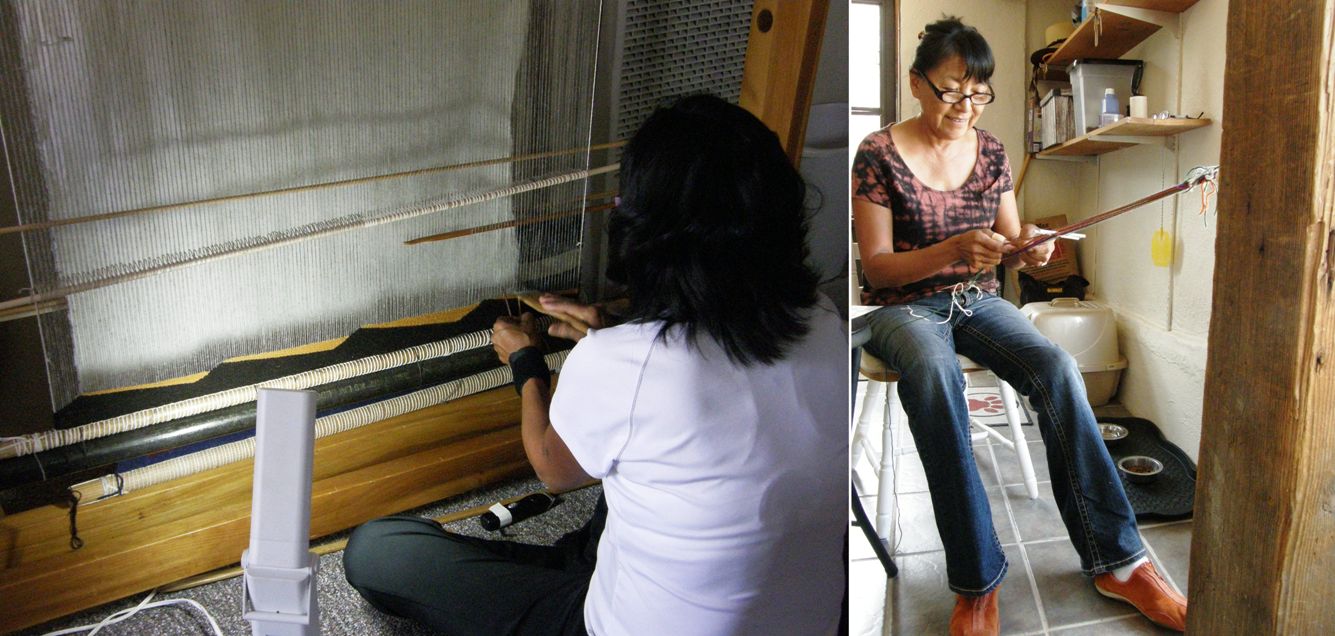
DY weavingIt was nice waking up in the morning hearing DY’s fork beating the wefts into place as she creates her latest tapestry using her own handspun and natural dyed wool. Her home has lovely solid wooden posts which are convenient for backstrap weaving.

Now I shall proceed to bombard you with images from the International Folk Art Market to give you a wee taste of all that Annie and I got to see over those two days of market…

ayoreo bags and clans??????????????????????It was great to see the Ayoreo people of the lowland region in which I live in Bolivia represented. This the fifth time that they have been invited to attend the Market and sell their looped bags.

The fiber that is used for the bags is extracted from a wild bromeliad which in the Ayoreo language is called dajudie (elsewhere known as garabatá). The thread spun from this fiber is called dajua.

New Mexico Summer 2013 006One of the craftswomen was twisting three strands of thread into one on her thigh but, unfortunately, I was never present when they were making the actual bags.

I have quite often seen the women making these in the streets of Santa Cruz but they are very reserved and not comfortable with people examining what they are doing or asking questions.

I was, therefore, happy to be able to take the opportunity at the market to talk to the ladies (picture at left by Annie).

The traditional patterns belong to the seven clans of the Ayoreo society but some women have created their own new patterns inspired by their surroundings. Mostly natural dye substances are used but some artificial colors are being used in response to the demand for brighter colors by customers.

From Uzbekistan, which probably had more representatives than any other country…

uzbekistan crafts

selection of art and craft santa fe folk art market

Bright colors and simple black and white: pictures made from colored sequins from Haiti, beadwork from the Ukraine, paintings from Cuba and baskets from Panama.

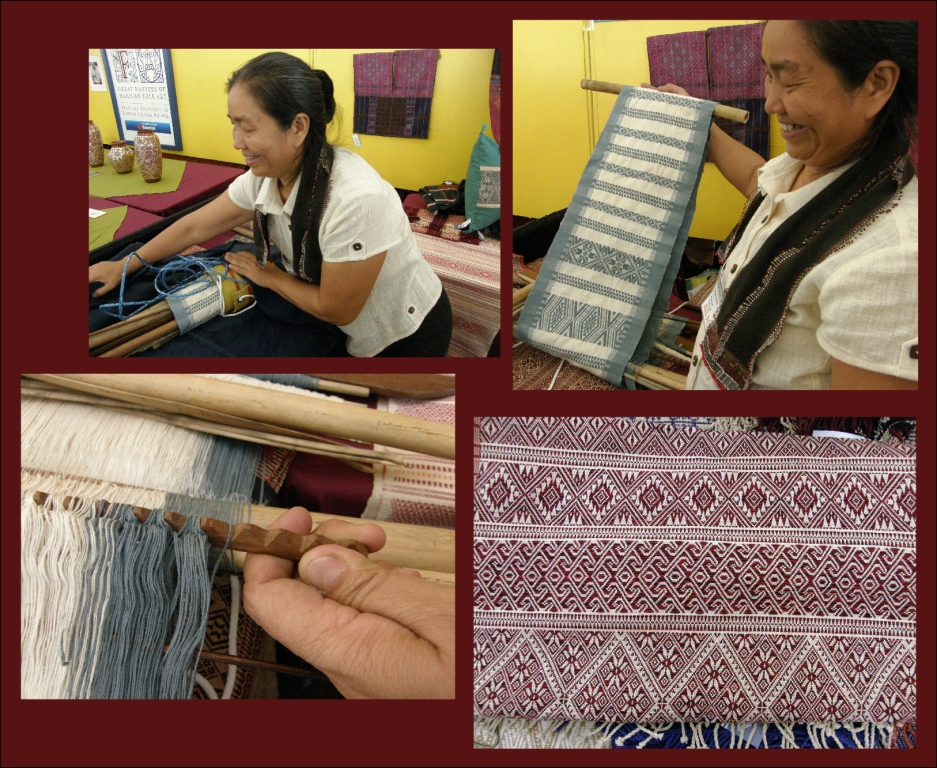
myanmar backstrap weavingKhun Shwe, a backstrap weaver from Myanmar, was happy to open up her rolled up backstrap loom and show me her work in progress. Her circular warp held a piece of equipment that I had not seen before. She told me that the notched stick was used to help spread the warps. Her work with supplementary wefts was fine and beautiful. She was so friendly and happy to meet someone so interested in her loom. I would love to study with her! I think she was doing well at the market. Quite a few people were trying on garments at her booth including Annie.

The variety…

variety of crafts santa fe folk art market...from Peru, Laos, India and Mongolia.

There was this on the Hungarian stand…

???????????????????????????????It was only $25 and no, I didn’t buy it. A lady was walking around with one and I decided to ask her about her band weaving interests. It turns out that she doesn’t weave and had no idea what the piece was. She simply found it interesting and bought it.

And the people came and came and looked and spent… When we were arriving at around 10am on Saturday, there were already early birds leaving with their purchases! I spent some time on Sunday afternoon with a very happy vendor from East Timor who had sold everything.

???????????????????????????????

???????????????????????????????Nilda was opening out this very large piece for an admiring couple when I was walking by and yes, they bought it! She couldn’t hide her pleasure at the sale. Of course, the ladies from Chinchero were seated at their looms and Nilda had a corner booth so they would have room to sit away from the crowded aisles in the shade and weave. That attracted a lot of people to the booth I am sure.

artisans at work santa fe folk art marketAn artisan from Pakistan creates a piece using applique and reverse applique techniques while another from Nepal works on a painting.

Everything about the Huichol artists from Mexico creating their yarn paintings was fascinatiing….all those woven bands and belts and straps to look at.

???????????????????????????????

huichol artsists at santa feThere is more….much more. Remember that there were over 150 artisans there! This is just a taste of the color, and excitement. I am saving the vast majority of pictures of textiles decorated with supplementary wefts for another post. When I have finished my bag project, I will start the next in the red, black and white wall hanging series and this piece will be all about supplementary weft patterning. I will show more market pieces as I progress on that as well as pieces from Nagaland that were on display at the Travelers’ Market in Santa Fe. They have all kinds of interesting ways to decorate using supplementary wefts.

Here are some finished projects from Ravelry group members and friends…

julia's supp weft projectJulia and I got to weave together and she has been captivated by supplementary- weft techniques.  She sewed a band onto fabric and made a bag and then cleverly made a square braid for a strap, fanned out the ends and wove a balanced weave shoulder pad and then finished the braid for the other half of the strap (much the same as one would do when making an Andean sling).

Cindy wove tubular band with me and is now making several slim bands to wear as a necklace, She is experimenting with making the bands in cotton. I find that it is harder to get an even finish with cotton than it is with wool. Her band looks great.

cindy

Gmp set me a picture of her latest band.. She simply added rings to the end so that it can be used as a belt. The pattern is charted in my second book.

???????????????????????????????I saw the handmade book made by Betty at ANWG. It was her contribution to the Portland Handweavers Guild study of  Japanese textile techniques. The paper is handmade and from Nepal. Betty used a traditional binding for the book and wove the cover. She wove a warp-faced double-weave band on a backstrap loom with Japanese characters to decorate the cover.

bettys book with warp faced double weave bandThat’s all for this week.

From hooray Santa Fe to hooray Santa Cruz….the weather is supposed to warm up any day now to a pleasant coolness…perfect weaving weather. I have come home with lots of ideas from this trip and am happy to be back at the loom for a few months.

My cat has gone to a new home. I spend too much time away and it is not good for her. It’s sad after ten years together but I know she is happy in her new place…she even caught her first mouse!

Here are DY and I and Drey, DY’s cat, one of my many kitty companions on this trip…

dy and drey

Backstrap Weaving – Building skills and resources.

BUILDING SKILLS AND RESOURCES

I have been busy behind the scenes building  the resource pages on this blog. I am about three quarters of the way to finishing the “Frequently Asked Questions” pages which will deal with fifteen or so topics related to making your own backstrap loom and weaving on it.

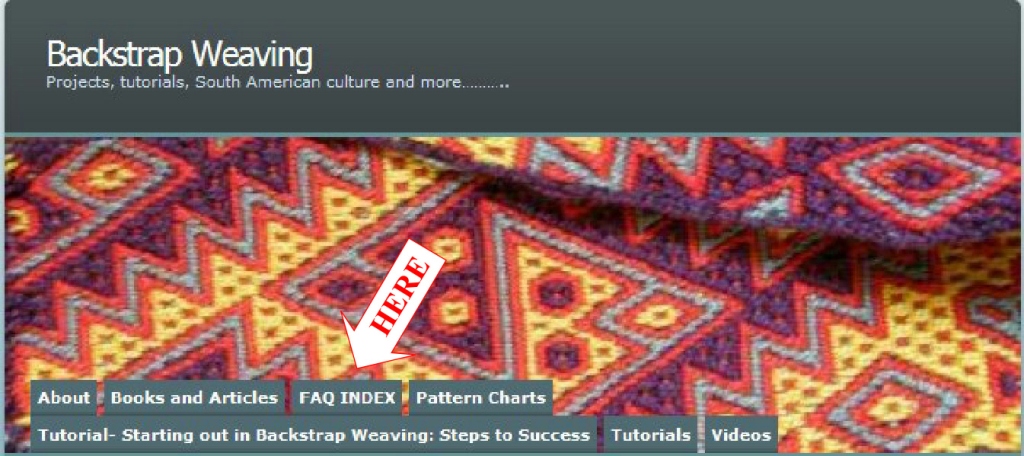
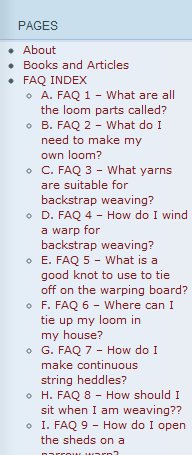
You can access the index by clicking on the FAQ INDEX tab on the header image. There you will find links to the finished pages or you can go directly to each page by clicking on one of the topics on the sidebar.

The pages include explanations with photos, links and images. I hope that you find them useful and please feel free to ask any questions, add information from your own experience or suggest other topics by leaving me a comment here on the blog or the relevant FAQ page.

And….I will be translating all the tutorials to Spanish and putting those on new pages too. (Y….voy a traducir todos los tutoriales a español y los voy a poner en paginas nuevas también).

So, that was my keyboard activity for this week along with writing an article and getting some pages done for my next book!

As for 0n-the-loom activity, I was asked to weave some bookmarks for a friend. I was told what design to use but the colors were left to me. I got to use some more of the Turkish cotton that I bought recently and I can’t say enough about how beautiful it is to weave with. It is only for special projects, though, definitely not for sampling as it is a bit pricey. Details can be found on the FAQ 3 page which answers the question “What yarns are suitable for backstrap weaving?”

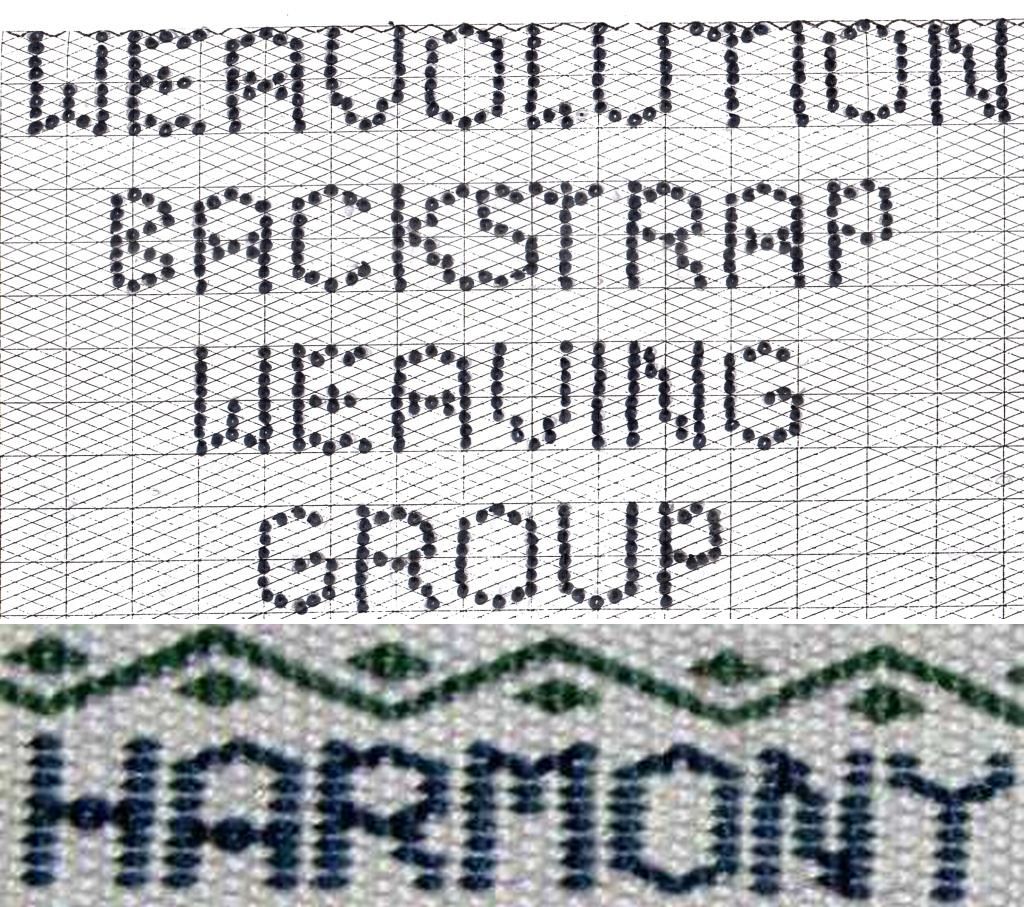
These have been woven in double weave. As the borders are plain weave I used two wefts. One weft wove the borders and upper layer of the double weave and the other wove the lower layer. Lettering is really easy to do in double weave and although these letters I invented are very basic, they can be very effective. I have charted them out for you all to use. Most of the letters are in the following two images and I am sure that you can invent the ones that are missing. You can, of course, weave the letters after following my tutorial for one weft double weave.

Other woven messages can be done in the Montagnard style lettering. I learned this warp float weave by studying a band I bought from some Montagnard weavers that I met in the US on a recent visit.

This is a “looser” weave and the resulting band is quite flexible unlike the double weave which is very firm.

Next week I will do a tutorial on this warp float lettering.

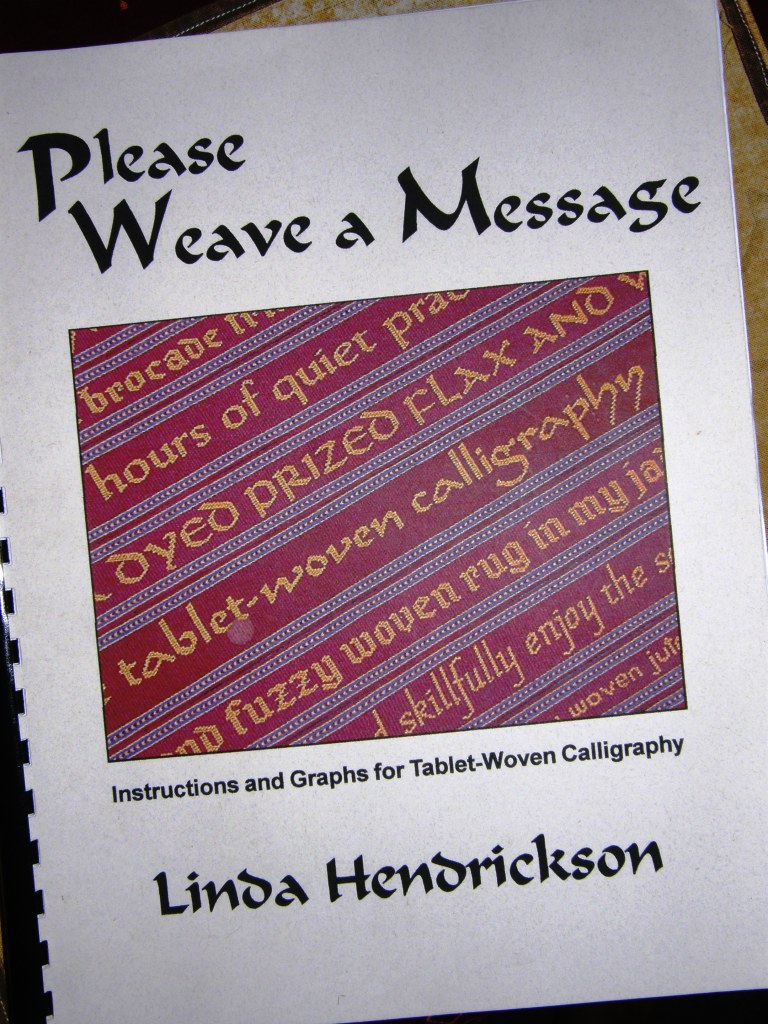
You have probably heard me mention before my love of the letters that Linda Hendrickson has charted in her book Please Weave a Message.

I got this book hoping that I would be able to use the charts for double weave but found that the “stitches” produced in card weaving sit one on top of the other as opposed to those in double weave that are staggered from left to right. This meant that I would have to adapt Linda’s charts for double weave. I did adapt many of the letters but they were seriously altered and just did not look as nice as Linda’s but now I have had an idea!

I realize now, after my recent experiments with weft twining, that weft twined “stitches” also sit one on the top of the other and that I should, therefore, be able to use Linda’s charts to twine letters and messages. I am not sure how much the slant on the weft twined stitches will affect the appearance of the letters but I can’t wait to try it out.

I haven’t done so yet as I am still building my weft twining skills while working on another project this week with slightly finer yarn.

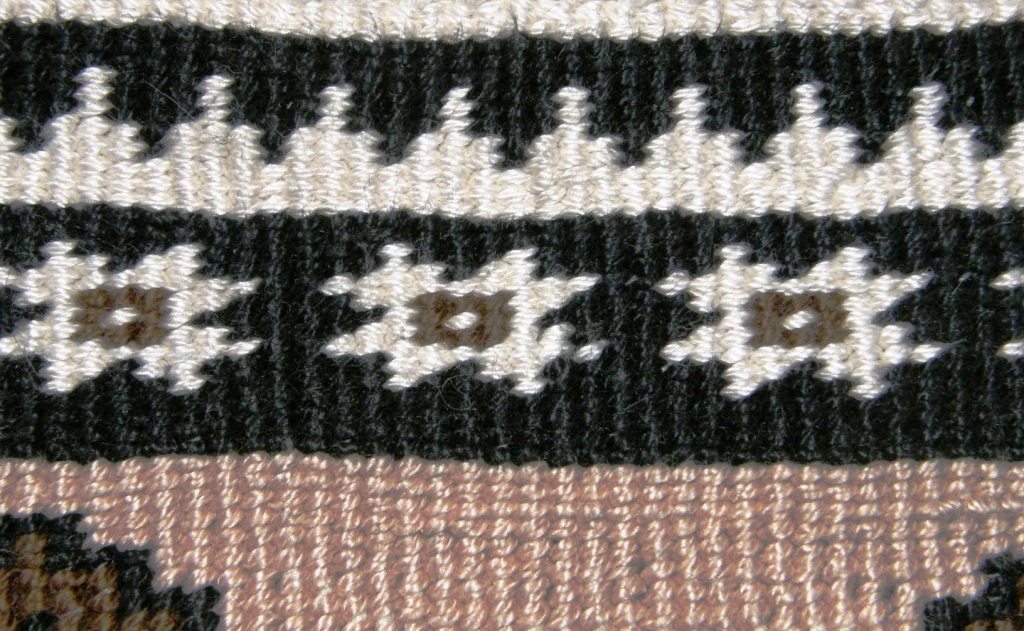
This time I am using three and sometimes four colors at a time and it is a little cumbersome but I do like the results. The design has been inspired by pieces in a book on Bedouin weaving. From a distance this looks pretty much like a piece of tapestry. Many things amuse me about this technique….firstly, it is something new, secondly, it helps me to better understand what the Montagnard weavers are doing at the edges of their warp-faced weavings and thirdly, it is an off loom technique that does not require tools apart from one’s own hands.

I am grateful to Bonnie Datta who told me that a chapter of Peter Collingwood’s book The Techniques of Rug Weaving is devoted to twining…both warp and weft. The book can be downloaded for free here. The opening line of the chapter reads….Twining is not weaving,… so that settles that debate!

It shows some ways to turn the wefts at the edges for rug making which I must try as that is something with which I am still battling. The piece that I am working on now is still a “skills builder” but, who knows, I might be able to make something useful out of it.

As far as lettering goes, my boyfriend’s mother asked me a long time ago to make something for her. She is from Cochabamba in the Bolivian highlands and, although she was raised speaking Spanish, both her mother and grandparents were bilingual, speaking both Spanish and Quechua. She told me that there are three lines that comprise the “Law of the Qechua” which go…


which translate to… Don’t steal; Don’t lie; Don’t be lazy. She would like me to weave these words into a wall hanging for her. Well, I might not weave them, I might twine them.

What I am really leading up to with my twining experiments is weaving a double weave piece on my backstrap loom with twined edges where the design on the twined edge matches the double weave motifs. There is much skill-building to be done before that point. Hmm…I am not sure if I am less adventurous now or wiser. I am sure that in years gone by I would have launched myself straight into this and not bothered with the “skill-building”!

In the meantime I have been admiring some ikat pieces from Sumba which I found online which have very broad twined edges. They leave the wefts tails hanging out at the sides as fringe. I am trying to hide the weft ends so I can have smooth neat edges, without much success, I might add!

This has led me to look at other twisty twined off loom techniques and especially one that is practiced right here in Santa Cruz where I live by the Ayoreo people. Actually, I have always wanted to learn about this but gave up some time ago trying to find a willing teacher. Maybe it is time to try again.

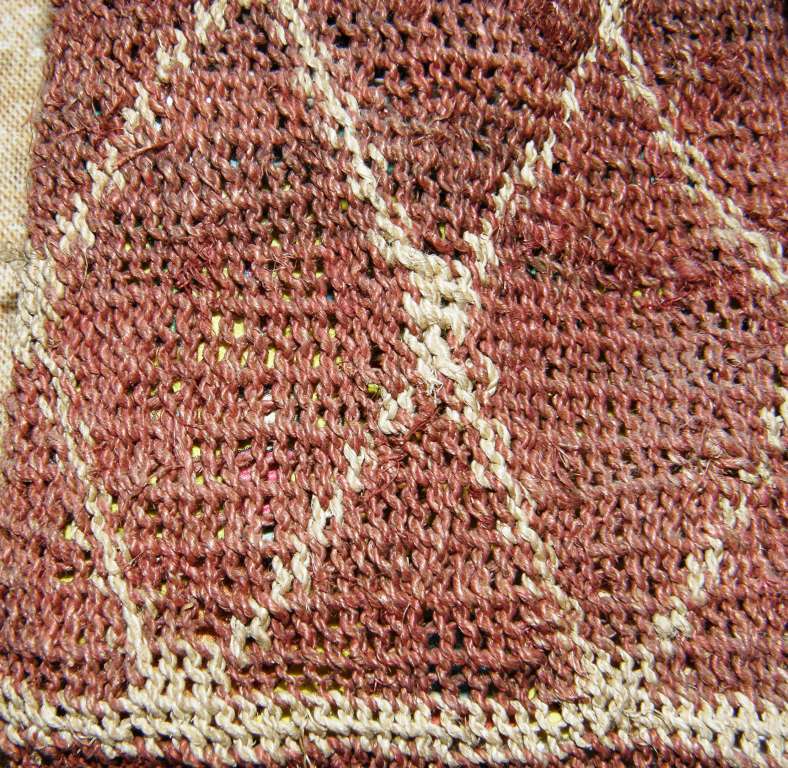
Information about the Ayoreo people is sketchy. Population estimates in different sources range from seventeen hundred to four thousand Ayoreo people, distributed amongst seven to ten clans living in the area known as the Chaco. They use off loom netting, twining and knotting techniques, sometimes with the aid of a needle, to make a type of shoulder bag called utebetai using a fiber called garabatá fino from the Bromelia Hieronymil plant. The fiber is twisted by rolling it on the thigh using ashes to take away some of its stickiness. It is plied and may be also dyed before use.

I have three of these bags but have opened them out to use as wall hangings.

According to a booklet put out by CANOB (Central Ayorea Nativa del Oriente Boliviano), the designs used in the pieces represent seven clans. The motifs include representations of the patterns on armadillo shells, clouds, snake skins and the eyes of a jaguar.

Miniature pieces are also made which are said to be used to carry talismans.

Even if I don’t make something like this myself, I would like to sit down with the ladies and watch the process and document it. Sometimes they are seen working with the fiber in the street but unfortunately I have not found them very open to my questioning or hanging about in the past.

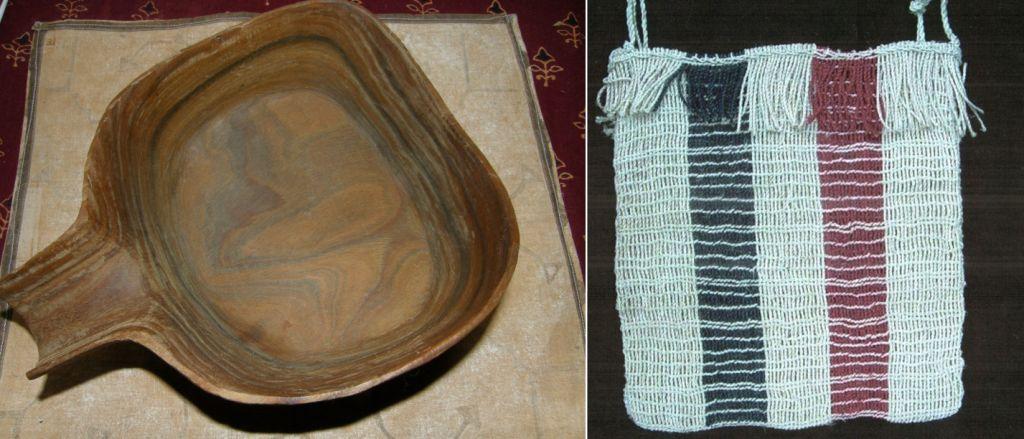
The Ayoreo also use weft twining to make bags and carve beautifully simple bowls.

My friend Kathleen sent me pictures some time ago of bags called chácaras, which are said to be of Mayan origin, being made in Panama by the Ngöbe and Buglé people. The fiber is from the Aechmea magdalenae plant and is also twisted by rolling on the leg. The netting method appears to be the same although their color palette is quite different.

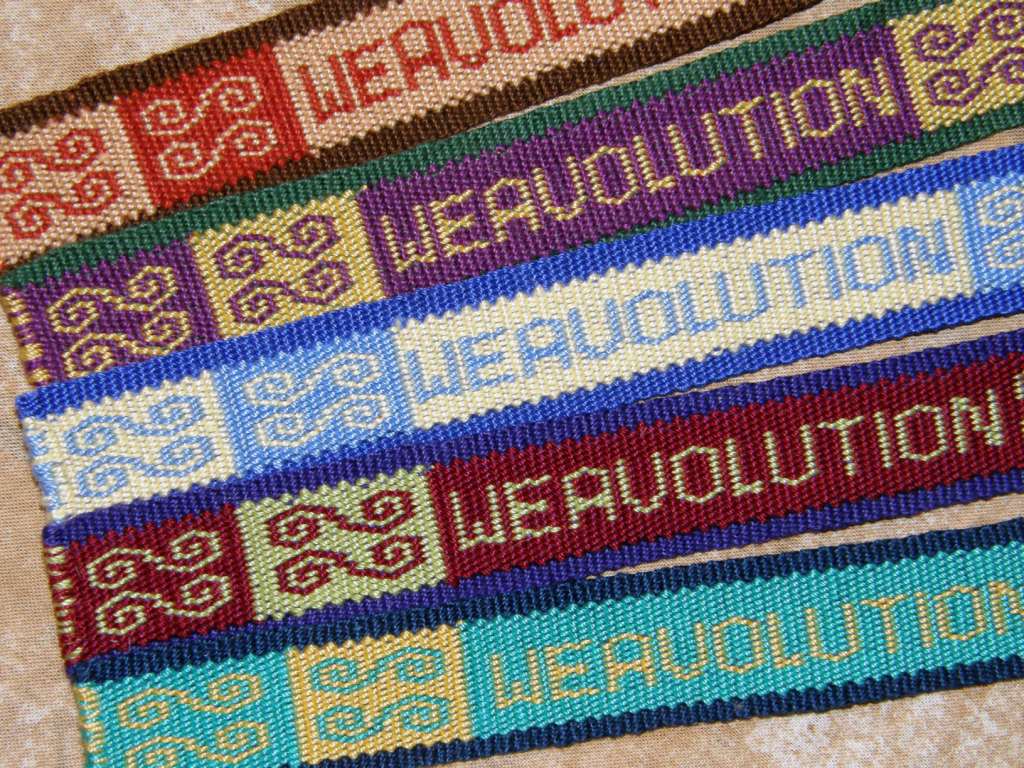
To finish this week I have some projects to show you from Marsha Knox who is in the Backstrap Weaving Group at Weavolution and Eladio Salas Torres who lives in Mexico and follows my blog.

Marsha used a tapestry loom to weave a band patterned with simple warp floats. I know that Marsha had a few false starts with this but she persevered and I thank her for showing us how warp faced bands can be woven on a tapestry loom.

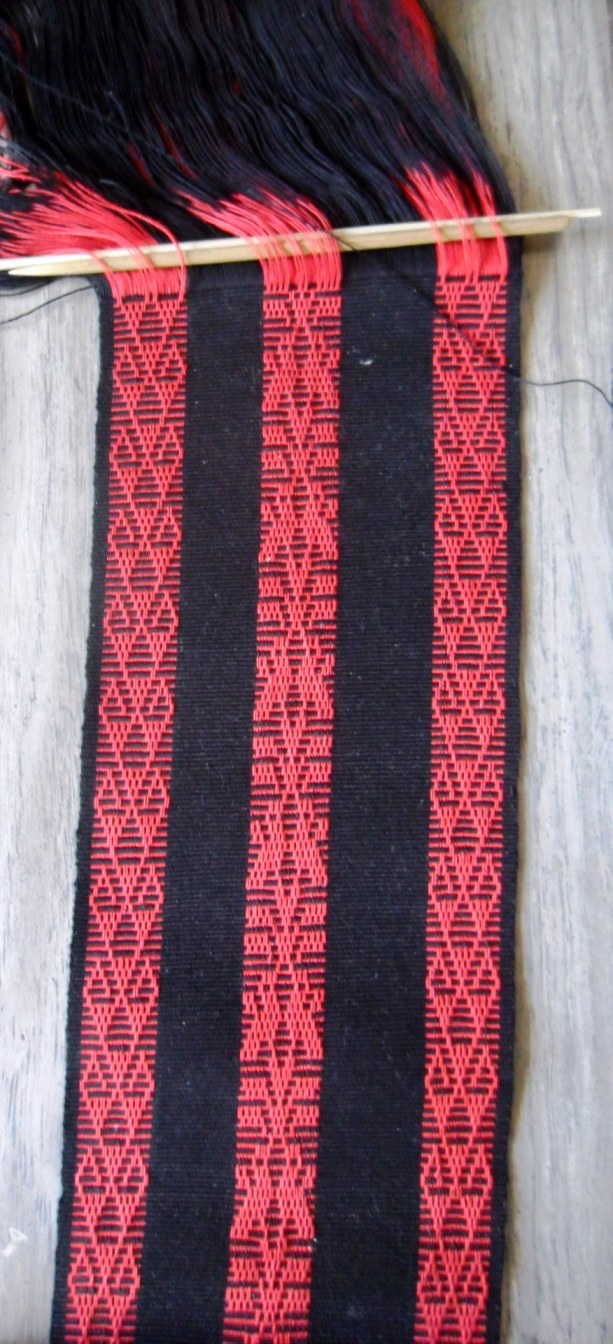
Eladio has woven a wide piece incorporating three strips of simple warp floats using patterns from my blog. The red and black together look stunning!

He is using the double bird design from coastal Ecuador and a hook design that I adapted. He also sent me a picture of himself at his loom. I LOVE getting photos like this!

It looks like he is using a cardboard roll for his shed rod and maybe pvc pipe or wood for his loom bar and roll up stick. I wish I could sit cross legged like that! He has just bought my pebble weave book and I am sure we are going to be seeing pebble weave bands from him soon.

NEWS AND STUFF…

Here is the link to the most recent Synergo Arts newsletter about their latest progress with the ergonomic bench in Guatemala.