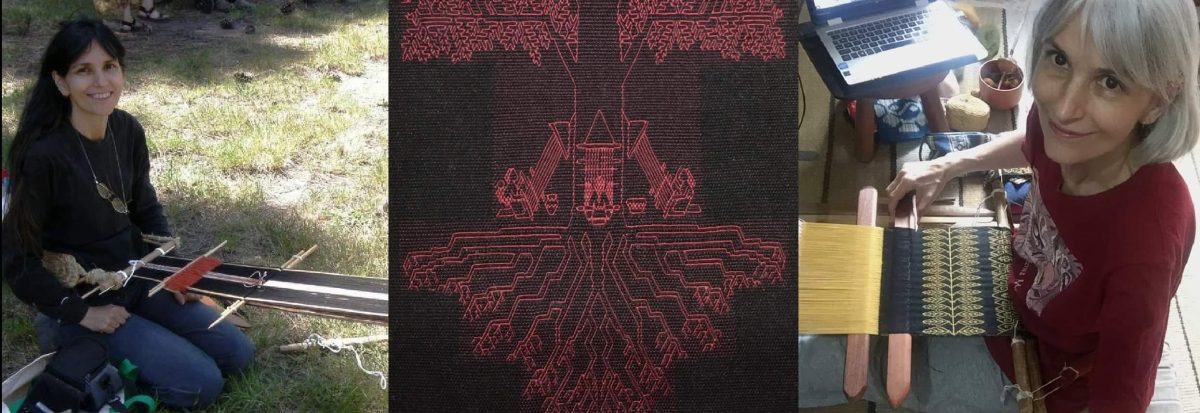
Backstrap Weaving – The Story of the Hummingbird.

I am busily weaving the third panel in the Within These Walls series and having quite a lot of fun with it. After all the pick-up that I had to do on the second panel to create that sensation of chaos, I am enjoying the wide open spaces in this third piece and feel like I am zooming along. In this piece the friendly hummingbirds play a major role in building the transition from the chaos and darkness of Panel 1 to the harmony of a newly established normal in Panel 3.

I am using doubled 140/2 silk for this one as I had run out of my red 60/2 silk. It’s a rosier red and I love it even though much of it ended up being covered by black dye. It did mess with my head at the start when I kept counting the doubled threads as two threads instead of one when I was doing the Andean Pebble Weave pick-up. I am well over that now.

It’s funny to think that the very first motif I ever wove with my teachers in Peru was a hummingbird. This year of 2021 happens to mark the 25th anniversary of my first trip to Peru during which I had my first experience learning to weave on a backstrap loom. I know that I met my teachers some time towards the end of August 1996. My birthday is in mid-August and I remember quite clearly spending that day alone in Ayacucho. I was so sick and had been for weeks after having eaten something that had been fried in bad oil. I decided to move on to Huancayo and find a place to stop still for a while so that I could give myself a chance to recover. It was either that or head back to Chile. Thankfully, the abuela who ran the hostel at which I stayed made it her mission to make me well again. She made me dandelion and papaya smoothies every day which she said would clean my liver.

I have been thinking back on that experience and those little bands of fine threads that I wove with one end of the warp connected to my waist with string and the other end tied to a bush in the yard. Before my teachers arrived with their thread and sticks I had no idea what motifs we were going to weave, what structure I would be learning or even what kind of loom we would use.

The very first motif the ladies started demonstrating looked like it was gong to be a simple triangle flanked by a couple of inverted ones. I thought that it was very sensible starting with some basic shapes like that. However, just as I started to get my head around that, hoping that I could then predict what was to follow, things changed and I was lost. I thought that asking what the figure was meant to be might help. I was told it was a hummingbird. That didn’t help because I simply could not relate the little figure on the band to anything that looked like a hummingbird to me!

Even after returning to Chile with all my little bands with their clearly recognizable dog, llama, puma, human and various bird motifs, I simply could not make out how that little figure was supposed to be a hummingbird. The figure you see above is my replication of my teachers’ motif woven with a lot of their help which mostly involved their pushing my hands out of the way and taking over every time they saw that I was lost or about to make a mistake. You can tell from the wonky selvedges that this was not their masterful work.

And then I thought that perhaps I had misinterpreted what my teachers called “picaflor”, which is not the official Spanish word for hummingbird. Perhaps that’s their nickname for bees. But nope, I still couldn’t see it. In any case, I have since learned that picaflor is indeed another name for hummingbird.

Here are some more figures from my learner bands from 1996…

And then one day, it occurred to me that perhaps the black outlined triangle in the figure is the bird’s beak and the bird is looking straight at me. That would make the red line and two little bumps directly above it the top of the bird’s head and two eyes. The main red triangle is the bird’s body and the sides are its wings. Can you see it? The bird is flying straight towards me. I was delighted! How unusual to depict a bird head-on lie that! Once I could see it, I couldn’t un-see it. The band was glued into my journal and I never wove it again. It was quirky and interesting but I didn’t like it enough to use it in any of my projects. Later, I found another hummingbird motif on a band from Taquile Island and now I have created my own original one.

Just the other day on a Zoom call I pulled out my learner bands because I wanted to tell my weaving friends about my 25th anniversary. I had long ago removed the bands from my journal so that I could photograph them and show them in my workshops. I started telling them The Hummingbird Story and showing them the little figure. Literally as the words were coming out of my mouth, I suddenly saw it! The figure is TWO hummingbirds in profile facing each other with connected beaks. Of course! How did I not ever see that? I am sure that you saw it right from the beginning and must think that I am mad.

I was actually a little disappointed about this new discovery. I had quite enjoyed the unique idea of depicting a hummingbird flying straight towards the viewer. Oh well.

The little hummingbirds that I created in my Within These Walls series are depicted in profile. Some are solid and some are outlined. You can see one of them in my latest panel busily unraveling the chaos lines that had covered the previous panel…

Others are collecting sticks and plants with which they will help me build my own world within my walls. I am quite accepting of the fact that I shall most likely remain within these walls for the rest of the year. The supposed roll-out of a vaccination plan here has been carried out in the true Bolivian style that I have come to expect…utter chaos and confusion. I gather that it may not have been much better in some other more developed countries. And, I know that with limited resources this can’t be an easy task.

Some of the supplies have already mysteriously “disappeared” according to a newspaper report today. Every time I turn around there is a new website on which we are supposed to register. I have signed up to three so far with no sign yet of when anything will actually start happening for the general public..

I have advanced quite a lot since I took the picture of Panel 3 above. I am just about to reach half way and my thoughts have started turning to what I might weave after this project. I am still deciding about whether to weave a fourth panel in this series. If I don’t, I hope to weave something with my handspun wool and have decided that all Zoom time from now on should be spent spinning. I would really like to do some more of this three-color reversible Andean Pebble Weave. Here you can see the technique on two wrist cuffs that I wove last year.

I also have these two strips that you can see below (they’re both about twice the length that you see here) that I wove from my handspun llama fiber years ago, probably back as far as 2005. I sewed them onto cotton cloth that I had also woven on my backstrap loom and made shoulder bags. The black bag with the grey strip got used a lot and the cotton part ended up looking rather shabby. I have since removed the llama part which looks good as new and thrown away the cotton cloth. So, I want to weave new pieces to create new bags but, this time, in my handspun wool. I am never short of projects! The brown one was my attempt to replicate a scrap of band that I had bought in Cusco on that first trip in 1996.

The fabric for the bags will be in warp-faced plain weave and I’ll weave straps in the three-color reversible Andean Pebble Weave. On a strap, the different ways that the three colors position themselves in this technique on the two faces can be appreciated. The two faces can look quite different…

While on the subject of spinning I wanted to tell you that tinyStudio Creative Life Magazine is now offering subscriptions to its magazine in print form. I have seen Suzy Brown and the team showing off the print version of the latest issue and it looks luscious. There are 120 pages of content beautifully bound in such a way that it always lies nice and flat on the table. You may remember that Suzy asked me to contribute to issue 9 (below) with a bit of a story about my learning to weave with my indigenous teachers. Hopefully, once subscriptions have taken off, she will consider printing some of the back issues too. Subscription includes free shipping for the four issues per year from New Zealand. Here is an excerpt from the website which will give a better idea of what this magazine is about:

Mindfulness, simplicity, and a conscious approach to fiber crafts. These are the foundations of an inspirational magazine! tinyStudio Creative Life Magazine is created especially for fiber artists of all kinds, spinners and yarn artists. We aim to enhance your fiber life with projects, patterns, creative rituals, fiber artists’ stories and articles, ideas for storage and decluttering, ways to reuse and recycle, and articles on fiber producers who themselves adhere to conscious and caring processes. The ultimate lifestyle magazine specifically for people like us, who have a passion for all things fiber!

I actually have a lot more to show and tell you about things I have been seeing online in forums, Zoom lectures and via backstrap weaving friends about backstrap weavers on the Tibetan Plateau, on the island of Yap, the Himalayas and in Costa Rica but I think I will keep those for a post all of their own soon.

To finish, I would like to share with you another part of the continuing story of Maribel. You may remember that I first met her back in 2017 when I went to the central Bolivian highlands to meet the ladies in my teacher Maxima’s co-op. Nineteen-year-old Maribel had been the first one to show up at the gathering with her toddler Daniel, eager to get involved, put the weaving skills that she had been observing but not practicing her entire life to use and become a paid member of the co-op. She asked to learn how to read my pattern charts and after starting to weave one of the patterns set about copying charts from my book.

Some weeks later, she showed up at the co-op with her first woven band in naturally dyed handspun yarn using the pattern that I had taught her via the chart.

You can see that it was accepted and labeled by the co-op ready for sale. I so wish that I had bought it!

Next came her first faja

That has been followed by her first aguayo, completed with the help of her mother-in-law. This piece was not destined for the co-op but is most likely for her own use. These ladies much prefer the finer synthetic threads with their bright colors when they weave for themselves.

Dorinda tells me that Maribel is now Secretary of the Association of Artisans in her community of Huancarani. Such good news! I can’t wait to see what she weaves next.

March 31st marks the end of another quarter of business on the Taproot Video website where I sell my books and video class. Thank you so much to all of you who continue to support me by buying my books and telling weaving friends about them. I have been enjoying meeting new pick-up weavers and re-uniting with past students in my Zoom workshops and love running into some of you here and there in the social media forums.

Take care everyone and stay safe, please.

Backstrap Weaving – Limbo Land

I don’t like being in weaving Limbo Land. Usually, while I am sitting weaving one project, I have the next one already developing in my head or on paper. I’ll be gathering yarn and charting patterns when not at the loom so that I can launch myself straight into warping once the current project is off and washed and sewn. 

While I had the general idea for the next project sorted out, I hadn’t quite pinned down the finer details and so I found myself in Limbo Land once my current project was off the loom.

Urgh…I dislike Limbo Land. Limbo Land is the place where I do crazy things like suddenly decide to cut my own hair. Fortunately, I decided to spend this little jaunt in Limbo Land in a much better way….starting my next book! And then I suddenly got the little spark of idea I needed to pull together all my thoughts for the next project. I really need to write these things down because I have already forgotten the source of the spark.

The ikat piece that I just finished was about weaving shapes that would allow me to calculate take-up for future projects. I was interested to see how much length was lost in the original ikat shapes once they were woven using warp-float patterning rather than the plain weave that I usually do.

I think I mentioned in my last post that I was getting bored with the pick-up pattern that I had chosen to weave within the ikat shape. Well, I came up with a way to amuse myself for the second half of the pattern. I decided that the bottom half looked like foliage and that I could slip a little hummingbird in among the plants in the upper half. Planning that out was fun and I realized that this was really what I originally had in mind  when I saw the drawing of a hand in that magazine ad that I have mentioned in past posts….weaving pictures within pictures.

So I have decided to weave a series of small silk pieces based on this basic shape filled with pictures. I have just finished tying off a larger and simpler version of this shape in red 60/2 silk again which is now soaking in preparation for dyeing tomorrow. I have a pretty good idea of how I want to fill it. Let’s see where all this takes me.

I suspect there will be some moments of “What was I thinking?” when it comes time to weave and I have to come to grips with all the detail that I have put into the pictures! I can guarantee it won’t be boring to weave!

Another source of inspiration for this idea of pictures within shapes arrived in my inbox just this morning. The Textile Museum in DC announced the arrival of The Textile Museum Journal, Volume 47 and the cover picture fits very well with my latest weaving projects.

This volume is devoted to “color in textiles across time and space” and includes an article by Elena Phipps on “Woven Brilliance: Approaching Color in Andean Textile Traditions.” You can take a look here for more information about subscribing to the journal, this issue, and back issues.

The cover of latest volume of The Textile Museum Journal…what I see are pictures within pictures!

I have actually had a pretty colorful morning all told as I got to attend a Zoom presentation by dye master Dagmar Klos on the basics of dyeing which was simply marvelous. There was plenty of information for me to apply to even the occasional dyeing that I I do for my ikat projects.

This picture of a weaver taking a break from her backstrap loom from the Threads of Life Facebook page really speaks to me. Maybe she is turning over ideas for her next piece.

And, sticking with the subject of color, I wanted to tell you about collections of beautiful backstrap-woven fabric squares that Threads of Life in Ubud, Bali is selling via their online store. I have been signed up for the Threads of Life newsletter ever since my failed attempt to attend their weft ikat workshop back in 2017. They were incredibly understanding about the misfortune that prevented my being there and I have always been very grateful to them for that. Of course they are just one of the many organizations that are being sorely affected by the pandemic and the resulting absence of tourism. They rely heavily on the purchase of textiles from visitors to their gallery in order to be able to continue supporting the various backstrap-weaving communities with whom they work.

From their website:  By aligning with indigenous culture in its fieldwork and marketing, Threads of Life alleviates rural poverty, helps weavers to form independent producer groups, and facilitates their sustainable management of their natural dye resources.

I was very impressed by how quickly the Threads of Life staff sprang into action once the full extent of the pandemic had been realized and came up with new and truly unique ideas for their online store. Apparently, they have been holding onto an assortment of textiles that have been purchased from the weaving communities over the years that, due to having some small flaws, have not been sold in the Gallery. These pieces have been cut into squares and are being sold in beautifully coordinated color sets that can be used in patchwork and quilting projects. They make my mouth water!

The sets include squares of solid-color naturally-dyed cloth in stunning indigo blues and in rust and terracotta tones woven from handspun cotton as well as ikat and batik pieces. The cloth originates from various Indonesian islands and have been placed in these sets accordingly.

Here are some pictures of some of the sets: those blues!!

This is just a small sampling of all the products that they have to offer. There is also a range of large naturally-dyed lengths of fabric in the collection that they call Farmer to Fabric, tablet-woven trim in naturally dyed cotton and heirloom quality textiles and baskets representing various islands and communities.

This link to Threads of Life won’t just take you to their store. I hope that you can take some time to explore the site. There is a nice slide show at the bottom of the page illustrating the steps and time involved in the creation of an ikat textile. There are also tabs that take you to pages with information on the organization’s field work, natural dyes, the artisans with whom they work and the organization’s classes and workshops. 

And, finally, I would like to tell you about the inclusion of an article I wrote in the latest issue of tinyStudio Creative Life magazine….”The Inspirational Publication for Mindful Crafters”.

(I would like point out that I would never have dared to wear shorts if my weaving teacher, Trini, was not also wearing them! This picture was taken by anthropologist Kathleen Klumpp when I accompanied her to stay with Trini and her family of cotton spinners and weavers in coastal Ecuador.)

I met the magazine’s editor, Suzy Brown, when I was in New Zealand last year. We wove together over a couple of days and she later invited me to write about my experience learning to weave in South America. The magazine comes out quarterly and this issue has 126 pages of luscious fibery inspiration and yes, there is quite a lot about color in there too with extensive articles on dyeing with woad and cochineal. It covers topics ranging from sheep breeds to fiber preparation, spinning, dyeing and felting, spinning tools and equipment and includes focus articles on various fiber artists (this issue includes an artist who creates amazingly innovative art work using machine-knit fabric as a base), visits to artists’ studios, as well as instructions for craft projects.

Suzy puts together a fun flip-through video for each issue on Youtube….

With a new ikat project about to hit the dye bath and a new book in the works, I don’t see any more wallowing in Limbo Land in my near future!

Take care and stay safe, please.


Backstrap Weaving – Different Paths

Facebook is fond of showing me memories from past years and the latest one to show up is from November 2017 when I was at my brother’s home in Australia working on weaving the samples for my Complementary-warp Pattern Book. Sometimes, the will is there to start a new book but for some reason it is just so very hard to get the project off the ground. At times, I have started by laying out the table of contents in a Word doc and that has been enough to kick me into further action. In the case of Complementary-warp Pattern Book it was the act of sitting down with this lovely blank Andean Pebble Weave warp stretched out before me that started the ball rolling.

There would soon be four horses galloping along the length of that warp…four horses called “Eldy’s Mustangs” by their creator, my weaving friend, Deanna Johnson. I love the simplicity of this set-up. Another warp that I set up for this book would have angels dancing among snowflakes, candy canes and Christmas trees. I think that just the colors  that I had chosen would have provided a hint of what was to come.

And this next one was set up to display different kinds of maze-like and geometric patterns.

Watch and learn….Of course, I was focused on the way my teachers’ fingers were moving among the threads while picking colors to form the patterns. The body movements when using such narrow warps are very subtle.

All three warps are set up for the two-heddle pebble weave method that I favor when I weave this structure on my backstrap loom. The pencils that you see in the warp are holding what I call the “permanent picking cross”. In the twenty-four years that I have been traveling here and there to study these structures with my indigenous teachers, one of the most important things that I have brought home with me time and time again is the fact that there is no one correct way to do things. There are many different paths that can be taken in order to arrive at the same place. I am so glad that I have been exposed to four very different methods that can be used to weave the Andean Pebble Weave structure.

The set-up that you see in these photos was the one that was taught to me by my very first teachers back in 1996. The mother and daughter who sat with me day after day as I wrestled around with those two sets of heddles came from Ayacucho in Peru. They happened to be living in Huancayo at the time.

I would like to say that they sat by patiently as I made a mess of their carefully prepared warp but it isn’t so. They were perplexed and annoyed by the fact that I was pulling away so violently at the heddles. My warp threads were breaking with all the friction and abrasion. I was not aware at that time of the role my body needed to play in the operation of the loom. The body needs to move and make subtle changes to the tension on the warp which makes the smooth operation of the heddles possible. Several movements need to be coordinated and when you finally find yourself picking up and slipping into the rhythm, it’s almost like a dance. Until then, you are brutish and clumsy and the result is heddles clogged with fluff, broken warp threads and annoyed teachers!

I didn’t understand that there was much to be learned about basic backstrap loom operation before I could hope to learn about the patterning technique. Fortunately it all started to come together eventually.

You can see my teacher picking out her pattern while working close to the cross sticks. This is the method used by weavers in Ayacucho. The two sets of heddles hold the regularly repeating pebble sheds….those that create the little spots, or pebbles, in the fabric.

(If you also find yourself seated at a nicely prepared warp but are unable to progress because of heddles clogged with fluff, you might consider taking a look at the video class that I prepared back in 2016…Operating a Backstrap Loom. It’s available as a dvd or as streamed content from Taproot Video.)

My weaving teacher here in lowland Bolivia uses this pebble weave structure on the large vertical frame loom that is used by the Guaraní people to weave hammocks. Angela uses three sets of heddles…one set holds the threads from one of the two pebble sheds. A second holds all the dark threads and the third all the light threads. The threads for the second pebble shed lie on a shed rod or in one large loop depending on the width of the piece being woven. The Guaraní weavers have a very interesting way of making their string heddles. You can see how they are sort of chained together.

Angela was only working on very narrow commissioned pieces when I studied with her and so I have included here a picture (courtesy of Aude Rossignol) of another Guaraní weaver who is using the full width of her loom for a hammock in pebble weave. You can see the advantage of those loose chained heddles on such a wide piece. If the heddles were suspended on a rod, it would not be possible to just pull on the rod and achieve a good shed clear across that wide warp. This is a fixed tension loom and so using the body to make tension adjustments as one does with a backstrap loom is not an option. Instead, the weavers pull on groups of chained heddles working their slowly way from one side of the loom (in this case from right to left) to the other and inserting the sword as they go.

Picture courtesy of Aude Rossignol.

My weaving teachers in the central Bolivian highlands use yet another method when they weave narrow bands to create the same Andean Pebble Weave structure…

The only name that I can think of for this kind of loom is “body-tensioned”. Maxima’s index finger is one “beam” and her big toe is the other. Her left index finger is permanently in this position to maintain and adjust tension on the warp. All loom operation and pick-up is done with the other hand. There’s no backstrap. The warp is set up with one pebble shed in heddles and the other pebble shed in one large loop. Max makes a picking cross with these two sheds and from there picks the colors to form her pebble weave patterns. And, you should see the speed with which she does so!

The last time I visited Max and the other ladies in the co-op, I demonstrated a new pattern for them using a warp that was tied to my waist in the manner to which I am accustomed. I could see Max studying me and I could almost see from the expression on her face that she approved of this set-up which gave me two free hands with which to operate the loom…a definite advantage when working with the rather sticky handspun wool thread. All the ladies kicked off a sandal and started winding warps using their fingers and toes as warping stakes. Max took a length of yarn and tied hers to her waist. She had decided to try out this “new” method that I was using which involved tying the warp to her body rather than just suspending it on one finger. To my surprise she was immediately mocked by all the other ladies for wanting to do things the “gringa” way!

Max, Antonia and some of the other ladies learned to read my pattern charts. You can see a picture of Antonia showing off the band she wove using patterns from the book I had left behind. Don’t we all love to learn new patterns?

The fourth way is the way that is used by some of the backstrap weavers that I have observed in the Cusco area of Peru in my travels. We were also privileged to have two ladies from Chinchero come to Santa Cruz Bolivia, where I live, to attend a small conference that was held here back in 2011. Only a handful of people from the general public applied to attend and it was wonderful to be able to spend so much quality time with these weavers over the three days that we had together. My Guaraní teacher, Angela, was also invited to demonstrate.

The warp being used by the Chinchero weaver in this picture is set up with all the threads of color A in heddles and all the threads in color B held on a shed rod. She uses two swords to hold what I call a “temporary picking cross” in which all the threads from both layers of warp are raised at the same time and held on swords. She can weave a variety of complementary-warp structures using this method. Some of the patterns that Chinchero weavers use are a complex combination of more than one structure which means that there is no real advantage to storing the pebble sheds in heddles. Some parts of a large motif can be woven using the two-two-two pebble arrangement of warp floats while other parts of the very same motif can be based on a two-one-two-one arrangement.

This two-sword method is he one that I teach in my Complementary-warp Pick-up Book. In my Andean Pebble Weave on Inkle Looms book I teach both this and a modified version of the two-heddle method. In fact, I teach three methods in that book.

You might have guessed that my favorite method for the backstrap loom is the first one that I showed with its two sets of heddles. For me, it has many advantages. I won’t go into them but, if you have ever taken one of my Andean Pebble Weave classes on a backstrap loom, you may recall my talking very enthusiastically about a thing called the “saver cord”. On the inkle loom, I guess I prefer the two-sword method of the three different methods I teach on that kind of loom.

Mary Spanos has woven with me on several occasions when I have been visiting the USA. She loves the backstrap loom and recently showed me her latest project….

This is a Japanese sashiko pattern that is charted in my Complementary-warp Pattern Book. Julia Weldon translated the traditional stitched pattern to the Andean Pebble Weave structure and kindly contributed it to the collection. Mary is weaving it beautifully into this band. I particularly like the way that she has chosen to use a lavender and white strip of plain Andean Pebble Weave as a border stripe instead of a solid color.

And, here’s another band by Mary using a series of fish patterns from the same book alongside some of her own creation…

Carlos is also using a backstrap loom and the two-heddle method to weave a wide piece of fabric to be made into a shoulder bag. The same book mentioned above has charts for three bee motifs. The center bee on this piece is included and is Carlos’ own creation.

Lausanne also learned the two-heddle method using a backstrap loom with me on one of my visits and you can see her here weaving a hatband for her husband with, yet again, a pattern that is charted in the Complementary-warp Pattern Book (from a pre-columbian textile fragment). This is one of my favorites…one of some cheeky viscachas rocking to and fro…

Here it is on the hat….

Annette Giles is using the two-sword/temporary picking cross method to weave the Andean Pebble Weave hummingbirds. Yes, they’re from that book again.

And, here are some initial results from Carol Berry from one of the very first Zoom classes I gave on Andean Pebble Weave on Inkle Looms…

So…… enough pebble weave! How about some double weave?

Nancy Ayton is using her inkle loom to weave warp-faced double weave bands and is creating her own fabulous patterns. Don’t you love the elf?! That’s just one of Nancy’s original designs on this band.  The band includes some motifs from my book Warp-faced Double Weave on Inkle Looms.

I think I will weave the elf on a set of Christmas tree hanging ornaments like the ones I made last year.

On Maureen Farndell’s warp-faced double weave band you can see the motif that I adapted from Bedouin textiles and charted in the book. It’s lovely the way she has connected the motifs and turned them into one continuous pattern along the length of the band.

As for me, I am plodding along with another silk ikat sample. This one is a study of take-up  and the number of warp-ends and picks I need to create a square. Hopefully the information on take-up will help if I later decide to try and tie some curved shapes into a warp. I do hope so because the study sample pattern I have chosen is just plain boring to weave! It’s rare for me to sit at my loom and think “Urgh, I just couldn’t be bothered”! But sometimes you just have to slog through this sampling process. Hopefully, when it comes time to write my next post, it will be off the loom and I will be on to something else with all the valuable information I have gathered from this sample.

Until then….stay safe and well.


Backstrap Weaving – Looking Forward, Looking Back

These days I get a little taken aback when an email arrives asking me if I am able to attend an event in July 2021 or consider contributing a piece of writing with an October 2020 deadline. Who are these people who are able to think so far in the future? I am glad that someone can, because I most certainly can’t. I am sure that it is those who are determined to keep looking forward who will come out of this whole thing hitting the ground running. I need to make that effort. It seems everything I do these days takes my mind back to the past. I am finding it hard to think beyond the next date when the current lock down situation is assessed. That will be May 17. I am sure that many of you feel the same way.

Meanwhile, the days march onward, the seasons change and the glorious toborochi tress here in Santa Cruz break into full bloom.

From Bolivia 360 Facebook page

I have been working on my next ikat experiment. I think this is number eight and might be the last in 60/2 silk as my supply of un-dyed 60/2 is running low. I didn’t want to start a new experiment unless it involved a new challenge and something new to be learned. So, I decided to try a motif with finer lines than I have been using until now and with lines that lie at different angles. I have to say that I have been dithering and dithering over this. First of all because I think I needed a break after having finished my latest book on Warp-faced Double Weave on Inkle Looms. I goofed off for about 5 days, I think. But, mixed in with the need for a break was the uneasy feeling that I had bitten off more than I could chew for my next planned ikat project and that disaster was looming. Some of this had to do with the fact that I might be wasting the last of my un-dyed 60/2 silk and couldn’t have a do-over if things didn’t work out. I wasn’t entering into it with a great deal of enthusiasm.

This is the leaf-like motif that I came up with. It was easy enough to sketch on paper but would I be able to tie those lines? I wanted to place two identical motifs side by side with some other kind of motif between them, possibly also in ikat, but maybe in supplementary weft. You can see the sketch for my last ikat project in the background. For that one, all the steps in the diagonal lines were equal in width and length which made them relatively easy to measure and tie onto the warp.

I am so used to winding these silk warps now. That process is hazard-free. I wound 1640 ends in 100-end sections. I never completely trust my warping stakes not to lean and so I wind small sections low on the stakes and then remove them and place them on beams that are waiting on the floor. What I love about warping for backstrap weaving this way is that it feels like a full body work out…..standing, swaying, stretching, bending. I do it in silence and find it very relaxing.

Then came the task of dividing the warp into the sections that would be wrapped in ikat tape. This is the part where I can listen to music and even sing. I chose Even in the Quietest Moments by Supertramp because the most wonderful thing about this lock down has been the absence of sound. That music sent my mind back to 1998, the year I arrived in Bolivia from Chile. Roger Hodgson, the lead singer of Supertramp, had brought a band and played an evening outdoor concert at the football stadium a few weeks after my arrival. The ticket was $9! It was a gorgeous balmy tropical evening. After five years of living in howling winds in Punta Arenas in Chile, I thought I had died and gone to heaven. It is a sweet memory.

I divided the warp into 10-end sections and chained a thread around them. In my experience with ikat so far, I have found slim bundles harder to wrap than thick ones. My plan was to fold the warp in half, halving its width, and wrap around two layers at once. That meant that I would be wrapping around bundles of 20-ends which would be much easier to handle.

Once the warp was divided into sections, I was ready to remove it from the frame so that I could fold it in half. It would then be placed back on the frame. The next step was to align the bundles from the top layer with the bottom layer and create new bundles. With that all taken care of, it was time to start wrapping. However, suddenly, there was a multitude of other things that needed doing. Yes, I was dithering again! (procrastinating, is probably the more appropriate word for it.) This was the point of no return. I could modify my motif to something easier or dive in and risk making a mess.

Then came what I am going to call the game-changer.

I usually use plastic zip-ties to hold the warp under tension on my wooden frame. They are okay except that sometimes I would pull one too tightly and it would be a nuisance trying to loosen it off without bending the plastic too much and destroying it. This time, I happened to remember the turn buckles that I had bought last year and decided to try them out as a new way to hold the warp under tension. Oh my gosh, they are awesome! I cranked up the tension and was able to make fine adjustments so easily. In the picture, I have yet to get the set-up squared off. I also added a third turn buckle to the center. I managed to get an amount of tension that I haven’t been able to in the past and suddenly this project seemed all the more doable.

With this amount of tension, I can actually draw very fine and precise lines onto the warp with my charcoal pencil. I have been using charcoal all along to mark my patterns, but every time I would touch the tip of the pencil to the warp, the threads would fan out and slightly sag and the best I could achieve was a smudge. That worked well enough as a guide because I could also rely on a ruler to show me where the next step in the stepped diagonal needed to be.  I can’t trust my eyes to judge the spacing accurately. That’s never been a talent of mine.

I can look at dozens of photos online of ikat warps stretched on their frames but until I actually get to touch one, I can never know just how tightly the have been stretched. I had always marveled at videos showing ikat artisans drawing entire fine and detailed patterns onto warps using pencils of different colors. There was a limit to the amount I could tighten the plastic zip-ties when I used them on their own. I can go beyond that limit now with the turn buckles.

The artisans that I have seen working with ikat don’t use turn buckles. Sometimes the warp is secured to a frame with nothing more than torn strips of cloth. I don’t have their skill or expertise! The first time I saw turn buckles in use in weaving was on the Navajo reservation back in 1995. The weavers were using them on their metal looms to tension the warp instead of using rope.

I once read about a gentleman who was studying knotted pile weaving with a Master from Afghanistan. He said that he knew that his warp had enough tension on it, when he was at home weaving and away from his teacher, by the sound the threads would make when he plucked them. Imagine trying to gain that kind of knowledge from an image on the computer screen!

And what about the actual wrapping? Well, I just wrap. If there  is some special way of doing it, I haven’t yet found it. I did see a video where the bundles were somehow twirled very quickly with the aid of what I am guessing was a kind of electric drill. The artisan simply stood there holding a piece of black rubber wrapping material and the spinning warp wrapped itself! These were very long warps that were destined for floor looms. Even if I had a way of doing that, I wouldn’t. I’ll go as far as turn buckles, but not electric drills!

This is all I do…

I start at the center and wrap to one end, turn back, go past the center to the other end, return to the center and tie. I like tying off in the center rather than at the end. I find that I am less likely to accidentally snip the warp threads when I later come to cut off the ties if I am cutting at the center of the wrap.

This is where I am at…The warp looks narrower here because it is folded in half. But it also looks narrower because there was an unfortunate incident in which I accidentally cut about 50 ends at one edge! That’s all I want to say about that! It could have been worse. I hadn’t started wrapping the pattern yet and it hasn’t meant having to modify the motif. Once I am done getting this sort of leaf motif done, I’ll decided on the motif I want to use between the two.

So….I have to tell you how grateful and excited I am about the response that I have had to my latest book Warp-faced Double Weave on Inkle Looms. This is the first time I have released a book on a new technique where both PDF and spiral-bound book have been available at the same time. Being part of Taproot Video allows this to be so. Patternfish only dealt with digital products. It was exciting and just a touch stressful to find that the books sold out very quickly. I think they were only out-of-stock for 24 hours, though. The printing service was again very quick to get production underway and we were back in business quickly.

I have had a lot of really nice feedback. People are very sweet to write and tell me that they bought the PDF or have received the book and are pleased with what they see.

Of course, the most exciting feedback of all comes in the form of woven work. And that has started to trickle in…


This is Joan Near’s learning band. I have provided several patterns in the book that fit on the 11/12-thread learning band. Joan has taken the little alpaca figure and used it to practice color changes.

Barbara Hoffman’s learning band shows examples of both angular and curve-like patterns. The interlocking diamonds were contributed by an Australian student of mine, Patrick Castle. The leaf is a smaller version of the “signature” leaf pattern that I like to use. The large version is also charted in the book. You can see it on the left of the cover image above.

I have also seen some first attempts at designing…a little animal figure has been woven by one lady and I’ll show you that in my next post. A nice way to ease yourself into designing is to take one of the charted patterns in the book and perhaps tweak it a little to give it your own personal touch. As I say in the book, I find this structure one of the easiest ones for designing and I hope that the shapes and figures that I have provided in the book can be used as stepping stones to the creation of your own unique patterns.

And while there has been a lot of focus on my latest book, those who bought some of my other publications some time ago have been fishing them out to use while following advice to stay at home.

Susan, who has woven with me before on my visits to the States, shared her hatband project with me with a picture that was taken  on a gorgeous Californian spring day. She uses a backstrap loom to weave her Andean Pebble Weave bands.

Carlos Vargas in France had been away from the loom for a while and is also taking advantage of time at home to get back into it. He uses a backstrap loom. If you own my Complementary-warp Pattern Book you will know that Carlos contributed a beautiful bee pattern of his own design to that book. In this piece he is weaving a bee pattern that was contributed by Julia Toft in the same book.

Stacy Holder is using her inkle loom and working with some of my original books on Andean Pebble Weave from 8-10 years ago. Those first books did not include specific instructions for setting up on an inkle loom but Stacy has been able to adapt my instructions and get to work on the several models of inkle loom that she likes to use. I love her band with its S-hook pattern in which she has used variegated thread as the background color. The other face is just as stunning with a colorful S-hook shape on a black background. My 2019 publication Andean Pebble Weave on Inkle Looms is aimed at the standard inkle loom and includes video clips.

Wendy Garrity lives in Western Australia where movement away from one’s home is not as restricted as in many other places. She has come up with a clever way to be able to use a backstrap loom anywhere. She is working on a Andean Pebble Weave pattern while on a camping trip.

Erika in Michigan isn’t enjoying that much freedom of movement yet, but is still able to enjoy the outdoors with a view of her garden while she sets up her backstrap loom for a new project.

I have become fully absorbed in my ikat now that I feel more confident about my ability to tie my latest pattern. However, I do have a couple of unfinished projects lying about. The flower band below needs finishing. This pattern was designed and contributed to the double weave book by Gerbelien Cocx-Wilschut.

I have also been planning a new double-wave strap for my camera bag for the next time I go traveling…There! I have caught myself thinking about the future!

Another little experiment that is awaiting completion is my dabble in double width. It seemed to be a natural thing to do after having worked so long on double weave on my little Inklette. I was curious to see how much width I could crank out this small loom. I have started with only a very narrow warp just to get the moves down and to see if it really is something worth bothering with. It was fun. Now I would like to try for maximum width. I don’t believe I can get double the loom’s capacity…perhaps one-and-a-half times that or a little bit more.

In the pictures below, you can see the warp on the loom. Then I have taken the band off the loom and am unfolding it. Finally, you see it opened to its full width and lying flat. Of course, I can always go to my backstrap loom for wider bands but I thought that this would be a interesting experiment while I was still in “double” mode.

And, finally, a grey-hair update…THE LAST! I said farewell to my Grey Hair group on Facebook with this collage (yes, grey-hair groups are a thing and the one I joined was fun and helpful):

Some group members asked me to stay and give advice to others but, to be honest, the only advice I have is to be be patient and put on your thick skin! I would like to acknowledge those who truly went grey gracefully by never dyeing their hair in the first place. They have no need to make all this fuss about it!

I think I only have one more cut to be rid of the last of the dark tips. I figured that would take place this month….ain’t gonna happen, but that’s fine. I quite like those dark tips!

Here’s a throwback to 2009 during the time of the N1H1 virus.

I was teaching English at that time at the Centro Boliviano Americano and teachers had to wear masks at all times while in the classroom. Every twenty minutes or so we had to squirt disinfectant gel onto all the students’ hands. The gels were colored and our hands would be stained either bright orange or blue by the end of the day! We got shut down three times because teachers were caught not wearing masks. No one objected to my home-made one.

When the first case of corona virus was confirmed here in Bolivia on March 10, I posted this photo on Facebook as a memory. I removed it a couple of hours later as I thought that it might be irresponsible to show people that wearing inferior home-made cloth masks was acceptable. Well, as we all know now, it turns out that it is in fact acceptable to wear one. I’ll be downloading a pattern so that I can hand-sew a couple for myself this weekend. It had better be an easy pattern!

Stay safe all of you, please.


Backstrap Weaving – The View from my Window


My makeshift photo/video studio at my living room window.

For those who visit my blog to see weaving, there is some in this post, but there’s also a bit of rambling. Forgive me. These are strange times! If you just want to see weaving, and there’s some great eye candy to be enjoyed, you should scroll on for a little bit.

Since I set up my little “video studio”  to shoot the clips for my book on double weave, I have become much more aware of the view I have from my windows. I usually have blinds on these windows and they are always drawn in an attempt to keep out the heat and dust. Now, with everything wide open I see that a good quarantine activity might be washing windows! While hunched over the camera, I feel a little like James Stewart in the Hitchcock movie “Rear Window”. I see little slices of  life through the various windows in the condo. Then again, I wonder who in turn might be observing me and wondering “What is the gringa up to now?”

Filming has been interesting. I have to straddle the tripod, sort of semi-squat, lean to one side to see, and reach around and weave all while trying to keep my head near the camera and in good range of the microphone. My leg muscles start to scream! So, when you buy my book and watch the videos, you will see that one of the clips has an ant merrily making its way in and out of shot. I did many, many takes for many reasons but I decided that the ant could stay. It amused me. I can say that no ants were disturbed or harmed in the making of my movies! 😉

I now know that  one of the neighbors on the second floor in the next building has a Tonkinese cat. Mine now lives with a friend. I had to re-home her because I was traveling so much. She turned 17 on April 1st! I usually visit her twice a week but visits are off for now. Now my friend sweetly sends me videos of her. I see the neighbor’s cat sitting on the window ledge. Like many of us, I suppose it’s wishing it could go out and wander around. I see other neighbors sweeping, cleaning, shaking their table cloths out the window and putting me to shame. I have been wholly devoted to the book these last weeks…heck, months! Everything could do with a good cleaning.

In my last post I remarked on the absence of familiar sounds during the current lock-down. Now there is a new sound of which I had not previously been aware…the rustling of fallen leaves. I live in the tropics. There is no apparent change from summer to fall. We have a sort of winter with slightly milder temperatures but that is all. We have a wet season. All remains lush and green. Today we sit at 93 degrees. However, now I am aware that there are some trees that actually lose their leaves in what is our fall season. The cleaners aren’t coming in every day to sweep up the leaves and they blow about and rustle along the cobbles.

Certain smells are absent too…the “interesting” aromas from the big street market down the road that the wind sometimes blows over is happily missing. The market has been shut down. And that most typical Santa Cruz fragrance…the churrasco! (barbecue) which seemed to be in the air at almost any time, even at 11pm when I would go out sometimes to enjoy the cool air, is no longer around. However, a new aroma is in the air. I noticed talk in one of the Santa Cruz Facebook groups of the disinfecting effect of burning eucalyptus leaves. Someone here burns them every afternoon. I can close my eyes and imagine I am back in Australia on cool autumn evening when people in the neighborhood would rake eucalyptus leaves into piles and burn them.

Because this is what I actually see from my bedroom window, I often play a little mind game when I am seated at my loom. I sit on a firm foam cushion on the floor with my loom attached to the base of my bed. From there I can’t see out my window.

While sitting there, I imagine that I could be anywhere in the world. It wouldn’t matter where I was, because at that moment I have chosen to sit on the floor and be completely focused on my weaving. The foothills of the Himalayas could be outside my window. The Mediterranean Sea could be out there sparkling in the sun. Or it could be the Straits of Magellan stretching away to Tierra del Fuego in the magical low, soft light that is so peculiar to that far end of the world… or any number of fantastic scenes that I have been lucky enough to experience in the places I have chosen to live and travel. I once woke up to this magical scene of snow on a train trip from San Jose to Seattle. I was lucky to be in the last carriage to get this view. It’s a bit harder imagining this to be outside my bedroom window because it is so darn hot!

Depending on the time of year, the evening golden moment has the light of the setting sun bouncing off one of the building’s terracotta walls and filling my room with a warm glow as I weave. In winter when the sun is in a certain position, soft late afternoon rays skim the surface of the fabric on my loom.

I have been missing my backstrap loom and my little spot on my bedroom floor! Yes, I have been weaving, but on an inkle loom because the title of my new book is Warp-faced Double Weave on Inkle Looms. The book is finished! But there is still work to be done. One file has gone to the printer for the making of the spiral-bound books. The other has gone to Taproot Video so that it can be uploaded to the website. All that takes time and I will let you all know as soon as the book is ready for purchase. As usual, it will be offered as a PDF as well as a book.

I am now ready to return to what might be an over-ambitious plan for my next ikat experiment. I have to put the cochineal aside for another day as I was never able to get hold of the alum. I still have synthetic dyes that I can use with my silk but that part of the process is still a long way off. I now have to figure out how to go about tying the pattern that I have sketched into a silk warp.

I have been weaving a lot of double-weave samples lately. Here’s one of the double-weave patterns from the new book which was created by Marilyn Romatka in one of my workshops. It’s amazing how this figure which is undeniably a llama, and a very elegant one at that, has been designed with so few threads. It is stunning in its simplicity and I am so happy that Marilyn allowed me to include it in the book…

I am left with a large box full of the woven samples for the book. I often just wove one figure, photographed it for the book and moved on. This means I have a lot of small pieces that could be used as key fobs and bracelets. The llama band will be a key fob.

Here’s another example of a very simple pattern. Both bands were woven using the same thread for warp. The one on the right uses a finer material for weft and I wove it with a much heavier beat. There is also quite a difference in feel and visible texture between the two. The one on the left has been washed and pressed while the one on the right is fresh off the loom. Both will become bracelets. There is a nice section in my book on different ways to finish double-weave bands depending on their intended use.

There is one thing to be said for deadlines…they force you to come to a halt! Although there is no real deadline in self-publishing, I would always have the trips away from home in the spring and the fall… the trips I called my “weaving safaris”… that would bring my weaving and writing projects to a necessary halt. This year has been different…no travel… and I have had to really force myself to stop the book project! How many times can I fiddle and adjust and enhance?! When do the changes I make stop being improvements and actually start to muddy things up? So, yes, it’s done…the files are in other hands and I am beyond the point of no return! Phew!

I will finish by showing you what my weaving friends around the word have been creating. I don’t step out to see the world. The world comes to me 🙂 These projects bring me so much joy!

My friend Emerald in Sydney has had her job put on hold and has not wasted any time getting back into her backstrap weaving. She has woven one of the two weaving figures from my Complementary-warp Pattern Book. The figure was first designed by Maja Bürger in Germany and she allowed me to make some changes so that I could have two versions in the book. This is how Emerald has her backstrap loom set up at home… When I stayed and wove with her in Australia, she was a sit-on-the-floor weaver but has now created a different set-up sitting in a chair.

Nora Dereli is welcoming spring with my Garden set of patterns from the same book linked above. This set includes, birds, blooms and butterflies and there’s another set which has bee patterns. Nora uses the Windhaven Accordion loom.

And, here’s yet another Andean Pebble Weave/ complementary-warp project and a different kind of loom with patterns from the same book, Complementary-warp Pattern Book….Gonit Porat teaches weaving in her studio in Israel. This is the work of one of her students, Michal. The warp is tensioned on the frame of a rigid heddle loom. There are four lovely horse figures in the Animals set which were designed and contributed by my friend Deanna Johnson.

This band is from Linda who is enjoying using 5/2 cotton on her inkle loom. The pattern is from my More Andean Pebble Weave Patterns book.

Maria Leticia Galve in Buenos Aires, Argentina sent me this picture of her work. I am particularly happy to see the patterns on the left which are from my very first book, Andean Pebble Weave, that I published ten years ago! The other beautiful knot-work pattern is in More Andean Pebble Weave Patterns. That book has several knot-work patterns, some of which I adapted from Louise Ström’s tablet-woven designs.Deanna, who designed the horses that you see in Michal’s work, has been test-driving a new band loom and wove this beautiful piece using a pattern from my Complementary-warp Pick-up book. This book has instructions as well as 42 pattern charts.

Facebook keeps reminding me of where I was and what I was doing at this time last year. Here I am at Deanna’s with Yan having so much fun with both of them as I sit at Yan’s foot-tensioned loom. My grey-hair transformation was in full swing and I was getting used to the odd looks people were giving me.

And here we are in April 2020. I have a lot of awesome places, people and experiences to ponder as I gaze out of my bedroom window (and get some Vitamin D at the same time!). News of the book release will be coming soon.