Backstrap Weaving – Feedback in Words and Cloth

I’m back at the loom again after all that pattern-drawing and book lay-out work!

I am way beyond the halfway hump now on my silk scarf project and am weaving the small paisley-like motifs between expanses of plain weave. There will be one more section of intensive patterning to match the beginning before I finish.

I love sailing along through the plain-weave sections and I finally managed to do something I have been meaning to do all along, that is, make a short video of myself weaving a plain-weave section.

I stopped myself just in time before I could finish one of the last plain-weave sections on this piece and took a short video.

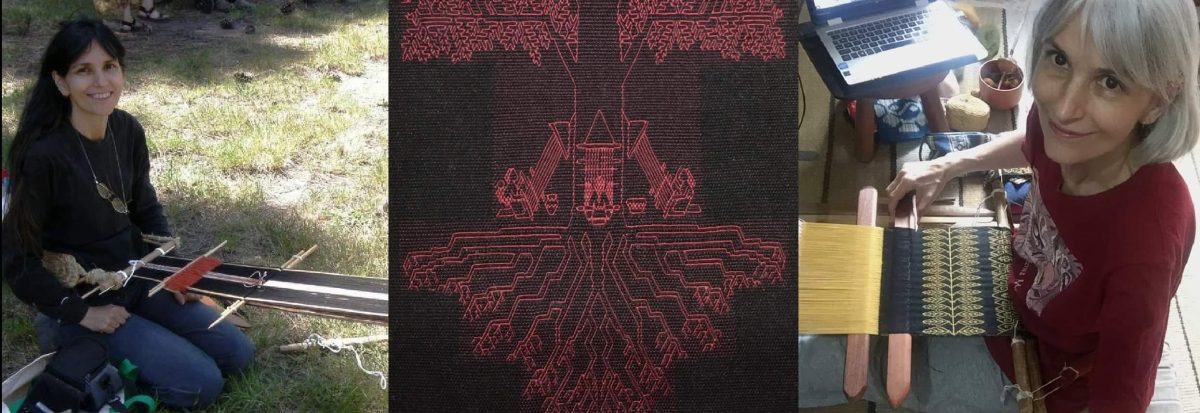
In the fuzzy screen shot at left, you will see that my cross sticks have caught up with my coil rod. When that happens it’s a message to me to unroll more unwoven warp from the far beam, roll the coil rod away, shift the cross sticks and heddles further away from the weaving line and continue. I did all that after filming. So it is a slightly cramped scene you will be seeing. Mind you, this is exactly how I will be forced to weave when I finally get to the end of the warp. The amount of working space I have will be greatly reduced. There is a lot of extra wood clacking sound just because everything is so close together.

The black and white mess of string on the far beam are the loops I tied around all the individual warp sections as they came off the warping board. They serve no purpose there. I just haven’t bothered to cut them off.

It is kind of amusing and interesting to watch video of myself weaving. I do some things so automatically and unconsciously…like the one-handed shuttle twirl that I do a couple of times at the start to release some thread from the shuttle. I had no idea I did that! And I think it’s funny how my strumming stick seems to be glued to my hand. I never put it down! It’s like a handy, extra pointy finger.


I hope the video shows you a little about some of the possible movements I use to operate the loom and open those two basic sheds. Different sizes and textures of thread and yarn will behave in very different ways and I modify my moves accordingly. You can learn much more about these moves and set-ups and the way I use them to operate my loom in my video Operating a Backstrap Loom.  It’s on dvd or available for lifetime streaming on Taproot Video.

I have to give a million thanks to everyone who has bought my new pattern book so far and especially those who have sent me so much wonderful positive feedback. It’s heart-warming seeing it go out to so many places around the world like Taiwan, Slovenia and Israel. I feel that this new book completes a set. It is the natural companion to the instructional book, below left, that I published last September….

Here are some of the looms that I used to weave the samples and that other weavers have used to learn the technique and weave the patterns…

The wooden rigid heddle is a sweet little one that the folks at Vavstuga gave me when I first visited some years ago. That’s my tiny Ashford Inklette which surprised me by comfortably taking on 72 ends of #3 crochet cotton. I know you won’t be surprised to hear that I favor the backstrap set-up in the lower left picture. And that’s Julie’s Gilmore Mini Wave loom on the right, a loom that seems to be growing rapidly in popularity!

Speaking of the Mini Wave loom, here is Marsha’s project on one  in luscious tencel using a pattern from my instructional book, Complementary-warp Pick-up.

I have loads of 8/2 tencel and have only used it once as warp. Marsha’s project reminds me that I must do something with it. The colors are so deep and rich..

Bonnie used a band she wove using another pattern from the instructional book to decorate a bill fold for her husband..

Claire had this fun and original idea to use her bands to secure the comfy pads for her spinning wheel. She made these bands in one of my classes and, yes, those patterns are in ”the book” too!

Kathy packed up looms, sticks and tools to travel and escape the snow for a while and wove these gorgeous pieces.  (You know where to find the patterns if you like them :-)). I love this earthy combination of colors. She uses Knitpicks Curio cotton combining some of their colors with some that she dyes herself. I like the Curio cotton because it is 2-ply but I agree that it could do with the addition of some richer colors.

More from Kathy…

This is one of the Central Asian patterns that appears in the book alongside a nice border pattern that I like to call the ”cajitas” (little boxes).

This beauty uses a pattern from my second book, More Adventures with Warp-faced Pick-up Patterns.  I am not the only one who finds cable ties super handy!

Diane is weaving this band to match and hang alongside the Mola on her wall. Isn’t it a great match? There is something very tribal about this combination of colors. She is weaving it more like a warp-dominant than a warp-faced piece and I like the way the dark weft looks in the places where it is slightly exposed.It has taken on such a different appearance that I didn’t recognize it at first as one of the patterns in my book. The fact that her weft is somewhat finer than the warp gives it a more compressed look too. It’s wonderful.

A couple of posts ago I showed you Jan’s cuff with its exotic long twisted fringe. She has come up with a really cool use for that fringe!

Marilyn spends half the year in Alaska and the other half in Mexico. I love that her backstrap gear and my books travel so well with her across all those latitudes. Here’s her latest Andean Pebble Weave band.

Indigomargo has been piecing together various patterns to create her own original combinations and contribute to the Cuffs and Bracelets Weave-along on Ravelry which is still happily receiving new projects. She has her own neat ideas for adding button loops to her bands.

Here’s another gorgeous one…

  Brittany has just joined us in bracelet-making too.

Maja has been giving me exciting glimpses of this large wool project for some time. The patterns are from my second book. She has woven it with four selvedges and you can see her small terminal area toward the bottom where she had to close the gap between the two ends of weaving. She is currently experimenting with different structures to use to close the gap rather than using plain weave.

And, I am really excited to show you what my weaving friends up in the highlands have been doing with the copy of my second book that I left up there on my last visit. These pictures were sent to me by Dorinda. Antonia wove a band of various patterns. She copies them from the photos in my book. The ladies love these brighter colors and it leaves me wondering why I don’t weave orange and pink together with a green border. It looks spectacular!

Maxima has woven one too. You will all know Max well if you follow my blog. That’s her on the left.

The other lady is Beatris. I didn’t get to meet and weave with her on my last visit as she lives in another community much further away. Dorinda tells me that she particularly enjoyed learning new patterns and is the only one who can read the patterns from the charts rather than from the photos. We all love learning new patterns!

Thank you so much everyone for all your feedback in the form of words and clicks of ”like” and ”love” buttons on the various social media sites and especially for all the messages I get with pictures of your beautiful weaving!

I can’t wait to get the first messages with pictures of things made using my latest book.

And, the instructional companion book is now also available in German!


Backstrap Weaving – Inspired by Nature

It’s that time of year again. The beautiful bands that I order every year from a group of spinners, dyers and weavers of Cochabamba in the central highlands of Bolivia have arrived….a box of color and rich aromas from the countryside.

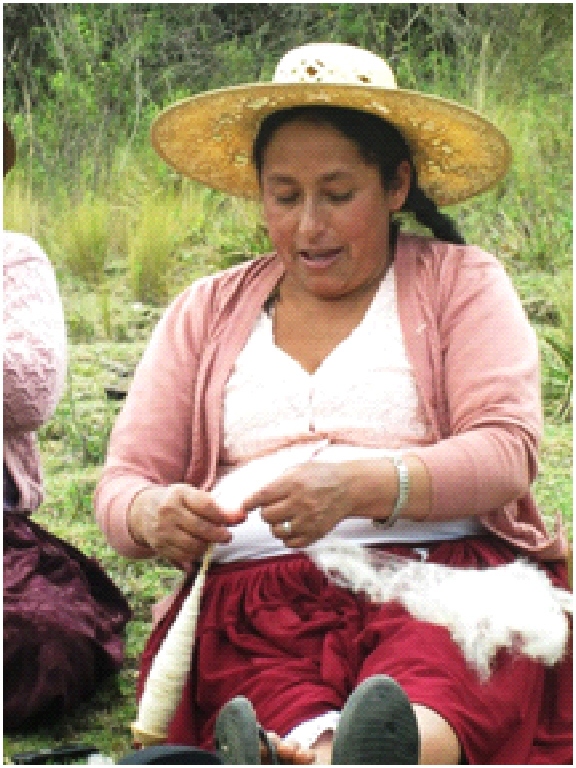
Here are some of the ladies who spend months spinning, plying and dyeing their yarn with plants and cochineal before winding warps and weaving beautiful cloth on their simple leaning vertical looms…

faja weavers

These are also the ladies who are part of the team that took part in the 2014 global spinning event –Spinzilla.

I wonder if some of that Spinzilla thread was used for these bands. Dorinda Dutcher of PAZA Bolivia, lives in Independencia and devotes herself to promoting the recovery and revival of  these fiber and textile skills. She told me that the ladies were overjoyed to have the time of the Spinzilla event to spin, chat and laugh.

maxima It was exactly what they used to do as young teens. They would head out with the family flocks and meet up at a rendezvous point. 

The hottest topic of conversation would be the weaving advances they had made for the creation of their aguayos, the large pieces of cloth worn over the shoulders, that would be shown for the first time at Carnaval.

Because the ladies challenged and competed with each other, it was the time of their finest work. Now their daughters go to school and that particular tradition is no more.

Doña Máxima, at left,  is one of the few weavers whose daughters weave, most of the weavers’ daughters having migrated to the cities.

Here are the bands with all the stunning sun-soaked colors of the Bolivian hghlands…

weaving highland BoliviaI can’t help showing you picture after picture of individual pieces so that you can better see and enjoy the color arrangements. I love seeing how the varying amount of twist in the handspun yarn creates different textures  in the cloth and how each weaver has decided to arrange the colors that she has available from the latest days at the dye pot.

PAZA colors 1


??????????????????????

??????????????????????

??????????????????????

??????????????????????

??????????????????????

???????????????????????????????

??????????????????????All the patterns are Andean Pebble Weave.

And, we have our own talented spinners, dyers and weavers in the Backstrap Weaving Group on Ravelry as well as members who are brilliant at combining colors.

Here’s a cuff that Janet wove made from her own handspun Perendale wool which she dyed with indigo, cochineal and walnut…

janet cuff 2She made a series of wool cuffs and Wendy also showed one that she completed made from variegated cotton thread and finished so neatly with weft  twining…

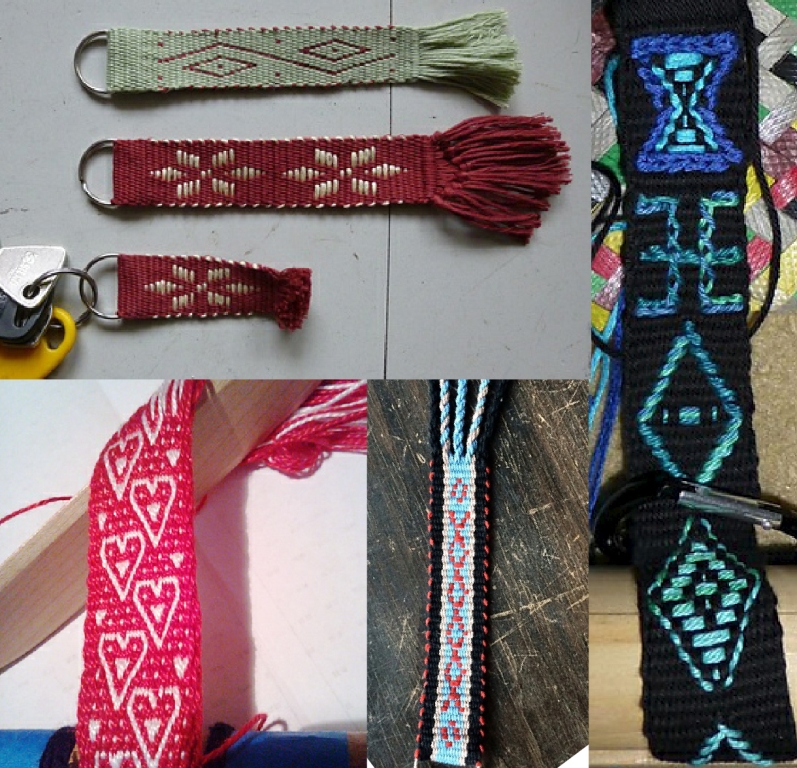
cuffsJulia T in her home in tropical far north Queensland in Australia was inspired by the colors of nature and used fruit to inspire a set of bands for key fobs. She captured the essence of the fruit so well!

???????????????????????????????I contributed something cheery as well….a field of flowery “O” s amongst a lattice of ”X”s…

flowers both sidesCatharina joined our group to share with us her explorations in traditional Estonian patterns in the supplementary-warp structure and our minds have been blown.

llunallamaBut, back to the ky fob WAL which has been chugging along to its one-month anniversary…

pebble fobsJulia T, Arlene and Betsy worked on Andean Pebble Weave bands. After her first sample, Betsy added more twist to her handspun wool and is happier with this latest result. Arlene’s band, with its rope pattern, has an unusual and attractive tapered finish and Julia T used JoAnne’s original cat design along with her own heart composition and a knot work motif from my second book.

plain weaveI love that plain weave continues to be popular inspiring more and more creativity in combs and stripes. What I have dubbed ”Wendy’s Watermelon Warp” (center bottom left) inspired the idea for Julia T’s tropical fruit collection as well as Gwen’s comb combo, above right. WannaGTD wrapped the warp-ends for a neat finish on a her classic band of horizontal bars. The yellow stripes really give it a zing.

mixedSupplemental weft made another appearance in the work of Valtricot, above left, Linda, center bottom, and Wendy, bottom right. Wendy also put to use her considerable skills in Bhutanese supplemental weft technique. Susan celebrated Valentine’s Day with her own composition of hearts in Andean Pebble Weave. I like how she added the small heart spots betwen the large motifs…they really set it off.

sheep combo

??????????????????????I had been reading comments online about confusion in the English-speaking world about what exactly the animal is for this Chinese new year…a sheep, a goat, or…???? At the same time, I spotted Louise Ström’s sweet tablet-woven pouches (above left) with their animal motifs and decided that I would try something similar in Andean Pebble Weave (above center and right). The level of success of my attempt to create sheep will be left for you to decide!

I also played with beads, at left, in a plain-weave comb design band. I lined the edges with beads and popped couple up in the center just to see how they would hold there. I think I would like to use beads in the center of a band to form part of the pattern itself.

My large three-color Andean Pebble Weave/ikat bird  project is moving along at a snail’s pace with the workshop prep and key fob WAL having occupied my attention for the last few weeks.

And now I am going to warp to make covers for some small journals that I would like to take away and give as gifts. One of the key fobs I wove during the WAL will serve as my width sample for the Guatemalan thread that I want to use. I will use patterns inspired by nature…my little leaf motifs that I like so much.

supplementary weft leaf pattern journal cover backstrap weaving


Backstrap Weaving – Warping, warping….

I wound over 120 warps this week as prep for weaving with groups and friends and I am not even half way. I put on some music or the tv, make sure I have absolutely every thing I need on hand…scissors, rubber bands, cross sticks and string…and away I go. I have long sticks all over the room wedged between books on the book shelves and I hang the completed warps on those as I go. It’s very efficient. I always wind in the same direction with the balls of yarn in the same place. It has become so automatic and so much about feel that I have reached the point where I can wind two colors and separate them into sheds as I go without even looking to check if I am putting the right color on the right stake.

And then I decided to take a break and wind something for our Key Fob Weave-Along that is still buzzing along in the Ravelry Backstrap Weaving Group.

wal collage 1I decided to weave what is often called a ”threaded-in” pattern. Basically they are stripes, or ”dots” (tiny horizontals or single ends in a contrast color), or horizontal bars, or any combination of the three and can be as simple or as complex as you like.

??????????????????????Here is one that I did a couple of weeks ago for the key fob Weave-Along…

??????????????????????

Warping in pairs in my workshops helps makes the processa little less daunting.
Warping in pairs  helps makes the process for beginners a little less daunting.

And that is when I was reminded of how it feels when you are first learning to warp…trying to follow the path, handle two threads at once, remember which color goes where and when while trying to tie off ends and maintain tension. You feel like you are all thumbs.

I was remined of that beginner feeling because winding some of these kinds of threaded-in patterns from one stake to another and back, as I do for the backstrap loom, can be a little tricky. It is not always as beautifully straightforward as it is when winding them using a circular warp for an inkle loom, for example, where one circuit of the inkle frame gives you a single end. The way I warp, each ”circuit” gives two ends and often four if I am winding doubled threads.

Sometimes a half revolution is required, knots have to be tied at the other end of the warp and sometimes it works best if you reverse the winding direction after the halfway point. I am not used to having to stop and actually think about what comes next…about how to avoid spaces between the colored horizontal bars in each column, about which of the two central posts each color is supposed to pass around and how to make sure the pattern is balanced. I didn’t like having to get out paper and colored pencils when I got confused! I tell you, old habits and muscle memory are hard to break.

The idea of a threaded-in pattern is that it is created by the way you set up the warp and separate colors into the two sheds. Once that is done, all you have to do is weave it off in warp-faced plain weave…no pick-up or other manipulations are needed and the weaving moves along so quickly!

??????????????????????
??????????????????????So, if you are interested, here are the warping instructions for the fob at left. These instructions are for those who are already familiar with winding warps on four stakes/posts and separating colors into their sheds as they go….

I am calling the Start and End post ‘A’, the two posts in the middle ‘B’ and ‘C’ and the post at the other end ‘D’.

3 revs of purple
1 rev purple and yellow wound together and separated between posts B and C (yellow on C, purple on B)
1 rev yellow
1 rev yellow and green together (green on C, yellow on B)
1 rev only green
1 rev green and purple together (purple on C, green on B)
1 1/2 revs yellow and green together (green on C, yellow on B) you will stop at post D, cut the green and tie purple to the green end.
1 1/2 revs purple and yellow together starting at post D (yellow on C, purple on B) you finish at post A.
2 1/2 revs of purple finishing on post D. You need to tie the purple off to something. I tie it to the green and purple ends. I like to untie the knot in the green and purple and then tie all three ends off together.

###############

The only other key fob I wove this week required nice straightforward warping. I was inspired by Joyful’s use of a button on one of hers. Instead of sewing the folded woven band to itself to secure the ring, she created a slit, ot buttonhole, while weaving and used a button to make the connection. I wove a black plain-weave fob for my silver-color button.

??????????????????????The other small project I have been working on is a silk bookmark. It was originally planned as a keyfob for the WAL but I was enjoying weaving it so much and didn’t want to stop at key fob length. It is 60/2 silk and has a traditional motif of the Isoseño Guaraní people of lowland Bolivia. Many thanks to the people who commented last week with ways to make one’s hands silk-friendly. The piece on the right is a supplementary-warp band that I made ages ago in tencel which needs to be finished and used as a fob or bookmark.

sil cotton tencel bands backstrap weavingTerri, who very recently joined the WAL, showed us that simply knotting the warp ends is a very neat and time-efficient way to finish a band and this is how I finished the black fob rather than try a new braid.

Let me show you now what our other Weave-Alongers have been making…

simple warp floats supp warp and pebble weaveHer are three fobs made by three weavers using three different structures. Eska’s fob on the left uses the simple warp-float technique floating two colors to create a motif found in yurt bands and other Central Asian textiles. Ilze’s name band is woven in the supplementary-warp structure and Julia’s is in Andean Pebble Weave using a motif that I adapted from Central Asian weavings and which is charted in my second book.

combs and barsWendy, Terry and woolfancy were all  on the same wave length color-wise and designed with stripes, combs and bars. That D ring with the added split ring makes so much sense for wide bands that won’t sit well on the curve of a regular ring.

supp weft designsValtricot continues her studies in patterning with supplementary weft. Celticthreads made three fobs, two of which also have supplementary-weft motifs.I love the white plain-weave one with its colorful stripes and braids. Joyful, wove a rabbit figure in angora supplementary-weft. You can also see her use of a button as well as sprang in the unwoven warp-ends.

Our two Julias have been working on Andean Pebble Weave

andean pebble weave fobsJulia T wove a Valentine’s Day themed fob while Julia W wove one of the knotwork patterns from my second book.  Sarah’s completion of her first Andean Pebble Weave band and Lesson One in my first book shows that she is well on her way to starting her first patterns.

Gwen took a break from weaving the panels which she will sew together to make a cover for her weaving bench to join us in the WAL. Let me show you the two gorgeous panels she has made so far along with her first fob…

gwens fob and panelsSo, it is back to the warping board for me and the workshop prep. I have decided that I must finish this task before settling back into my big bird project.

???????????????????????????????While I wind my dozens of warps, my mind is on to the next big project and then the next and the next and I am thrilled to say that, thanks to something inspiring that showed up on my Facebook newsfeed recently, I have found the curvy shaped motif that I want to create in the ikat technique and then fill in with pick-up patterns. I can’t wait to work on it!

That has been the whole idea behind my recent ikat bird experiments. I want the ability to create curves and irregular shapes and fill them with pick-up patterns. I stand at the warping board and dream about that, plan out the steps and think about the wonderful opportunity that has recently come my way to study with an ikat artist while I am in the US this spring.

This city is vibrating to the rhythm of the coming Carnival. See you next week…


Backstrap Weaving – Where the Yarn Grows on Trees

Oh give me a home,

Where the sheep roam,

And the yarn grows on trees…

handspun yarn tree at Janets

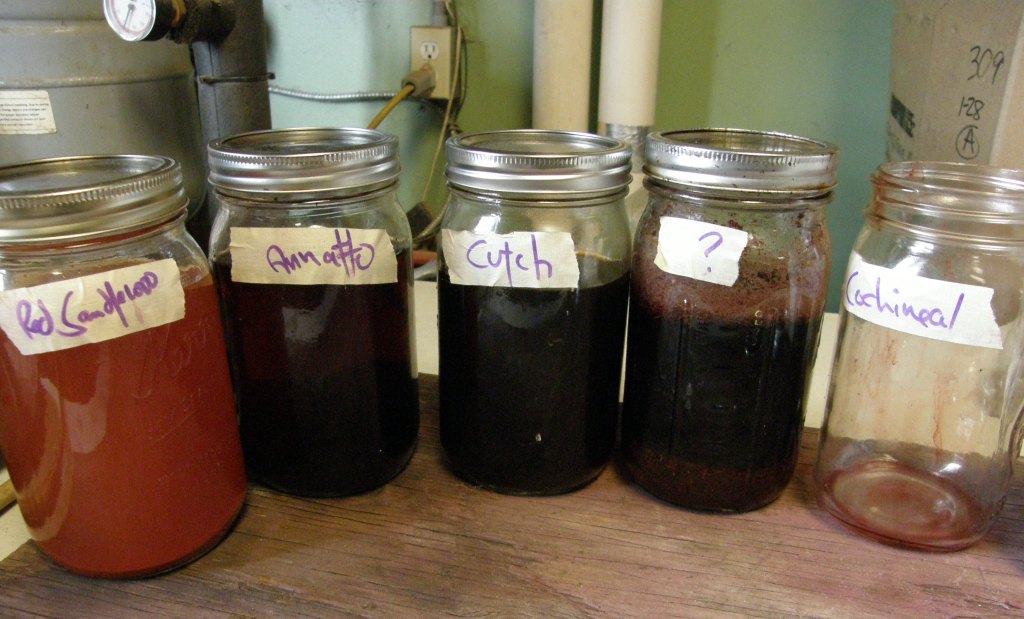
yarn tree sculpture at lydiasThere have been two stops on my trip since I last wrote…one in  Texas and another in Humboldt County in California. Above you can see luscious skeins of Janet’s handspun at her home in Humboldt that I strung up in a tree after a day of dyeing. Janet used these natural substances…

???????????????????????????????…as well as indigo in an old vat.

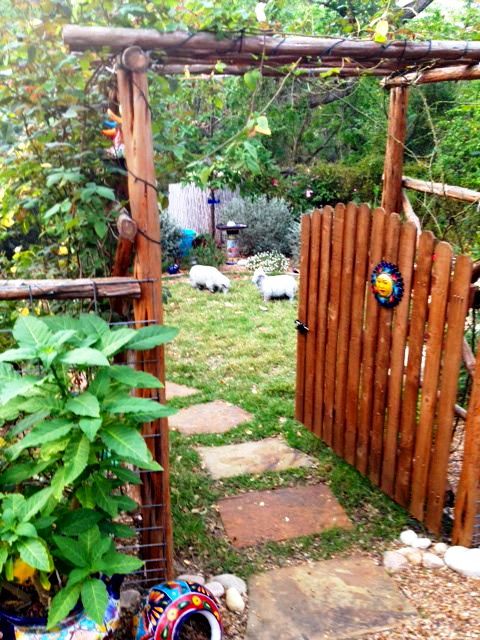
And then there is Lydia’s sculpture wich spans branches in her yarny yard in Texas. It is a patio and garden space that whispers serenity and begs for exploration with plenty of benches and seats tucked in shady spots around every corner on which to sit and simply ponder.

Here’s her garden loom dressed up to greet the spring…

gardenloom031813_mediumAnd she brings the colors of spring, the desert and the garden into her home covering her walls and banisters with her own woven art.

lydias trio

??????????????????????That’s Lydia in the center with Eileen. I stayed with Eileen last year too and we met again in Manchester UK at Braids 2012.

Driving up to Lydia’s home, you get a hint of what is to come within the home and beyond when you see the weaving that stretches between the front porch posts. Lydia would love to have a group backstrap weaving in her home and I think that weaving in her garden would be heavenly!

Speaking of heavenly spots, here is a group of weavers from last weekend in northern California…

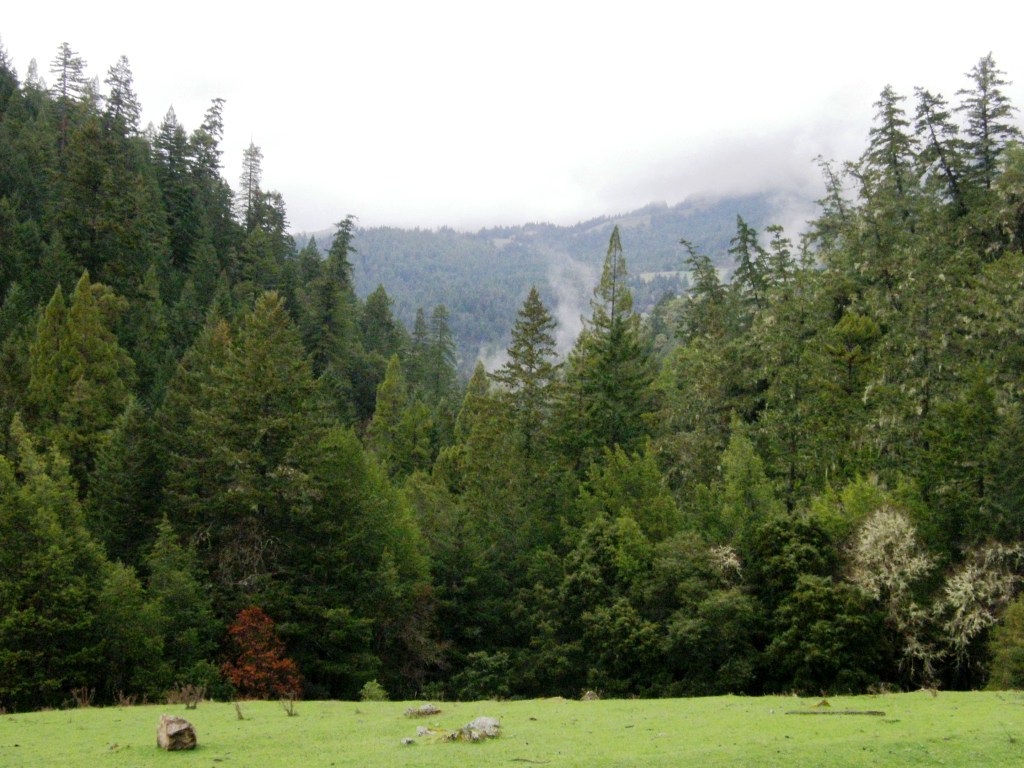
??????????????????????Ace and Pam of Ace ‘n the Hole Romneys offered their home for our group. You can see that neither the weavers nor the weaving are the feature of this particular shot…instead, it’s that amazing view through the glass of the redwood forests and mountains!!

??????????????????????And, while wee resin sheep figures roam in Lydia’s Texan garden…

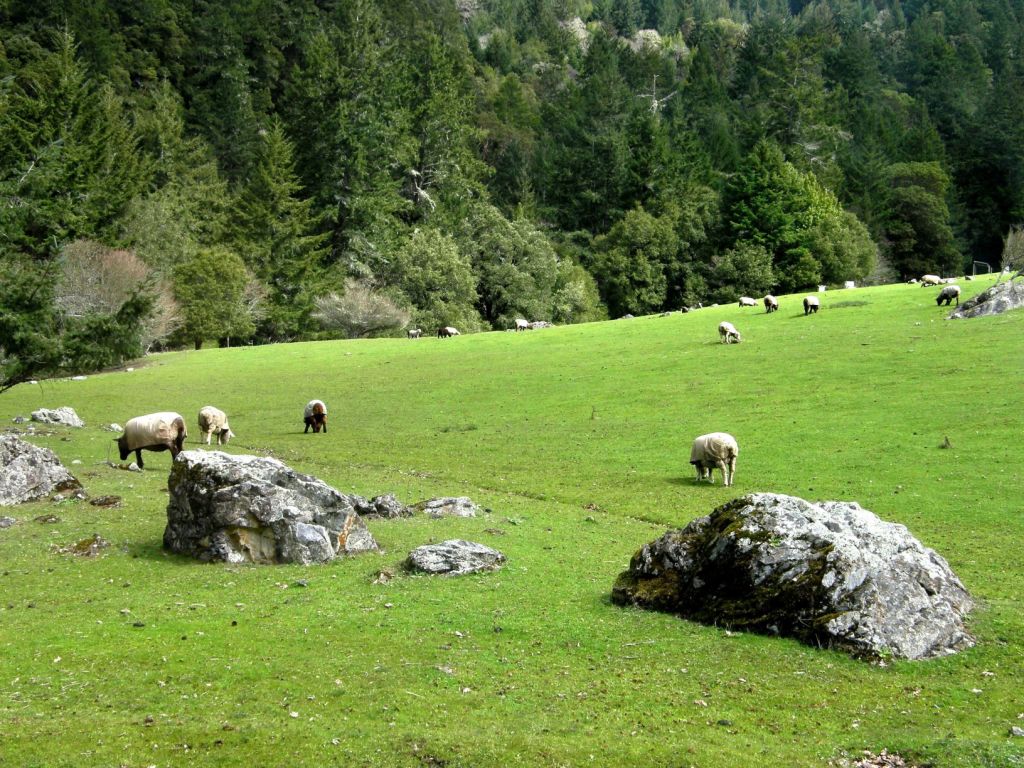
sheepAce’s romneys, whose fleeces have won many ribbons at fairs on both the east and west coasts, roamed the hillsides. Meanwhile,  indoors, we wove pebble weave on backstrap looms.

aces sheep

Janet in the GlimakraAce is a prolific spinner and is finally fulfilling his dream to weave with his handspun having just bought a pre-loved Glimakra counter-balance loom which we put together with Janet at the helm.

Ace and  Janet playfully tease and compete with each other at local fiber fair speed spinning contests. I won’t tell you who wins.

There’s Janet seen through a curtain of heddles on the floor tying up “stuff” (you can tell that I know next to nothing about these kinds of looms!) to get Ace’s loom up and running.

Looking at these things I am  amazed at how people sigh and roll their eyes at the masses of string heddles on my backstrap loom when floor loom weavers have to contend with all those heddles and shafts and treadles!

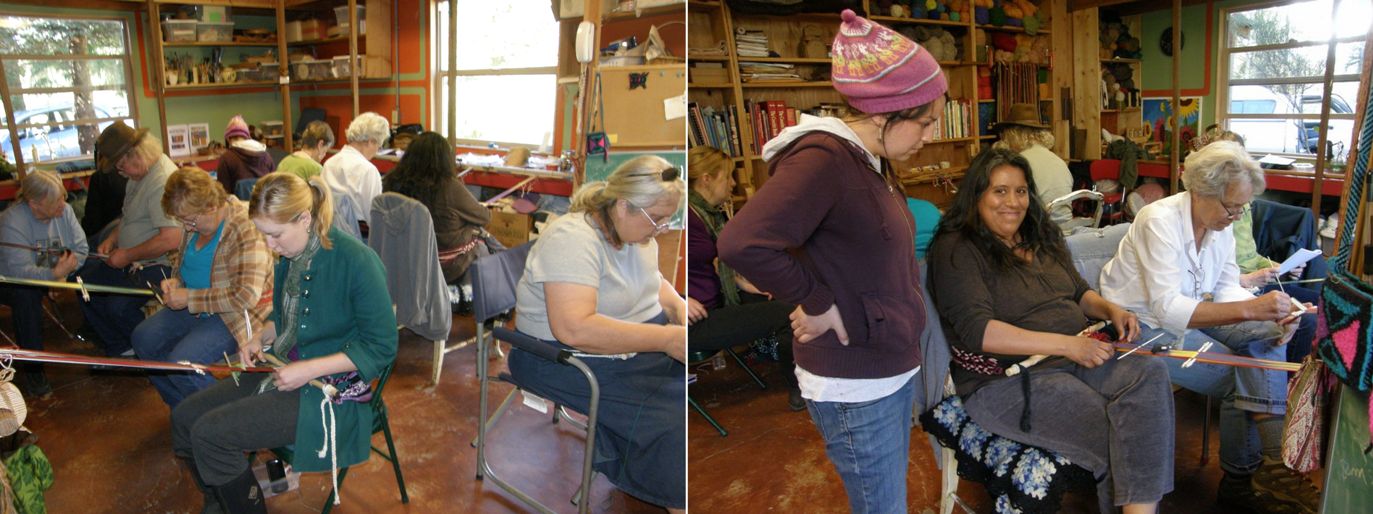
Nine weavers got together at Ace’s place. Two wooden pillars in the living room gave us the perfect places for attaching the looms. We had that beautiful view to enjoy while weaving and during breaks.

backtrap weaving from posts at aces placeIt was fun to see the  bevy of bands accumulating around the posts as the pick-up weaving skills developed and patterns started to take shape.

pebble weave bands backstrap looms

Betsy and Janet's pebble weave bands alongside some other pick-up work that we did during the week.
Betsy and Janet’s pebble weave bands alongside some other pick-up patterns that we had played with during the week.

As our bands filled with motifs, the mist would eerily rise and fall over the trees and hills. The sheep would run and scatter at a sudden roll of thunder and the wild turkeys would come out to strut their stuff.

wild turkeysThe previous weekend had been spent with another group in Janet’s mill.

backstrap basics at janetsOn the right you can see Priscilla and Rose whose families are from Ecuador and Peru. Both were excited about experiencing something which has its roots in their South American heritage. Some of these weavers also joined us at Ace’s for pebble weave the following weekend.

That left a week between to have fun in Janet’s mill.

janets processingJanet showed me what she is currently processing in her mill. While the machinery does its stuff, Janet and Betsy can spin and weave. Betsy learned to spin and weave with Janet and you can see the band she is weaving on her backstrap loom using her handspun. This band will participate in our Year of the Snake Weave-Along.

janet and betsy weaving and spinningJanet is just as much at home spinning fine and smooth yarn for backstrap bands, a different weight and quality for blankets and then something completely different yet again for rugs.

janets yarn x 3 aWhile working in the mill she can jump from a backstrap loom to her huge Glimakra floor loom, from her wheels to  drop spindles from wool to silk as the mood takes her. Pretty much every weaving project no matter what size or what loom, involves her own handspun.

Janet at the Glimakra

janets weavingBetsy also creates beautiful pieces of fabric with her handspun which she sews into lined shoulder bags. She weaves the straps on on backstrap loom.

betsys handspun weavingsI wove with Betsy and Janet doing an Andean pick-up pattern during the week and then Connie came over to weave intermesh with Janet.

tanka choro and intermesh

???????????????????????????????

Connie weaving intermeshConnie weaves all kinds of bands and braids and brought her band box over to show her takadai work as well as her inkle loom-woven bands.

Connie's band box

Aunt Janet's Fiber MillThere’s always something good and fibery going on in Janet’s mill and, with its heated floors, it is definitely the place to hang out on chilly mornings and evenings. Fleeces, handspun yarns, rolags and batts spill from the shelves. Half-woven backstrap bands dangle from shelves loaded with books on all kinds of fiber arts and crafts.

Every second Saturday night, the looms are pushed aside and chairs are pulled up all around for Honky Tonk evening. I was lucky to be there for one of those when eleven local musicians, including Janet and her husband Larry, gathered for an evening of jamming….two upright bass, a flute and clarinet, mandolins and guitars, an Irish drum, and spoons!

I got to help rescue a large handspun and naturally dyed ikat project that Janet had started on her backstrap loom. It had been left to languish on the UFO (unfinished object) pile when Janet got a little frustrated with trying to open the sheds.

Janets wool ikat projectYou can see the gorgeous colors she obtained from madder, onion skins and onion skins overdyed with madder. She wrapped the yarn to create rectangular ikat patterns. The problem was that she had pulled the weaving in too much and that was making the sheds almost impossible to open as the warps were pushed together so tightly. I was itching to get into this project!

Standing to backstrap weave

standing to weave tacabamba peruOnce the width had been re-established and some broken warps repaired, I got out my wichuña, the llama bone tool which is used by weavers in Bolivia to strum the warps and separate them. This makes opening the shed-rod shed easier.

The wichuña is also used to push the weft into place. Janet will be able to use a deer antler that she has.

I found that standing to weave this piece made opening the sheds easier. I had seen weavers of wide warps in both wool and cotton standing to weave in Peru and thought that I would try it. I think that having the warp angled slightly upward as well as having one of the large butt-cradling backstraps that I saw the weavers using would have made things a little more comfortable. I am not saying the sheds now pop open magically. There is a technique to apply and you still have to work at getting the sheds cleared.

I was so happy to have had the opportunity to try this.

After all this wooliness, let’s go back to Texas with its vastly different climate. It isn’t one that begs for wool much the same as Santa Cruz, Bolivia where I live. I often look with envy at the lovely socks that people knit and thick wool scarves that they weave. But, who can complain when there is so much beautiful cotton to be played with!

???????????????????????????????

cascade ultra pima and eileen's backstrapHere we are in Eileen’s home shopping for yarn during a break in weaving. We had Sue Ellen of Old Oaks Ranch Fiber Arts Center with us as an added bonus and I asked her to bring her skeins of Cascade Ultra Pima.

This cotton yarn comes from Peru and we called Cascade Yarns to check if it is mercerized. It has such a lovely sheen that we thought that it must be even though the label does not indicate so. It turns out that it is.

Eileen had used it to make her backstrap (pictured above) and it came out beautifully.

I am going back to Bolivia with three skeins to try out for myself.

Karen mary and susan backstrap weavingOf course, it wasn’t all shopping. Here we are weavingg.

??????????????????????It was nice to see some familiar faces in the group. Karen, at left, had woven with me in Pennsylvania and just happened to have a business trip to San Antonio planned which happily coincided with this gathering. Susan, in the green top, had woven with me last year  here. Penny was also a returning.. Mary, pictured next to Susan, was new to this group and backstrap weaving and has been brought up to speed by Eileen.

I was lucky to be here during Austin’s famous SXSW Music and Film Festival. I was astounded afterwards to look online and see all the big names that had been performing at the festival. Eileen and Guy took me out on Saturday evening to stroll through the downtown parks and soak up some of the festival atmosphere.

After visiting Lydia’s home and magical garden, Eileen took me to Old Oaks Ranch. The yarn store was lovely but it was the sculpture garden that really caught my eye.

origami horse sculpture

An origami horse sculpture provides a spot of cool blue among the sandy ground and cactus.

sculpture at old oaks ranchI love this shade-dappled woman astride her giraffe drawing you to gaze up at the tree tops just as she is doing.

bear sculpture at old oaks ranchThe sculpture garden is a soothing place to stroll or sit and chat as these chaps are doing while on a break from weaving class or yarn shopping at Old Oaks Ranch.

It’s almost time to leave Janet’s and head back to the cities. Next stop will be the state capital, Sacramento, where I will get to weave with long-time online weaving buddy Franco. I will get to meet Laura, another Ravelry group member, there too.

Let’s look at some Ravelry group projects before I leave you….

hetty and jenniferThat’s Hetty’s backstrap on the left decorated with pebble weave motifs from my Andean Pebble Weave bookHetty wove with me when I visited the Netherlands last year and it is wonderful to see that she now has her own woven backstrap and is continuing to weave using a backstrap loom. On the right is Jennifer’s band on which she is weaving a pattern of Tinkipaya, Bolivia. This one is charted in my second book, More Adventures with Warp-faced Pick-up Patterns.

cindyq and juliaCindyQ wove a stunning band also using pebble weave patterns charted in my first book while Julia is clearly having a wonderful time adapting traditional Japanese textile patterns to the pebble weave structure. This piece was woven on a floor loom. The instructions for weaving pebble weave on a four-shaft loom are included in the first book. (Edit: Julia has since told me that this piece was, in fact, woven on a backstrap loom) My second book guides and encourages weavers to draw their own pebble weave patterns and Julia has certainly taken up the challenge! She has even include some weft twining. (See the tutorial for this here)

So, it’s back to the mill for one last day with Janet and Betsy. We will weave tubular bands this afternoon. I can see Janet making pretty edgings for her handspun handwoven pieces with those.

janet and betsy on the last dayThat’s Janet on the left weaving a ñawi awapa while Betsy on the right tries to squeeze as much as she can out of one of her pebble weave bands.

I was telling Janet about how weavers in Peru use a tanka, or forked stick, when they weave the ñawi awapa so, we decided to go out stick hunting in the late afternoon sun on this most gorgeous spring day.

stick huntingWho knew how difficult it can be to find the perfect forked stick?! I wanted a large, strong one to use in my warp  for weaving bands like this weaver from Peru…

???????????????????????????????

???????????????????????????????Janet was the best spotter.

The one below, that Mikey has his eye on, turned out to the best one for me. What a nice weaving souvenir to take home from my visit up here. 🙂

forked stick for backstrap weavingHopefully I will squeeze in more posts before heading home. See you then!