Backstrap Weaving – In Focus

In Focus… that’s a funny title for a week that was spent weaving moifs that are meant to be blurry. My camera kept rebelling against my attempts to have it focus on something that was not sharp and my eyes kept rejecting patterns formed by threads that refused to stay in place. I am talking about ikat.
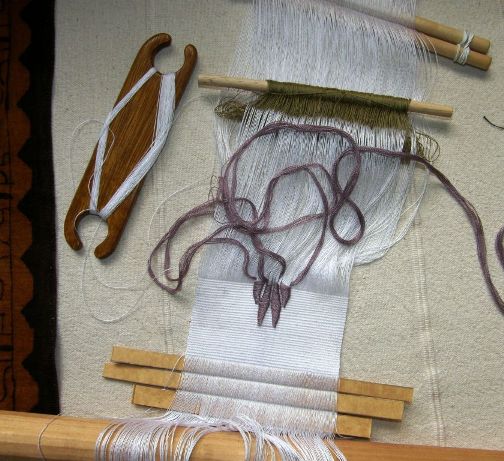
backstrap sample with new cottonI was weaving the wee sample that I started last week with the new-to-me UKI 20/2 cotton. This would give me an idea of the number of ends I needed to wind for the 7 1/2 -inch width of my next wall hanging panel.

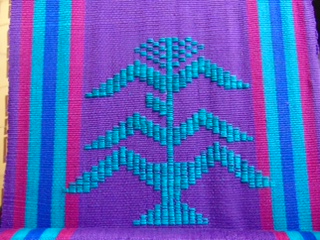
At the same time, I was attempting to make this a “two-fer” and try out a new patterning technique using supplementary weft. After finding that my count was off, I unwove the Guatemalan flower pattern I had been creating and then came to the conclusion that a little discipline was needed… a little FOCUS. Sure, I could get a “two-fer” out of this short warp but let’s focus that “two-fer” entirely on the project at hand….ikat with 20/2 cotton.

So, I decided to drop the Guatemalan flower project and use this warp as a width sample and also as an opportunity to wrap a sample ikat motif.

I love how the splintery old frame that I found abandoned up on the rooftop terrace several years ago continues to be so useful. One side of the frame is longer than the other which makes the whole thing rather wonky. Nevertheless, it works well as a support for the stakes and rods onto which I wind my discontinuous-warp projects….172870_203704546310057_3438857_o….as well as a frame on which I can stretch warps before I wrap them with ikat tape…

ikat-on-frame-and-off

ikat sample for backstrap weavingAbove, you can see  the last ikat project I did using cassette tape for wrapping.

Now I am using tape that has been produced especially for this purpose.

I like the cassette tape because it is opaque. You can immediately see white spots peeking through if you have not wrapped a section well and left parts of the warp exposed. The pink-ish color ikat tape that I have is close to transparent which means that  it is far less apparent when I have missed a spot when wrapping.

On the other hand, I am enjoying using the ikat tape because I can split and easily the tear the tape into strips of any width I want. While the cassette tape is strong and holds knots well, the ikat tape is even stronger. I haven’t had any trouble with it snapping if I pull a knot very tightly.

Above, you can see the sample motifs. This is not exactly the pattern that I plan to use in the wall hanging. The whole thing has been an exercise in achieving consistently accurate measurement of really tiny lengths. It hasn’t been entirely successful so far. In the end, I will be interested to see whether the accuracy at which I have been aiming is absolutely necessary. For eaxample, I simply “eye-balled”  the pattern in the project wrapped with cassette tape above. You can see some very obvious differences in the length of the wraps  from one motif to the other but the overall look is quite okay. With this latest attempt at ikat, however, I have been measuring and re-measuring and fussing about a whole lot.

cambodian ikatI have to remind myself to “think like a bird”. I wrote a whole blog post about this once…trying to train myself to walk away and look at this kind of thing from a distance to get the overall effect rather than focusing too much on the finer details.

I have a piece of silk ikat from Cambodia as my guide and inspiration. It has a very simple and tiny pattern of blocks. The warps shifted during weaving and, in some cases, a part of a motif has completely separated itself from the rest. Yet, when you stand back and look at this pillow cover, that’s not what you see. You see a simply gorgeous piece of fabric covered with tiny, even motifs.

So, I had the warps for my hook motifs wrapped as accurately as I could manage. I told myself that even with accurate measurement and wrapping, the warp threads will most likely shift whichever way they please once released from their wraps for weaving.

It was time to stop fussing and move on to the dye pot.

There isn’t much that can go wrong in the dyeing part unless you haven’t wrapped tightly enough. It is obvious from looking at some ikat warps that I have encountered in my travels that some weavers do not consider a bit of seepage a problem.

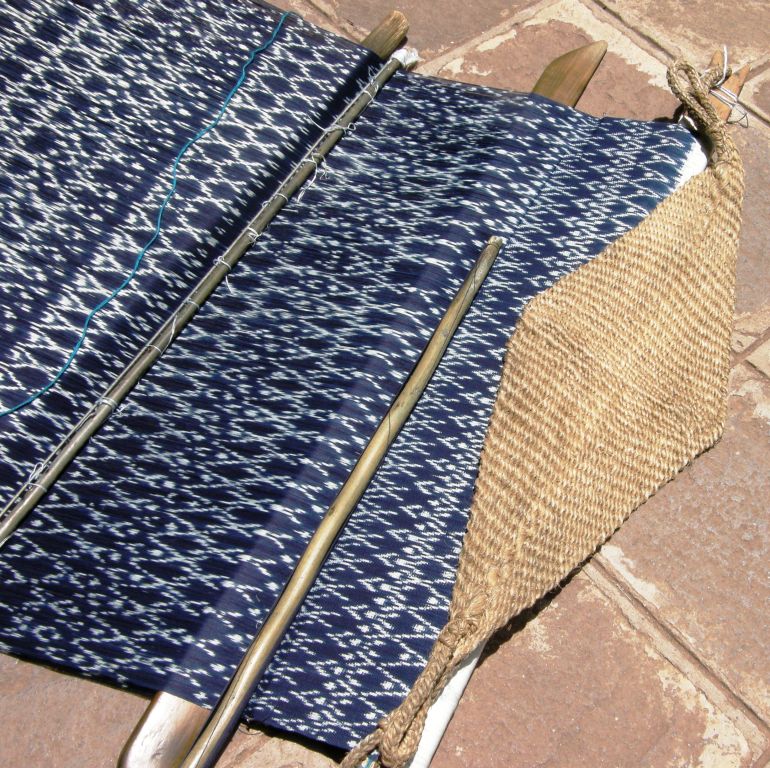
The ikat warp below, with its blue pattern on white, is from Tacabamba Peru. There is a heck of a lot of wrapping involved there. All those white parts need to be wrapped in order to expose just the small sections which will be dyed blue. I wish I could have seen this warp before the wraps were removed as I am wondering if there is an ideal length for the wraps. Is there a length after which a wrap becomes unstable thus allowing dye to seep in? Should long sections be wrapped as several small sections instead? You can see several dots and spots where the dye has penetrated the wraps.

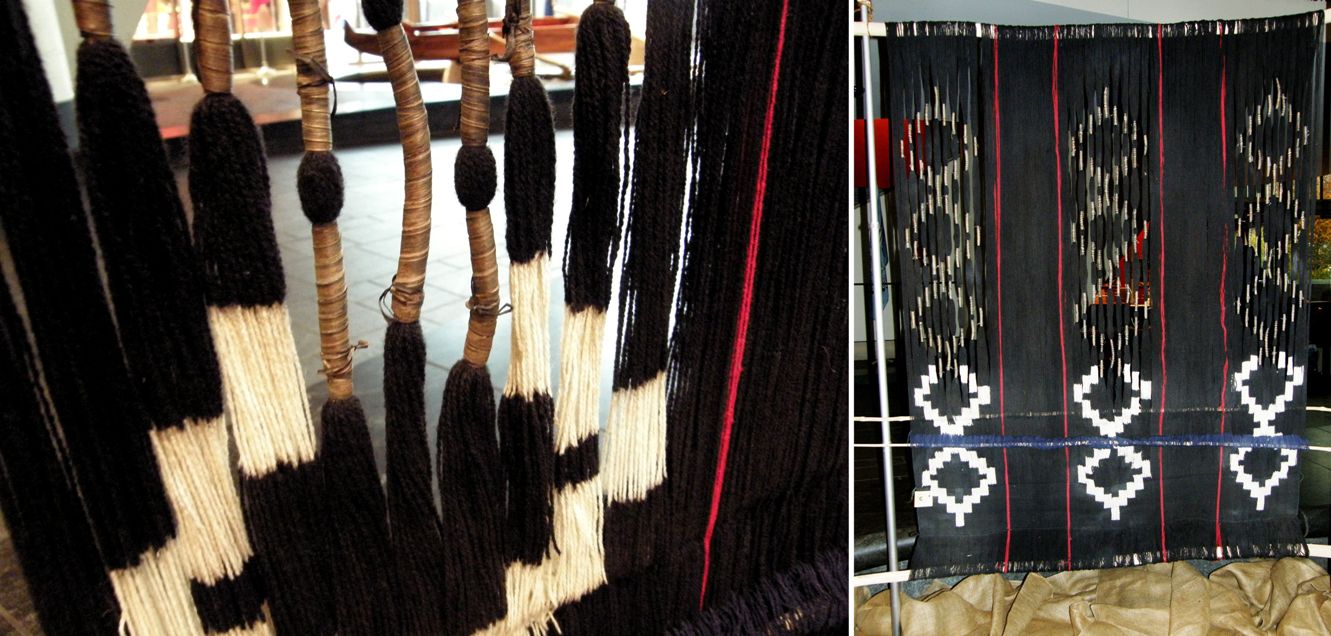
tacabamba ikat threadsI was told that Mapuche weavers apply a kind of white mud mixture to the sections of the warp where the dye needs to be resisted. Then they wrap them. When I got to see and touch an example on the loom, white dust would fly when I gently strummed the warps in the sections that had been recently unwrapped. I guess this is an added measure against seepage.

mapuche-ikat-11As it turns out, my ikat motifs more closely resemble these Mapuche ones with their sharp straight edges rather than the delightfully fuzzy and feathered outlines that one normally sees in ikat work.

I dyed the piece blue in a watered-down dye bath of navy blue that produced a  shade that I loved. Will I ever be able to produce that shade of blue again?!

ikat after dyeingDarn, I then noticed that I had neglected to add the last wrap on the right to the upper motif. Oh well, it’s just a sample. Above, you can see the warp with its heddles  and on its way…..time to unwrap. I always take lots of pictures of this part because the next part… the weaving… is where things tend not to go so well.

first ikat motifs unwrappedWell, there was no use putting it off…it was time to weave the unwrapped section, while holding my breath…

weaving frst ikat motifSo far so good. Yes, there was a bit of seepage. And I forgot to throw some of the thread in the dye pot to use as weft. Again, never mind, it’s just a sample. I’ll add that to the list of things not to do when I am preparing the real project.

ikat motifs with supplementary weft patternOnce I had woven all the ikat motifs, I used this sample warp to test the number of strands of silk I would need to make a supplementary weft that would be suitable for creating patterns on the 20/2 warp-faced ground cloth. I am hoping to add patterns made with supplementary weft both above and below the ikat section on my wall hanging panel. I love how the buttery-yellow silk weft looks against this particular shade of blue. I must weave something with this color combination soon.

I left this sample project at this stage to wind the warp for the wall hanging panel. I figured out the number of warp ends I would need, sketched and refined my ikat and supplementary-weft designs, and have already started wrapping. But, every now and then, I will stop wrapping to go back and weave some more of the sample warp. I need to take breaks like these in order to stay focused. It is too easy to start getting sloppy about the wrapping if you keep at it for too long. When I start wrapping too loosely, stop measuring well, or stop being able to judge a straight line, I know that it is time for a break.

If I keep weaving the sample warp, I may even be able to turn the finished fabric into something. In that case, it will be a “four-fer”…a width sample, an ikat tape wrapping test, a silk supplementary-weft test, and a useful, or at least pretty, finished product.

wraps for new ikat project?Here is the new warp with a small part of the ikat motif wrapped. I have already had one wake-up call….clumsy handling had me breaking a warp thread right in the middle of a wrap. Luckily it happened now and not while weaving! I was able to replace the thread. It had already been enclosed in five wraps so, those had to be re-done. Can you imagine trying to replace a warp thread once the piece has already been dyed?

My kingdom for a fine-tipped charcoal pencil! I have read in a few places online about ikat pattern “masters” who mark the motif on the warp with charcoal so that a team of wrappers seated around the warp frame can correctly place the ties. Of course, the charcoal must just wash out later.

Now I walk around with static-charged pieces of ikat tape stuck to my clothing. I find it in my bed and in my food!

I have a couple of finished projects from friends with whom I wove on my last trip to show. Elizabeth finished her backstrap with Andean Pebble Weave motifs. It looks thick, cushy and comfortable. She used one of the variegated varieties of Plymouth Yarn Fantasy Naturale  along with off-white in the pick-up section. I don’t think I have seen Andean Pebble Weave done yet with variegated yarn and I think it looks great!

elizabeth tahoeCheryl finished her camera strap with its Andean Pebble Weave motifs. She used the hardware from an old camera to put this together and it’s beautiful!

10561559_10204211964800394_1974920106637256794_nBack to the wrapping frame for me…tearing strips of tape, measuring and wrapping, and standing back to take it all in. While doing so I will think about what I shall make from my wee sample and what I shall weave into the red panels that will accompany the black-and-white ikat one. I have plenty to keep me focused on this one project!

See you next week.


Backstrap Weaving – Simply Red (and Black and White)!

These are the best light conditions I could find for photographing the red-on-red pattern on the two side panels of my wall hanging.

The late, low, winter sun was drifting in through my bedroom window and I looked up from my weft twining to discover how well the light and shadow brought out the relief pattern. I have posed these pieces all over the place…on the floor, on the table, in this room and that…used natural light and flash, held the camera in my hand, and used a tripod, and was not happy with any of the results. All I got was a flat red mass.

And then, there I was, happily seated with my backstrap in place and the warp stretched out before me. The light came to me through the window and gave me the shot at last.

sunlight on red panels backstrap weavingIt was great after all this time to be able to see how the red panels looked beside the center one. The tricky part was lining the three panels up precisely and have them suspended under the same amount of tension so that I could twine across the top of all three at the same time.

I still can’t decide which face of the double weave looks better…

back of double weave panelI used the solid stepped lines and the arrow motif as part of the weft-twined pattern in much the same way as I had in the red panels…

finished weft twining on backstrap loomI need to do a bit more solid black twining to finish. That will be the part that gets clamped within the wooden hanger. Once off the loom, I will decide how to finish the ends of the twined wefts and how I will cut the fringe around those long woven tabs at the other end (see below).I need to contemplate that for a while. Once cut, that will be that, and I want to get it right!

finishing the shipibo backstrap pieceSo, it is time to move on to the next project….a clean slate and a bunch of sticks…exciting!

I bought a large cone of UKI 20/2 cotton for the next project with which I have never woven before. That means it is time to sample the yarn while I play with ideas for the ikat  in the next wall hanging. I’ve been at the sketch book creating hooky designs. Whether I am creating a design that is way beyond my limited wrapping skills, remains to be seen.

First, I need to get an idea of what kind of width I can get with X number of ends in the 20/2 cotton and so I wound a short-ish warp as a sample.

To make it more interesting, I decided that I could play a bit with the silk that I recently bought at CNCH and try a new-to-me supplementary-weft technique that is used for decorating hair sashes from Jacaltenango in Guatemala. Dr Carol Ventura has written a book about the Jacaltenango hair sashes. I have owned this book for years and once dabbled with the technique many, many years ago. As is always the case when using supplemental weft, the success of the project is very much dependent on finding the right kind of material for the supplemental weft for the weight of the ground cloth. While I understood the technique, my sample was downright ugly because my supplemental weft was too “light” for the ground cloth and there were large gaps between the rows of pattern. Then, I got distracted and wandered off in another direction.

I don’t even know where that sample is now. It was obviously not worth keeping. However, seeing a Jacaltenango hair sash that one of my students brought to class in Seattle last spring re-ignited my desire to try this technique….

jacaltenango hair sashI have made mistakes in my new sample and my count is off. I will un-weave this and start again now that I have a better feel for handling and counting these fine warp threads.  Hopefully the next attempt will be better. In the meantime,  this 20/2 white sample will give me a good idea of how many ends I will need to wind for my next wall hanging panel. I like two-fers.

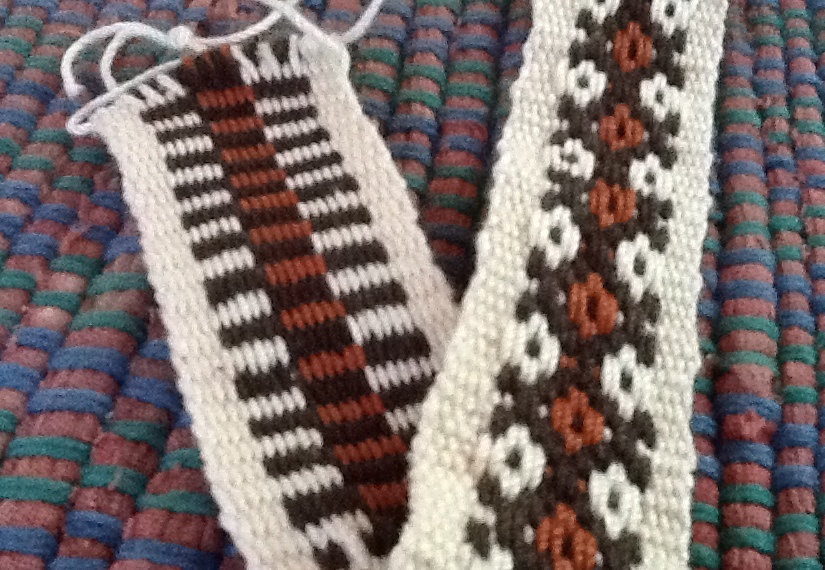
backstrap sample with new cottonAnd, do I feel confident about this next ikat project? No, not at all! My experience with ikat has been quite limited but I figure that I may as well just jump in there. I do know from my own experience that the wrapping and dyeing part, although painfully slow, is relatively easy. For me, the hardest part has been keeping the warps well enough aligned while weaving so that my motif remains recognizable. Yet, I don’t want them to be so rigidly aligned that I lose the feathery outlines that make ikat so charming. This is one of my tiny attempts…

three ikat motifsHere are some narrow strips of ikat that I placed in a piece that includes supplementary-weft patterns…

strips of ikat backstrap weavingAnd finally, this experiment involved dyeing and then removing some of the wraps to dye again for a second color.

ikat book coverWay back in 1998, my weaving teacher in Candelaria, Bolivia showed me the first piece of ikat I had ever been able to handle. It was a  bedspread on which she had been working on and off for several years. This was something she was weaving for herself rather than the usual pieces that she weaves for the store in the museum in Sucre.  She was weaving with rather coarse handspun wool and her name and her husband’s had been worked in amongst the flower motifs..

stitched-ikatI’ve examined the wrapped warps, the finished cloth, and watched the weavers at work in many different places in my travels in South and Central America, trying to capture the secret of limiting the amount of  movement of the warp threads and the resulting image distortion. Below are examples from Chile, Ecuador and Peru.

mapuche-ikat-2

ikat weaver Bulcay Ecuador

The simple backstrap loom of Tacabamba, Peru on which the indigo ikat-patterned "panones" are woven. They are up to one-meter wide, covered with tiny motifs and have patterns knotted into their fringes.
The simple backstrap loom of Tacabamba, Peru on which the indigo ikat-patterned “panones” are woven. They are up to one-meter wide, covered with tiny motifs and have patterns knotted into their fringes.

So, that is what I have been up to this last week….

Meanwhile, there has been a fair bit of red, black and white appearing online in the various places where band weavers hang out.

Cheryl wove with me last spring and now she is already designing her own motifs and weaving more than just samples.

cheryl (3)She designed the gecko figure and I love the arrow motifs at the bottom which remind me of little boomerangs. This will be a strap for her camera. I showed you some weeks ago the sample bands that she wove in preparation for this project. Here is the completed weaving…

cheryl finished camera strap pebble weave backsrapThe center motif is charted in my second book and is a pattern that I adapted from tablet-woven band by Louise Ström.

Ann Mester created this enticing warp for backstrap weaving which could be used for complementary-warp pick-up techniques like Andean Pebble Weave, or simple warp floats, or just to create attractive horizontal bars of black and white…

ann mester fb (2)Rufio, the kitten (who would look very stylish with a red collar) was rescued from Pet Rescue of Mercer.

Susan AndersonAnd, if you are wondering about what I call “simple warp floats, the technique that I used on the red-on-red panels, Susan Anderson’s example. above, very clearly shows the single-faced nature of this pick-up technique. Susan has floated the warp threads singly. For me, this gives a more delicate yet solid look to the motifs than that which is achieved by floating pairs. The pattern is from Anne Dixon’s The Weaver’s Inkle Pattern Directory. Susan wove this on an inkle loom and has done a beautiful job.

So, it will most likely be all about winding the warp and then finding a comfortable position and set-up for wrapping many many threads for ikat this coming week…

cropped-ikatThis was my first ever attempt, around eight years ago, I would guess. It’s wool warp…Navajo warp…wrapped with cassette tape. The wrapping and dyeing were successful…the weaving was not! This is another sample that has disappeared!…nothing to show for those hours of work except this picture and “experience”.  And I am sure that there will be much more experience to be gained and  many more lessons to be learned in this coming week.

See you next week…


Backstrap Weaving -The Bag of Tricks

I had to dig deep into the bag of tricks this week to come up with a new idea for finshing off my latest three-panel wall hanging. Two days of experimenting with the structure that I had hoped to use for the two outer red panels finally led me to the conclusion that it just was not going to be as I had envisioned. It was time to plan again and take a look at all that I have at my disposal in my “bag of tricks”.  And there is a lot of stuff in that bag of tricks after having spent almost 18 years now studying weaving techniques and simple looms used in South America.

main panel of Shipibo inspired wall hanging backstrap loomThe main panel for the wall hanging is now finished. I can’t cut it off the loom yet to better show you the stepped effect of the woven fringe as I will need to place the two red panels, when I am done weaving them,  on this same loom and then twine across the top of all three to join them together.

It is always fun turning a finished piece over to look at the other side. I have been looking at white squiggles on black for so long now as I inched my way through this weaving. Yes, literally inched. I took note of my progress on the woven fringe part and it was pretty much an inch a day.

light sde of shipibo inspired hanging off loomThis side actually looks more like the painted Shipibo cloth that inspired this project. It is much more common to see light cloth with dark lines. But I don’t have to make any decisions here about which side to show. It needs to be the dark side in order to match the other pieces in this wall hanging series.

I want this second wall hanging to represent the weavers of the tropical lowland regions of Peru. For that reason I had chosen to use the structure that is used by people of the upper Amazon Basin to make wristlets.

shipibo-wristletsI have never been to that part of Peru and so was relying on a sample that I had been given from the work of Nora Rogers and Ann Blinks as well as notes by Cheryl Samuel in order to reproduce the structure. I bought red hemp twine for this project while in the USA. The weave is based on having twined warp threads lying next to what Samuel calls a “half basket weave”.

wristletI did succeed in reproducing the structure but the hemp twine did not give the design the relief that I had been hoping for. It was just a flat red mass at which I had to peer in just the right light in order to make out the pattern.I tried all kinds of weft and beat but I simply could not get the desired effect.  Nevertheless, I found myself sitting alone stupidly squealing with happiness as the piece started to take shape. It was a joy just to able to reproduce it but a disppointment  not to be able to use it in my hanging.

Back to the drawing board. I wanted something that would be all red but with texture and, of course, something that would represent textile techniques of the lowlands.

But, of course….simple warp floats!

shipibo pattern in simple warp floatsSome time ago I had woven the placemat, above, using a two-color simple warp float technique. I copied the pattern from a cotton bag from tropical lowland Peru that Teyacapan shows on her Flickr page. The design is one that I have also seen painted and even embroidered on Shipibo cloth.

The set of placemats I wove became a study of the use of this structure in several regions across the globe…

backstrap weaving placemats simple warp floatsAt the Encuentro de Tejedores that I attended in Cusco in 2012, I was able to observe Matsigenka backstrap weavers from Bajo Urubamba creating striking black and white pieces with their handspun cotton. The pieces were decorated with patterns that were created from simple warp floats.

??????????????????????

Photo by Jennifer Moore

The picture above was taken at Tinkuy 2013 in Cusco and shows a weaver from Pacaya, in tropical lowland Peru, weaving a warp float pattern with handspun cotton on a backstrap loom.

It isn’t necessary to have two colors to create patterns in this structure. If I used an all-red warp, I could create patterns of raised red-on-red….textured patterns rather than colored ones.  I also had a Mexican sash that my friend Annie MacHale had given me way back in 2010. I then remembered that weaving a single- colored piece with warp float patterns had been on my to-do list for some time. It was all coming together nicely!

???????????????????????????????The weaver of this Mexican sash has alternated a heavy warp thread (doubled threads) with fine to create a high-relief pattern in white on white.

???????????????????????????????Above, you can see my red experiments…the hemp twine wristlet structure and the red-on-red simple warp floats.

red-on-red simplewarp floatsI experimented with floating pairs and floating single threads and decided that single was the way to go. I wanted the pattern to be fairly delicate and subtle so as not to interfere with all that is going on in the main black-and-white panel. I decided to weave the solid lines of the main panel with the arrow motif in the center.

I set up both panels on the one loom in the same way that I had done for the first wall hanging. This would ensure that both came out the same way.

???????????????????????????????

red on red panels on backstrap loom

arrow motif red on red panelsYou’ll have to trust me when I tell you that these panels are deep red and not the weird pinkish-red that you see here.

Now it is time to start sketching ideas for the weft-twined pattern that will go across the top of the finished three panels. I remember I had a heck of a time with the twining on the first wall hanging trying to group the warps correctly so that the twined width matched the woven width. Hopefully it won’t take as many attempts this time to get it right!

And in my spare moments I doodle and think about wall hanging number three…the ikat one. Luckily I have a giant cone of thread and a a huge roll of ikat tape (thank you Betty!). I expect there to be a few do-overs for that one! I am also hoping to use supplementary-weft to create patterns on that piece. These ideas are just sloshing around in my mind for now but I hope to base the overall design on hook motifs in positive and negative space like the ones I played with recently in silk supplementary weft on cotton…hook motif mirrored and flippedThen there will be the third series of wall hangings in which I hope to put what I learned with my ticlla (discontinuous warp) experiments to use….using wool and the red-black-and-white combo, of course!

dovetail join ticlla waddington

ticlla with supplementary weft inlayI have spent a lot of time putting that big bag of tricks together. It is nice to be able to use these experiments to create bigger things. I look way, way ahead and I get excited about all these projects as I inch my way along!

See you next week.


Backstrap Weaving – The Boomerang Effect

I am supposed to be in Miami airport right now awaiting my flight back to Bolivia. I have had a wonderful month in Australia and it is time to go to my home (the real home in Bolivia).

Off I went to Sydney airport yesterday to get my flight to the US. I put on a brave face after sad goodbyes to family. But here I sit today back in my brother’s Sydney home…it’s a long story!!

Orange banksia give a warm glow to the bush in mid-winter.

The Boomerang Effect! It is common in Australia when lending someone something, to hand the item over while emphasising that it is “a boomerang”. That is to say, it is expected that the item will return to its owner in the same way that a properly thrown boomerang will.

Well, I am feeling rather boomerang-ish today having bounced from home to airport and back again.

Looking on the bright side, this unexpected turn of events means that I can spend more time with my nephew as well as write a blog post today.

It also means that I can go back to the Blue Mountains tomorrow for the gathering of weavers at Helen’s place in Springwood. Yay! All her floor loom weaving friends will be there in the morning for Show and Tell.. I wasn’t expecting to see any of these weavers again on his trip, yet here I am boomerang-ing back there!

I love the Blue Mountains! I got to spend even more time up there this last week exploring 4wd back roads and doing a bit of hiking through the beautiful Australian bush.

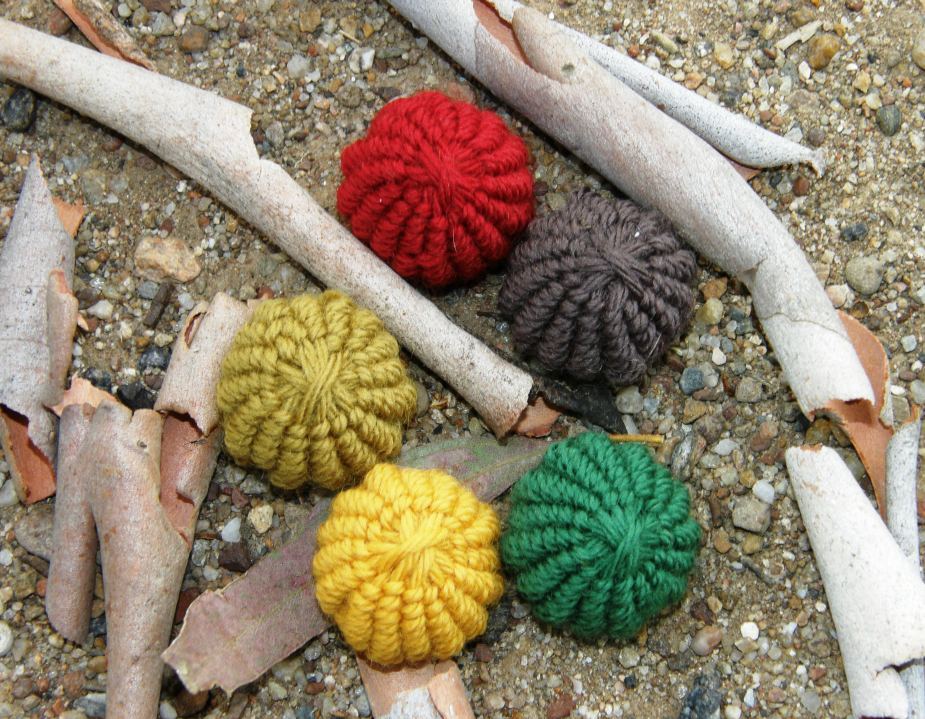
The banksias that we saw that day make me think of the little ridged baubles that I learned to make with a Guild friend the last time I was here in Sydney…

???????????????????????????????

We walked to lookouts with lovely over Lake Burragorang.

blue mountains sydney

Perched on the end of that rock, I felt like I was sitting in the tree tops…

bush walking in the blue mountainsThe real winter suddenly set in and it was cold!

Last weekend it was still warm enough to take things outside for a bit of warping. I had a group over to my brother’s home for two days of Andean Pebble Weave. We enjoyed the chance to stretch our legs in the fresh air while winding some more warps for sampling and designing.

warping for backsrap weaving sydney


Kelcie gets a new band started with palin pebble weave.
Kelcie gets a new band started with plain pebble weave.

fr-kyriakos-pebble-weaveThe group comprised Kelcie and Jen, who had woven with me last November, Pam, whom I have known online for years and who had come over from southern New Zealand (Sydney weather was relatively balmy for her!) and father Kyriakos who came up from the monastery in Bombala.

We wove together for two days.

Father Kyriakos, as you may know from having seen his work in previous blog posts, had more than just dabbled in Andean Pebble Weave and has been designing and weaving his own pebble weave patterns. I am so glad he came. We have been corresponding for some time and I really wanted to meet him as well as see his projects “in person”. He said that…While your videos have always been a big help and enabled me to do as much as I have so far, having personal demonstrations and answers to my own questions has already helped me to be more efficient and have more understanding of what this weaving is about.

Above,you can see his partly woven backstrap from a photo that he sent me some time ago. The design is one that Julia had created and father Kyriakos added his own elements to it at start and finish. He brought the finished piece along to Sydney to show along with narrower and samples and examples of his own “sotis” work of East Timor that he had studied on floor looms with Australian weaver Kay Faulkner.

???????????????????????????????Kelcie had brought examples of East Timorese weaving when we had woven together last year…

???????????????????????????????Father Kyriakos also brought a Latvian belt, woven using a supplemental-warp technique, that a friend had bought in Latvia and brought back for him. I have seen plenty of pictures of these but never one “in person”…

latvian beltJen brought in pieces that she had bought on a trip to Peru where she had studied tapestry techniques with Maximo Laura. This is a striking embroidered belt that had been made for the tourist market in Arequipa…

embroidered belt from arequipa peruI love the color ideas that these pieces give…I would never think to combine those colors!

Father Kyriakos has been working on and refining a kangaroo motif using the Andean Pebble Weave structure for some time. He also brought along his progress with that to share and I thought that it would make a nice project as a souvenir of my Australian vsit.
One of the tasks that I had set myself for this trip was to investigate the kind of cotton that is available in Sydney stores that would be suitable for warp-faced weaving on backstrap looms. I bought what is labeled as “4-ply” thread at Lincraft. I was told that the name 4-ply in Australia actually refers to the size of the thread rather than to the number of plied strands. In the USA any weight of yarn could comprise four plied strands. It’s a little confusing! I also bought 8-ply versions of this cotton thread at Spotlight and I will give report on this and other available thread in future blog posts.
So, here is the “Kyriakos Kangaroo” woven by me using the Lincraft 4-ply…

???????????????????????????????

barefoot warping for backstrap weavingFather Kyriakos says that he still has some refinements in mind. I played around a bit with the mountains under the kangaroo. They made me think of the southern highlands…the “Australian Alps”…where I had lived and worked for many years.Kangaroos could be spotted now and then on the drive up to the ski fields.

The Lincraft thread is not mercerized but is fairly tightly twisted. It will pill if the heddles are wrenched about and needs to be handled with care. I really like the way it feels. Lincraft has a pretty good range of colors on its shelves.

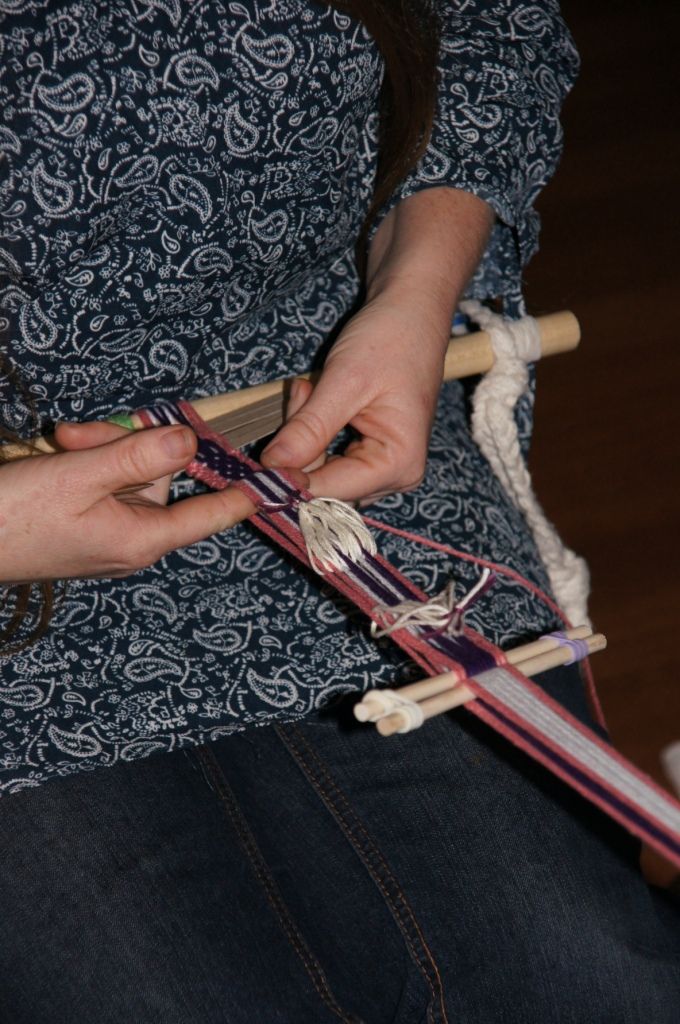
I set this band up in a very “barefoot” manner.I had already packed all my backstrap weaving gear away and did not feel like fishing out my warping stakes and loom bars.

I warped around my index finger and big toe as my Bolivan weaving teacher, Maxima, does. This is probably the widest thing I have warped this way and, as the threads piled up around my finger, I figured that I was bound to have some tension issues. As it turns out, I didn’t!

When it came time to weave,  you can see, I only got out my sword and used pencils for cross sticks and loom bars. A piece of string is my backstrap. The front beam is a pen onto which I attached rubber bands so that the “backstrap” would not slip off. It was pretty comfortable!

Normally, I would use heddles spread along a stick for a piece of this width but I chose to just tie them in a bunch rather than to search for more pencils.

barefoot backstrap weavingSomeone else who is getting into barefoot weaving is my student, Emerald. You may remember that I stayed with Emerald in her home in Ultimo a couple of weeks ago and wove with her. One of the things we did was the intermesh technique and, although she has a nice set up for backstrap weaving in her living room, she decided to try to include her entire body in the loom…

emerald backstrap weavingThere are chopsticks and a pencil in her set-up. She also finished off a short and narrow pebble weave band barefoot. This was an exercise in weaving without a chart.

emerald (2)In the meantime, in other parts of the world, Diane, one of the ladies who wove with me when I visited Yale university, was inspired enough to apply for a grant to go and weave in Guatemala during her summer break. My friend Barbara, who is in contact with her, sent me this picture of something Diane wove with her Guatemalan teachers…

diane yale guatemalan weavingCheryl, who wove with me last spring, is sampling for a camera strap project…
cheryl pebble weave backstrap


And now… a wee favor to ask of all of you. You may have noticed that I have sometimes mentioned my nephew here in past blog posts and the fact that he is a triathlete. I am staying with him now in Sydney and get to watch his rigorous training schedule. He is up and out and swimming laps or biking and then getting home before I can even get out of bed.

During the Ravellenic Games that ran alongside the Winter Olympics this year, I wove one of his favorite inspirational sports quotes into a silk bookmark for him..

??????????????????????I guess that I haven’t had much of a chance to be a big part of his life. After seeing him a few times in his very early months and years, I headed off to live in South America. I returned for a visit when he was 3 during which I watched Jurassic Park with him and he offered to sit by me in case I got scared. I didn’t see him again until he was 12. He wrote to me when he was 8 to ask me if I lived in a hut in the jungle. Fortunately, I visited Australia more often when he was in his teens and the internet kept us in good touch. He taught me to juggle and we did a great trip,  just the two of us, to Ayers Rock in 2006.

1531560_610507969021654_2085106992_nNow he is a traithlete studying to be a teacher (like me!) and will be representing Australia in the ITU World Championships in Weihai, China in September. He took part in ITU World Championships in the USA and Spain winning the silver medal in his age group in both. It was quite a blow when he was injured for the championships in France last year. So…he is going for gold this time…his last amateur event before turning pro.

His trip to China, as with all the other trips to the World Championships, must be self- funded and he is looking for sponsors. What I would ask you to do for me, as a big favor, please…. is simply to go over to Facebook and “like” his page. More “likes” will show potential sponsors  that he has the loyalty of a good-sized audience and could make all the difference.

I haven’t told him I am doing this and would love to surprise him with a small boost to his fan page tomorrow. I hope that you can take a moment to help out.

???????????????????????????????

And now to see if I can make it on a flight out soon….wish me luck!

Backstrap Weaving – Vivid!

VIVID is the name of an annual festival of lights, music and entertainment that took place in Sydney at the end of May just in time for my visit. Colorful images are projected onto buildings and landmarks around Sydney harbour and the city center. My brother captured some of them with his camera when we went together to the festival one night….

The white sails of the famous Sydney Opera House were transformed to an amazing  piece of crystal glowing in the dark…

vivid w waddington 3

And then adorned with butterflies…

vivid w waddington

I don’t know how to describe this next one!

vivid w waddington 1Other buildings along the waterfront were also used as giant screens onto which fantastic slithering images were projected…

vivid w waddington 2I have been enjoying a variety of landscapes and weather here in Sydney from the city to the country. I had a day out in the pretty rolling hills just west of Sydney…

???????????????????????????????And a hike in the bush. It was tshirt weather in the middle of winter…

???????????????????????????????I got rugged up on a cooler day for a trip to the city, the waterfront and Chinatown with my weaving friend, Emerald…

chinatown crop

???????????????????????????????Emerald and her family are from Burma and they invited me to come and stay with them in Sydney’s inner city for a couple of days of weaving. I had forgotten how exciting it is being there right in the heart of all that inner city action. Emerald has distant memories of having taken some weaving lessons in her younger days in Burma. Now she wants to learn more about the backstrap loom and the weaving culture of her homeland.

She showed me her beautiful collection of longyi, the long pieces of fabric that are worn by both men and women in Myanmar. They are wrapped about the lower half of the body. Some of these pieces were woven on floor looms but there are still backstrap weavers to be found in certain parts of the country.

The Wikipedia page on the longyi includes this saying…

Men who cannot read are like the blind; women who cannot weave are like the cripple

—an old Burmese saying at a time when every household had a handloom and the womenfolk wove all the longyis for the family.

???????????????????????????????


VIVID colors against black….

emerald longyiWe warped and set up her backstrap loom for an Andean Pebble Weave project. Emerald has placed hooks into the wall of her home and has created a very nice backstrap weaving space.

???????????????????????????????

???????????????????????????????I feel as happy as she looks here when I am seated in front of a fresh warp! Now it is time to get down to work and pick up the pebble sheds and create the string heddles….

???????????????????????????????A lovely green warp for a lady named Emerald. I showed her how to operate the two sets of heddles on this wide warp and now she is all set up to weave a cell phone pouch and whatever else she may be able to squeeze out of this warp. Emerald first contacted me via this blog. You may have read her enthusiastic comments here. Then we became friends on Facebook. I wasn’t able to meet with her when I visited Australia last year but it worked out this time and we had two fun days together.

??????????????????????Emerald showed me the book that she recently bought on Sazigyo ,by Ralph Isaacs. Sazigyo are very fine tablet-woven bands from Burma which were used to wrap palm leaf manuscripts. The book comes with its own silk tablet-woven book mark.

Images and lines of text are woven into the tapes themselves. This Facebook page contains many images of these woven tapes.

Emerald is very excited about learning about these and now wants to study tablet weaving so that she can also create bands of woven text in her native language.

It was a very educational experience being with Emerald! She also told me about Inle Lake in Burma where yarn is spun from lotus stems and woven into cloth.

Julie Hall has written a very interesting  and image-packed blog post about her visit to Inle Lake and I appreciate her having given me permission to use some of her images here…

Textile weavings made from lotus and silk, a specialty of Inle Lake, by Koh Than Laing
Lotus flower on Inle Lake…image by Julie Hall used with her permission.
xxxxx
Pulling apart a group of cut lotus stems to extract fiber for spinning…image by Juile Hall used with her permission.

The following video from this page shows a small part of the process…

My weaving friend, Wendy Garrity, has also written about a visit to Inle Lake and includes images and video on her blog.

Meanwhile, back at my brother’s place, vivid colors are all around with evening visits by flocks of lorikeets to the backyard accompanied by the screeches of the sulphur crested cockatoos and laughter of the kookaburras at dusk…

??????????????????????I met with weavers up in Springwood in the Blue Mountains in a lovely bushland setting for a weekend of backstrap weaving in the home of Helen Halpin, editor of the Weavers Forum newsletter. Last weekend I wove with folks in a pretty homestead on the suburban outskirts in front of fields of grazing sheep.

Part of theVirginia Farm group getting serious about pebble weave!
Part of the group getting very serious about pebble weave!

The second day was cold, blustery and very wintry. We could hear owners Jenny and Phil’s flock of sheep bleating outside but little did we know that two little black lambs were being born as we wove away warm and cosy indoors..

???????????????????????????????The ladies who wove with me are part of a group whose name forms the fun acronym “EWES”. It stands for Epping Weavers Embroiderers and Spinners. It really seems like an extremely dynamic group. Sydney folk who read my blog might want to join. Here’s Brenda wearing a handknit sweater and her inkle woven EWES lanyard…

???????????????????????????????Images of warmth and vivid colors have been arriving in my inbox from the other side of the world. Snuggled up under a blanket with a miniature poodle snoozing on my lap, I look at my friend Janet’s sister’s grandkids learning backstrap weaving in bikinis in summery USA. One of Janet’s own backstrap woven guitar straps, made from her own handspun, lies on the ground between the girls providing plenty of inspiration.

janets sister grandkids

larisa (1)Larisa, who is Russian but now lives in the UK, sent me a picture of a fabulous stole that she wove on a backstrap loom…such vivid colors and wonderful pick-up work!…

The image she sent me is of a  low resolution and I hope she sends me a larger one soon so that we can all better appreciate the detailed pick-up in this beautiful piece of work.

Weavers who hung out with me on my recent US visit have been busy weaving in their summer months.

They are happy to be able to enjoy the portability of the backstrap loom which enables them to easily weave outdoors or even in the front seat of the car!


10366148_10203782422742111_554034780892193392_nCheryl has a ”loom with a view” at her lake house. She is weaving pebble weave “hugs and kisses”.

I don’t know where Elizabeth was going but she took her loom on the road anchoring the warp in the glove compartment of the car…

elizabeth

santa cruz backstrap weaversAnne has been working on her Andean Pebble Weave and is making great progress…

10350538_10201018377261098_4865296949662558862_nCharlotte launched herself into a new band challenging herself to some mental gymnastics handling the color changes in the three columns of motifs. This is the same motif that appears on yurt bands of Central Asia. In Central Asia it is woven using a single-faced structure. Charlotte is using a complementary-warp structure . This means that her band is double-faced.

charlotteJulia found a good use for a pebble weave band that she had created over a year ago. She made a bag for her sister’s flute. As is always the way with Julia’s work, it has been woven and put together beautifully.

julia flute bagJanet, who wove with me last year,  has become an active member of the Ravelry group and has been sharing her latest experiments with supplementary-weft patterning. janet supplementary weftSheila is a new member of the group and bought a Gilmore Wave loom for her studies of Andean Pebble Weave. She is working on adding extra string heddles to this two-shaft loom so that she can weave the structure as a semi loom-controlled one as I was taught to in Peru. It is much easier to operate the two sets of string heddles using a backstrap loom which enables you to freely and easily adjust tension on the warp with spontaneous body movements. Sheila is working with a ”fixed tension” loom which means that she needs to apply other strategies to achieve consistently clean sheds with her string heddles. It looks like she is succeeding!

gilmore wave loom set up for andean pebble weaveAbove, you can see the two sets of string heddles which Sheila is using along with the loom’s own two shafts. She has unrolled her weaving for the picture. When she is weaving, the two sets of string heddles are positioned further away from the shafts than they are in this picture.

sheilaShe is weaving one of the knotwork designs that I have charted in my second book. The Andean Pebble Weave  structure can be used for motifs not found in the Andes. Basically, any pattern that comprises diagonal lines can be adapted to this technique. A part of my second book is devoted to this idea and I show how motifs from various non-Andean cultures can be adapted to the Andean Pebble Weave structure.

I will leave you for now with some more VIVID colors…images of some very exotic neck pieces that I recently saw on Facebook. These have been created via a collaboration of three Peruvian textile artists, one of whom is tapestry weaver Maximo Laura. VIVID! You will probably recognize  his contribution if you are at all familiar with his work. My backstrap weaving friend, Dorothy, is going to study tapestry weaving with him in Peru soon! According to the Facebook post, these artworks will be sold via the Puchka Peru website.

10175947_774636085881885_6728107276994461639_n

1798714_774635892548571_4144007971210964607_nMy visit to Australia continues….I have a group of friends coming over to my brother’s place this week to weave and then I will head back to Bolivia shortly thereafter as my brother and wife will be taking off to Ayers Rock on their motorbike. Maybe I will squeeze in one more blog post before I leave….