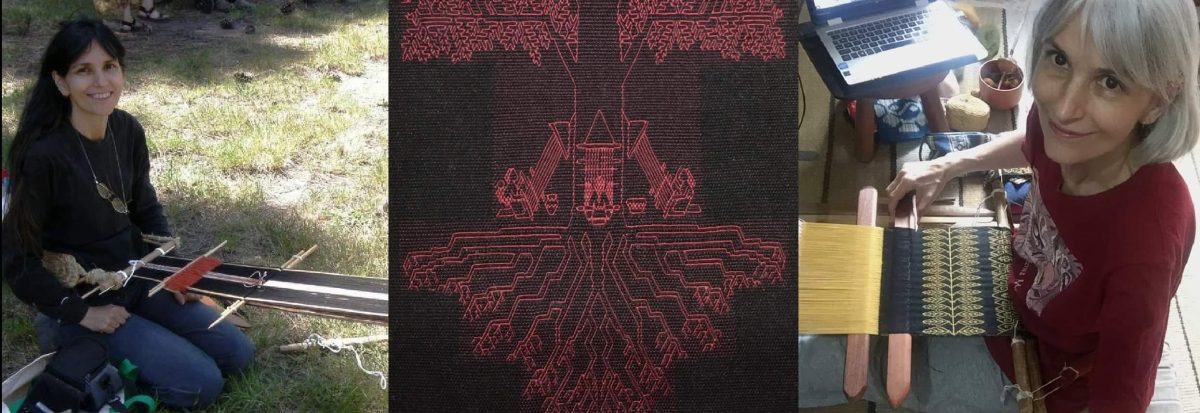
Just when I am at the point when I feel that I have learned enough about the behavior of the naturally-dyed silk that I was given to be able to move on to real projects rather than experiments and samples, I find that I don’t really have enough of this yarn left to be able to make anything decent!
These are the skeins of silk that had been used in natural dye experiments and given to me. I have used them to weave journal covers using a variety of warp-faced pick-up structures and, more recently, to experiment with ikat. If you have been following my most recent posts you will have seen and read a lot about my experiments in which I use multi-colored base warps for ikat. I wrap the warp in ikat tape to create a pattern. The taped areas resist the color in a dye bath and, when the tape is removed, a multi-colored pattern is revealed ready to weave.
Sadly, I am almost at the end of my supply of this naturally-dyed silk. There is just about enough to make one more small warp but I think that it is time to move on and try out the 30/2 silk that I got from my weaving friend Deanna in a swap.
The fourth in my recent ikat experiments with the multi-colored silk has happily changed its role from experiment to project. I warped up a wider and slightly longer piece and decided not to create stripes of random color and width this time. All the stripes were twelve ends wide and I used symmetry in the arrangement of the colors.
I divided the groups of warp threads to be wrapped in tape into twelve-end sections. This was going to be a very orderly warp. I didn’t challenge myself to creating the impression of curves or to create nice even horizontal lines. I went with bold diagonals instead.

Here it is out of the black dye bath and almost dry enough to place on my backstrap loom beams.
As soon as the first few inches I had been woven, I knew that this one was going to be my favorite so far.


A little further along and feeling really pleased with it :-).
And, finally, off the loom…a close-up.
One more picture (can you tell I am loving this one?!)

How would it behave once wet finished? I had high hopes that this would work as a cowl. I had used 60/2 silk as weft. Would it have enough drape? I love the wet-finishing part of working with silk. The fabric relaxes and almost oozes under the iron as I give it a good hard press.
I am trying to show the sheen after wet finishing in this next picture. It was really hard to capture.
 And, yes! It works as a cowl. I am so happy that I can wear this piece! (This is what fifteen months of cold turkey grey-hair grow-out looks like, by the way).

It is just draped around my neck in this picture. I have yet to finish it. I have three selvedges and need only deal with one raw edge. I’ll cover that edge with fabric and use three buttons and loops to close the cowl. I need to make the closure decorative as I am pretty sure that the cowl will swivel at will around my neck as I wear it. The buttons could end up in any position and they need to be pretty. Once again, I’ll have to put my meager sewing skills to the test.
Another project that got almost finished is the silk ribbon that I made for my Koru pendant:

I have washed some of the 30/2 silk so that it can be dyed. The first ikat project with this new material will be a narrow one while I get acquainted with the way it behaves. I want to focus on a much longer warp which will be folded in two on the ikat frame. In that way I can tie the ikat tape in multiple layers at the same time and achieve a repeat.
My weaving friend Pam shared pictures with me of her visit to Uzbekistan many years ago in which you can see a warp of many meters length folded and placed on the ikat frame where the young ladies sit ready to tie the pattern. The beams that hold the warp under tension are tied to bolts in the floor.


I am absolutely in love with this piece below from Timor. Kinga Lauren who collected the piece, kindly allowed me to show it here in my blog post.

I love those curvy irregular patterns. You can see how the irregularities in the pattern in the lower half of the fabric are perfectly replicated in the upper half. The warp was obviously folded with ikat tape wrapped around both layers at once.
A close-up of part of the ikat section and the fringe shows the number of beautiful subtle colors that were used in the stripes. This is naturally-dyed cotton.
 Wrapping multiple layers will be one new challenge for me. The other will be attempting to dye with more than one color. I tried a very simple version of this many years ago on a rather carelessly tied pattern. I really liked the effect and was able to use the piece as a book cover. I had some mishaps with this cotton warp. This was back in the days when I was using cassette tape for wrapping cotton warp. I made one of the dye solutions too hot and the cassette tape simply did not deal well with the heat.

So, on the heels of my happy cowl project/ikat experiment, let’s see what kind of mess (or success) I can make with 30/2 silk!
To finish, I have some nice work to show you from my inbox from new and old online weaving friends…
Shilpa Nagarkar Rao is weaving Andean Pebble Weave patterns using my Complementary-warp Pattern Book (after having learned the technique in my Complementary-warp Pick-up book). She uses an inkle loom to weave bands and then combines them to make beautiful bags. (See her Facebook page).


Cynthia has been working with supplementary weft creating motifs in several colors along the length of the band. This ability to change color at will is one of the many nice things about this technique and is why Guatemalan clothing can be so colorful.

I love how Vanessa De Columna made what I believe to be her very first Andean Pebble Weave band into a headband.

In book news, my latest pattern book, which ended up with 132 charted patterns, is in the hands of Taproot Video and I am just waiting for it to go live on the website. The Taproot folk are currently busy shooting a new spinning class with Joan Ruane…exciting news!

Wonderful work as always. I can’t wait for the book to come out.
You, your hair, and your ikat cowl are all just gorgeous, Laverne! WOW, are you ever industrious! I am amazed by how much weaving and project work you accomplish with each of your postings!
Your multi coloured silk Cowl is just beautiful Laverne and the grey hair shows up those warm brown eyes!
Amazing work!
Gorgeous! 🙂
Beautiful cowl, beautiful wearer!
Wonderful. Are these all natural dyes.
Dyed silk.
Thank you. All the colors in the base warp are from natural dyes. I didn’t do the dyeing. Tiny sample skeins of the various colors were given to me.
Absolutely stunning, piece, Laverne! And you look beautiful, with your gorgeous hair!
Congratulations on kicking the habit. You are beautiful! And your cowl project is stunning.
Hello!!! I am really loving your website! I am a beginner and my aim is to weave a small bedouin stripe. Do you think I can do it from a DIY loom? or do you recommend me to buy one? If so, which one should it be?
Thank you so much :)!
Yes, you can certainly do it with a backstrap loom which can be put together quite easily most likely with things that you already have in the house. Try reading my article on Backstrap Basics which has video clips to see how to put together a loom and operate it. Practice creating warps and using the loom. I have a good video on warping. Then you can check out the tutorials I have on Bedouin patterns and techniques.