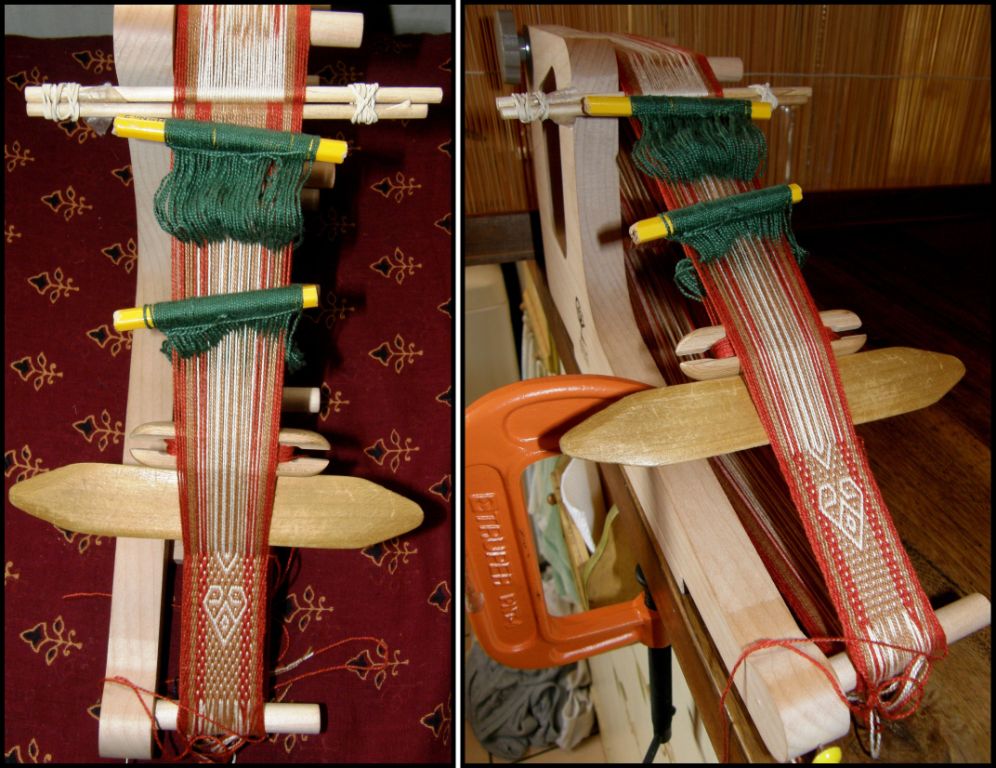
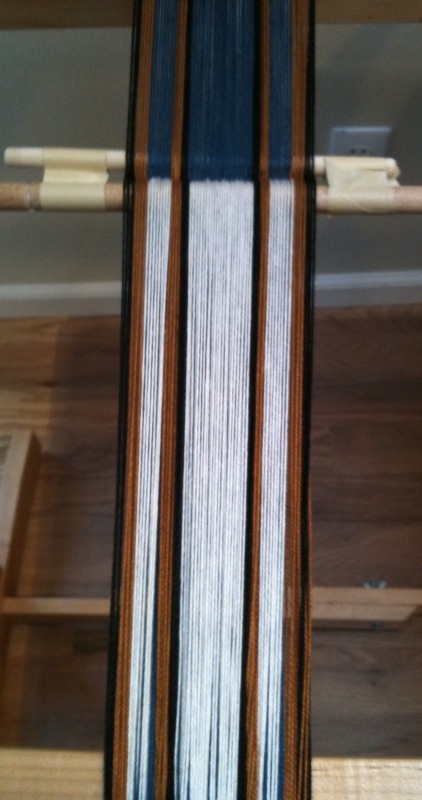
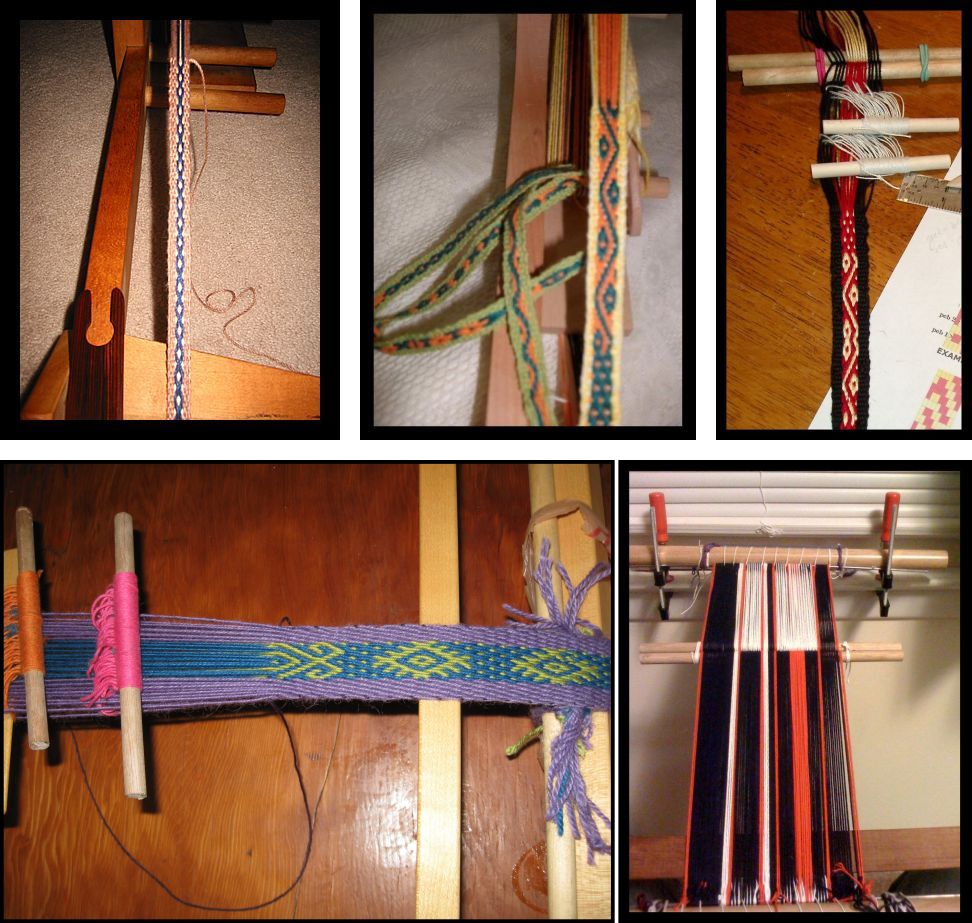
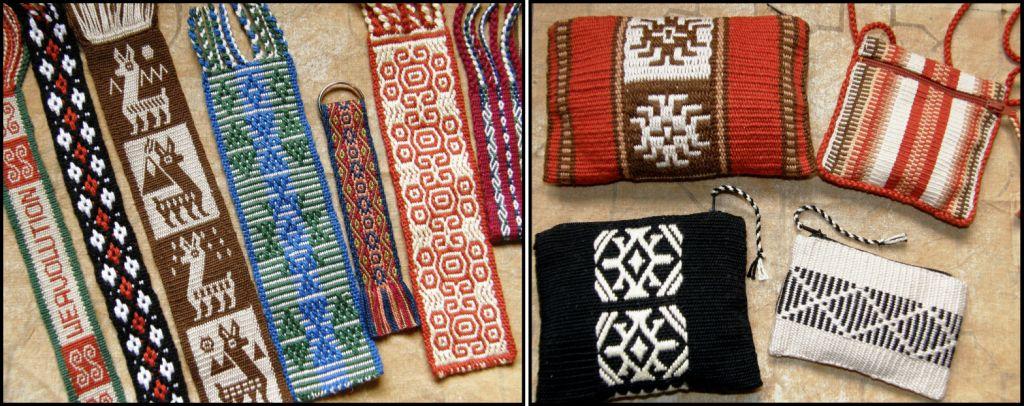
A short post this week as I get my sticks, strings, shuttles and spindles together for another trip to the US flying out tomorrow (Friday the 16th).
Andean Pebble Weave is now in print! It will also be available for purchase in its e-version on the WeaveZine site. (UPDATE: Now it is available in 4 languages at Patternfish.com along with the follow-up book, only in English.)
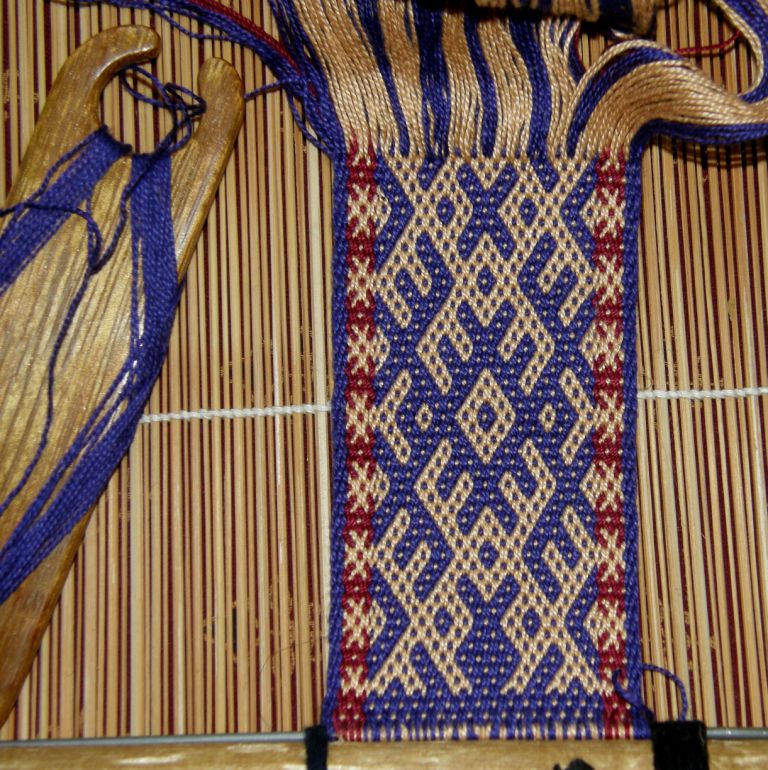
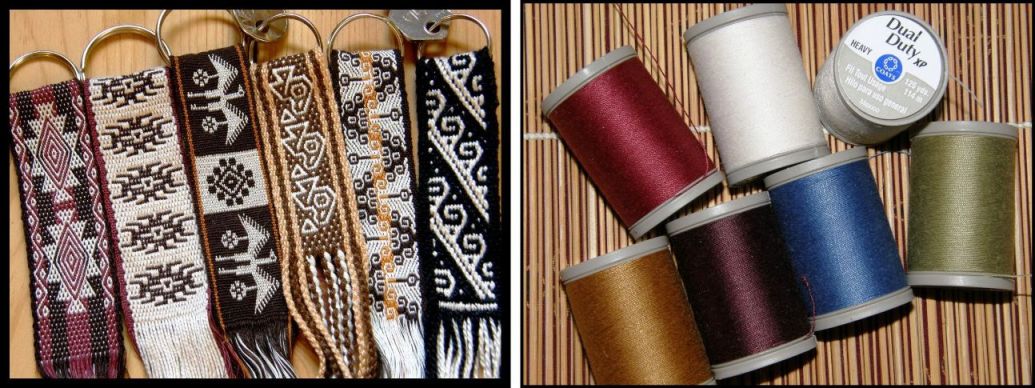
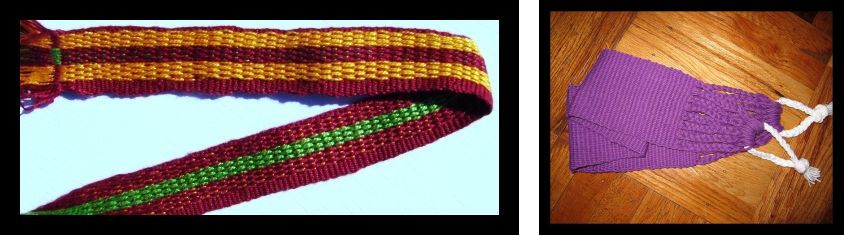
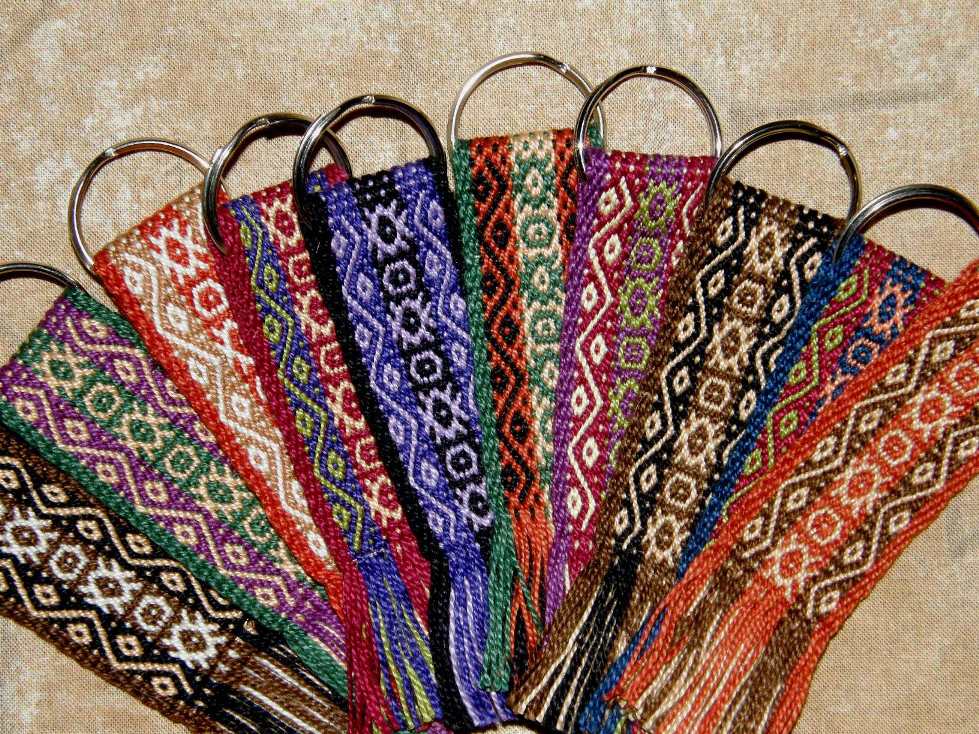
With all the loose ends that needed tying up and the time spent working with Syne Mitchell to get the print version of my monograph ready, I didn’t expect to get any weaving done this week. But then I had an idea and ended up weaving a bunch of keyfobs. I thought it would be fun to give a keyfob away with the first 20 copies of Andean Pebble Weave. So I sat with my basket of cotton thread and had a great time combining all sorts of colors to make the 20 keyfobs to accompany the books. I combined several small pebble weave motifs and now I can definitely see the benefits of weaving the same design over and over as some indigenous weavers do. I could probably weave this with my eyes shut now!! As long as there were new colors to combine it never got boring. Only one or two color combinations are repeated as I made tiny warps and wove one at a time.
And I didn’t stop at twenty as I thought that these fobs would make nice gifts all year round. I will be weaving these where ever I can find a spot to tie up my loom – in the Vendor Hall and probably to my bunk bed in my hostel!! as I am packing my mini warping board and crochet cottons.
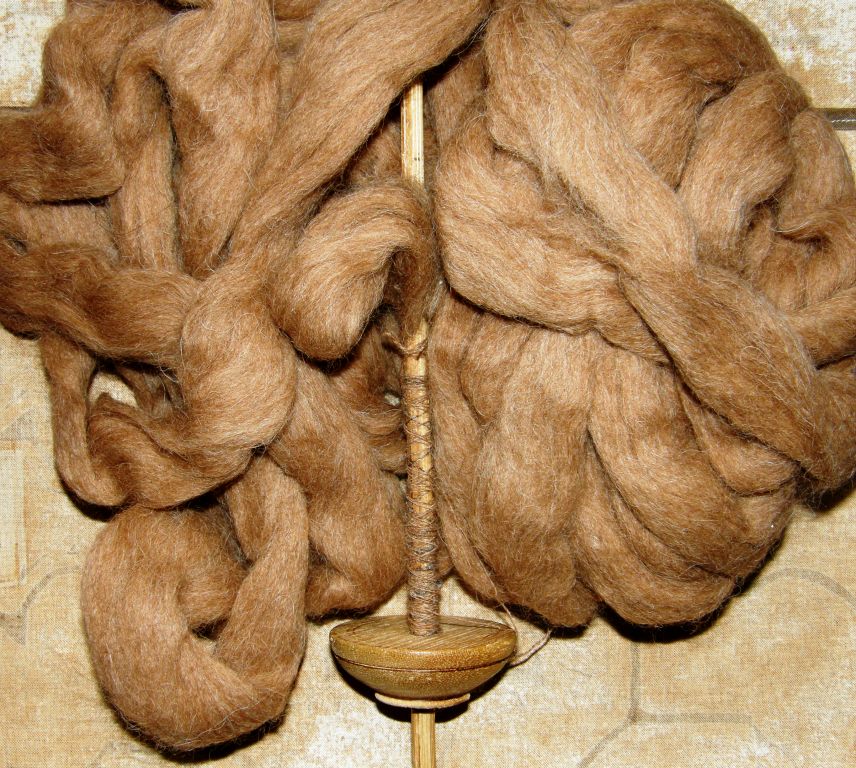
I am also taking my wobbly Bolivian drop spindle and some of the alpaca fiber that my friend Janet gave me on my last visit. I just spun a little to get it started on the spindle and it is so so beautiful to spin! This is not the first alpaca I have ever had to spin. I bought some many years ago in Peru and it was in a dried-out, brittle and filthy state. I lost a good third of it in the cleaning process and I knitted rather than wove with it. Now I have this prepared smooth luscious fiber to work with – what a dream! It almost feels like cheating! I’ll be spinning it to weave with on my backstrap loom.
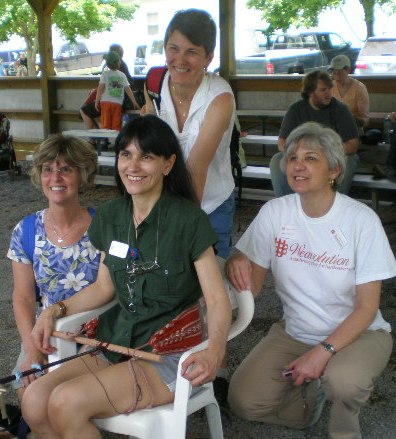
I am hoping to squeeze some of my smaller weavings into the backpack to show people who drop by the Weavolution booth at Convergence. I am also taking them to show some folks in North Carolina. I found out about a group of Montagnard people who have a small community in North Carolina. This is wonderfully convenient as North Carolina is on my trip route on my way home after Convergence. My good weaving buddy Lisa lives there and we have been invited to go visit the Montagnard community as there are backstrap weavers among them. What’s more, it seems that they have been recently joined by Karen and Nepali weavers. We hope to share our textiles and backstrap techniques and I am so excited about this opportunity. You can read a bit about the Montagnard people here and watch a video on one of the weavers in the North Carolina community here.
Betsy Renfrew who has been working with the weavers, and who extended the invitation to me after my initial enquiries, has started a blog about the group’s activities.
My backpack will also be full of sticks as I will be staying with one of the Weavolution founders in Washington and she may have some friends over to weave. I have loom bars and backstraps for several people so we can all weave together.
So…come and visit me at Convergence!! I will be with Weavolution founder Alison at the Weavolution booth or wandering about most likely with a bunch of sticks protruding from my tote bag. I would love to meet you and show you my weavings and loom. You can check out the new print version of my book. I hear that there will be a weaver from the Textile Center in Cusco demonstrating backstrap weaving too so I will definitely be there watching her.
Hopefully next week’s post will be full of Convergence events to report and stories of all the wonderful weavers I have met.
As Weavolution, the home of my Backstrap Weaving Group, approaches its one-year anniversary on June 8, I have had good cause to stop and reflect on all that has happened in the past year or so since I entered cyberspace in a big way and got into what I like to call the World Weaving Guild.
It all started when I joined WARP in May last year.
I had been struggling along trying to figure out balanced double weave so that I could reproduce one of my pre-Columbian fragments on my backstrap loom. There were a couple of things that had me puzzled and I really had no idea where to turn. I found Carol Ventura’s contact information in the WARP Members’ Directory. As Carol Venturahas been involved in Latin American weaving, having written, amongst many other things, a book on the hair sashes of Jacaltenango, I decided to contact her with my questions. She pointed me towards some other resources and also happened to mention an online group called Ravelry that had a backstrap weaving forum.
And it all took off from there…
Actually, my very first entry to this World Weaving Guild was through a backstrap thread in the weaving forum on Interweave’s Knitting Daily site. It was just by luck that I stumbled upon this tiny thread embedded in a knitting site and discovered that there were quite a lot of questions about, and interest in, backstrap weaving.
That tiny thread unraveled and lengthened, and along came my entry to Ravelry. Shortly after, the revolution that is Weavolution provided a place just for weavers and my own backstrap weaving group.
Then came the Online Guild of Weavers Spinner and Dyers with its in-depth monthly workshops on all kinds of fiber-related topics which I discovered on fellow Aussie Kaz Madigan’s blog and, after that, several Yahoo groups including Backstrappers started by my friend Caroline and co moderated by Franco Rios and myself.
One of the Online Guild members told me about this person called Syne Mitchell and a thing called WeaveZine and look where that led…an article, an e-monograph.
And now Handwoven magazine has launced its own new online weaving community called Weaving Today. The offiicial launch was June 2… and so the World Weaving Guild grows…
By the way, I started a thread on Weavolution asking about the balanced double weave project mentioned above and weavers from Scandinavia and other parts of Europe, USA and Australia came on to tell me about Finnweave and provide me with a myriad of resources which eventually led me to the Huichol people of Mexico and their double weave textiles – many corners of the world!!
I got hold of this pre-Columbian fragment after I had woven the balanced double weave/Finnweave band at right using a motif from a book.The eight journals I have put together so far where I have documented the techniques I have learned in this region. The two larger books in the foreground are big 2 1/2" volumes with braiding, weaving, dyeing, edgings and other crafts from the places I have visited.
Prior to all this cyber space globetrotting, I had used my one month of vacation per year to either go to Australia to see family, or take a weaving “safari” here in South America and spend time with weavers.
For the other eleven months of the year, my weaving world was so small. Apart from some foreign backpackers passing through town to whom I gave lessons, I didn’t know anyone with whom I could share this passion. I have run across many attitudes, one of the most common ones being…”if you can’t make money from it, what’s the point?”
Nevertheless,I continued to carefully document all the techniques I was learning in my journals but would often wonder what would happen to my substantial collection of books on South American weaving and all the information I was storing in my journals when the time came to head to the “big loom in the sky”!
So, when I discovered the online groups and the level of interest that there was out there, everything just started to pour out! It was so exciting to find people to chat with about this and many close friendships have formed where we have moved the chat from the online forums to our own personal emails.
I put together tutorials and ran weave alongs and was thrilled to see people getting their sticks together, making their looms, weaving and participating in the weave alongs with so much enthusiasm. Below you can see contributions from Bibi in France, Franee in Australia, Jeannine in Belgium and Kimo in the US.
But there was so much more that I wanted to say. After having had my knuckles rapped a couple times for veering off topic, having gotten completely carried away with a travel tale or two, I decided that the time had come for a blog. Opening one was easy…but how to get the thing started? It sat there pathetically for weeks with what I considered a very lame introduction. I was too embarrassed to tell anyone about it.
Meeting Weavolution buddies at MSWF
One night, my brother, the pilot, called me from one of his many trips to London. I told him about the blog, my doubts and my reluctance to take it further. He immediately read it and said “Well, what’s wrong with that?” Well I have to tell you that my brother’s opinion means the world to me and that little comment gave me the impetus to throw the blog out there for all to see.
Then came the trip to the US with a chance to meet, stay and weave with my cyberspace companions – amazing! as well the opportunity to attend my first weaving conferences.
What’s next? Convergence, Albuquerque 2010!
###########################################
Being part of this World Weaving Guild has brought ideas and inspiration flooding into my little corner of the planet.
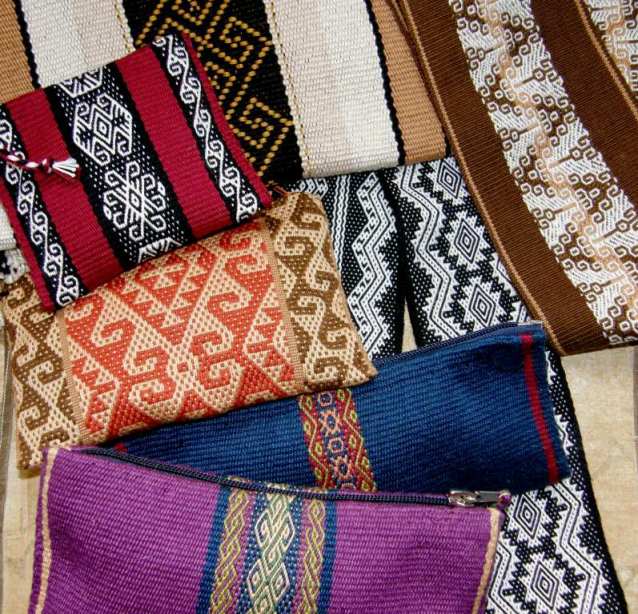
Two zippered tool bags with pebble weave designs
I told you last week about my new color adventure and what had influenced it. Well I forgot to also mention the weavings of Linda Hartshorn who I met at CNCH. Check out her gorgeous shibori shawls on her site.
I finished the shuttle bag I had on the loom. In fact, I got two bags from that warp. I wove a narrow band to make sides for the smaller of the two bags to make it a bit more substantial.
I had planned to edge them with a tubular band but, after having made the braided zip pulls, I decided that the bags didn’t need any further embellishment.
LEFT: Almost finished on the loom. RIGHT: Detail of the pebble weave design.
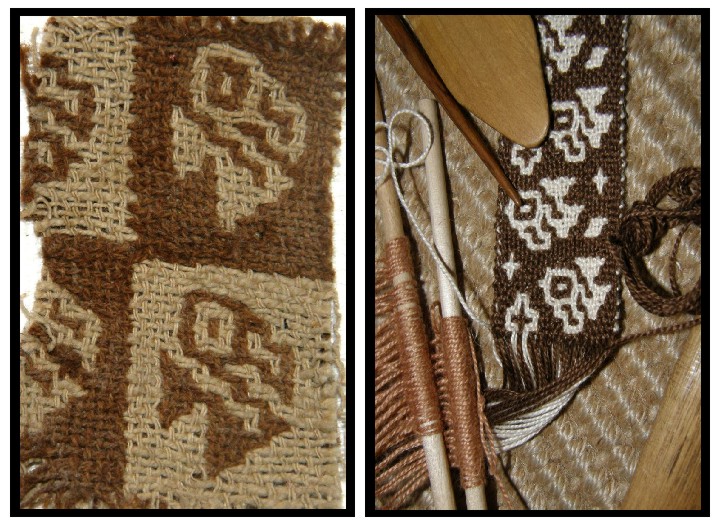
Another encounter in the World Weaving Guild…you may remember my story about having met Kathe Todd-Hooker and Pat Sparks at CNCH and how they shared with me stories of their experiences with the people in the Russian Old Believer communities in Oregon. Kathe allowed me to look at and photograph her collection of Old Believer belts. Well, I am still puzzling over the structure of the weave in the pebble-like belts and have woven a reproduction using Andean pebble weave technique.
The other side of the band on the loom
It certainly looks like the same weave structure but I have learned not to make quick conclusions about these things. The motifs on the back of the Old Believer bands appeared to be exactly the same only with the colors reversed as happens in complementary warp weaves like Andean pebble weave but I would be happier if I could examine them again.
Kathe told me that these belts were woven by members of one branch of the Old Believer groups which had migrated to China before being taken to other countries by the Council of Churches.
In the meantime, Caroline in Australia, my longest World Weaving Guild buddy foundthis articlewhich indicates that this structure could well be what I refer to as Andean pebble weave.
I will quote one small part of the article here…
The first example is the Andean pebble weave structure woven on 2-hole tablets with a 4-hole warp-twined selvedge. This structure is found in other regions, including Central Asia, but is traditionally not woven on tablets. There is no warp twining, and the front and back are identical but with reversed colors.
Now to hunt down other Central Asian textiles with this structure. I already know that the yurt bands that I have seen so far are not woven in Andean pebble weave. Hopefully any images I find will show both the front and back of the textiles.
So I am weaving this sample band, which unfortunately, is not a good size to actually make into anything. It is too wide and thick for a bookmark, too narrow for a coin purse and too short for a belt or guitar strap. It probably won’t go any further as I am planning to weave this reproducton band again in this heavy duty sewing thread that my friend Janet found for me in the US which should make a band of the right width and weight for bookmarks.
LEFT: From the left, fobs, 1, 2, 3 and 5 have been made with doubled sewing thread. I nearly went mad doing pick up with the doubled threads and so am grateful to have the heavy duty version of sewing thread you see at right to use.
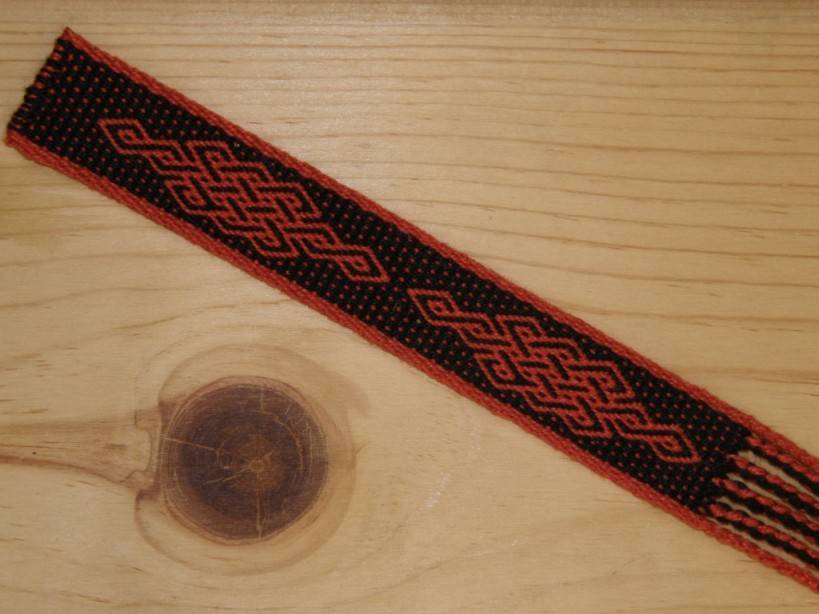
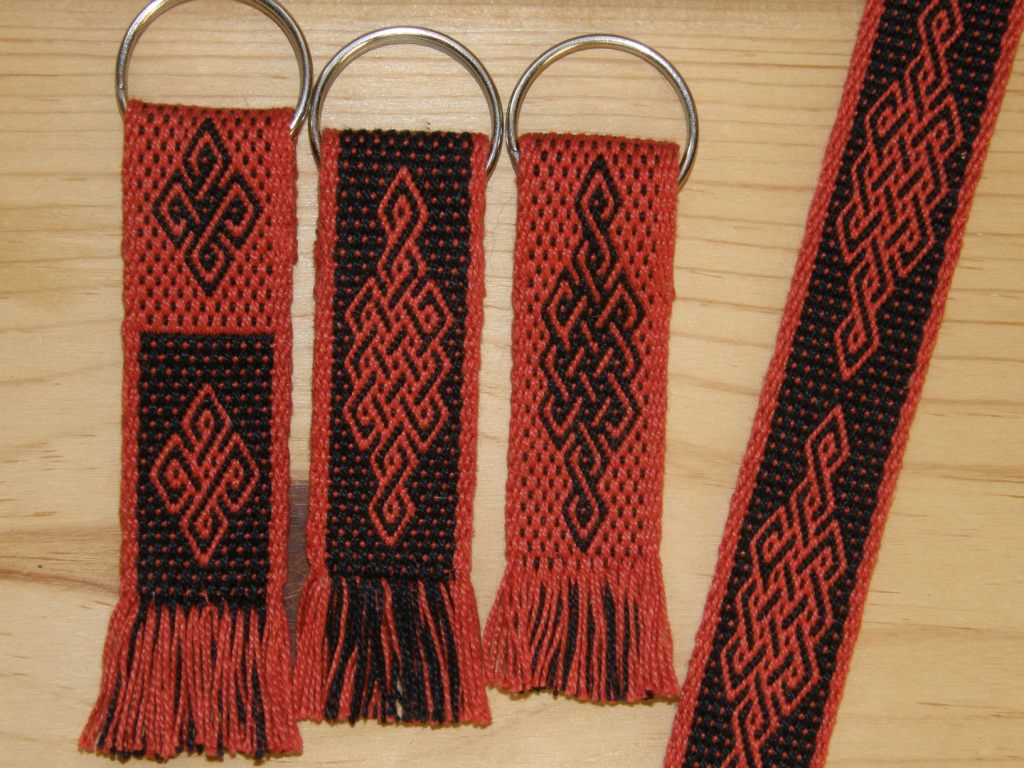
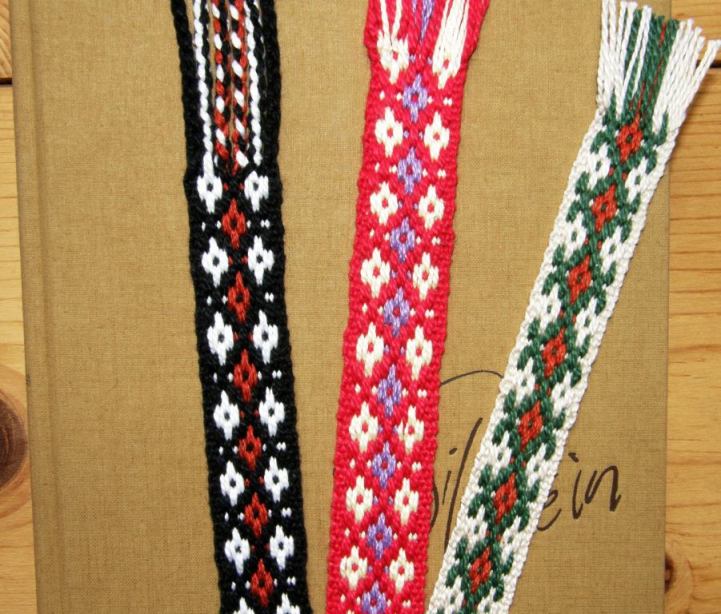
Caroline then directed me to a 2009 newsletter of TWIST, which is a tablet weaving group. An article in this letter tells of a card weaving technique which has been named Hochdorf after the location of a Celtic noble’s tomb containing weavings made with this pebble-like structure. And so the World Weaving Guild’s threads once again stretched across the world and I found myself at the web site of Kurt Laitenberger who just happens to be a frequent visitor and commentor on my Flickr page. He has been making card woven bands in the Hochdorf technique and I was immediately tempted to try and adapt the knotwork designs to Andean pebble weave. Above you can see a bookmark that I wove with one of the knotwork designs.
Keyfobs and a bookmark with knot work woven in Andean pebble weave. I think I MUST make a guitar strap with these motifs.
I don’t think that Mr Laitenberger reads my blog and so I will surprise him by posting these pictures on my Flickr page. 🙂
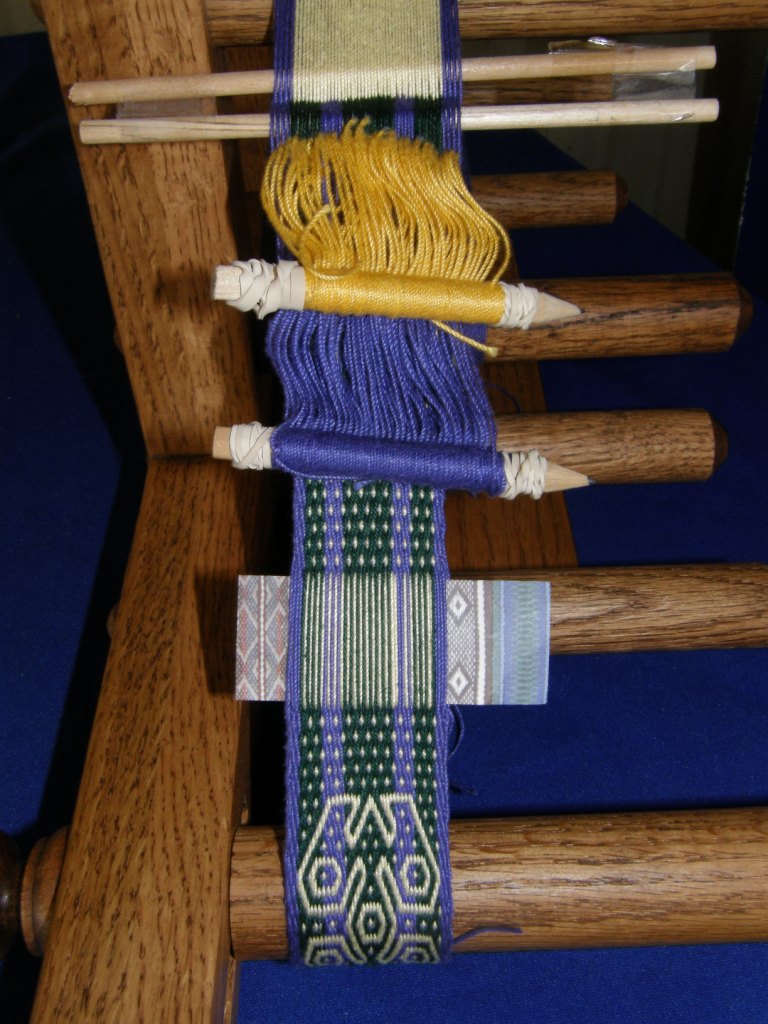
And I was able to dress up my Andean pebble weave band on the inkle loom which, you will see from the photo on the left, started out a little plain. The idea was to see how the inklette stood up to working with the two sets of string heddles required by Andean pebble weave. I really had not put much thought into the project. I added two knotwork motifs to either side and a couple of other embellishments and what a difference it made! This will definitely be a new belt.
The test piece for the Aunt Lydia's number 10 mercerized crochet cotton- beautiful thread!
This above yarn-test piece is coming along slowly.
The photo next to the test piece on the left shows what first inspired the three large motifs.
I took this picture at the National Museum of the American Indian in DC in 2007 and I am sorry to say that I can’t find the notebook where I wrote down the origin of this weaving.
The top motif on my weaving is based on the main motif in the photo. I then designed two other motifs that had the same elements as the first…basically diamonds, curls and spokes and put the three motifs together.
The charts for these motifs are included in my Andean Pebble Weave e-monograph.
The first time I used these three motifs was in a hanging I made for my friend Tess in Australia which you can see here on the left. I included the comb-like border beside the motifs which I also adapted from the museum piece.
The motifs are in red and gold on off-white but I actually intended the other face to be the front. Once off the loom, however, everyone agreed that this face looked better.
I haven’t seen it hanging in Tess’s house yet to see which side she decided to show.
Finally, here are a few bands from the backstrap group members and pebble weave weave-along participants.
Jeanne wove four different pebble motifs to make some keyfobs while Michele set up for her first pebble weave band on her Cricket loom.
Donna wove a wide band in plain pebble weave and Cathy made her own backstrap following my article on WeaveZine.
I sent Lydia my draft and instructions for weaving Andean pebble weave on her four-shaft loom. She is testing the instructions, for which I am very grateful, and it looks like she has been having a fine time with it. These instructions will be added to my e-monograph as an appendix at no extra cost and will be sent to all those who have already purchased the book. Coming soon......
I would like to finish this post where I began by mentioning once again the Worldwide Weaving Guild and the inspiration it constantly brings me from all corners of the world from so many people far too numerous to name here, but thank you!
I would like to thank especially Caroline in Australia who is constantly sending me links to articles and interesting sites, Sharon in Florida who has a DIY solution to every problem I have and has the keenest eye I have ever seen for charting motifs from even the very poorest of images and Lisa in North Carolina who keeps me up to date with her YouTube finds and shares images and information on Central Asian textiles.
AND FINALLY….
HAPPY ANNIVERSARYWEAVOLUTION!!!
Oh and, ahem, the video I promised showing the sticky warps will be going up some time before next Friday’s post. I ran into some uploading problems which will hopefully get fixed- erratic internet service. Look for it by clicking on the VIDEO tab on the blog banner. I will link to it in the next week’s post.
This showed up in my Inbox the other day – something Rodrick Owen says he stumbled upon in his home and was kind enough to photograph and send to me. I can never see enough of these double-woven belts from Potosi and this one has some new designs to add to my collection – some horse motifs which I have not seen before and I can’t wait to chart that particular version of the floral design which appears on a lot of these belts. The floral design rolls along and then suddenly a dog appears. This weaver had a sense of humor!
Its arrival is very timely as I decided this week to put the complete tutorial for one-weft double weave here on a new tutorial page on my blog. You can see it here and I hope you enjoy it.
Here is a reminder of some past projects I have shown here using this technique…
Another reason why I consider the appearance of the colorful Potosi belt well-timed, is that I have been thinking lately about being a bit more bold in my use of color in my weavings.
At left you can see a four-color pebble weave sash that I made way back in 1997. It didn’t seem any problem for me back then to dive into the yarn bag, pull out some colors and whack them all together.
Since then, there has been a drift toward the safe earthy colors – a splash of red here and there – but nothing too daring.
So I have been trying to look at all my balls of yarn with new eyes, imagining new color combinations and going through the pictures in my ‘ideas” folder. While sorting through my stuff and trying to make room for the new things I had bought in the US, I found a tightly sealed and stuffed black plastic bag at the bottom of the closet. Yet another bag of dusty unspun llama fiber, I thought. However, a small cut in the bag had these contents springing forth…
Firstly I should point out that these yarns, which I bought in Guatemala in 2008, are all acrylic. It is hard not to get color crazy when you are in Guatemala. At first it is all a bit jarring but you get quickly used to it until you are completely addicted by the time you leave. You also quickly overcome any prejudices you may have had against acrylic.
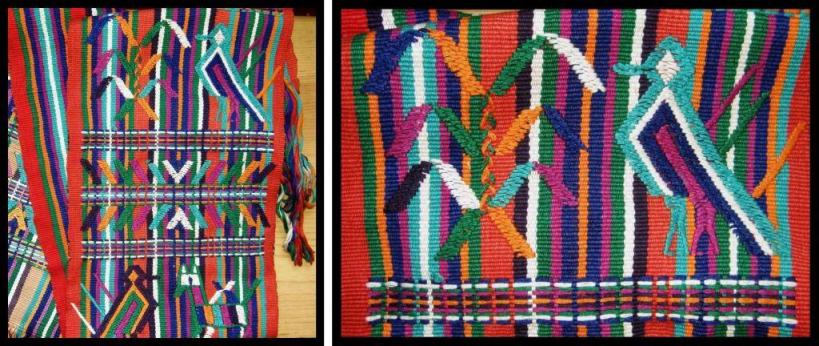
These yarns are used as supplementary wefts for decorating cotton ground weaves.
Simple cotton for the ground weave warp and weft is sold at most markets in Guatemala. The most popular brand seems to be Mish, a local product. I love this ad for Mish painted on the crumbling shop wall.
I wove some pieces when I got back from Guatemala with some of these yarns to consolidate the techniques I had learned there. Then the bag of yarn was put away and forgotten. Now I am going to respin and ply these acrylics – they are very fine – so that I can use them as warp and weave something bright and cheery.
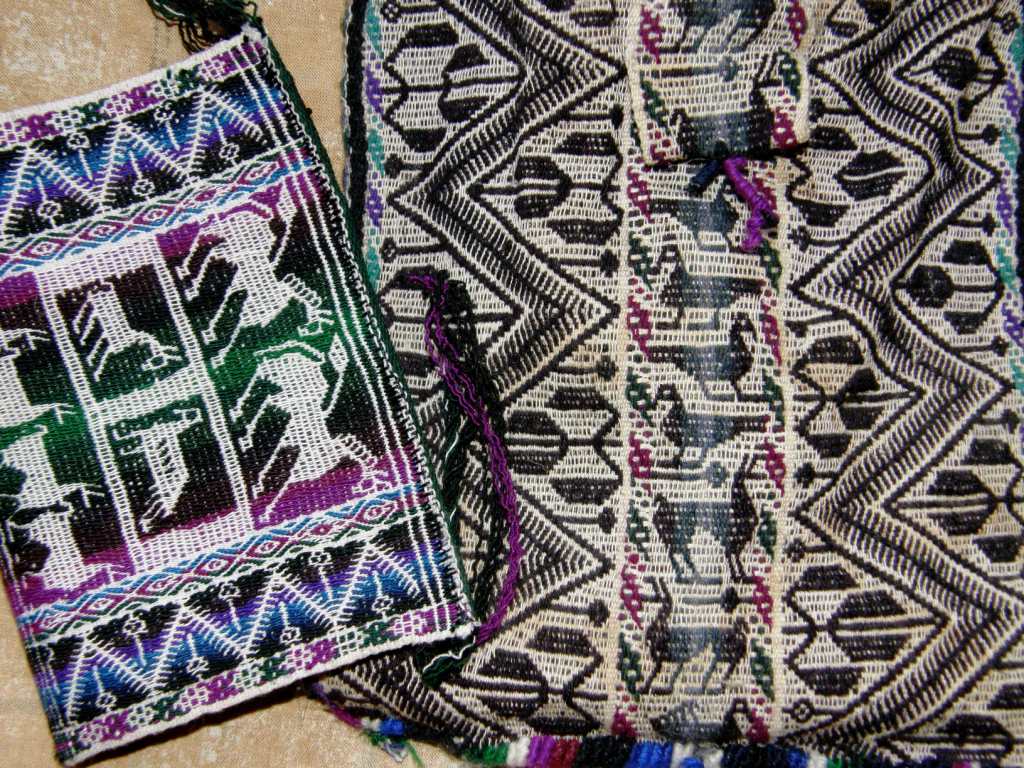
Some of the things that I have been looking at to inspire me in my new “color craze phase” have been these bags from Chincheros, Peru…
What I love is that they are made of natural fibers that have most likely been colored with natural dyes. Well, I have access to all the cochineal I could ever want here. Now I must get that instant indigo I was gifted and put it to work.
At far left you can see my handspun llama fiber colored with cochineal with different mordants and coca leaves – quite dull next to the naturally dyed piece from Calcha on the right.
A Weavolution companion has invited me to her home on my next visit to the US for a dyeing session in her studio. What an opportunity! I can’t wait to get my hands on some logwood.
So, until I can learn how to turn out richer colors in my dyepot and respin all that acrylic, I will play with color using the cottons that I have available here in Santa Cruz. My first project is a zippered pouch for my belt shuttles.
I have been a bit more adventurous here without getting too crazy. Ninety-nine percent of the time I weave a white or off-white motif on a base color. There is not one strand of white in this piece! This is the first part folded in half to show the size of the pouch and I probably have enough warp left to make another. I plan to make a tubular woven band to edge it as I was taught in Potosi. The tubular band I learned with my teacher Hilda is not as complex as the one shown on the blue Chincheros bag above.
I first wove a sample band using three small motifs in Andean pebble weave and decided I liked the green motif on the red background and the orange one on blue. So I put that all together for my shuttle pouch.
The samples got made into keyfobs.
I was able to make three keyfobs from my sample band.
Other hand woven fabrics that I have at home which I am now seeing with new eyes are…
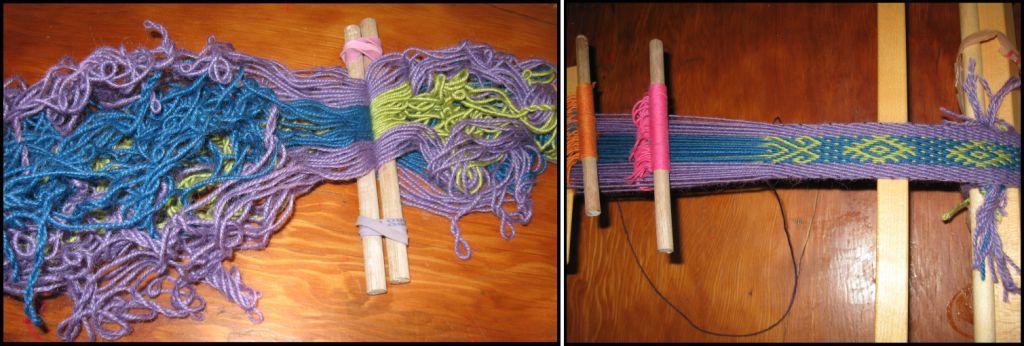
The piece on the left, from Chichicastenango market in Guatemala, is made from richly colored cottons. The piece on the right is the one that I worked on in Santa Catarina Palopo and has acrylic supplementary wefts on a cotton ground weave. My teacher would quite literally put her hand into the yarn basket without looking and pick up just any ball of yarn to form the little motifs. After a while I would do the same, handing the balls to her to measure and cut according to the motif.Carolyn aka Seaphish sent me this photo of her curled up warp of respun yarn when she took it off the loom and then at right you can see it "tamed' and on the loom with a nice Andean pebble weave band in progress. I am grateful to her for taking the picture as, when this has happened to me before, I have been far too perplexed to stop and take a photo!
I will respin and ply all those acrylics on my drop spindle otherwise they will never stand up to being used as warp on my backstrap loom.
I aways tell people in the online groups to be careful when using respun yarn when they are removing their warp from the warping stakes. The warp will spring to life and curl up on itself due to the overspin and, if you are not prepared with safety strings in place, you might end up with a disaster!
One of the other things I have been working on is a test piece for the Coats Aunt Lydia’s number 10 mercerized crochet cotton. It seemed obvious to me right from the start that this was going to be a great yarn to work with. I had two balls, one of red and the other of white, and so I combined those colors with some of my black 8/2 mercerized cotton and am weaving a piece in Andean pebble weave technique on my backstrap loom. This is a longish warp and could be a tool bag for my longer cross sticks or a series of zippered coin purses for gifts.
There you have all the information - down to the store name and price! Too fine a yarn for first-ever projects but something to build up to as you gain more experience.
The inklette has been christened! I am still pondering ways to perhaps use the inkle loom’s shedding sytem for Andean pebble weave but I have not found an efficient way yet to do this for any but the very narrowest of bands. For me, the best way is to simply use the loom as a frame on which to place your warp and set it up as shown in my e-monograph. I am inclined to think that nylon heddles may be better when using the inkle loom in this manner.
I found myself last night sitting on the foor with one foot anchoring the tiny inklette as I pulled up on the pebble sheds. Not a problem as I spend a great deal of time on the floor. However, I decided today to try it out in a slightly more civilized fashion by clamping it to the breakfast counter. Look at my tiny shuttle - how cute is that! I have gone back to muted tones on this band I am afraid. According to the leaflet I have a 72" warp on this so I think I'll be getting a new belt with enough leftover for something else. I am using a fairly relaxed tension on this which makes opening the sheds easier and stops the motifs from appearing stretched out.
So, we have been weaving along with pebble weave at Weavolution using my e-monograph. Different people are at different stages…some are warping, some are making their string heddles while others have started weaving.
I think that some are still in the process of choosing their designs and planning their piece.
At left you can see Jennifer’s choice of warp colors. I showed you one of Jennifer’s bands last week. Now she is venturing on to a wider piece. She wasn’t sure if the colors were suited to a pre-Columbian bird motif.
I think it will look great.
A lot of pre-Columbian cotton pieces were woven in either natural brown and white or white and indigo.
Her warp looks beautifully made…nice and even. Wind a good warp and everything else, such as making string heddles and opening your sheds, will be that much easier.
From left to right...Tony's and Caroline's first bands on inkle looms, Jeanne's backstrap piece, Carolyn's band on the frame of her rigid heddle loom and Virag's warp set up for backstrap weaving.
It is all about baby steps. We weave narrow bands first to get the hang of the technique and, in some cases, the loom. Then some more samples will help us to know what to expect from certain yarns. After that we can launch into some more challenging projects. Here are some project ideas…
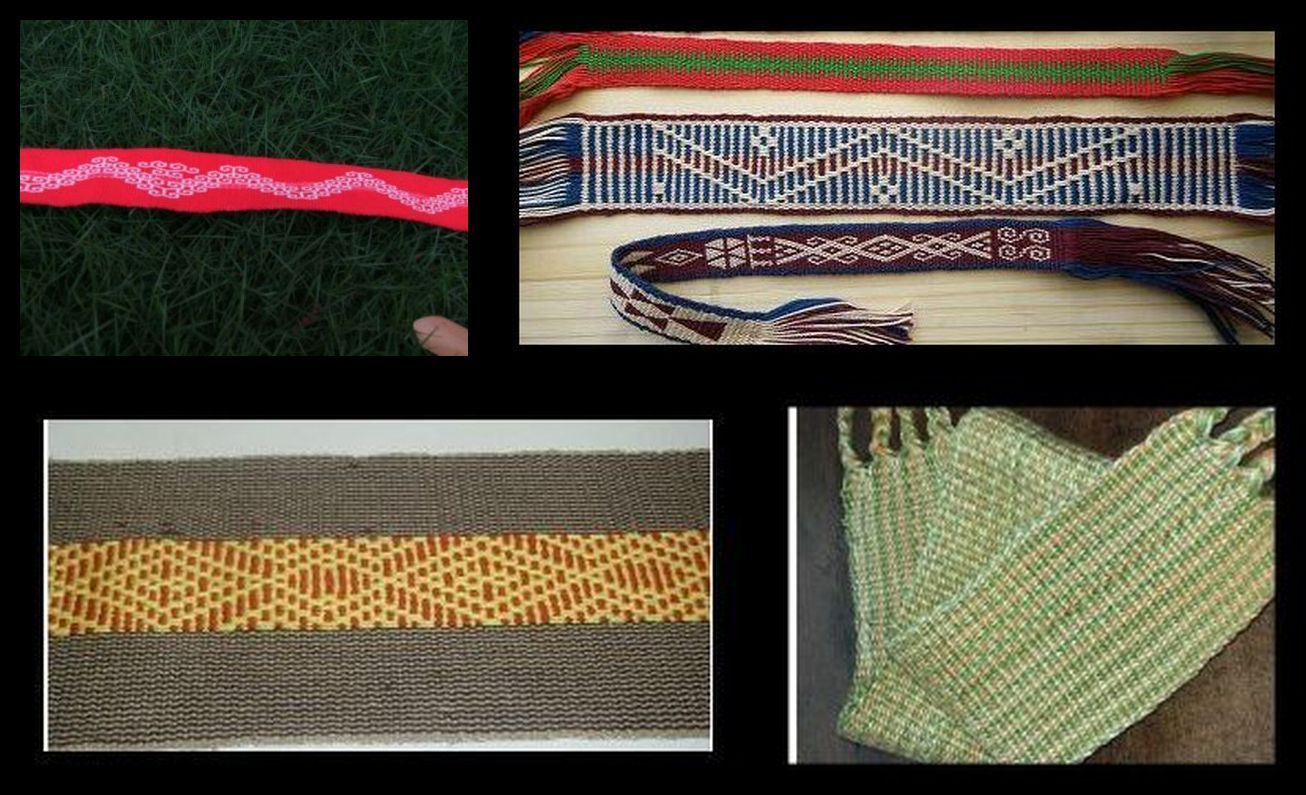
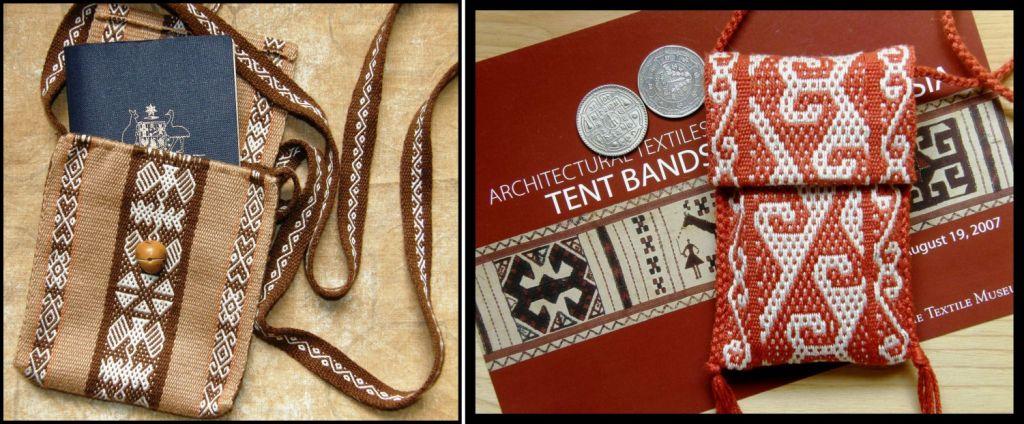
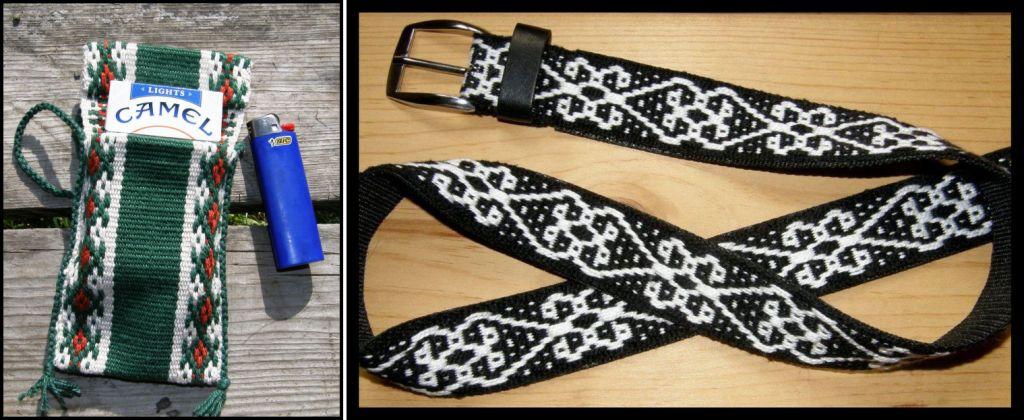
Keyfobs and hatbands look good even in heavy yarns. Bookmarks are better suited to fine ones. Wider warps with or without pick-up designs can be made into small zip purses for business cards, credit cards, coins and cosmetics. Going wider, you can make small bags for a passport, iphone or other gadget.What was originally intended as a cellphone pouch was turned into a cigarette pack holder. Long but narrow warps make nice belts. Finally, here are my two current small projects. Going wide does not necessarily mean more pick-up. A narrow strip of pick-up can be placed on solid color. The piece at left is weaving up really fast.
######################################
I am putting together some video pieces for next week’s post to show you all how to open the sheds on your backstrap looms smoothly and efficiently. This is one problem I noticed when I visited and wove with some people on my recent trip to the US. Opening the sheds becomes a real struggle when you have a lot of pilling on the heddles. Sometimes it is a matter of a less-than- ideal yarn choice but usually the problem is caused by sliding the heddles around too much when attempting to open them. So, I will have those videos for you next week and NOT just on the dream warp with the perfect yarn! I will show you how to deal with some of those sticky warps as well as wide ones with fine yarns. Included will be tips for working with two heddles for Andean pebble weave.
################################################
I put some photos together to answer a question on the Yahoo group, about using stretchers or tenter sticks on wide warps to help maintain an even width and I thought that I would share them here as well. I don’t use them as I have not woven anything wider than a table runner but I have used them with my teachers in Guatemala and coastal Ecuador.
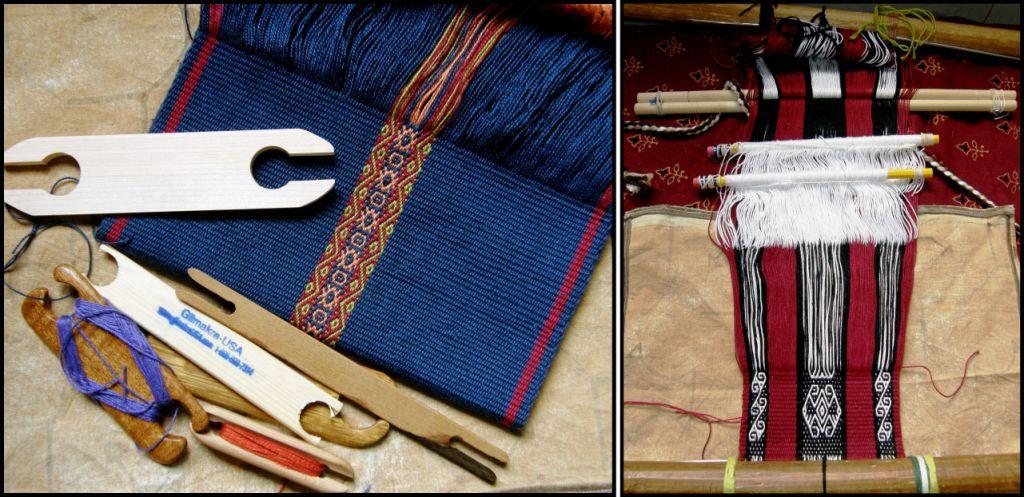
You can see the upper surface of this Guatemalan weaving at left. The stretcher bar is a hollow piece of bamboo which sits under the weaving just below the weaving line. All those threads hanging out are the ends of the supplementary wefts which may be snipped off when the piece is finished. The stretcher bar is moved up every few inches.A small nail pierces the upper surface of the weaving just below the weaving line and three or four warps in from both edges. The nails are then turned and inserted in the ends of the bamboo.This weaver in coastal Ecuador uses a bamboo slat to help maintain an even width for her weaving. It sits on the front side of the textile. Her tenter stick is a bamboo slat made by breaking open a tube of giant bamboo. Weavers will have a collection of these sticks for the various widths that they usually weave. The ends are whittled down to points which pierce the edges of the weaving. I wove on this piece and it was a real struggle removing, moving and replacing the tenter stick, which is held very tightly in its position, as the weaving progressed. The stick doubles as a spacer when the weavers are making their string heddles. These are the cotton saddle bag weavers I spent time with on a research trip with anthropologist Kathleen Klumpp in 2007.
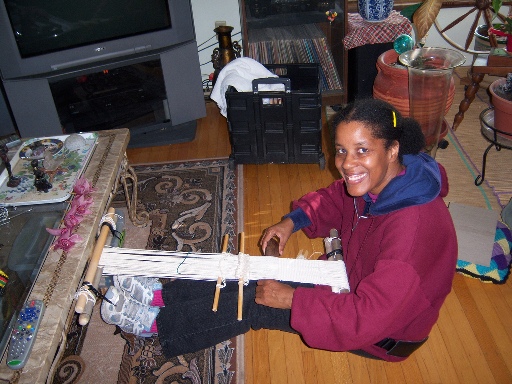
Cookie has allowed me to show you a photo of her first ever backstrap weaving project – here is her woven cotton backstrap.
And here is my favorite – possibly the coolest backstrap photo I have ever been sent as so few people have photos taken of themselves at the loom. I love how she has the remote control in the photo as that is one of my essential weaving “tools” too! This is an excellent set up. Her far loom bar is completely stable tied like that and, as she progresses, her legs will just slide under the table. I envy her being able to sit on the wooden floor like that! Thanks for the pictures, Cookie!
Back in beautiful Bolivia and already thinking about the next trip to the US for Convergence in mid July! But, first things first. In keeping with my policy of “new things in, old things out”, I have spent a few days tossing things to make room for the books and bits and pieces I brought back from the US. I do believe I have tossed out more things than I brought back – ah, more space…that is a nice feeling.
The other policy is to finish all the projects that I started on the road and I am pleased to report that I am ninety-nine percent on the way to completing them.
Project number one…the larger backstrap piece I was using for my demonstrations.
Demonstrating, finishing the pebble piece at home and the new tool bag, front and back.Needed - one more tool bag for my new collection of shuttles. Two months ago, I didn't have a single small shuttle. Always happy for an excuse to weave something!
I had warped this up with nothing in particular in mind. I just needed something to demo with at the Maryland Sheep and Wool Festival. This poor band had a bit of a hard life having been set up at different angles, worked under different tensions and constantly picked up, woven, and put down. My weavings always turn out better if I weave on them for a couple of hours at a time and having them tied up and worked on in the same spot helps a lot too. In any case, I got this off the loom and decided I needed another tool bag. Anyone who saw me rummaging around in my tool bags for that “special stick” or beater will agree. This new
I wove an inkle band with designs in Andean pebble weave on a couple of road trips and at the beach.
bag should help to sort out the confusion a bit. I wove a narrow blue band which served as the sides of the tool bag. All that is left to do is make a braid and sew on a button for a closure.
Project number two…the inkle band that I wove on road trips and at the beach. I completed this with twelve spaced motifs so that I could cut the band and sew it into key fobs. It was woven in Andean pebble weave with pre-Columbian and contemporary motifs.
This was a bit fiddly as I hadn’t woven quite enough plain pebble weave at the start of some of the pieces for threading through the metal ring, turning over and sewing so I had to cheat and glue some of the ends down.
So now I have twelve purple and green fobs. To be honest, I think I prefer making two at a time on my backstrap loom as I can change color and offer people more choices but…there are those times when there isn’t anywhere to tie up a backstrap loom and I can weave on my new inklette instead.
The twelve finished key fobs.
Hmmm, seems that I was in a very purple-ish mood when I was traveling as, the third project which I was weaving to show Andean pebble weave at its simplest on a very narrow band, is in an eggplanty purple shade with apple green designs. I had no idea what to do with this band when I got home – more key fobs? No…And then I remembered a wee twill-weave sample I had made ages ago. It is nothing special at all but it was the very first balanced weave I had ever attempted on my backstrap loom and I had gotten quite a kick out of it. It was also the first time I had ever wet finished something. I had not been in the habit of wet finishing warp faced wall hangings and shoulder bags so it was all new territory.
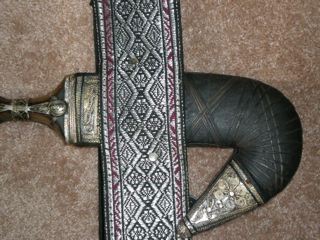
UPPER LEFT: The thin band. UPPER RIGHT: The twill piece on the loom. I wrapped black yarn between the warps on the loom bar in order to space them for the twill. LOWER LEFT: This little bag will hold my business cards. Many people were amused to see me carrying my cards around in an Altoids tin while I was traveling. I shall probably replace this pouch at some stage with another in pebble weave with two pockets so that I can also carry my e-monograph cards.Yemeni knife belt
The band served as sides for the pouch as well as to decorate the center. The picture at bottom right shows two other looms with projects that I took to show in the US. You may remember having seen these in other posts and I shall be getting down to finishing these in the next few weeks. The one on the left is the supplementary weft reproduction of a pre-Columbian fragment and the other is a warp float reproduction of a yurt band. I was lugging around quite a lot of sticks and string!
So those will keep me busy for some time and I have already decided on what will probably come after that. I would love to try and reproduce the Yemeni knife belt pictured above. It has been woven with a supplementary weft with a silvery sheen and is spectacular.
Now what about those yarn experiments? I have even had time to weave a few things in Andean pebble weave with two of the yarns I purchased in the US.
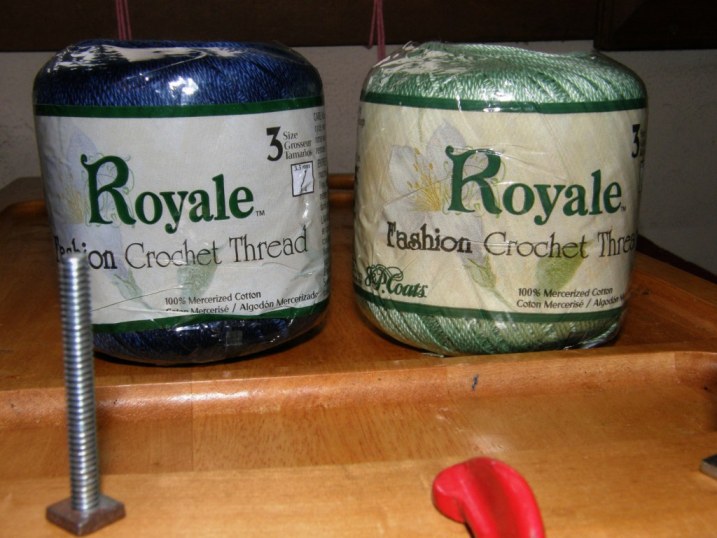
I got this Patons Grace yarn at Michael's-yikes! purple again! What can I say?-there wasn't a good color choice. On their site, Paton's decribes this yarn as super soft or ultra soft and I would not have bought it based on that description as soft yarn and warp faced weaving don't usually get on. I wove two key fobs with it and it is lovely. Zero pilling on the heddles and, being mercerized, it has a lovely sheen. It is a number 3 crochet yarn. These photos show how I make my keyfobs two to a warp so that both fobs have a clean edge. I weave one, then turn the loom around and rearrange the shed stick. I retie the knots at the other end so that they are right at the start of the weaving. When finished, the knots are untied and those ends get passed through the end loops once the metal needle is removed.A few more pictures showing the weaving process and the two fobs on the loom. The finished fobs are at bottom right along with two others I made using Coats Royale number 3 mercerized crochet cotton also from Michael's - not many colors to choose from for this brand either. I would buy it from the website. Thumbs up for this yarn too.
I have a finer number 10 merc cotton, also by Coats, to try out for next week and not in purple as well as some wool. People often ask me about respinning commercial wool for backstrap weaving so we can take a look at that too.
Other tempting project ideas that have been appearing in my inbox are pictures of belts and bags woven by the Huichol of Mexico as well as drawings of motifs woven by the Cayapa of Ecuador.
Teyacapan, too, continues to inspire me with her gorgeous photos of Mexican crafts and textiles.
#########################################
Now it has occurred to me that this blog has been filled with images of the US the last few weeks and that it was about time I showed you all a little of Bolivia. I recently contributed some photos and information to Handwoven for a piece they wrote on Sucre, the constitutional capital of Bolivia, and its attractions for tourism related to weaving. How frustrating it was having to narrow down the images to just three or four pictures! In May last year, I went to Sucre for what was probably my fourth visit but, this time, I went with my brand new and first ever digital camera.
So here is a little whirlwind photo tour of Sucre…
Sucre, the "White City of the Americas"
Sucre sits in a valley at around 3500 meters and it is obvious how it earned its nickname. From the hill tops to down at street level, both inside and out, Sucre is white – almost blindingly so in the mid morning sun! Wooden enclosed balconies adorn most of the downtown buildings as well as black wrought iron window coverings and flower filled window boxes. It has quite rightly been declared a UNESCO cultural heritage site.
The most well known weavings of the area are made by the Jalq'a people of Potolo, upper left, whose textiles depict wild mythical creatures which completely cover the woven surface. Those made by the people of Tarabuco, on the other hand, have designs that are placed in well organized columns and depict common every day objects and events. These textiles are woven by the women on oblique looms while the men weave the brightly colored tapestries, lower right, on floor looms.
More examples….
Weavers from Tarabuco and Potolo demonstrate weaving at the ASUR museum in the heart of the city and it is also possible to travel to the town of Tarabuco or, further, to the villages of Candelaria and Potolo to see weavers at work and purchase their textiles.Shopping! Traditional weavings and knits from floor to ceiling as well as items produced with traditional based designs for tourists.
More shopping...the Sunday market in Tarabuco, a couple of hours away, is a textile lover's heaven. Again, you can find traditional pieces as well as weavings made specifically for tourists. At bottom right you can see one of the market stalls in the Sucre campesino market where you can buy llama fiber, spindles, cochineal and bone weaving tools called "wichunas". People in and around Sucre...weavers from Tarabuco and Potolo, a woman spinning in Tarabuco on her way home from the market with her granddaughter wrapped in her carrying cloth, an elderly Tarabuqueno wearing the leather hat or "montero" which is said to be based on old European style helmets, men performing ritual offerings to "pachamama" on Sunday morning in a plaza in downtown Sucre. A visit with Felicia and her mother in the village of Candelaria. Felicia's cousin, also called Felicia, taught me to weave the pick up technique of Tarabuco way back in 1998. She and her family have long since left Candelaria and I was lucky to run into her cousin who welcomed me into her home to sit and watch her weaving. I took weavings and photos to show and her mother, who is not a weaver, was delighted looking at my things.
I have spent many years traveling around and spending time with weavers here in South America. It is not so easy finding a weaving teacher especially in the cities and not all my attempts to learn to weave have been entirely successful. One thing is finding the weaver, another is finding one who has the time to teach you and, lastly, finding one who is also a good teacher is something else all together. I have almost always found a good weaver and teacher with some time to spare within a few days of my arrival in a place.
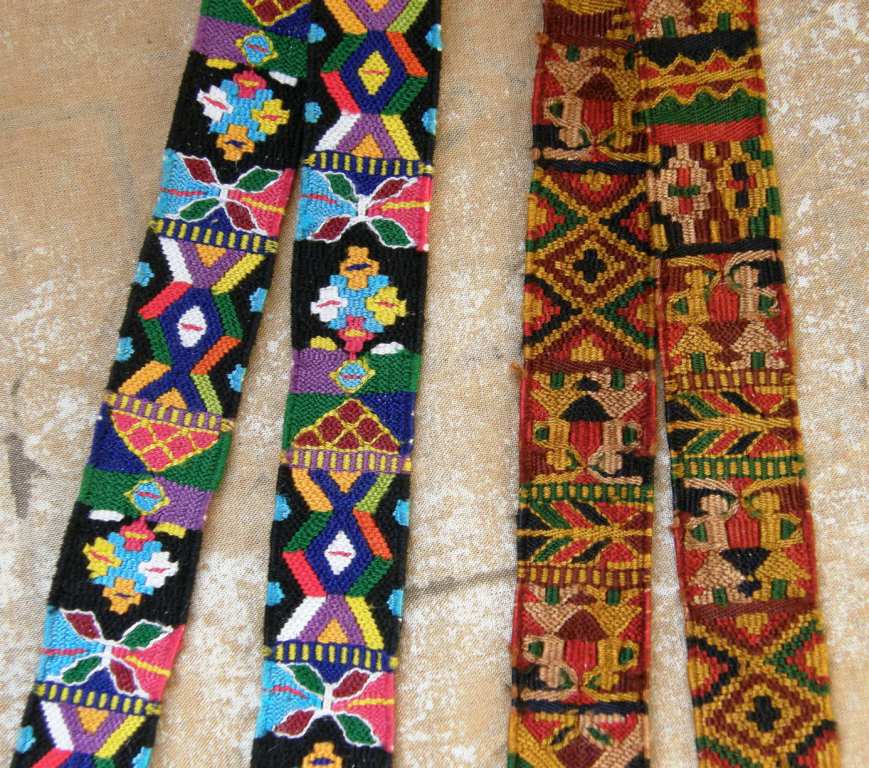
Typical textiles of the Tarabuco area.
On my second trip to Sucre in 1998, I found that I had enough time to look for a weaving teacher. The museum in Sucre had given me the name of a weaver in Candelaria but I bumped into Felicia while I was waiting for transport from Tarabuco to Candelaria ,we struck up a conversation and she persuaded me to come and weave with her instead. I doubt that Felicia herself knew what she was letting herself in for when she took on the task of teaching me to weave. Youngsters generally learn by observation rather than through explanation and Felicia seemed to have long forgotten which designs she had learned first, how difficult it was to learn from scratch, and I doubt that she had contemplated how time consuming and possibly boring it would be sitting for hours with me and having to help me along with every little thing!
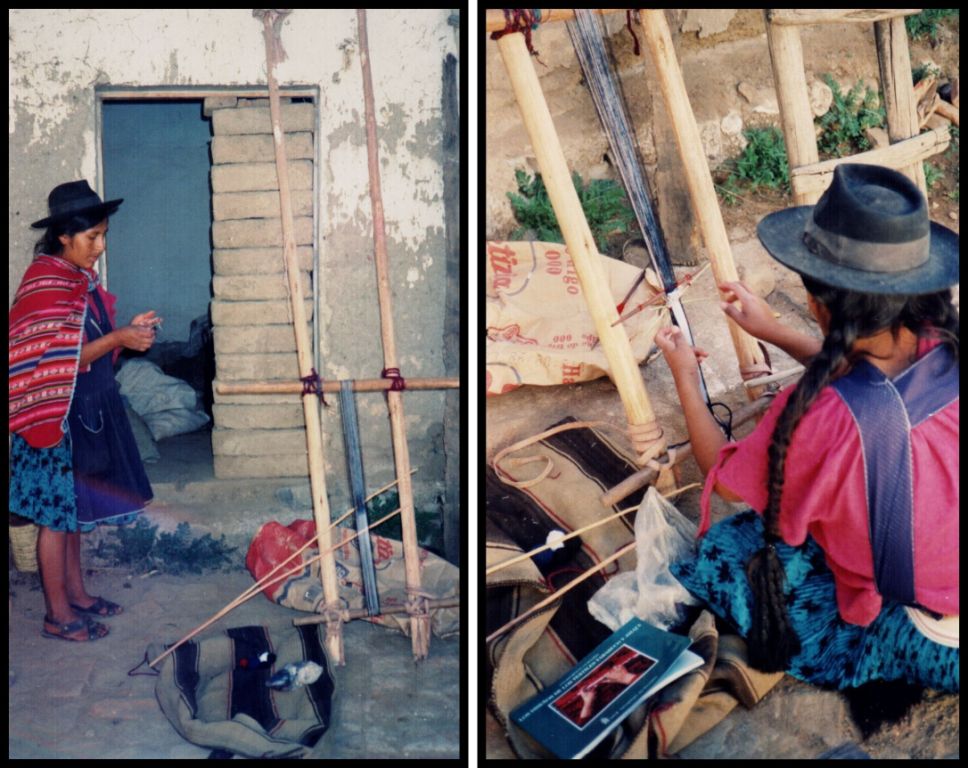
The first classes...Felicia would sit at her loom picking up her pattern warps on a metal needle. All I could see was the long end of the needle flicking to and fro as it emerged from her fist. I couldn't for the life of me figure out how she was forming and reading the patterns. Finally I was able to persuade her to set up a miniature warp for me on another loom and picked out the simplest design I could find from a book I had bought at the museum. I was being a stubborn gringa and I wanted her to teach me MY way.Here are the loom and mini warp that Felicia set up for me in the yard . But things still did not go well...Felicia still flicked her needle around, sighed with impatience when I didn't get it and rolled her eyes at my questions! Finally I figured that I could slip the warp off the loom bars at night when everyone was asleep. I tied the warp to my bed rail, set myself up with my backstrap and unwove. In a couple of nights, I got it figured out and once I had made a chart of the motif, I was on my way. I decide after that, that I would leave the weaving classes and just enjoy my stay in the village. There was no transport out anyway until the market day the following Sunday. So I joined in with Felicia's chores instead and learned a few things. I am sure she was relieved that I had suddenly stopped asking for lessons and no questions were asked! We made bread. I am eternally grateful that she didn't have me get my hands into the dough which was made with globs of pig fat from a sack in the corner-that apparently was grandma's job. She showed me how to peel wafer thin slivers of skin off their tiny potatoes with a knife and get the kitchen fire going. Can you tell I am a city girl? I also learned how to use the stone to grind the chili peppers to make 'llajua"-a spicy sauce which she served with the bolied potatoes. Then there were the neighborhood kids to mind. I would go out for walks with a long train of them behind me.
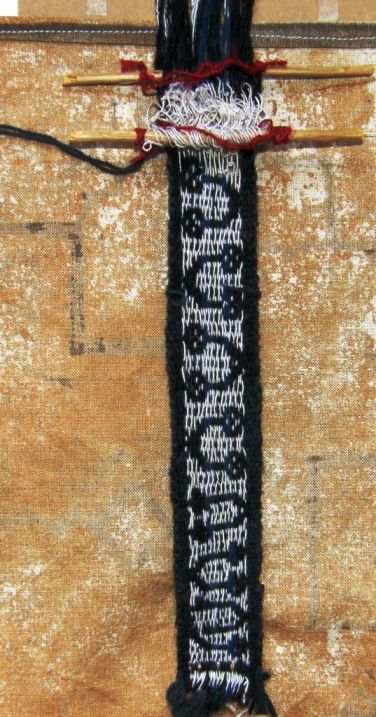
Somehow we ended up hitting it off and I finally showed her the motifs I had been secretly weaving at night. She was pretty happy about that but did not praise me by calling me “machita” as my other weaving teachers had. Probably not surprising as you can see at left all that I managed to weave in a week!
The white yarn used in the background area is a highly overspun cotton. You can see how the heddle strings, which are made from the same yarn, are curling up on themselves with the overtwist. The pattern warp is overspun acrylic-about three times thicker than the ground weave and not as tightly spun.
We just used twigs from the yard for the shed rod and heddle stick.
I was very surprised to receive a phone call from Felicia’s husband when I returned to Santa Cruz telling me that he had sent me a package by bus. Inside was a chuspa (coca leaf bag) and a wichuna which belonged to Felicia’s mother. Wow! I wonder if Felicia took on any other gringa students after I left!
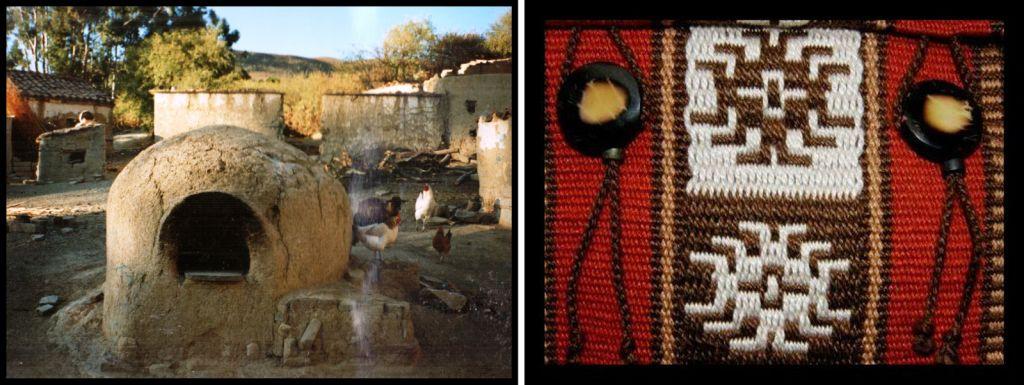
The bread oven in Felicia's yard. A piece I wove using the technique I learned during my stay in Candelaria. I used the same weight yarn for both the pattern and background colors which gives it a very different look.
###########################################
Two hair sashes that I had bought in the market at Chichicastenango. I particularly liked the one on the right in its soft autumn colors. I later discovered that it was originally woven in bright primary colors and then overdyed to suit the taste of foreigners. I have been told that sometimes textiles are simply soaked in tea to tone down the colors. Now I would like to wash this band and recover the orignal hues.
One of the things I enjoyed a lot on this trip to the US, was the chance to play on other looms. I had a great time on what I had been calling my “first encounter” with a four-shaft loom but I had completely forgotten the quirky little four- shaft/backstrap loom that I had woven on in Zunil, Guatemala.
While staying in Guatemala’s second largest city of Quetzltenango, I heard about the hair sash weavers of Zunil and the strange four shaft loom that the weavers used.
The warp is attached to and tensioned by the weaver’s body.
I was intrigued by the loom but also keen on learning how to make the lovely sashes.
Zunil is a twenty-minute bus ride from Quetzltenango and I arrived to market day madness. You can see some of the women there using their hair sashes. A short walk uphill brought me to the relatively peaceful town square and church where I found the weaving cooperative. There I was politely told that classes would not be possible as women were not permitted to weave during Semana Santa (Holy Week). Disappointed, I left, only to be chased down the street by a woman who told me she would take me to a teacher. And so I was led up the hill to Clara’s house which had a gorgeous view over the town and surrounding valley. We negotiated the price and when I questioned the Semana Santa thing I was simply told that “some people get jealous”.
So here is the rickety and very squeaky loom. The warp stretches from the weaver's waist through the reed and shafts around a hook in the door frame, back to the weaver's waist via another hook in the side of the loom. The warp is cotton which is sized with something that smells truly awful - corn starch and other ingredients - and the weft is acrylic. The reed is made from bicycle spokes.
Amazing to think that a weaver using such a loom can produce these beautiful even sashes.
The band on the left is what I wove in my classes. An experienced weaver using exactly the same warp and weft would produce those fine, narrow bands on the right. The sashes are finished with large heavy tassels. So that was my first four-shaft loom experience. Here are the loom parts that I bought in the hope of making my own one day. Clara was an excellent weaver and teacher.
#######################################
In the coming week on Weavolution I will be running a Weave Along. This will be for those of you who have been working their way through my e-monograph on Andean Pebble Weave and are wanting to extend their skills and weave a wider piece. It is also for those who have purchased the monograph but have been feeling a bit hesitant about getting started. Join in and weave with the group!
Easter is upon us. Here in Santa Cruz, the stores stock aisles of chocolate Easter eggs but people have not really warmed to this tradition so we usually see these same Easter eggs sitting forlornly at the check out well into October when they are replaced with Halloween goodies. Now Halloween is something that has really taken off here.
The night of Holy Thursday here has its own special tradition. All the streets of the downtown area get closed off to traffic and become a gigantic pedestrian walkway full of strolling families and teenagers out and about socializing, eating – there are food stands set up every few yards – and stopping in at the various churches. The idea is to visit nine churches. My mother tells me that this was the tradition amongst Catholics in India too when she lived there.
In Guatemala it is a very different story. So let’s see what activities and traditions surround Easter there. Of course as soon as Guatemala is mentioned, you know what to expect…
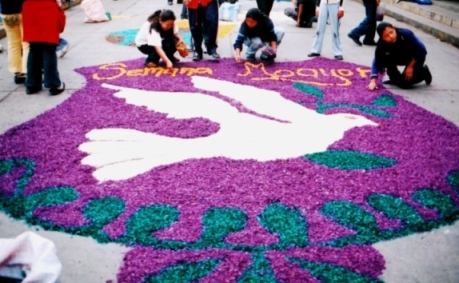
A sawdust "alfombra" laid out in wait for the Good Friday procession in Huehuetenango
Easter weekend was my final one on my trip to Guatemala in 2008. I don’t usually move around all that much when I travel. I like to find two or three nice places and a few weaving teachers and stay put but, as all my weaving classes were over, I was taking the opportunity to visit as many spots as possible before heading back to Guatemala city for my flight on the Monday after Easter. This meant that I got to take in the Easter celebrations in three different places.
I arrived in the city of Huehuetenango the Wednesday before Easter hoping to travel further into the highlands the following day. Little did I know that the whole of Huehuetenango would be shut down on Holy Thursday as an unofficial "hang over" day after Huehuetenango Day celebrations on the Wednesday night - food and music including a "battle of the marimbas" in the main plaza until the wee hours. So there was no transport to be had and Thursday was a very dull day indeed. BUT, I woke up to the preparation of these fabulous sawdust "alfombras" on Good Friday morning.
Now, Antigua is THE place to be in Guatemala if you want to see the most spectacular sawdust alfombras. People come from all over, the city is packed to the gills and prices rise so I was determined to avoid Antigua for those very reasons. I had no idea the alfombra tradition was carried out in almost every city, town and village in Guatemala and so I got to enjoy a smaller but no less colorful version of it in Huehuetenango.
Alfombra means carpet in English and the tradition is to create these fantastic carpets from colored sawdust on top of which the Easter processions will pass. Other carpets are made from pine needles , flowers, stones and even vegetables. Large metal and wooden stencils are used to form the shapes and designs and the entire carpet is intermittently sprinkled with water to weigh down the dust and hold it in place. The themes are most often religious and once the procession passes they are completely destroyed.
What amazed me most was how quickly and efficiently the designs were measured out and put into place. Everyone worked quietly on what is, after all, a somber day but it was very hard to feel somber with all those gorgeous colors about. Watching the whole process was irresistible and I had to drag myself away to take my bus into the highlands. I was actually glad that I wasn't around to see all that hard work destroyed.
Read an excellent article herewhich gives a lot of information about the origin, history and significance of the alfombra-making tradition. To quote just a little…
“HISTORY
The custom of making carpets was brought from Spain and the Canary Islands. However, it is believed that in pre-Hispanic times the Maya made carpets for various ceremonial reasons. Possibly the carpets were used in altars to induce positive energies and absorb negative ones. Thus the constant destruction of the carpet is necessary to remove bad energies and bring new positive ones with the construction of a new carpet or offering.”
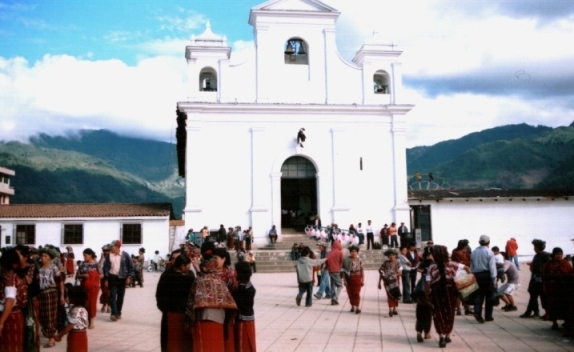
The church in the main square of Nebaj with an effigy of Judas hanging on a noose above the main door. In the afternoon young men came to shoot at it.
Next stop was Nebaj, a small town of adobe dwellings tucked away in a highland area known as the Ixil triangle. There I was also treated to splashes of color but in this place the color came in the form of the women’s traditional huipiles (blouses) and cortes (skirts).
People from the neighboring villages of Chajul and San Juan Cotzal had come into town for Easter to see and be seen in their very best hand woven huipiles decorated with animal and geometric figures in supplementary wefts and warp wrapping.
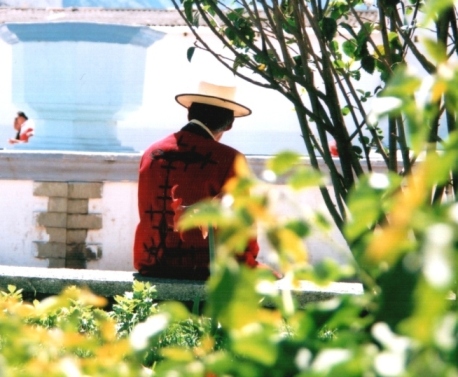
The typical scarlet jacket decorated with black embroidery worn by the men of Nebaj for festivals. Apparently the jacket is modeled on that of Spanish officers from colonial times.
Good Friday was no somber occasion here. The atmosphere was festive with even a ferris wheel set up near the market and cotton candy, icecream and balloon vendors strolled amongst the crowd. The older men too, were wearing their festival gear – scarlet jackets embroidered in black. In this way I got to see the traditional clothes of all three areas in one place. All I had to do was sit in the plaza and watch it all go by while trying to discreetly snap a photo or two.
The icecream vendor is wearing one of the typical backstrap woven hair sashes of the area complete with enormous tassels-quite a weight to be carrying around. So much decoration and color on every huipil!
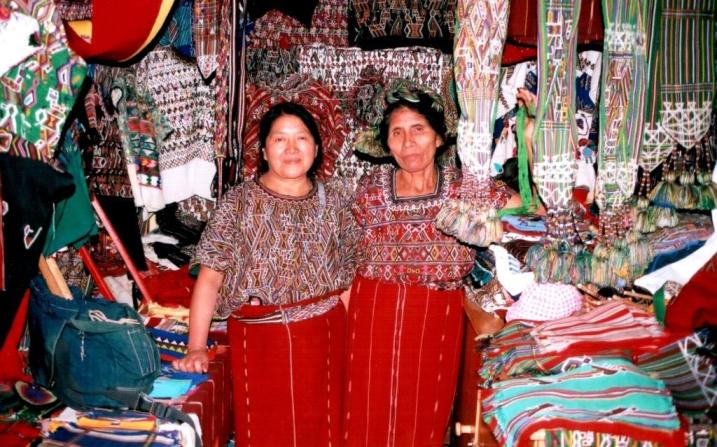
Finally on Saturday when things had settled back to normal I visited the artisans market and met two of the coolest weavers and vendors there. Such a shame that I was at the end of my trip and couldn't spend more time with them. We swapped heddle making tips and weavings.This is a lively Nebaj textile that I received as a friendly swap for one of my own weavings. I would have loved to have stayed longer in Nebaj but it was time to move on to Chichicastenango.
Colorful in its own way, the market town of Chichicastenango is more a tapestry of sights, sounds and smells. It was even more chaotic than usual on Easter Sunday. It was my second visit there and I could really tell the difference as this time the locals who had come into town for the Easter Mass far outnumbered the tourists. The Easter celebration was a strange and interesting mixture of Catholic and indigenous rituals.
One of the clogged market alley ways on the left - spot the tourist! Fortunately there are some places where one can escape the madness. The Hotel San Tomas allows you stroll around its beautiful colonial-style courtyards and enjoy the marimba music.Of course I had to revisit my favorite stall - guess which one!LEFT: Thread which the vendors were calling "seda" (silk) - only available in green and pink. Why only these colors? I was told quite simply that these are the colors of Chichicastenango. RIGHT: The steps of the church gave a nice high vantage point from which to survey all the activity until I nearly got run down by the emerging Easter procession.
After all this frantic travel and activity I went to Guatemala City and onto Miami where I spent three nights stuck in the airport waiting for a flight back to Bolivia – the hazards of stand-by travel!
As promised, I have made a tutorial on weaving another of the yurt band border designs using simple warp floats. I used this design on the cell phone pouch that appeared in this previous post. I warped up this week to weave the design with the tutorial in mind. However, there were obviously other things on my mind as well as, instead of warping up the required fourteen warps, or seven pairs, I warped fourteen pairs and so ended up with a warp twice as wide as necessary. So I wove the “S” border design in two columns as mirrored images and found that it was the perfect width for a belt.
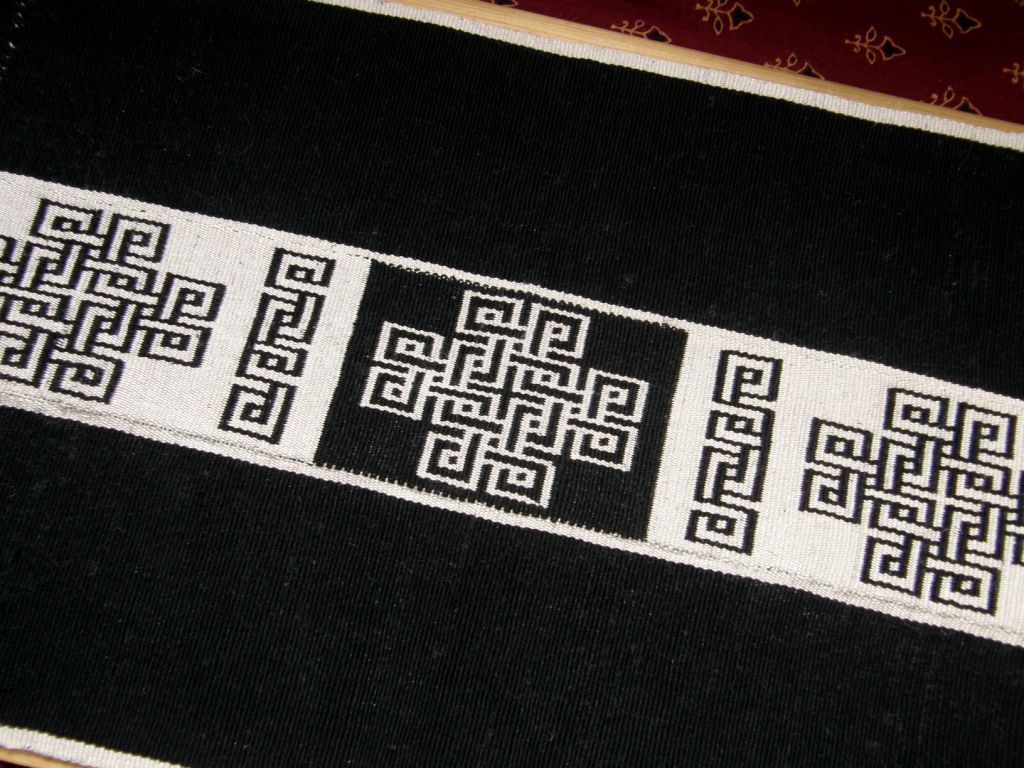
Continuing with the black and white theme, you may remember the Abba Yohanni piece that I showed you in this previous post.
The cross motif taken from a curtain in an Abba Yohanni cave church in Ethiopia
Here I can show you the table runner finished (which I think I am going to turn into a wall hanging) but I mostly wanted to revisit this topic as Alexis Tancibok in London, whom I met on Weavolution, recently emailed me with some interesting background information on these motifs and the curtains on which they were woven. (which I quote below). I am very grateful for this as I had not been able to turn up much on the net about it and was mistakenly under the impression that these curtains dated only as far back as the 17th Century…
“Curtains like this were a common feature of churches in N. Africa & the
Middle east from at least the fourth century. They were often devotional
items commissioned or donated by individuals making a vow, fulfilling a vow,
or as an act of piety. Similarly fabric woven with religious motifs – such as Abba Yohanni’s cross,
and stylised scenes from the Gospels, and Apocryphal texts were designed and
worn by people at all levels of society as talismans – the V&A has a rather
decent collection, so too does the Louvre. The best extant versions are Coptic (Egyptian) which is relevant to the Abba Yohanni piece because the Coptic church and the Ethiopian church have strong historic links…
Early christian art motifs are still extant in the Eastern tradition and in many cases almost unchanged from when they first emerged. The shape of the cross for example is commonly made in twisted leather both in Ethiopian and Coptic pendants.
Devotional curtains/veils/textiles serving different functions in Eastern Christian settings are still used today – especially in Ethiopian churches and shrines.”
################################################
I couldn’t keep away from the colors for too long….
I have another wonderful thing to share courtesy of a new online acquaintance. Chris Buckley in Beijing has generously allowed me to use images of his yurt band pieces. Those of you who saw the X and O yurt band border design in the tutorial on simple warp floats last week will recognise it here on this piece worked in two colors…
I am excited to have yet another yurt band design to chart and attempt to weave. Chris tells me that these Kyrgyz yurt bands were cut and sewn together to make mats and that he acquired them on a trip to far Northwestern China. I have only just started exploring his fascinating blog.
And here is another gem from Chris…
Here is a slight variation of the 'S' design featured in this week's tutorial! Ah...the colors!! If only I could get red and blue to work together so well for me!
######################################
And to finish, a contribution from a blog reader. Sharon finished her first mug rug in one-weft double weave with her own butterfly motif…
I have seen the rest of her butterfly charts and they are so pretty. Hopefully we will get to see the whole set of mug rugs as they come off the loom.
Oh… and I spied Grace Hatton on her blog working on the yurt band border from last week’s tutorial. She has a fun post entitled “Loom Porn – Size Doesn’t Matter” where you can see a photo of her band and other small looms.
Enjoy the new tutorial and keep the projects coming…remember, I love to hear from you all! 🙂

 With all the loose ends that needed tying up and the time spent working with Syne Mitchell to get the print version of my monograph ready, I didn’t expect to get any weaving done this week. But then I had an idea and ended up weaving a bunch of keyfobs. I thought it would be fun to give a keyfob away with the first 20 copies of Andean Pebble Weave. So I sat with my basket of cotton thread and had a great time combining all sorts of colors to make the 20 keyfobs to accompany the books. I combined several small pebble weave motifs and now I can definitely see the benefits of weaving the same design over and over as some indigenous weavers do. I could probably weave this with my eyes shut now!! As long as there were new colors to combine it never got boring. Only one or two color combinations are repeated as I made tiny warps and wove one at a time.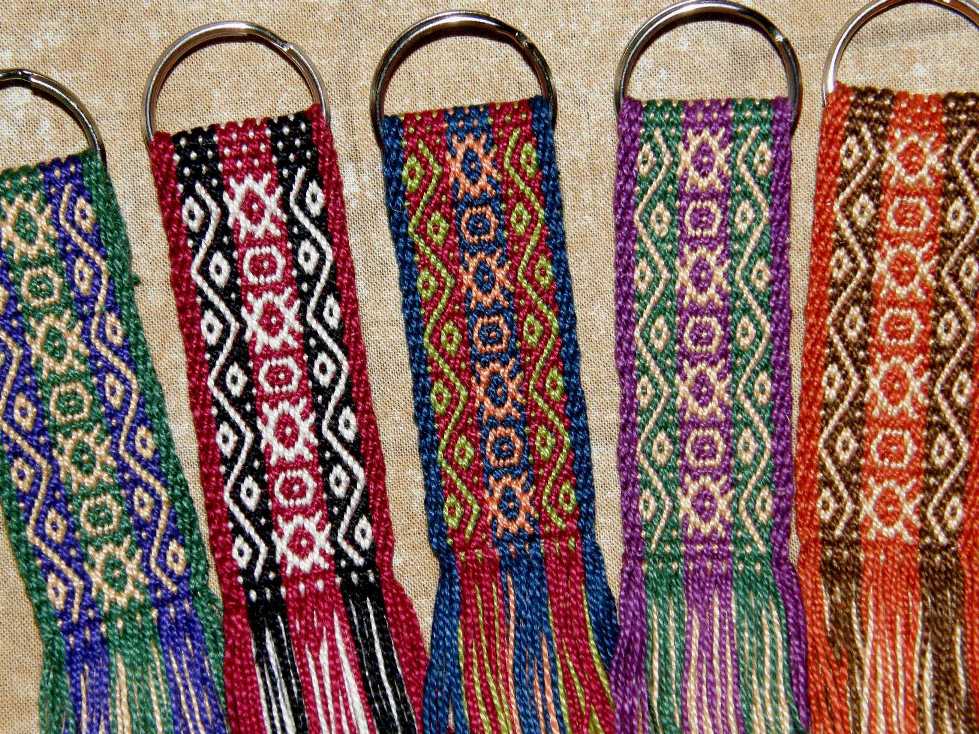


 I am also taking my wobbly Bolivian drop spindle and some of the alpaca fiber that my friend Janet gave me on my last visit. I just spun a little to get it started on the spindle and it is so so beautiful to spin! This is not the first alpaca I have ever had to spin. I bought some many years ago in Peru and it was in a dried-out, brittle and filthy state. I lost a good third of it in the cleaning process and I knitted rather than wove with it. Now I have this prepared smooth luscious fiber to work with – what a dream! It almost feels like cheating! I’ll be spinning it to weave with on my backstrap loom.