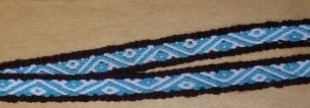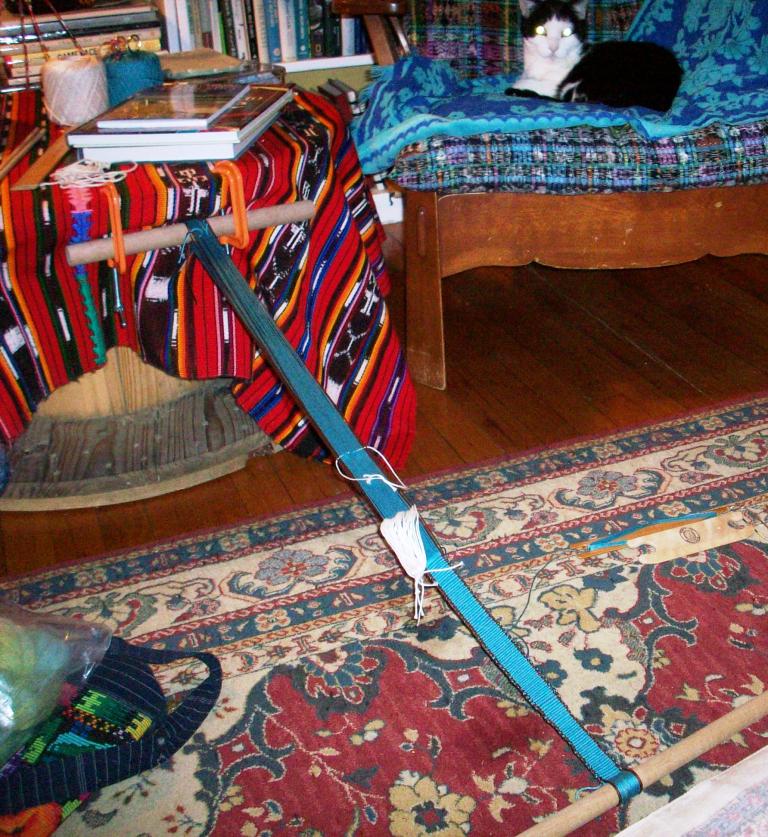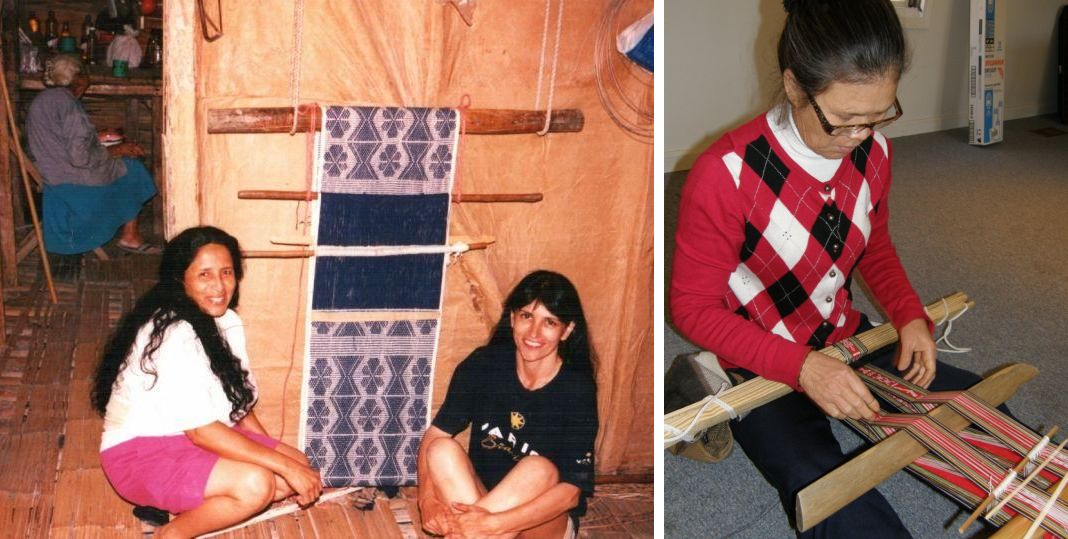
Backstrap Weaving – Material Gains

Tippity-tap at the computer for the most part this week trying to move some projects along before I go traveling in a couple of weeks….finger-dancing at the keyboard rather than at the loom but I have a couple of little things to show…
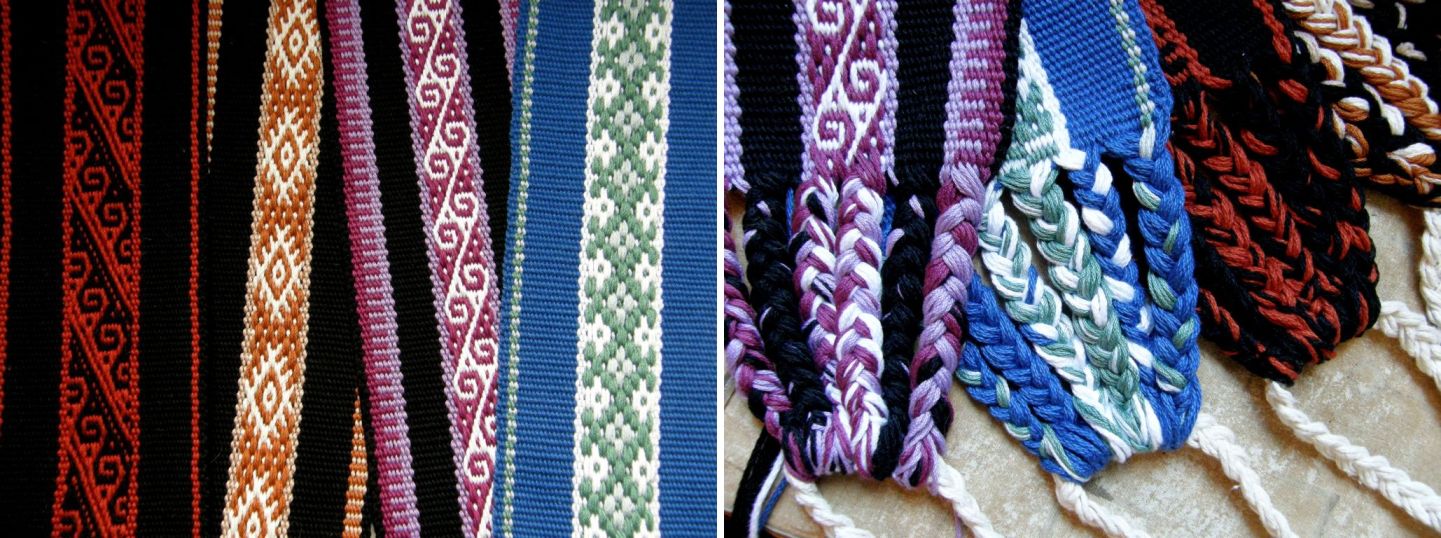
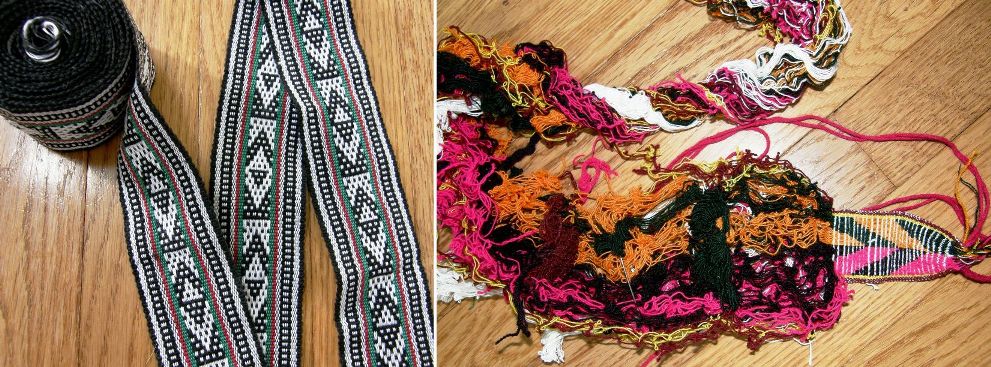
Well, I am cheating here…this is not loom work. I braided the friendly ends of my recent backstrap projects. Now I have to do the nasty ends…the other end with all the knots from the color changes.
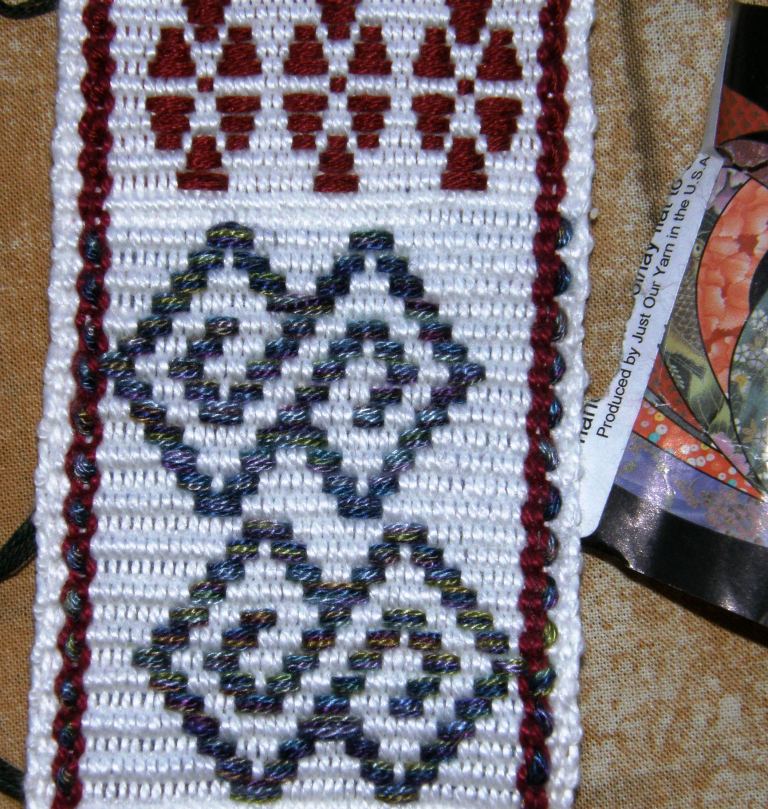
I also played a little with some tencel that my friend Lisa gave me last year when I was visiting her in North Carolina.

It is a multi-colored 10/2 from Just Our Yarn labeled “almaza” and it shimmers with mother-of-pearl colors!

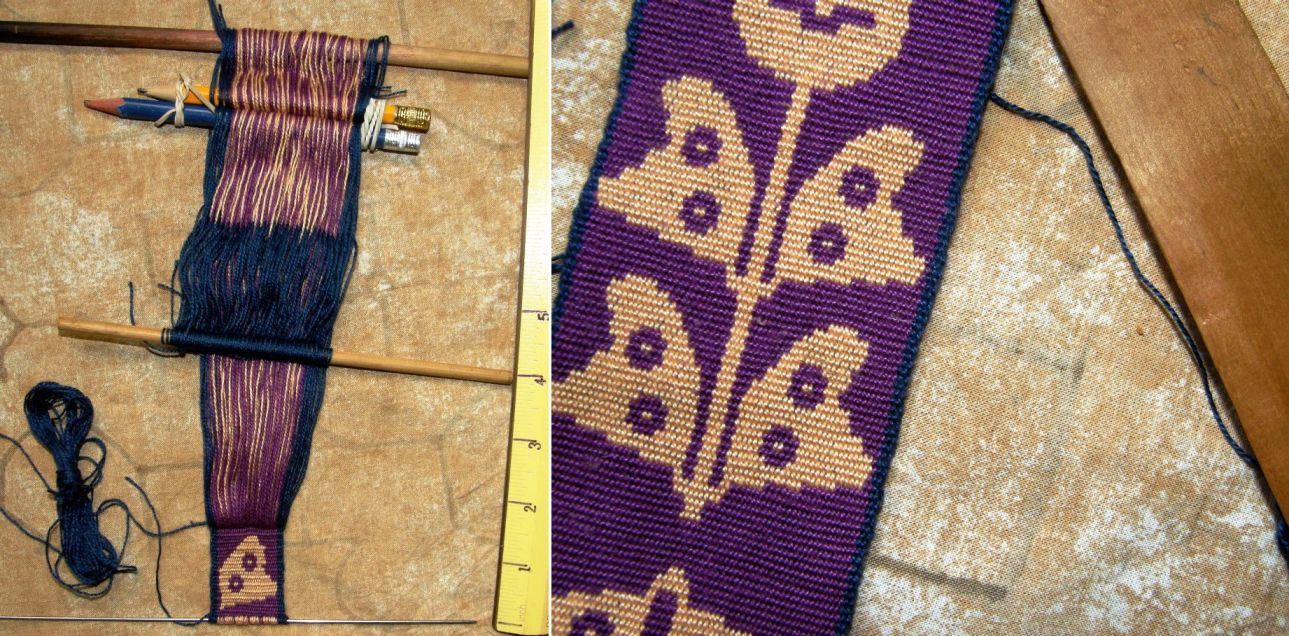
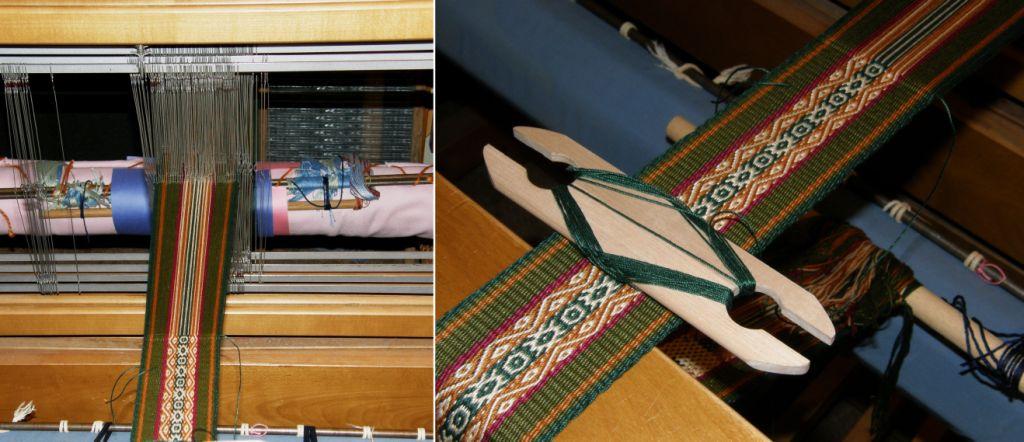
I suddenly had the idea that this may make really nice supplementary weft for some of the inlay designs I have been doing lately and so I warped for a white band in my 24wpi cotton and tried it out.

I used six strands and I love the way it came out. I warped four ends of red in the band on either edge and turned the supplementary weft between the two red warps on the left side and then on the right of the two reds on the right to see which way looked nicer.

The red supplementary weft above this is doubled strands of embroidery floss. I would like to make something now using the tencel on a band of my #10 cotton. You can’t see it so much in the picture but the tencel almost looks like beads on the cloth from a distance. The multiple strands bunch together and give a more raised effect unlike the embroidery floss which tends to lie flat.

Now listen to me getting all goofy about textures and such things. This is very unlike me! Maybe it’s because at the weaving event I attended last week I was determined to pay more attention to the materials with which we were working rather than solely the techniques and so have been able to make what I am calling some “material gains” in my weaving data bank. Discussion in the Spin-Along that has been running on Ravelry has also turned my thoughts this way.

So here are some of the materials that we got to play with at the weavers’ gathering last week…
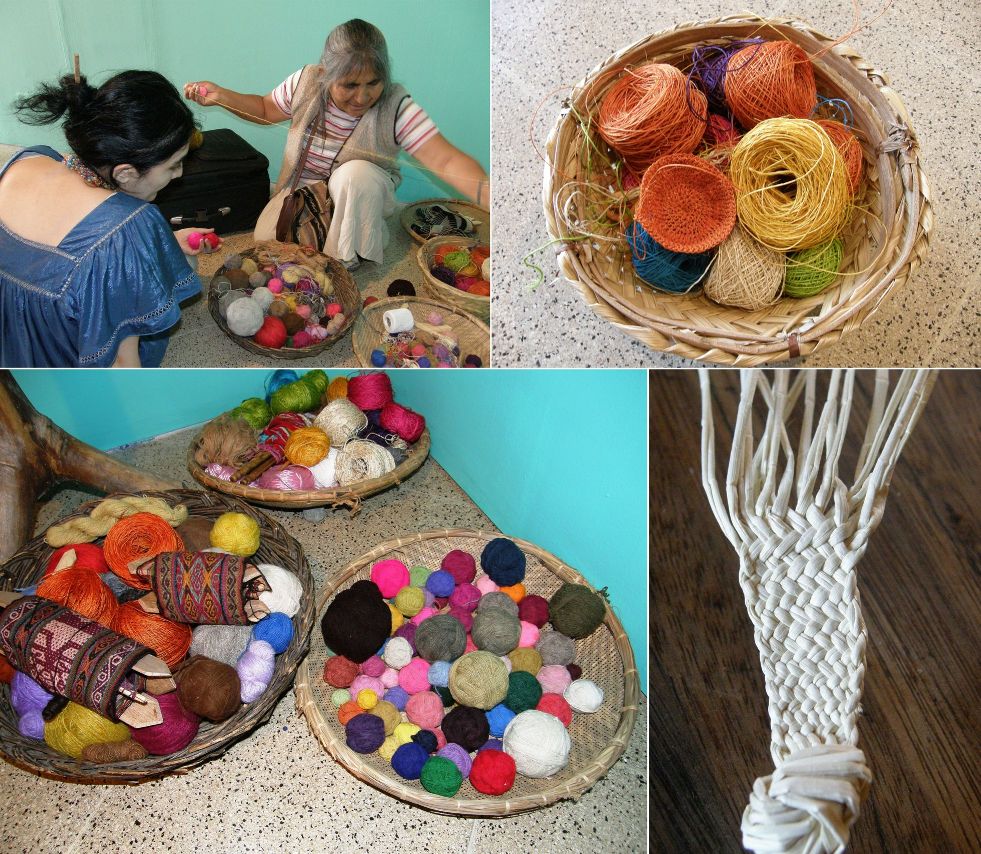
Celinda, an Aymara weaver from the northern Chilean high plains, is showing one of the participants handspun wool which she dyes with bright aniline colors. She also brought her handspun alpaca fiber in natural colors and I was able to keep some by swapping a couple of my handwovens. Zenaida and Sonia brought handspun wool from Chinchero which they left for educational purposes at the cultural center which sponsored the event. I noticed, however, that they use alpaca for weft in their wide weavings.

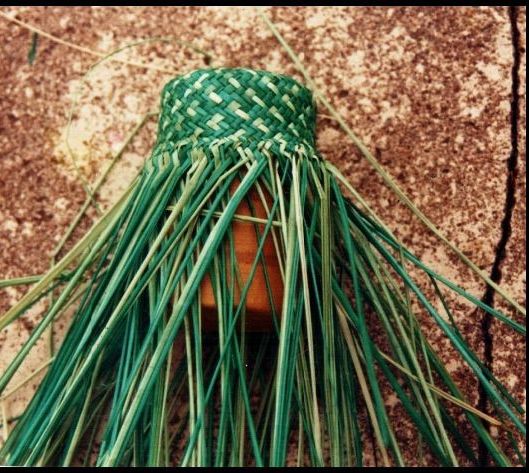
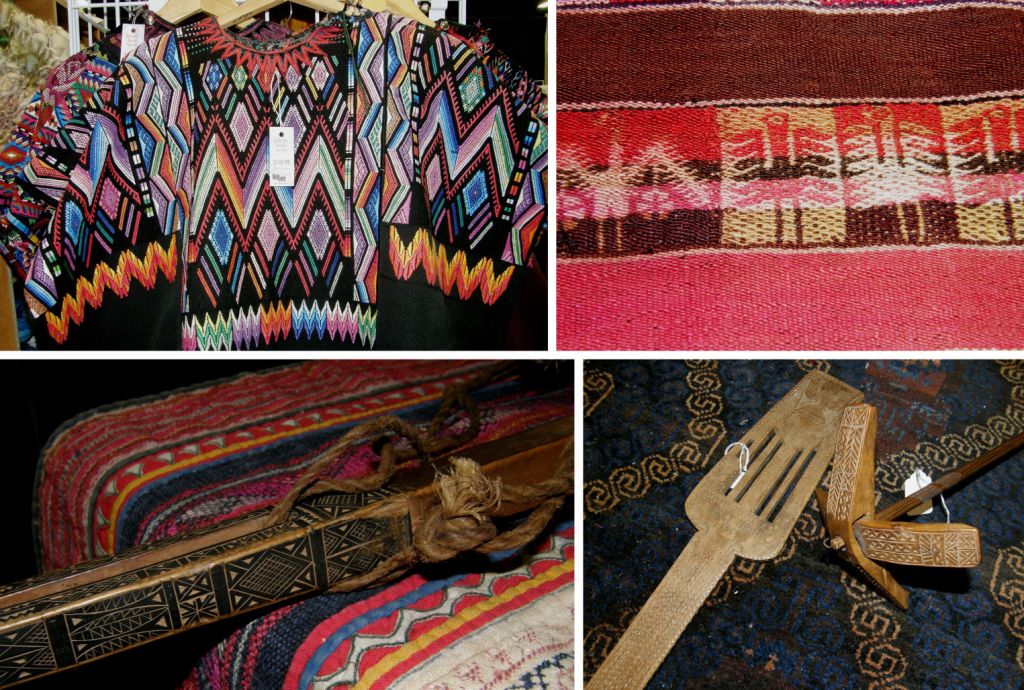
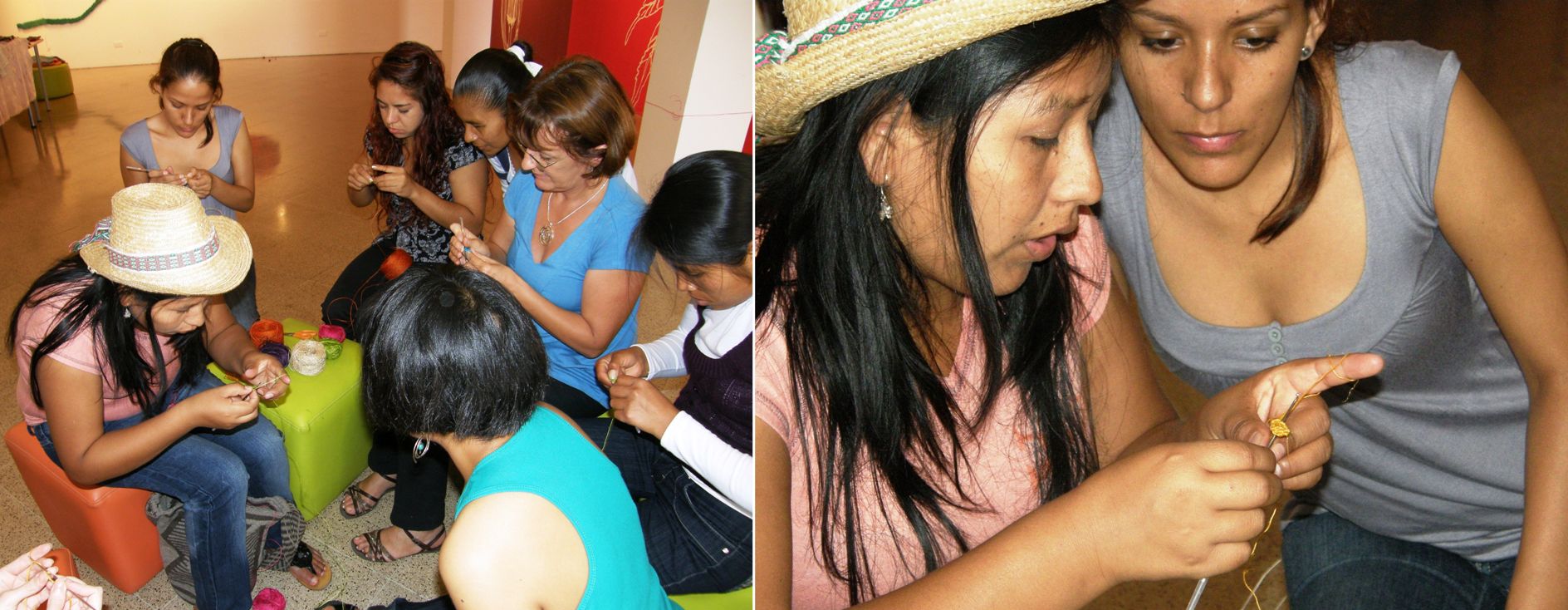
Domingo, a master weaver of the famed Panama hats of Ecuador brought the straw “paja toquilla” (above lower right) from which they are made. Maritza, from Colombia taught us how to work with the “cabuya” fiber that is extracted from the penco plant. (above upper right).

The Guarani weavers who attended, from the area in which I live in the Bolivian lowlands, are now using industrial cotton, the very same type that I use myself in my weavings.
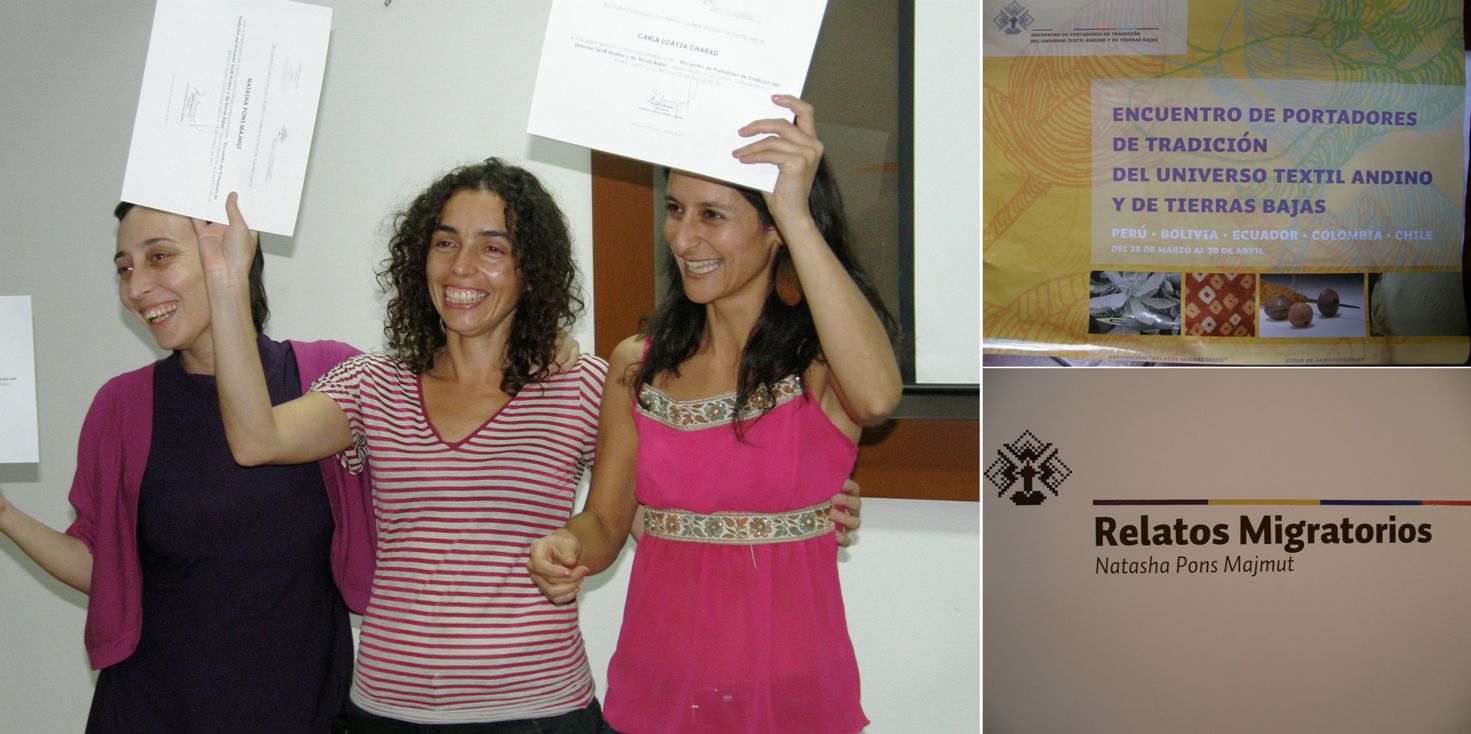
The event was organized and coordinated by the three Chilean ladies above…Cristina, Natasha and Carla who can be seen celebrating the end of a successful three days of interaction and sharing. Artisans from Colombia, Ecuador, Peru, Chile and Bolivia came together to show their work and exchange ideas and I was lucky to be a part of it.
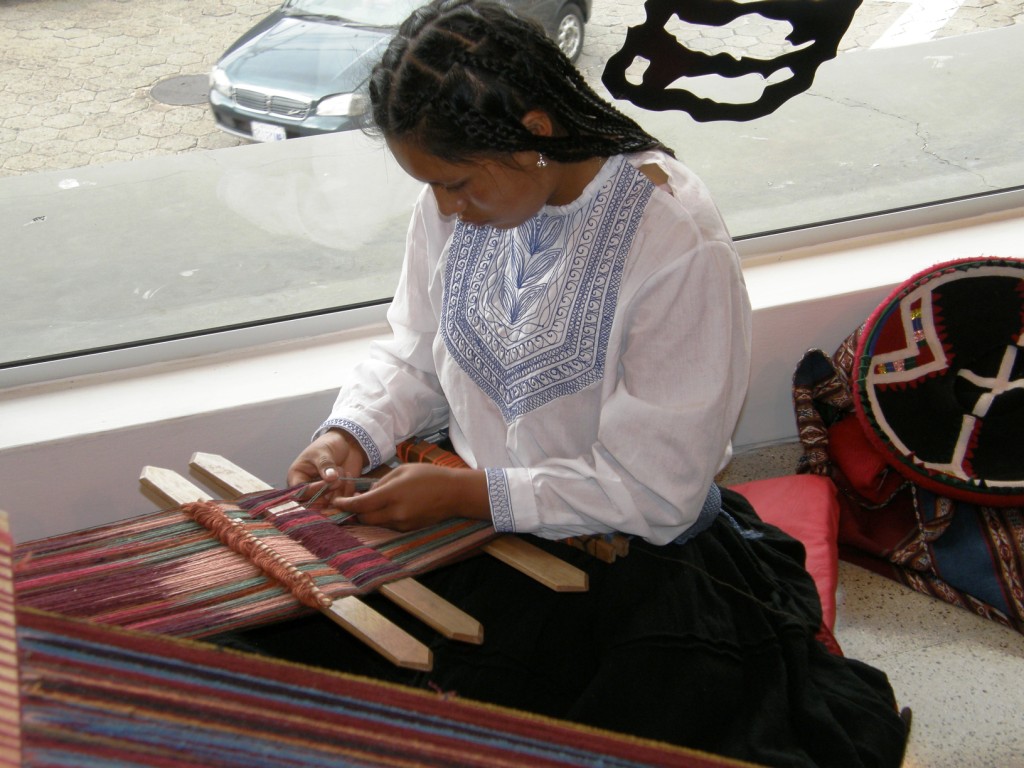
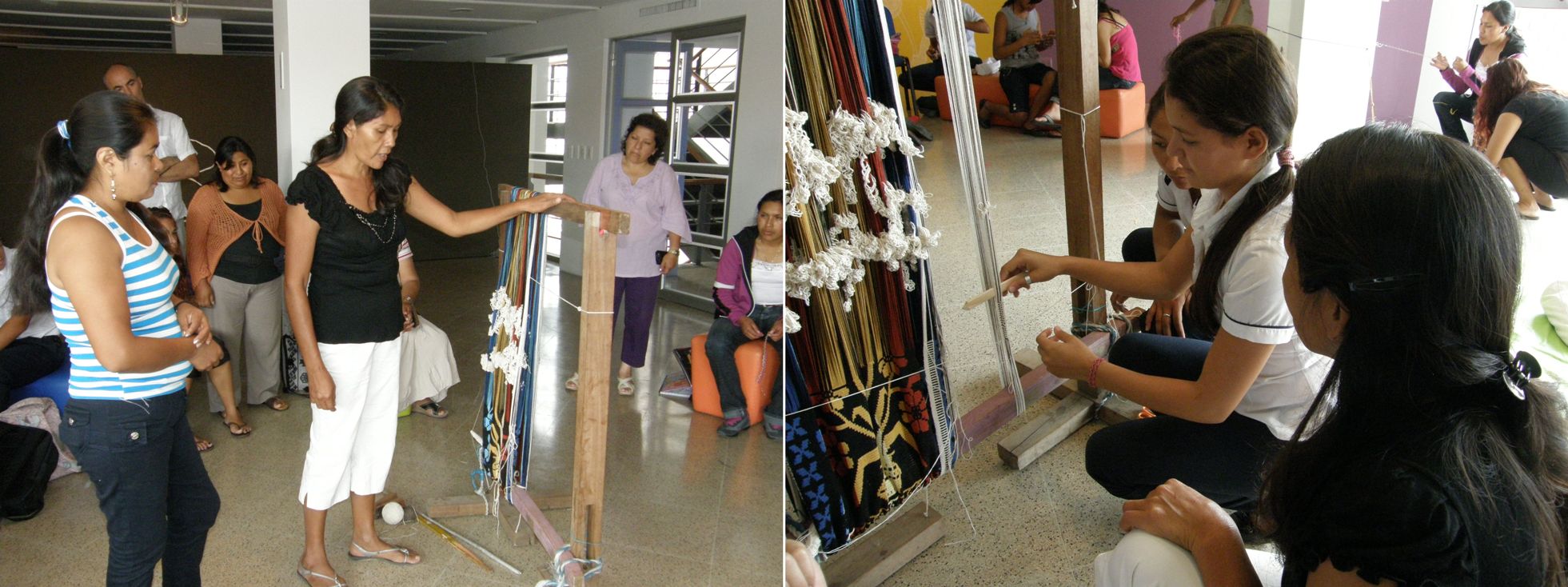
Day one had most of us barefoot and on the floor learning the fundamentals of backstrap weaving.

Okay, so I have already been backstrap weaving for fifteen years (which probably isn’t much in backstrap weaving terms) but there is always something to learn, right?

You can learn about the weaving traditions from a country, a region, a town, a community as well as from each and every individual weaver and this very small scale event was the perfect venue for sitting right by and having very close connection with the weavers themselves. And this interaction was not only possible as they showed and taught us their craft but also as they learned right alongside us the crafts of the other attending artisans.
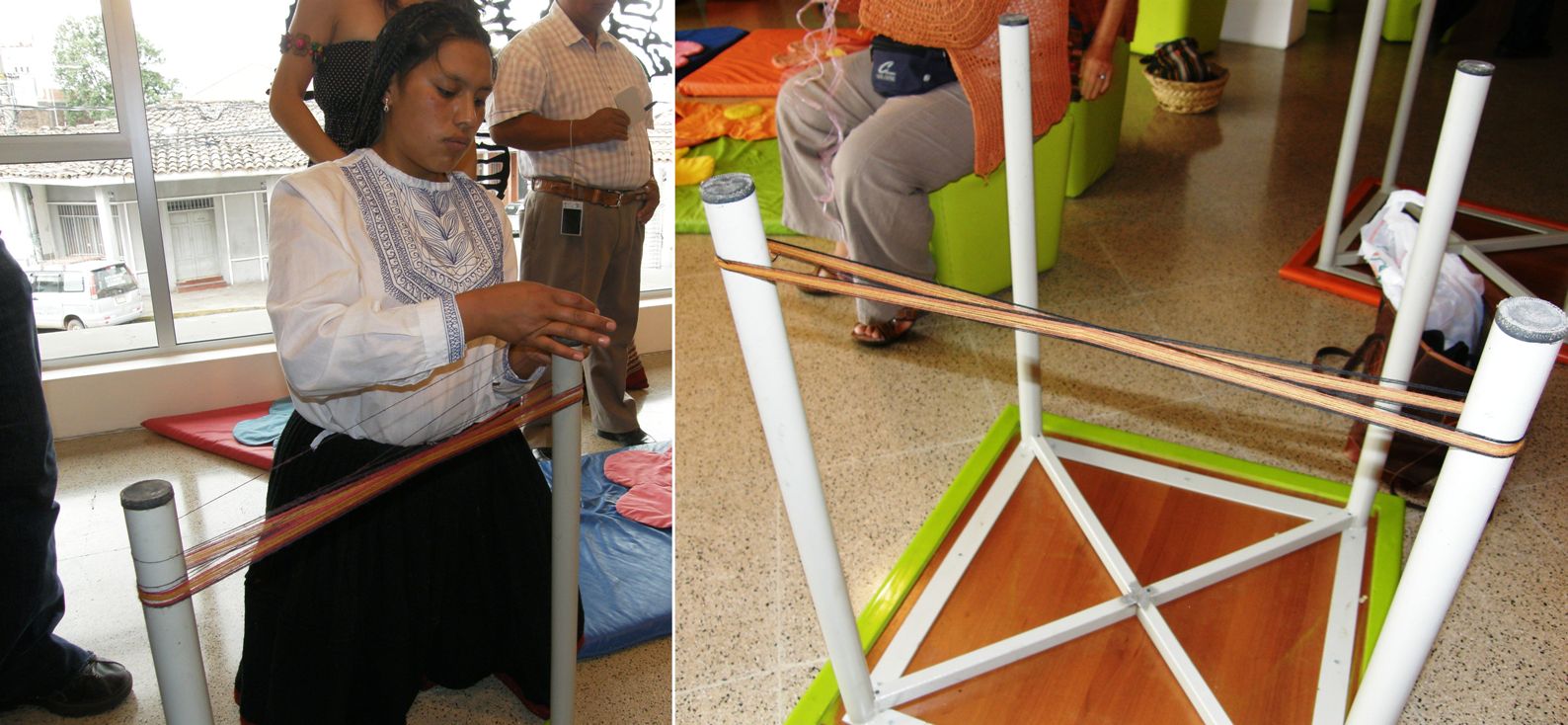
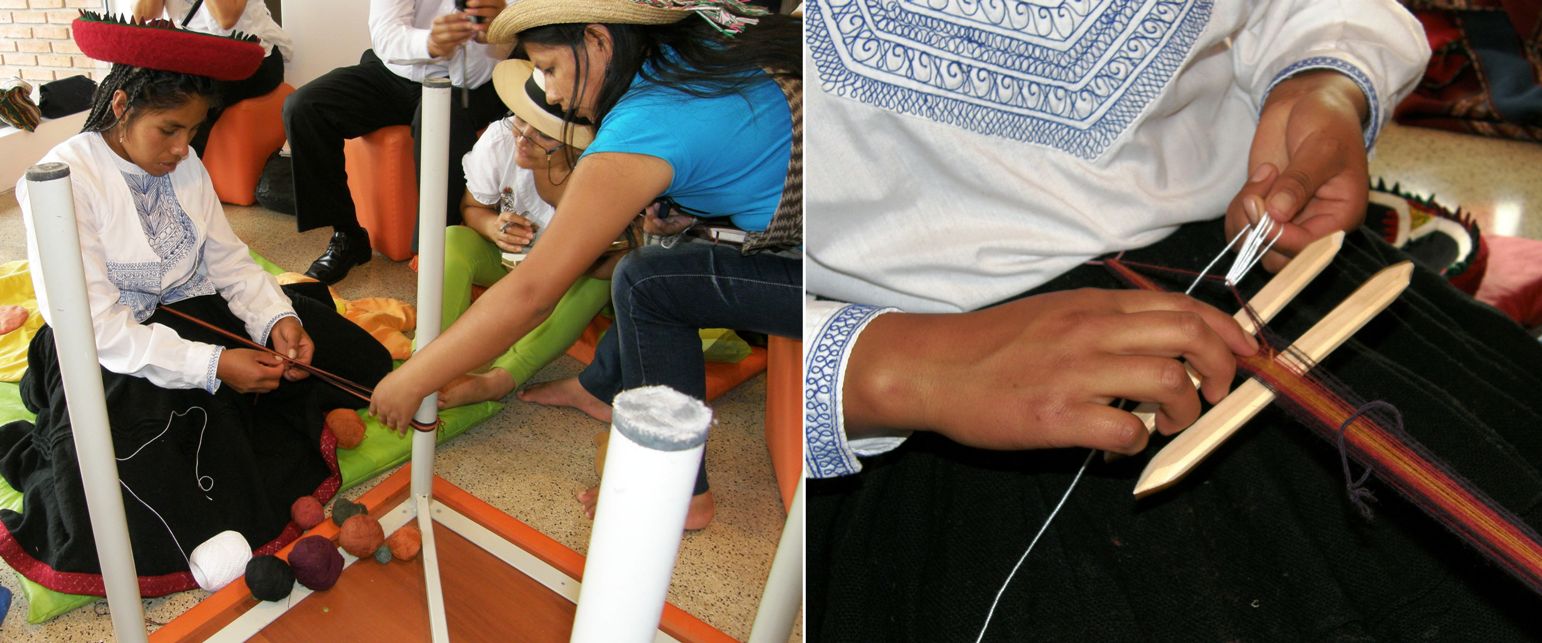
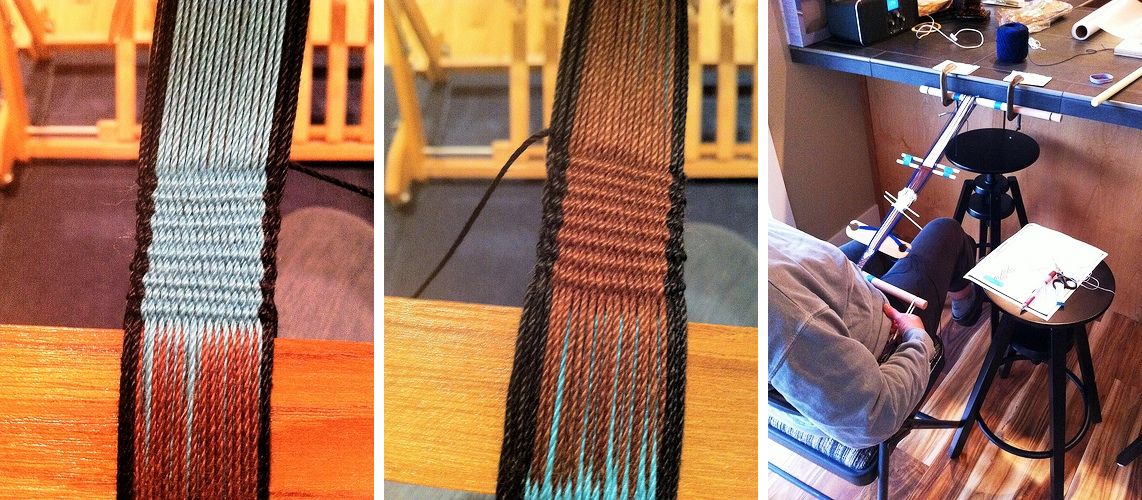
A lesson in warping…if your “stakes” are close together as these table legs are, you can simply hold your warp end against the stake (don’t tie a loop around the stake) and wind your figure-of-eight. When you are done with that narrow stripe of color, tie the end to your start end and then start your next color the same way. The advantages I can see of this…if one color has wonky tension, you can untie the knot and adjust without affecting the rest of the warp. If you warp a color that you decide later you can’t live with, you can chop it out easily without affecting the rest of the warp as it has been wound independently. Mind you, we were only warping narrow bands here of about 40 ends in five stripes of three colors and the warps were short which meant it was easy to anchor the warp end with one hand while winding with the other.

Next came strapping in, shed loop and heddle making, a demonstration of shed openings and weft management and then we all set about warping and weaving our own bands. Most problems arose, as can be expected, with opening the sheds smoothly and keeping the edges even.
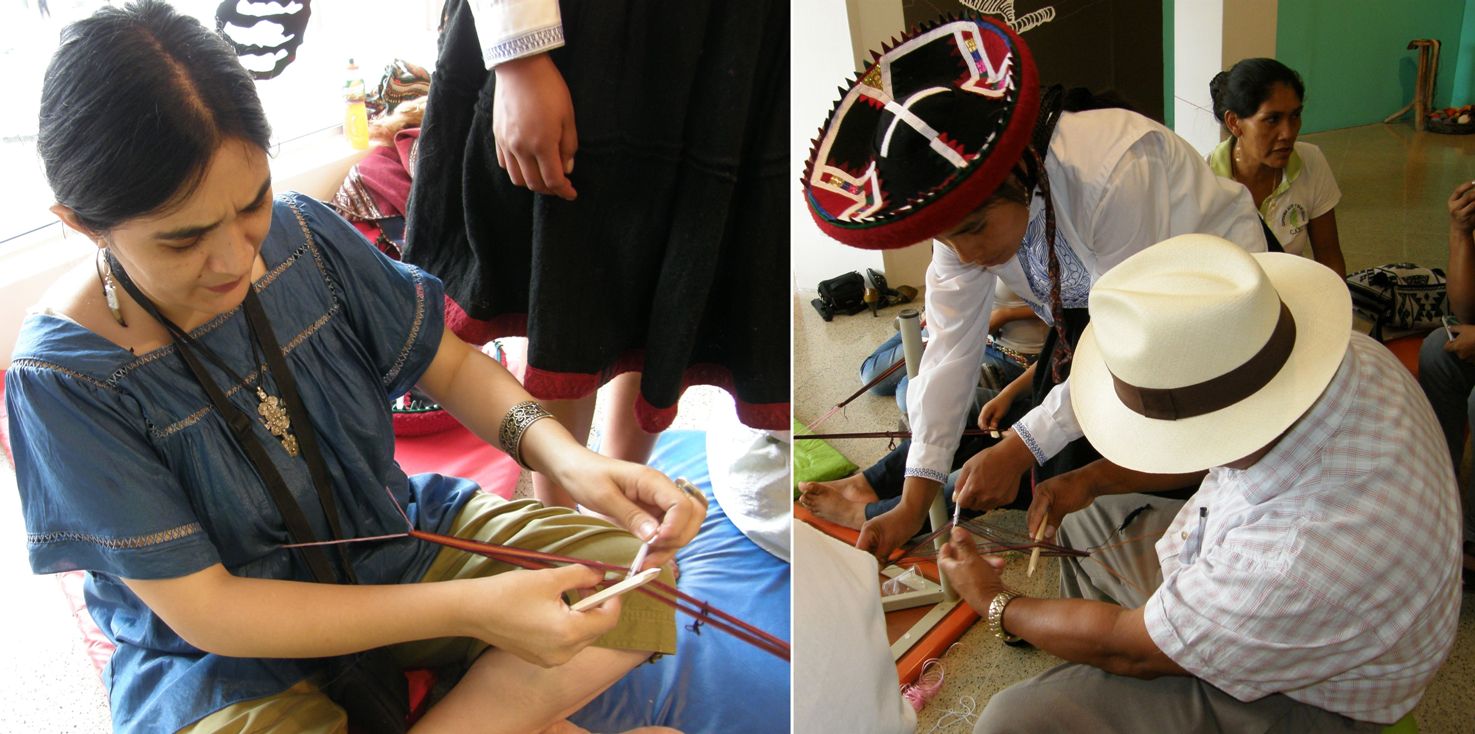
As usual there is a certain period of silent concentration in the beginning interspersed with pleas for help. You can always identify the Ecuadoran contingent by their Panama hats! That’s Domingo, the Panama hat master, on the floor getting his first backstrap weaving lesson. This silent period is soon followed by excited chatter and cries of victory as everyone starts to get the hang of it and relax.
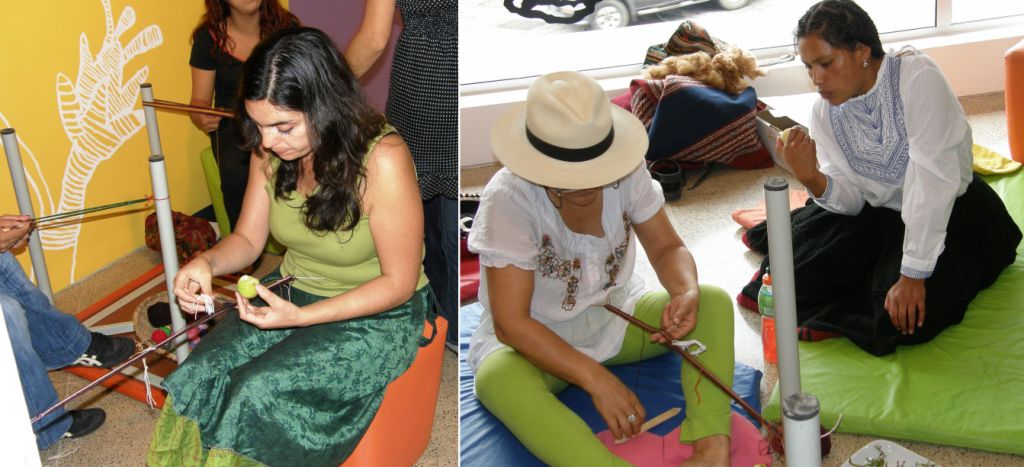
Snacks provided by the center….some participants are now so relaxed they figure they can even eat a peach and backstrap weave at the same time! That’s Mercedes from Mexico. Sonia has her students working away happily and can sit down too but is always keeping an eye on things as you can see. There she is watching over Libertad from…well, I don’t need to tell you where she’s from, do I!
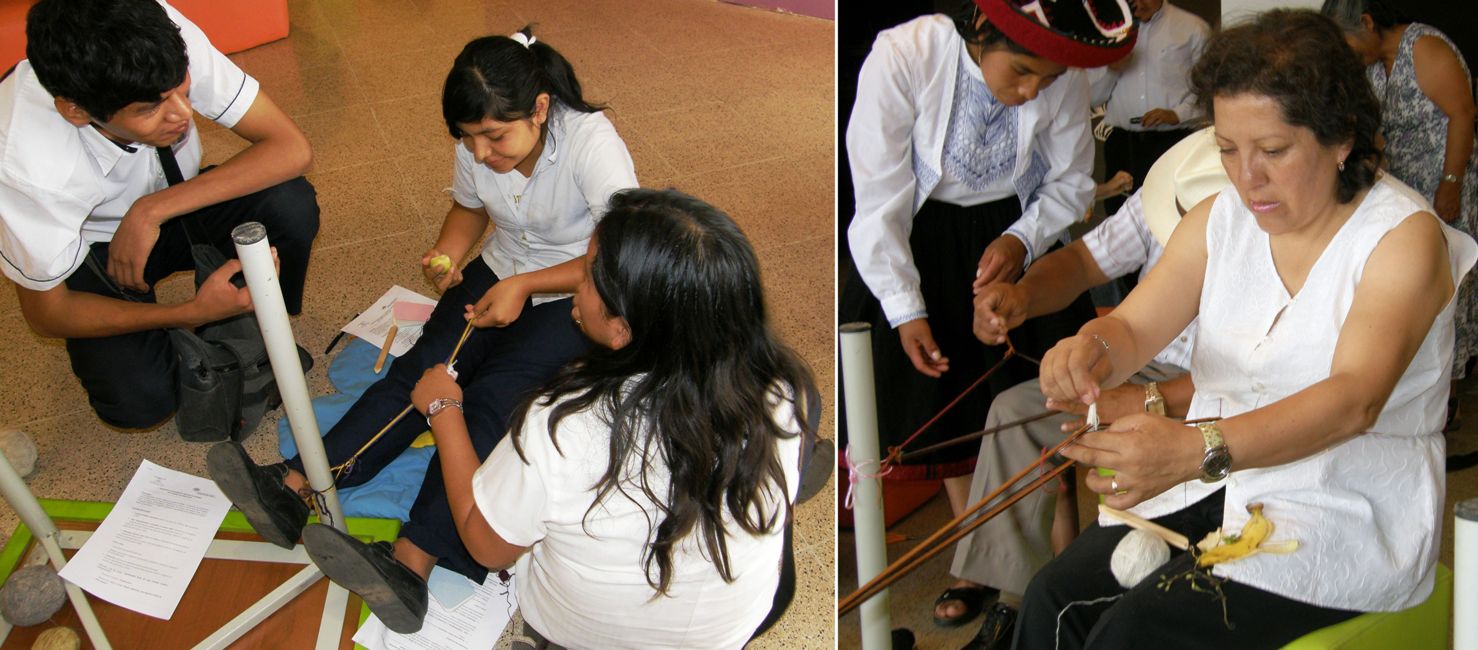
Some school kids dropped by and had some fun and there you can see Zenaida with members of her group getting acquainted with that tricky heddle shed. That’s Liliana from La Paz representing an organization called Nicobis which produces educational and cultural videos to promote intercultural dialog.

On the other side of the room, Aymara weavers Celinda and daughter Isobel were teaching backstrap weaving to another group.
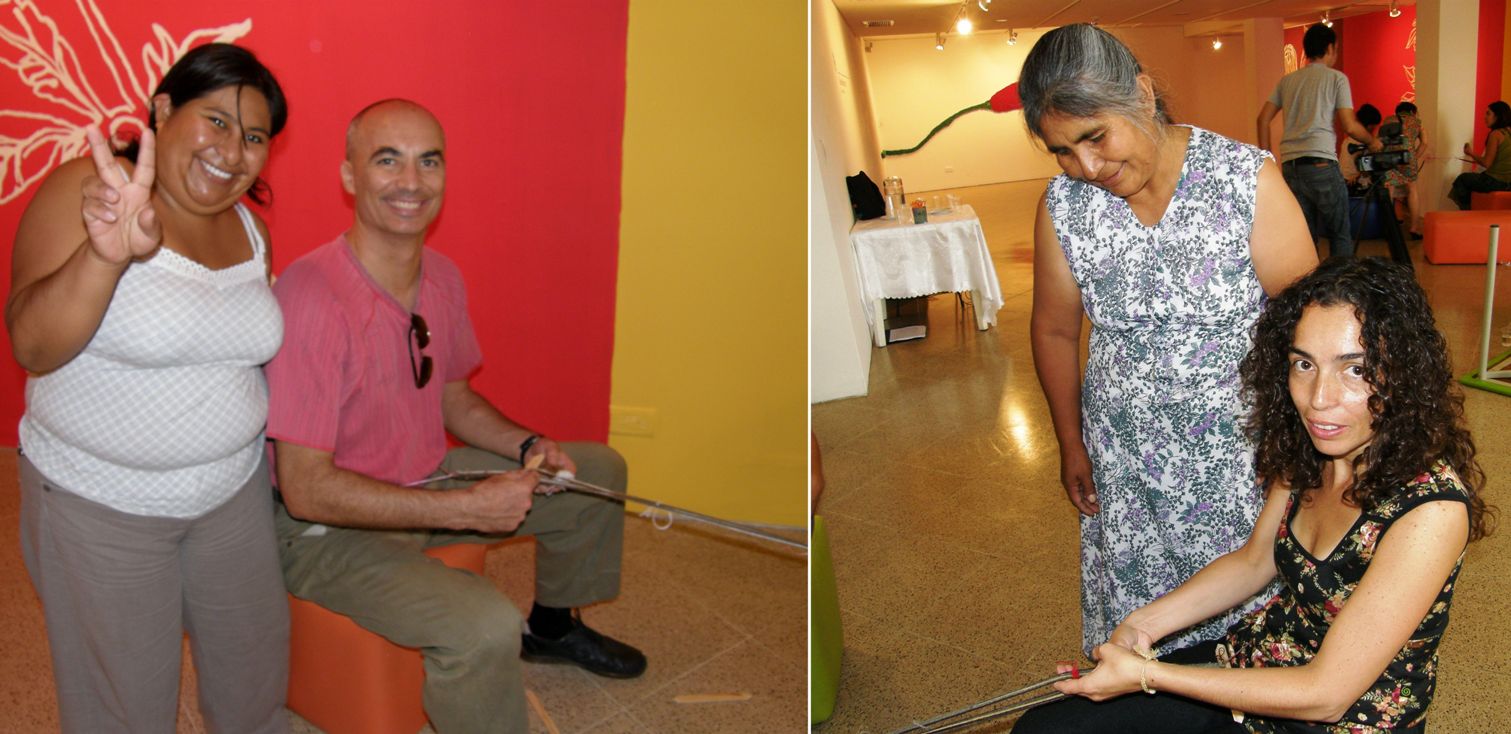
Isobel, always smiling and sharp as a tack, tells me that she does not have much patience for teaching. It’s hard to believe!
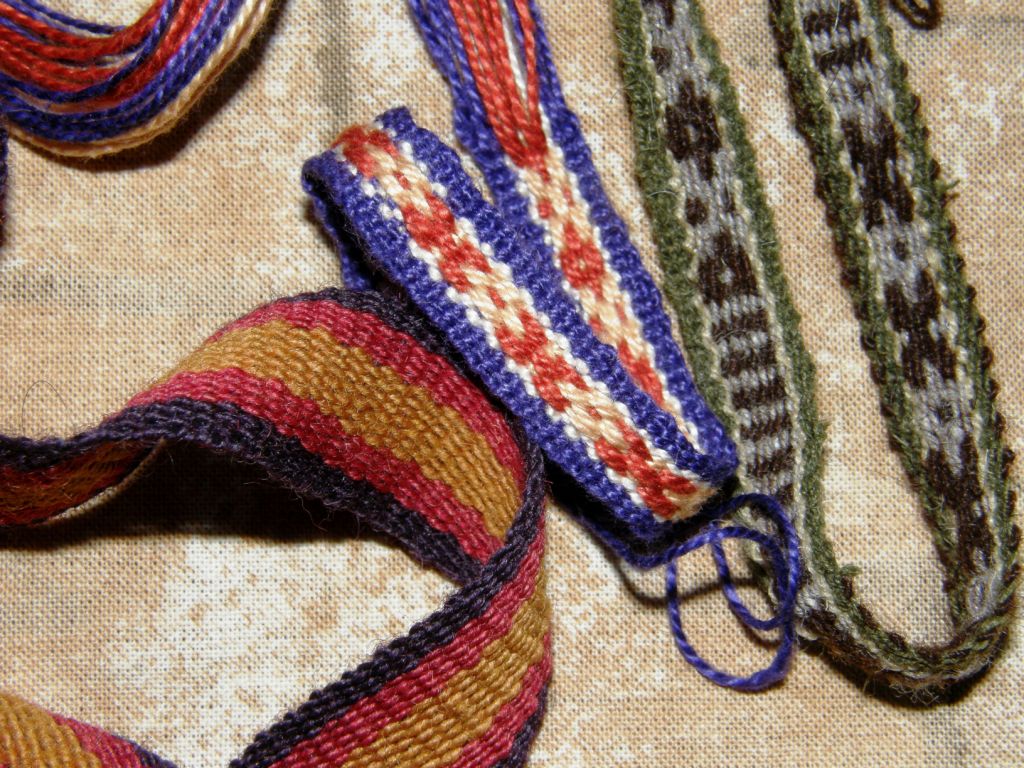
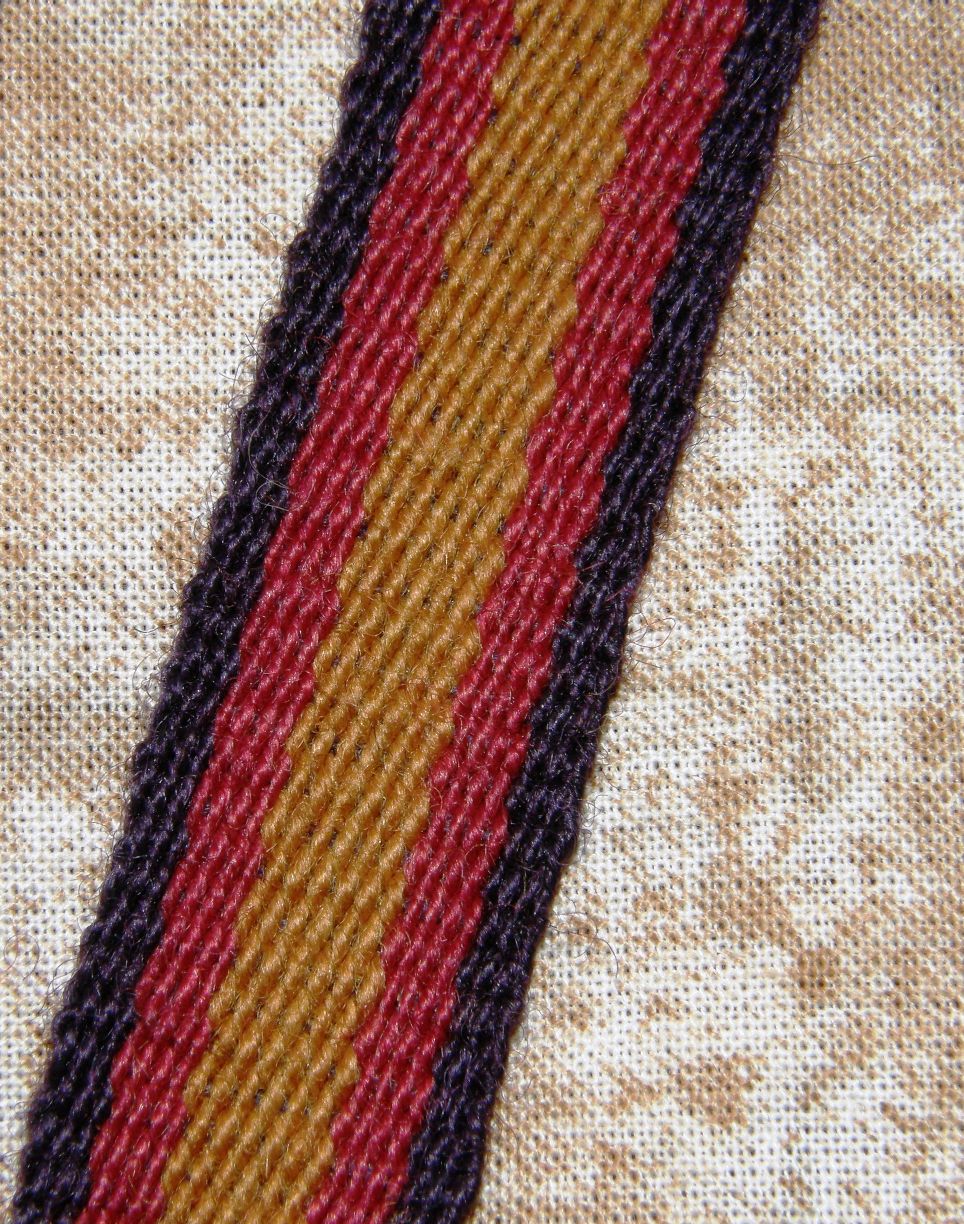
Materials!!

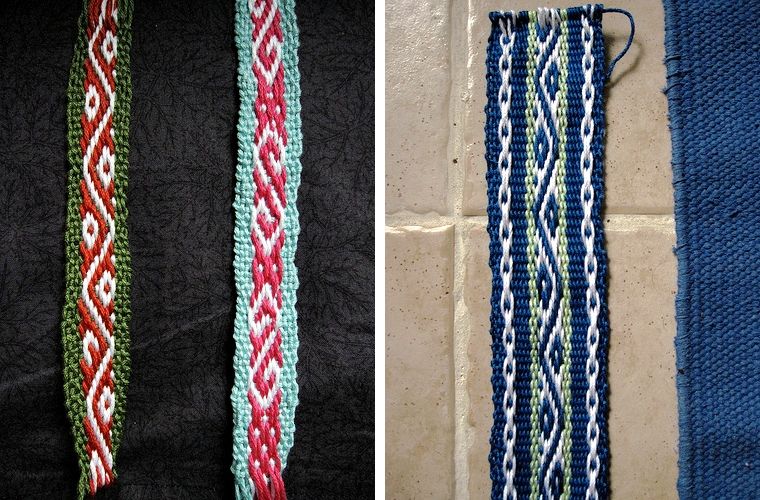
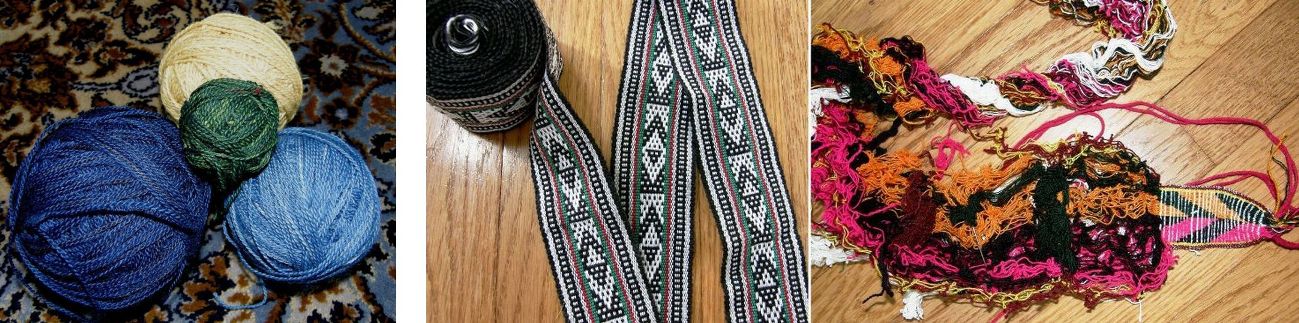
The twisty band above left is the one I made in Sonia’s class with the high twist wool warp and weft.

The one on the far right, I made with Celinda’s handspun alpaca fiber as both warp and weft. The green border is my own handspun llama fiber.

And of course, I wanted to have something made during the event from the material that the other group of weavers from Santa Cruz was using, Clea crochet cotton.

You can see the texture of the high twist wool on the surface of my little band at left which  gives a slanted look which I quite like.

All the while, a table was set up with various woven products made by the participating artisans and the groups that they represented.

Here you can see cotton goods made by the Guarani weavers using the kara pepo, moisy and simple warp float techniques (I don’t know their name for this technique, in fact, this was the first time I had seen anything made by the Guarani weavers with it).
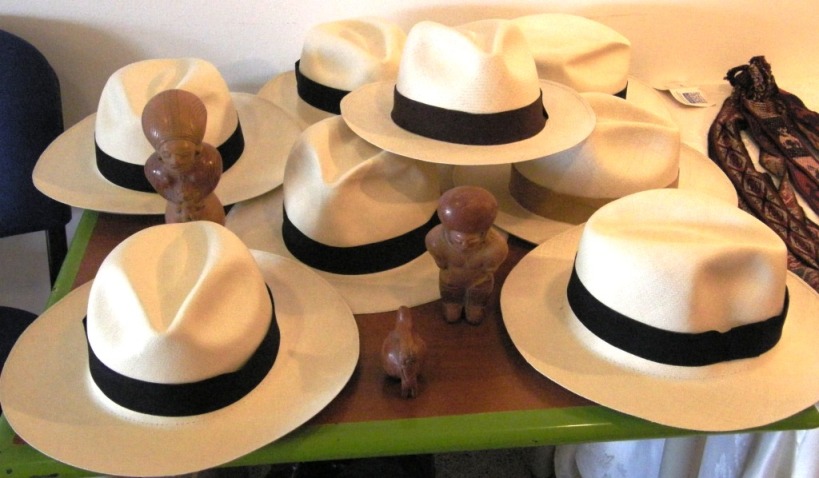
The next day was another of frenzied activity as we moved the focus to plant fiber…the paja toquilla and cabuya.

Domingo showed us how to produce the basic weave that is used in the spectacularly fine Panama hats which have their origin in Ecuador.

We soon learned that the basic weaving moves, while taking some time to grasp, were not all that difficult.

What was hard was maintaining good tension and Domingo patiently spent a lot of time trying to have each student position their hands as he does in order to produce a good tight weave.
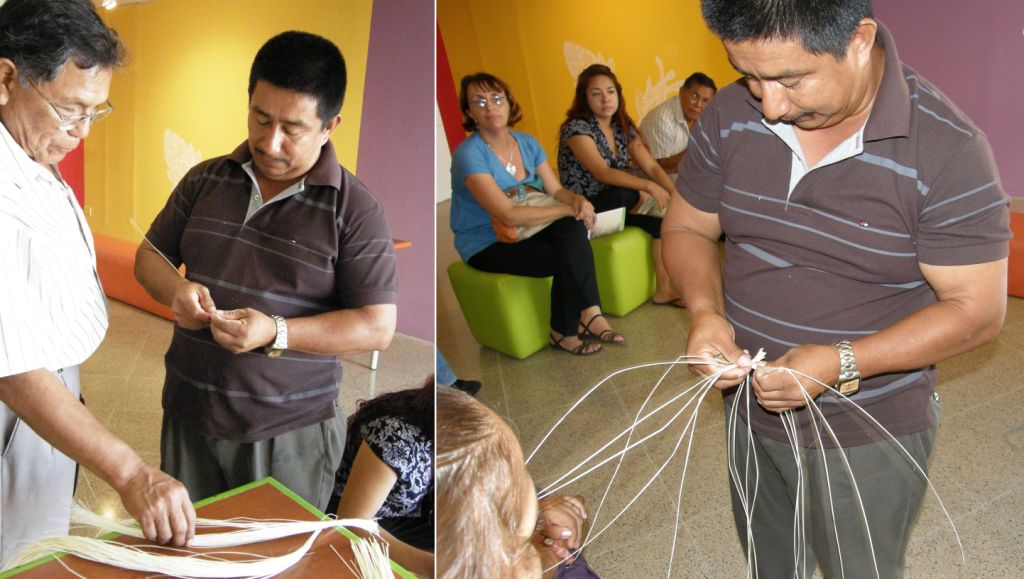
Bundles of twelve pieces of straw were prepared for the students. “Es facilito” (it’s really easy) Domingo kept saying referring to the weaving moves but admitted that weaving with correct tension was something that could take one years to perform at an acceptable level let alone the master level at which he does it.
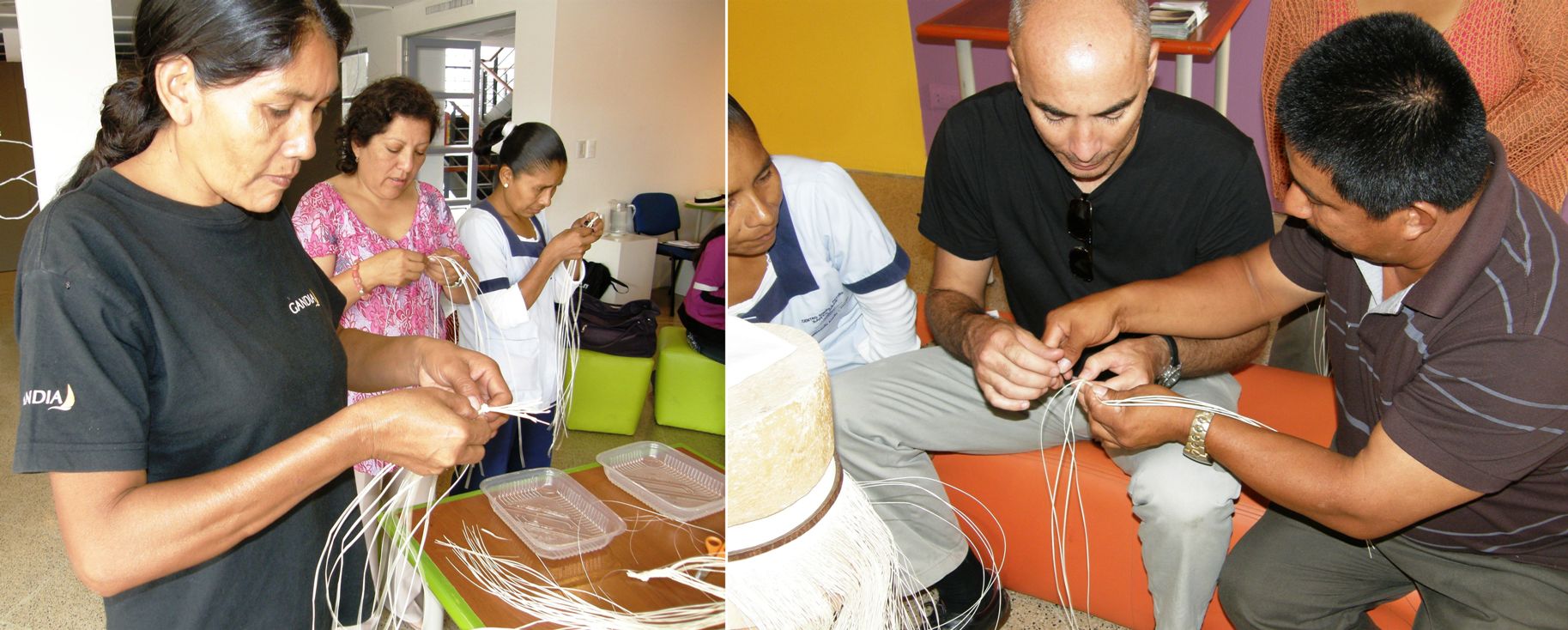
My Guarani weaving teacher, Angela was very keen on learning this. We have the paja toquilla here in Santa Cruz too where it is called “jipijapa” and so it made more sense to her to learn this craft rather than the cabuya work.

And here is the master at work…
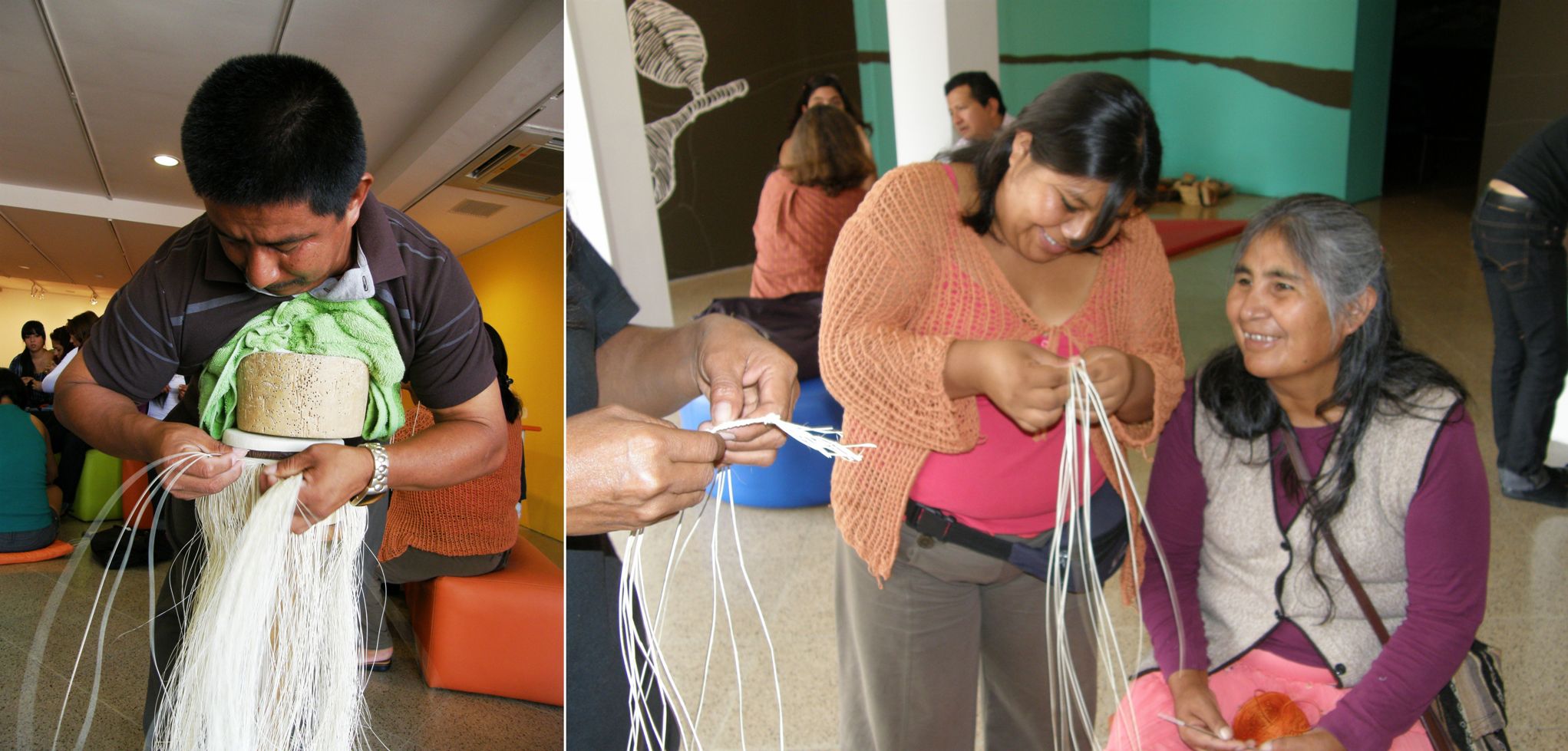

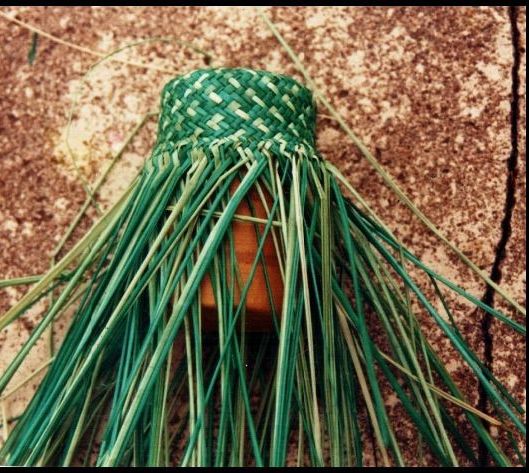
Above, you can see that Domingo, after weaving the flat top of the hat, is now weaving it down and around a mold to give it shape.

The picture at left of a miniature hat being worked over a mold will give you a clearer view of this. I spent an afternoon with a paja toquilla weaver in Gualaceo Ecuador and she showed the me whole process of making a hat in miniature.

Domingo stands bent over a post on which the mold and hat are propped, leaning on a wooden block and working with incredibly fine strands of straw. Maybe you thought sitting on the floor strapped into a backstrap loom looked a wee bit uncomfortable….

Above right, you can see Isobel, whom I told you is super sharp, working her fiber and showing her mum while exclaiming how “facilito” it is!

A few women in the Intag Valley in Ecuador still hand spin cabuya fiber.

Meanwhile, the ladies from Chinchero, Sonia and Zenaida, not in their traditional clothes this day, opted for cabuya fiber classes. With Maritza from Colombia they learned to crochet bags. This cabuya fiber is machine spun and chemically dyed in bright and lively colors and Sonia really took to this and got to finish her bag, made in black, neon pink with all kinds of glittery additions which Maritza had brought, in one day. It pretty well matched the colors in her outfit.

This cabuya fiber is much finer than the fiber that I worked with when I stayed with members of a cooperative in Ecuador. There the fiber was dyed with natural substances, was coarser and all together more rustic looking.

The women in the cooperative, crocheted, knotted and wove the fiber into mats, bags and other accessories.

On the left is a crocheted mat I bought from the co-op, a woven bag that I was taught to make during my stay in Ecuador, and a piece I wove at home on my backstrap loom. All these colors are from natural substances.

The cabuya fiber brought by Maritza is fine, smooth and consistent, lovely to work with and the colors sing!

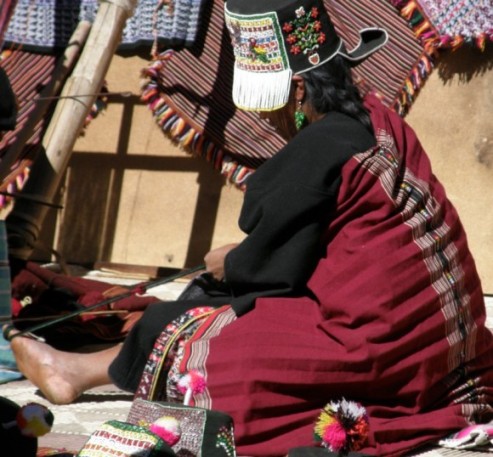
So, day two’s workshops were intense. In the midst of the madness, Ayamara weaver Celinda quietly took up her loom and started to weave and of course, I was immediately drawn to her as was Angela.
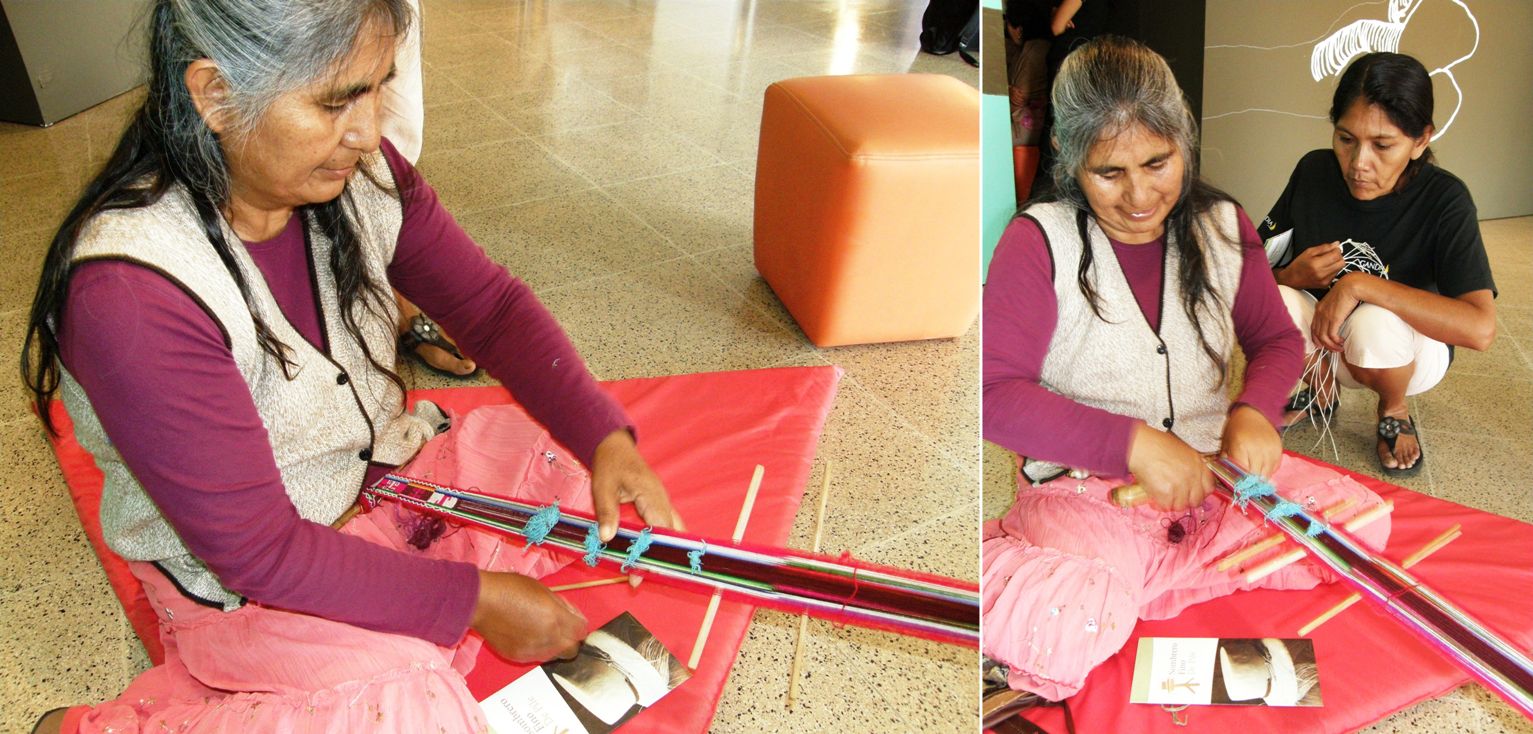
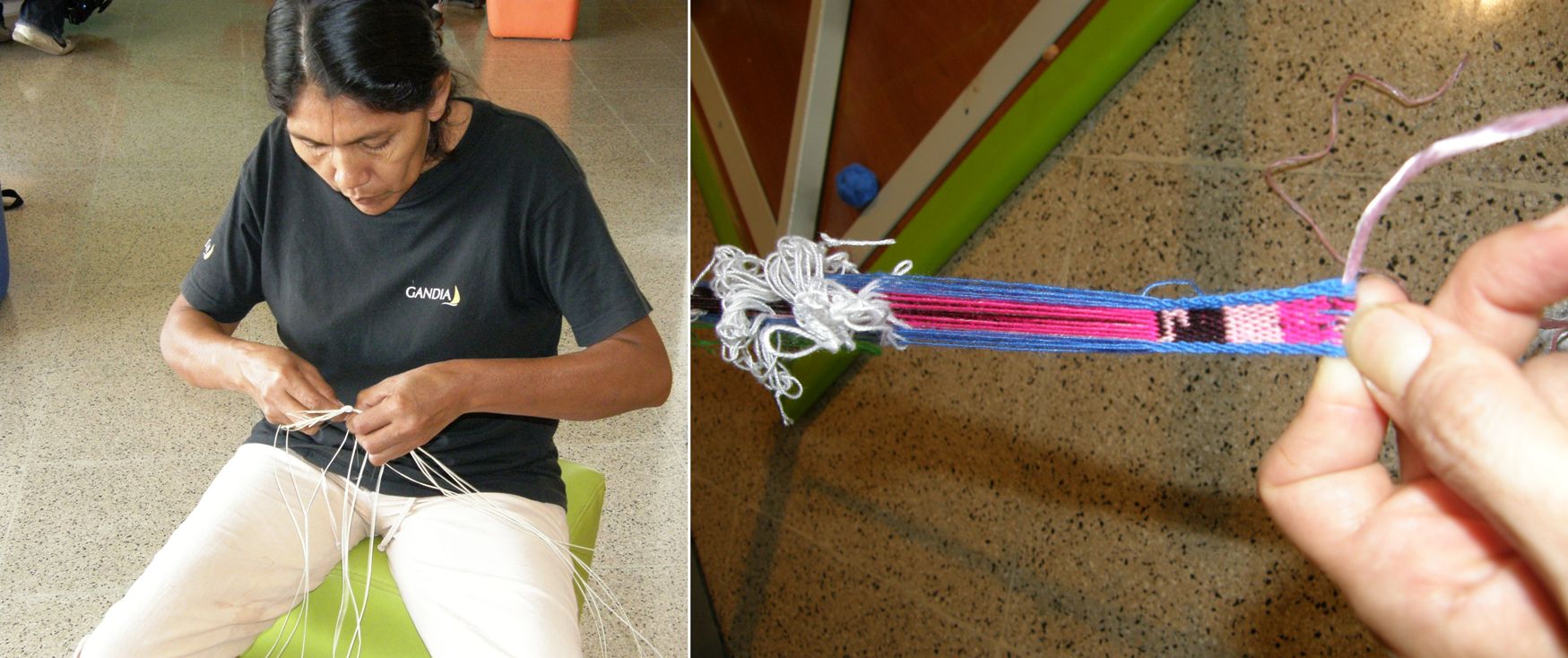
We got some nice relatively quiet time with Celinda and I got some good video of her on which you can hear all the noisy fun of the cabuya and paja toquilla weavers in the background!

Two of Angela’s new skills…weaving straw and weaving a triple color band. The afternoons of this conference were reserved for interaction between the artisans and, that afternoon, Angela spent more time with Celinda and learned her triple color technique. The Guarani weavers have a very special way of making their string heddles joined by a chain and you can see Angela’s signature heddles on this Aymara style band….two cultures joining hands in the one piece.

On day three, it was Angela’s turn to present and a class of teenagers was invited to see one of Santa Cruz’s own indigenous artisans at work. First, as a warm-up, Carla taught finger-loop braiding that she had learned in Chile. This was the first time that everyone participated in the same activity at once and, with all the enthusiastic kids there, it was explosive! This was a new braid for Sonia and Zenaida and I hope they will have fun teaching it to their friends in Chinchero.

Domingo particularly enjoyed the braiding and was braiding all evening during the conference presentations.
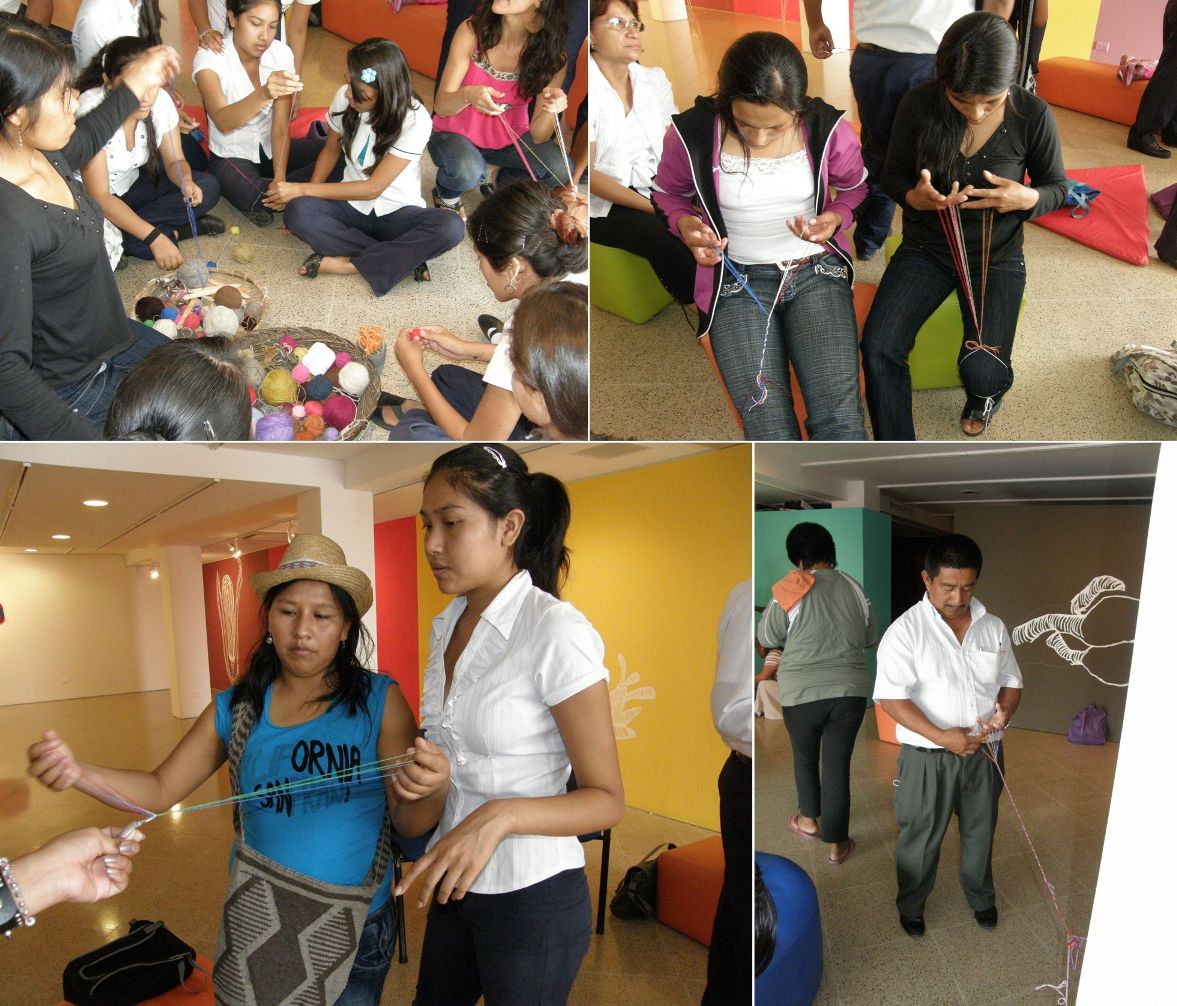
Then it was Angela’s turn  to show how she warps a band using the dovetail warping method and the school kids were keen to try their hand at weaving.
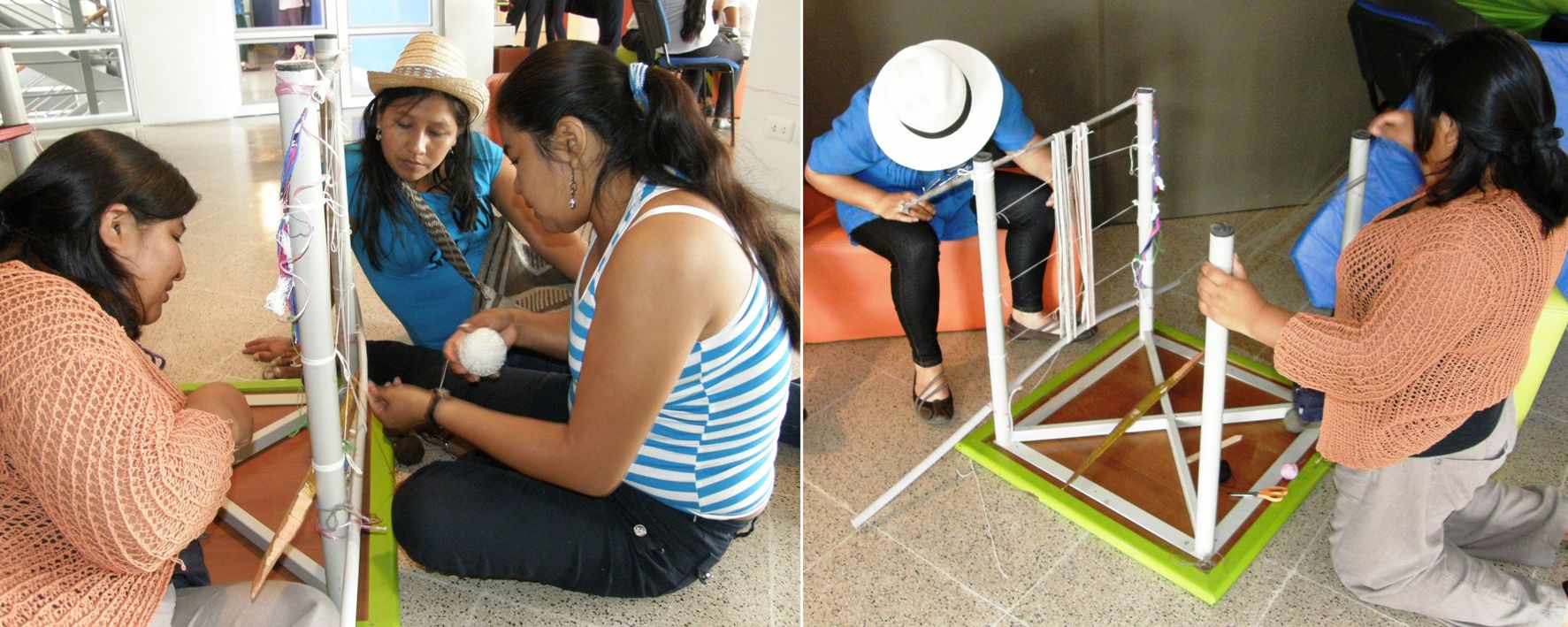
Over in the corner and away from all the riotous enthusiasm, Guarani weaver Marioly showed Maritza from Colombia and Isobel from Chile the dove tail warping system using  the table legs as an improvised vertical loom.
Maritza is from the Nasa ethnic group of Cauca in Colombia. It is terrible how little I know about Colombia. After Maritza’s evening presentation at least I can say that I know that in Colombia there are 102 indigenous groups and 64 languages amongst them. One of the most important woven  items for the Nasa woman is the chumbe, a belt which is used amongst other things to strap a baby to its mother’s body so it can be carried about and/or comforted. Maritza herself is not a weaver of cloth but has dedicated herself to working with the cabuya  fiber instead.

A new online friend, who is from Colombia, shared this link with me for a page of  beautiful images of people of the Guambiano ethnic group of Colombia who are from the same area of Cauca as Maritza. I really need to adjust my mental image of Colombia!
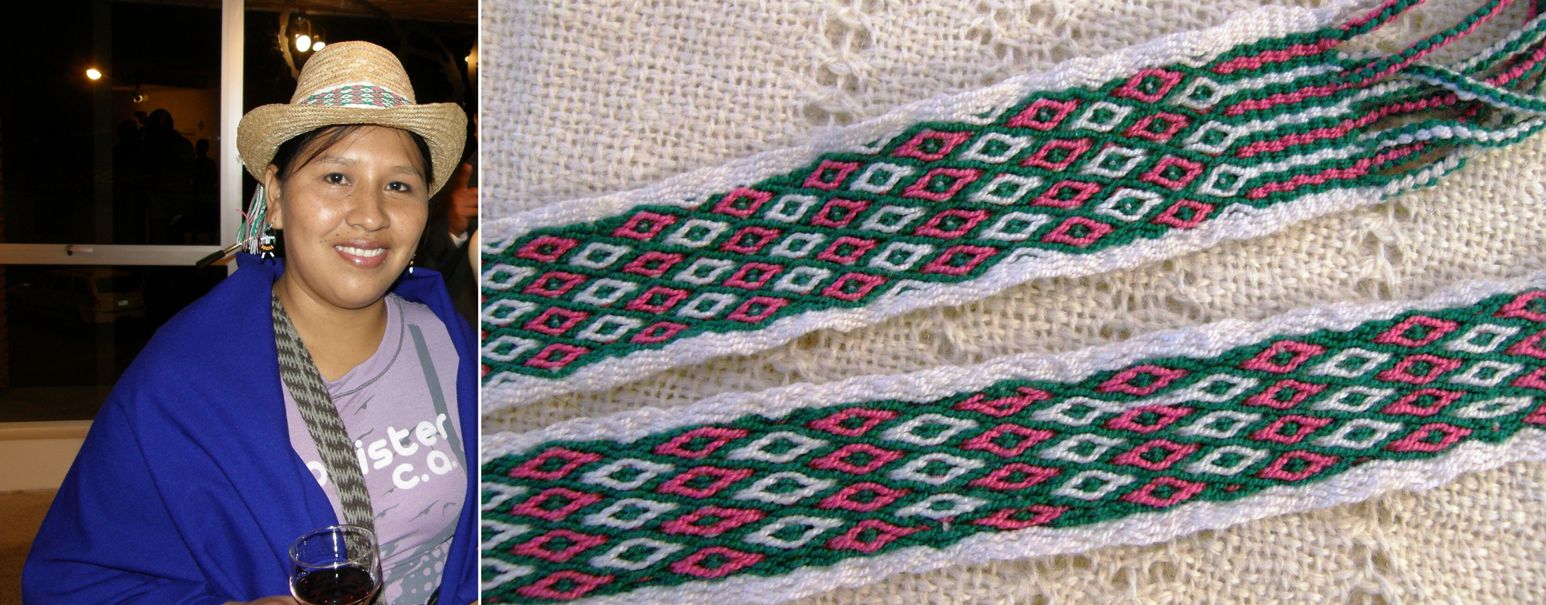
She told me that many narrow items, like the band which adorns her hat, are woven on a very simple loom which comprises little more than a forked branch.

Business and pleasure…it was all pleasure for me! Sonia and Zenaida took to the podium on the final evening to tell us about the work of the CTTC (Centro de Textiles Tradicionales de Cusco) and answer questions. Jean Paul of Ecuador and Mercedes of Mexico serenaded us with harmonized Cuban songs.
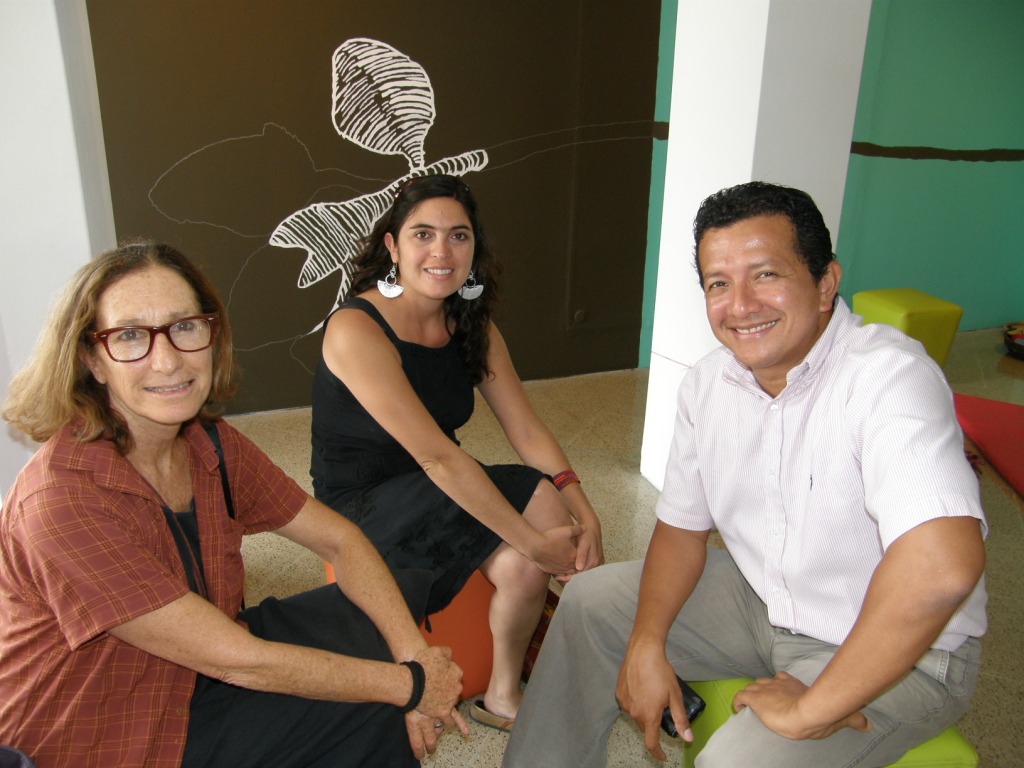
I really enjoyed meeting Maria Elena, above left, from Peru, who gave a lecture on her research into the bags made from garabatá fiber in Peru (a fiber that is also used by the Ayoreo people here in Santa Cruz). We discovered we have some mutual acquaintances in the weaving world.

A last look at some of the textiles…
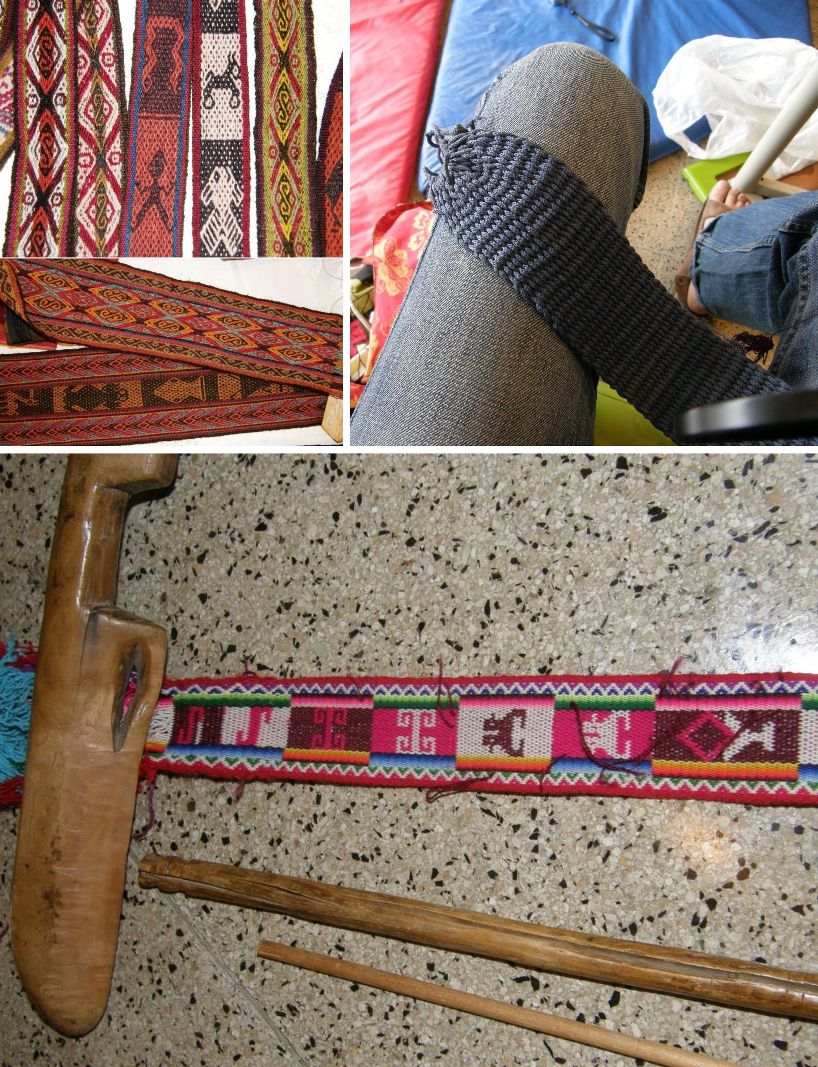
Chinchero textiles at top left, an Aymara triple color belt below and Sonia’s simple and practical backstrap! Of all the textiles there, the backstrap is the one I would have liked to have bought! I would USE it.

So now I am wondering… Will a finger loop braid or two soon be adorning a Panama hat!?…just a fun thought…but, more importantly, will some school kids in Santa Cruz now be able to recognize a Guarani woven bag if they see one in the street and will they be able to tell people something about how they are made? And this I don’t need to wonder about…I know for a fact that Angela will have a three-color band underway on her loom and most likely finished the next time I see her!

######################################################

The Weave-Along is over on Ravelry, the Spin-Along is going but, naturally, is slower to give results. In the meantime we are all still weaving along and finding it hard to drag ourselves away from the loom!
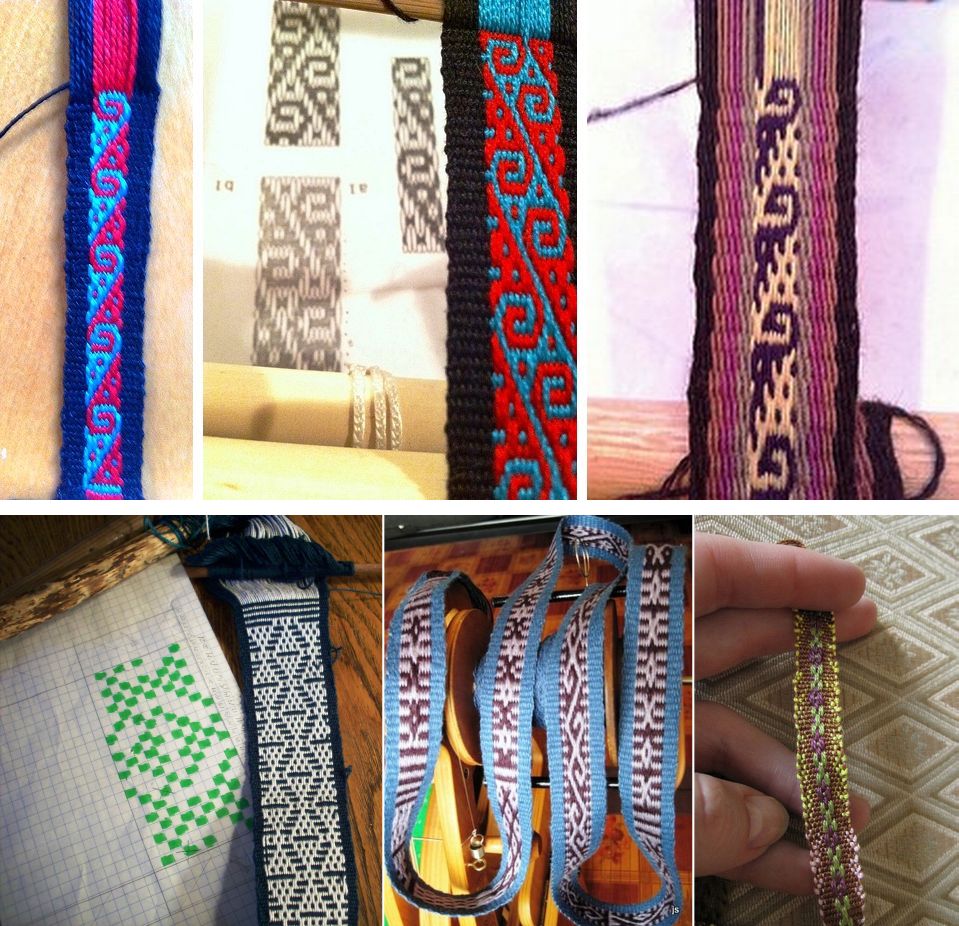
At the top, Jennifer has been producing swirls and curls of traditional, as well as her own, design. Linda wove a traditional design of coastal Ecuador into a bookmark using simple warp floats. The chart is here. Both popsicletote and Tracy have been exploring the tanka choro motif of Chinchero Peru. And I know that there is a lot of spinning going on there behind the scenes too.

My apologies to those to whom I promised some information on links and articles on the woven belts of the Russian Old Believers this week. I think this week’s post has gone on long enough and I would rather do the topic more justice in a separate post next week. See you then!
Backstrap Weaving – Barefoot Weaving

As the Backstrap Weave Along progressed on Ravelry this week and I got on with my own projects here at home, I was once again reminded of all the reasons I love the backstrap loom. Two things stood out in my long backstrap loom-love list…

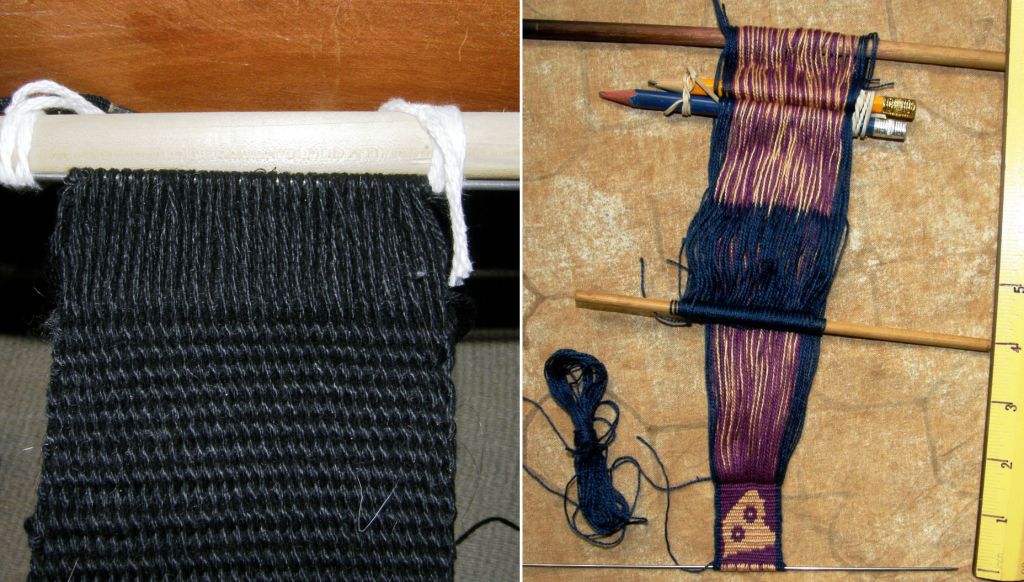
Number one: Minimal loom waste! One and a quarter inches in this case. I could have made it a four-selvedge piece and wasted nothing but that wasn’t necessary for this project. This is the back panel of my loom bag.

Number two: The ability to weave on tiny warps. I needed to sample a new design I was charting to check for scale so I was able to wind and weave on a ten and a half inch warp. In fact, I probably could have gone even smaller.

Which brings me to the title of this blog post:

BAREFOOT WEAVING

When I was teaching English here we had a visit from an American teaching consultant who introduced us to the concept of what she called “barefoot teaching”. She had developed this after having spoken with many teachers, especially those living in the developing world, who had convinced themselves that they simply could not teach effectively without flashcards, computers, dvds, interactive boards and all other kinds of whiz-bang audio-visual aids. It basically involved setting yourself the challenge of leaving all the tools at home and going into class with nothing more than a lesson plan and a piece of chalk (as well as a lot of enthusiasm and creativity)…in other words “barefoot”.

Talk in the backstrap group during the weave along got me thinking back to my first Peruvian weaving teacher and what one really needs to get started in backstrap weaving…basically your back, some thread/yarn and a toe! (and a teacher or an example to follow). Real barefoot weaving!

Little Juan Miguel above has a stake driven into the ground to which his warp is attached – his only real piece of equipment. If it were a shorter warp, he could use his toe. A string passed through the end loops of his warp goes around his waist and acts as his “loom bar” and “backstrap”. He is using a string loop for one shed and string heddles for the other. He isn’t even using a beater or sword. His hands do the trick. After passing the weft he opens the other shed and pulls the upper layer of threads up while pushing the others down in  order to force the weft into place.

A warp can even be wound around a forefinger and toe.

Don’t get me wrong, I won’t be tossing out my loom bars. I like using them even for the tiniest of warps but it is nice to think back to how I got started. We used pencil-width sticks about five inches long for loom bars, slightly longer ones for cross sticks and we had a beater. My teacher tied a cord around my waist and lodged the stick under it. Cord was passed through the other end of the warp which was attached to a rose bush so we could weave tiny pebble weave bands.

Here is my first teacher with her set of small tools. Oh yes, long thumbnails help too for heddle making and separating warps. I am at home now and have let mine grow shamefully long!

So, that was what I was pondering while visiting the weave along forum. Others there have had cause to ponder their yarn and project choices…another week of successes with some frustration thrown in but the sense of humor permeates all…

Here are some results…

Jennifer has gotten started on her first double weave project and has found her ideal place to weave attached to the kitchen counter.

Tracy has left us to go to India for two weeks but posted pictures of her pebble weave bands before she took off.


Jennifer also extended her pebble weave skills to a pattern in Marjorie Cason and Adele Cahlander’s book. Bobbie moved on to fine number 10 crochet cotton and wove a pebble weave band too.

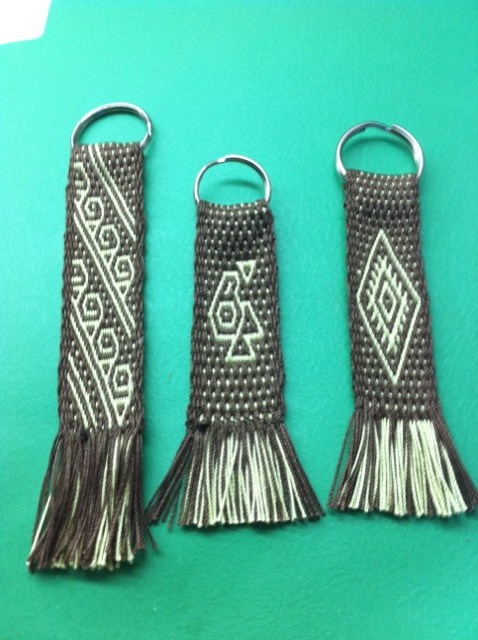
Fliegnepilz finished her pebble weave band. She took a classic design and added her own ‘twist’ by alternating the color of the diamonds. She named this project “Open Sesame!” when she posted it on Weavolution…I must ask her about that. She made this into a keyfob.

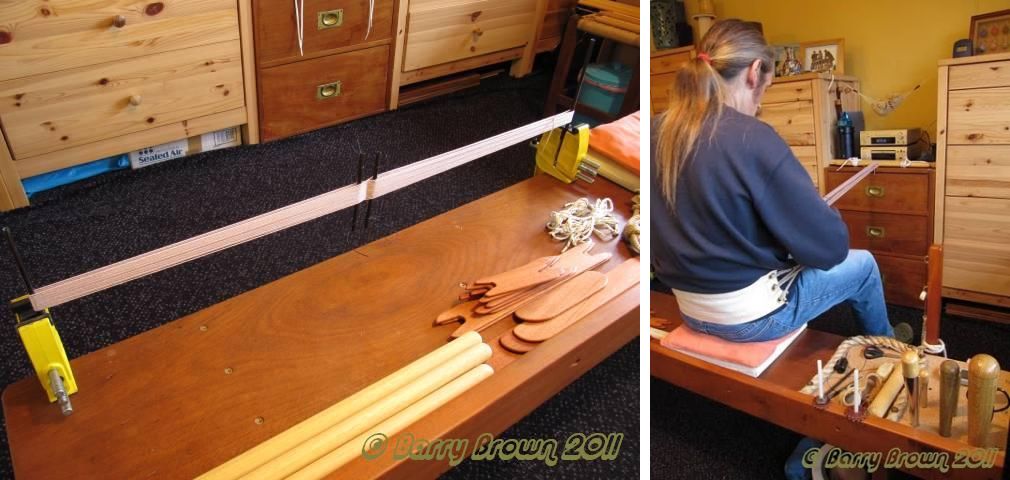
And then there’s Barry who recently joined the group and posted pictures of his warping and weaving set up…all his own handmade tools.

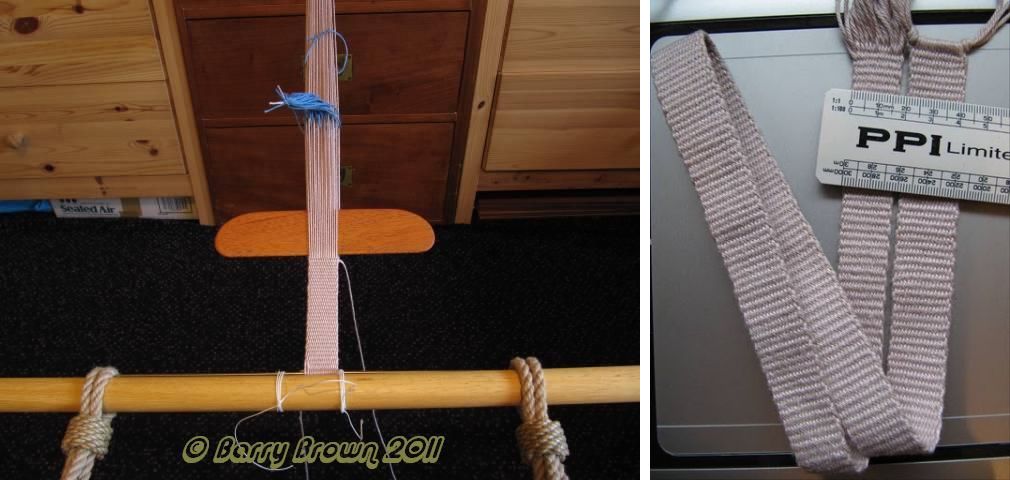
And the result of his work…his first backstrap woven band…

He is pointing out the fact that his band narrowed slightly toward the end, he knows why and knows how to prevent that for his next project.

I also got some pictures from blog reader, Linda who is weaving the practice band that I recommend in my WeaveZine article…


Basically everyone is sticking with narrow bands to learn and practice new techniques which is the best way to develop all those new skills. We have  come to the conclusion that going wider should be taken in baby steps. A couple of people have warped up for wider projects but have decided to stop and rethink as the leap was perhaps too great.

Jennifer has the brilliant plan of sewing several narrow bands together to make a small purse. Marsha has been doing that for some time with her simple warp float projects creating the purses and tote bags that I have shown here in past posts.

I decided to gather some sample bands and leftovers to show you here what one could do to make a simple piece wide enough for a tiny purse. I don’t have great variety of colors to show. These have been done in my thick demo yarn which does not come in many colors.


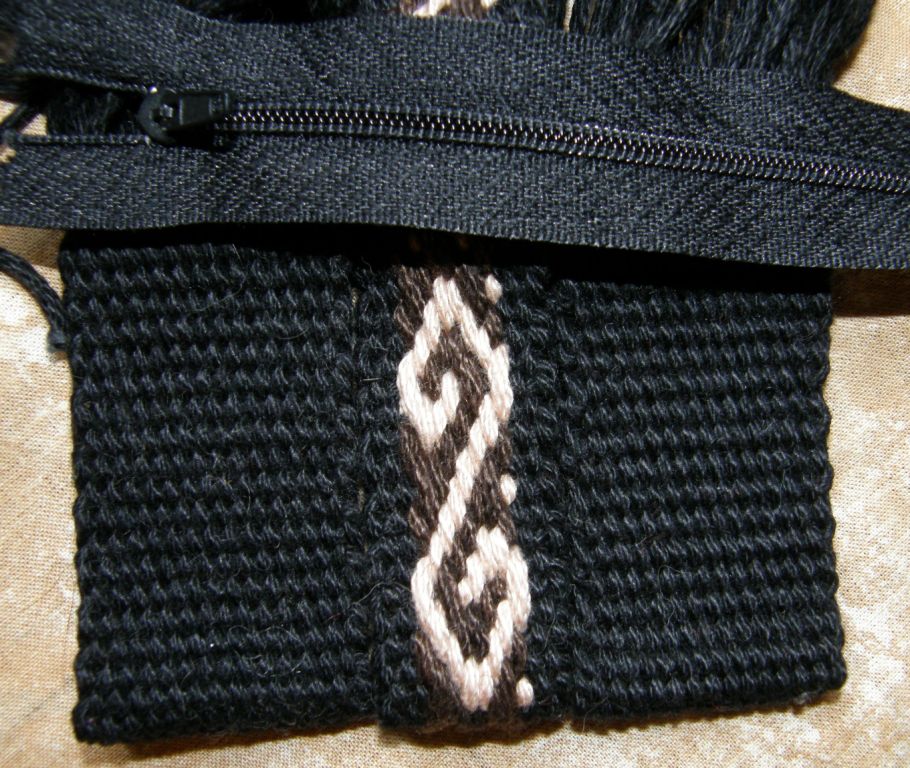
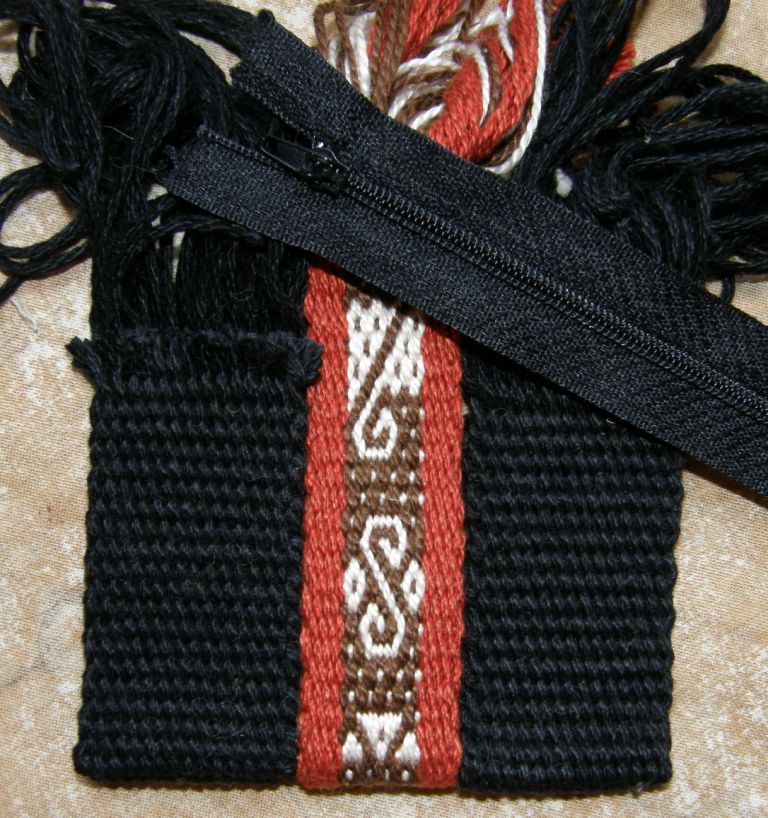
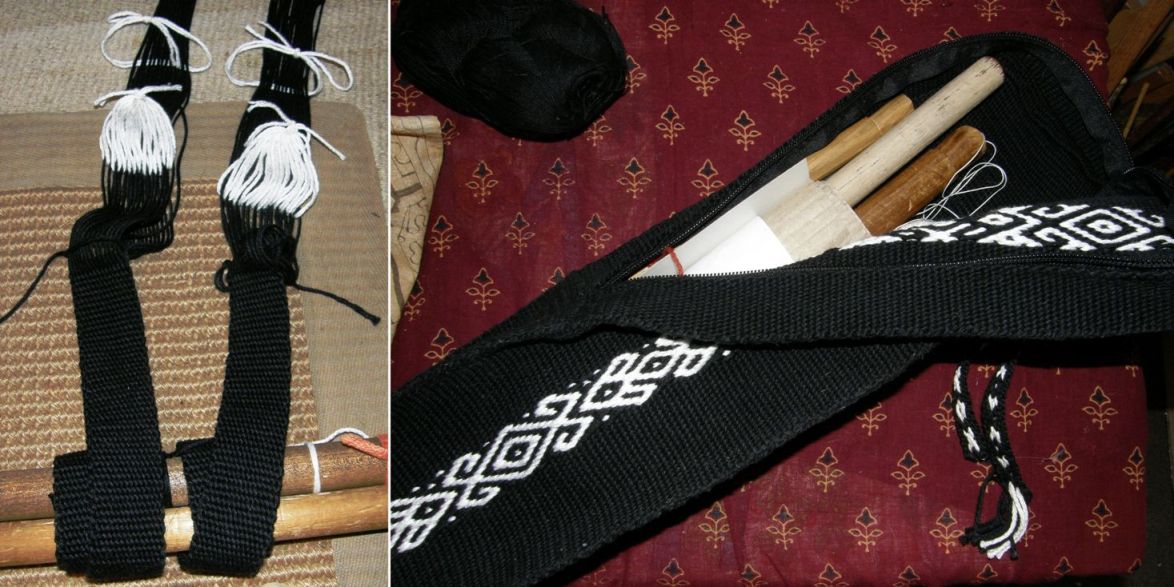
I have these two black off cuts from the loom bag I am making plus a pebble weave sample band I made ages ago. These three bands could be pieced together to make something. I have just placed them here together as an example.  A Van Dyke or other embroidery stitch could cover the joins if they are too obvious.

Here are the same two off cuts with another simple sample band that I have made in finer yarn.  Join them , add a zip and voila! a small coin purse or credit card case. You can see another even simpler red and white pebble band below.

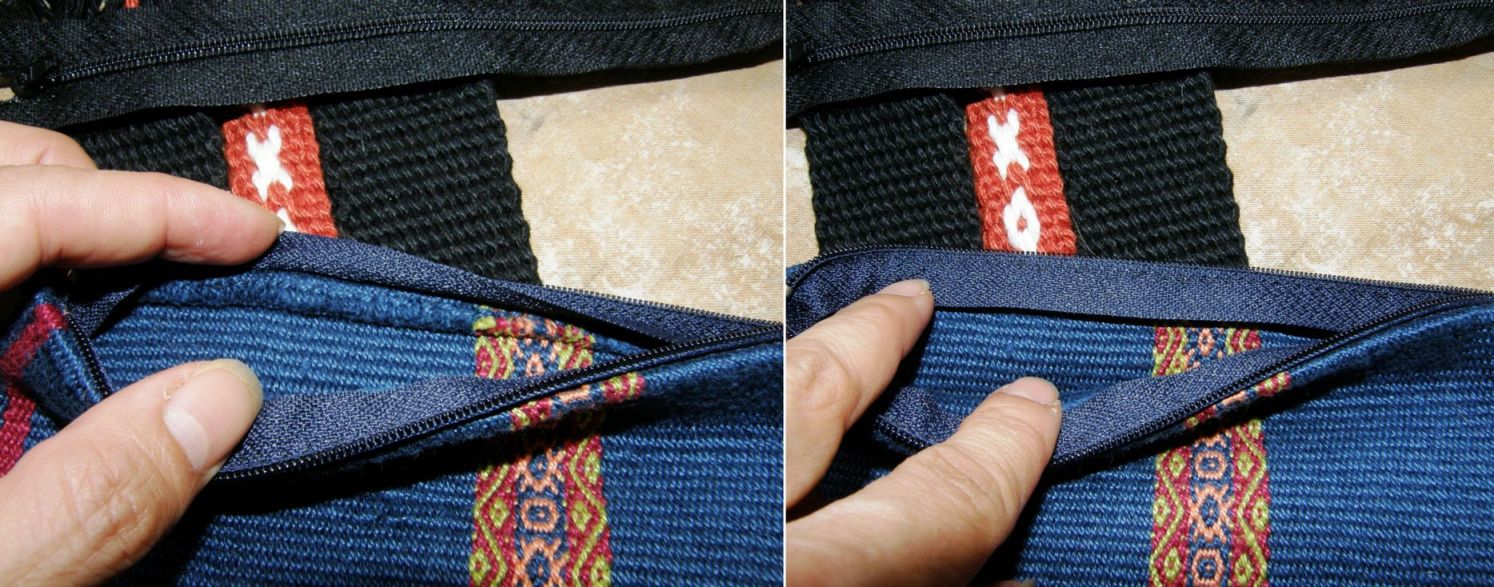
Turn over the raw edges and sew in the zip…

You can see on the inside of this bag that the raw edge gets hidden and protected by the zip. I hand sew and it took me a few attempts to get the knack of correctly placing the zip.

Speaking of zips and hand sewing, the loom bag is coming together…

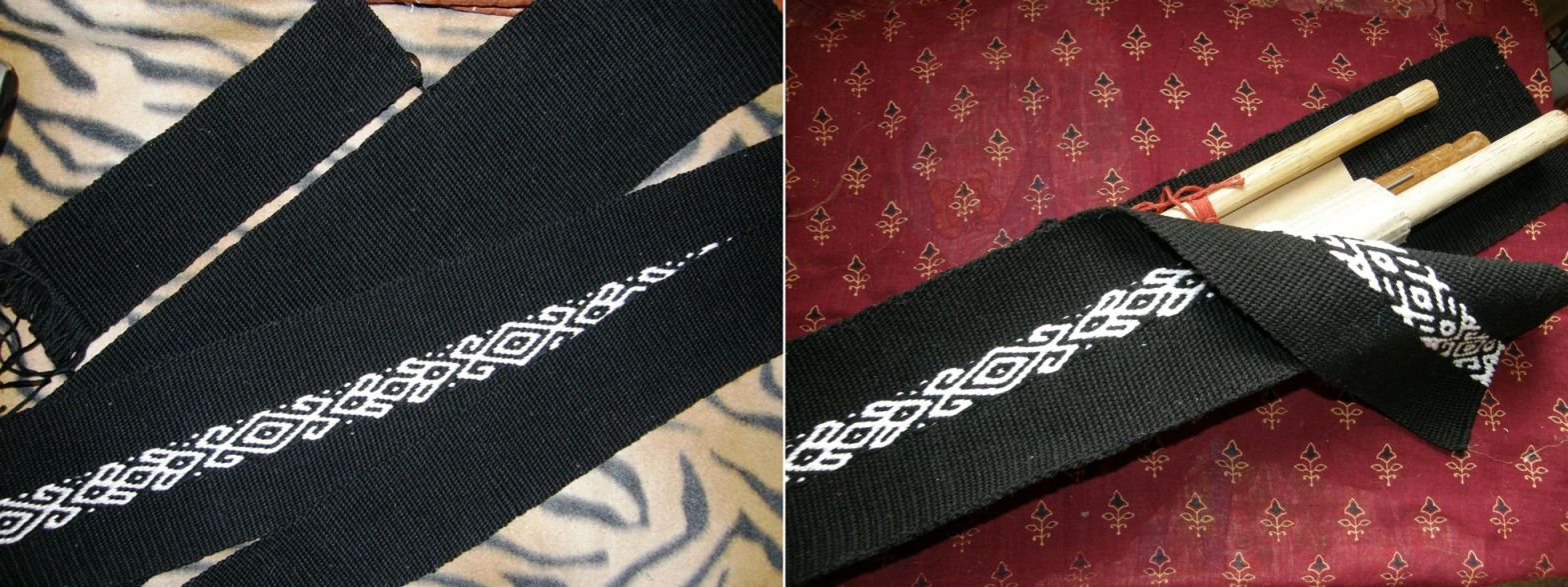
You can see the front and back panels and sides on the left and there it is pieced together on the right. What is missing is two narrow bands to go up the side around the top and back down between which the zip will sit.

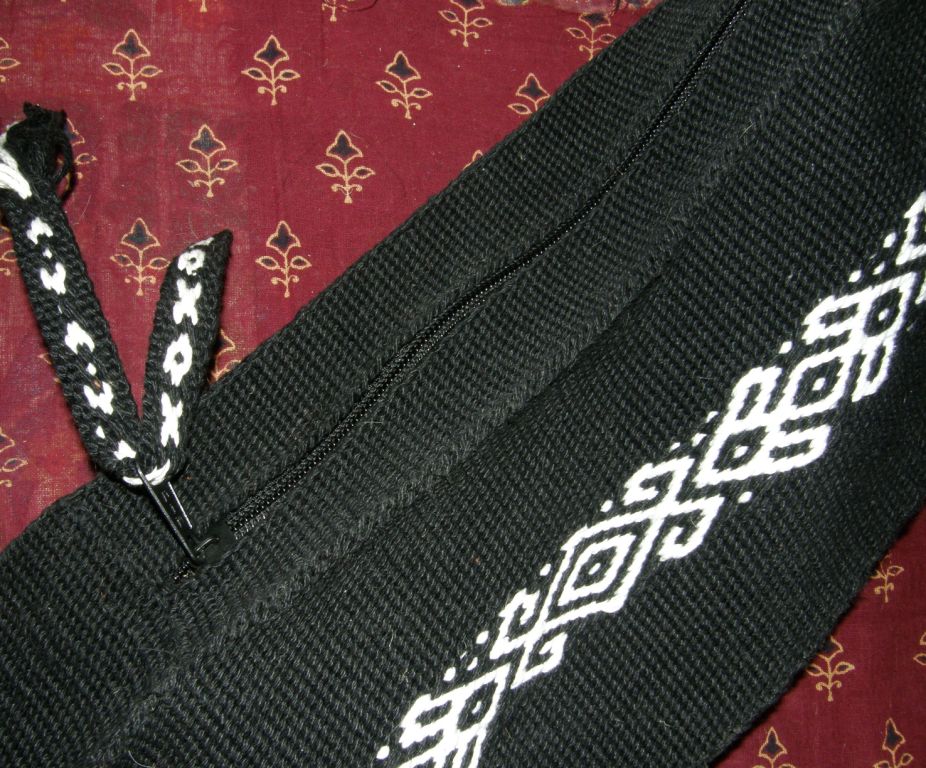
There they are. Just for the fun of it I decided that, rather than weave one long band and cut it in half, I would weave two side by side on the loom. Montagnard weavers often weave bands like this as it helps balance their really long loom bars which have been designed for wide pieces. I didn’t find any particular advantage in terms of speed or efficiency in doing it this way. On the right the bands are in place and the zip has been sewn in too. Thanks to that marvelous market stall called Buckle Land I can buy zips by the meter. They measure out your zip and then add the “pull ”. (What in the world do you call that thing?)


The zipper pull will have a woven tab…I just put that band in there for this photo.

The strap will, of course, be the twined band I have been working on for the last couple of weeks.

I only got one letter twined this week! – the ”s” of the Gaelic version of the word ‘weave’.

I am happy to say that I now have the Navajo, Ladahki  and Finnish words to add to my collection.

And then to decide…to edge or not to edge the bag.

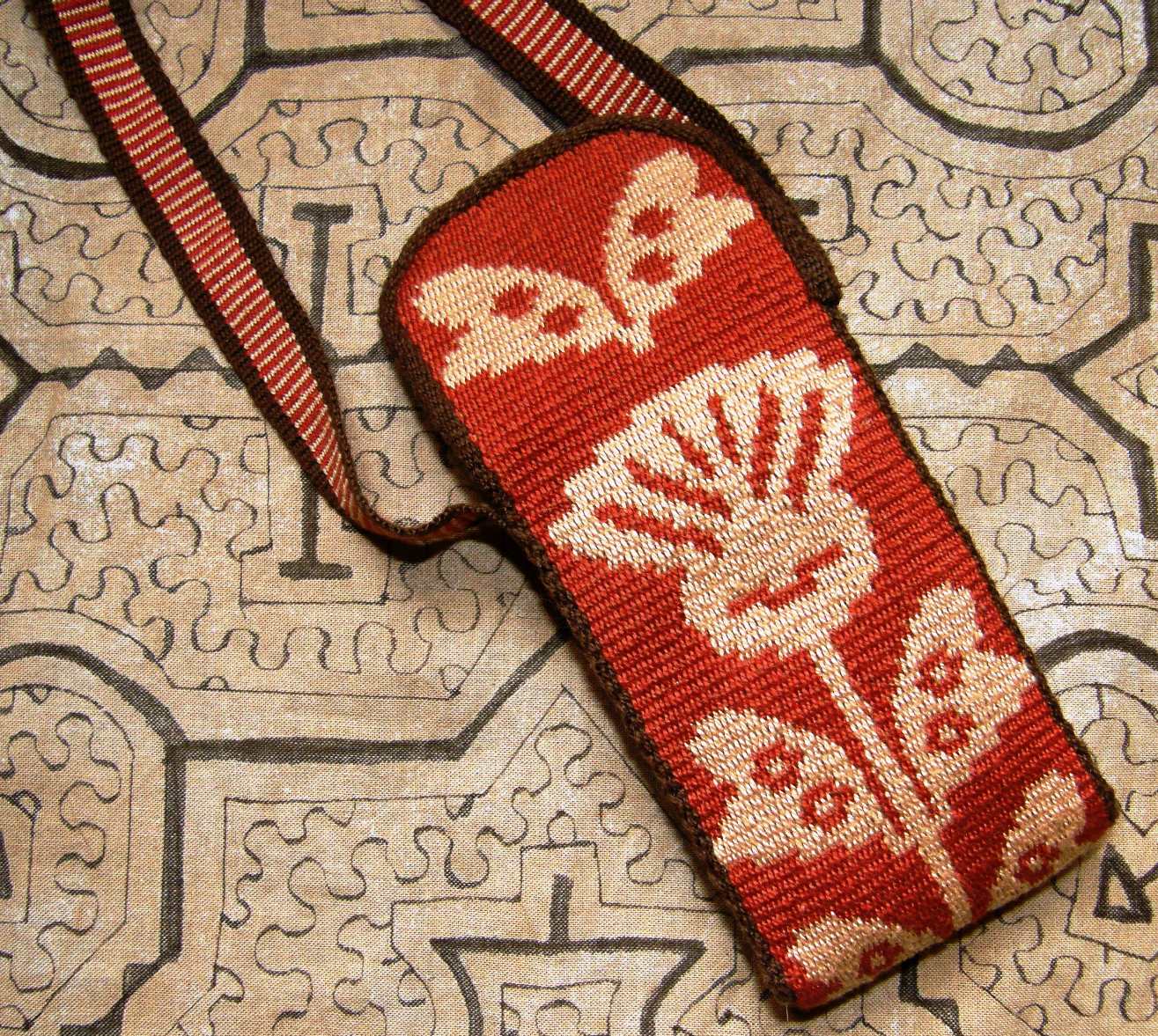
The other thing I was up to was charting the Guarani design from my cell phone pouch and seeing how it looked in double weave. As both double weave and the Moisy technique give a solid color background I was interested in comparing them. Even though I made a sample and then made adjustments to my chart, I didn’t quite get the scale right. It is elongated, but I did find out in the process that it is possible to weave a pretty good looking circle in double weave.

I am up to the head of the nettle (this is what someone on Ravelry called what I had thought was a flower and I think she is right) and have made a warp long enough to make two cell phone pouches.

Here is the same design in the Moisy technique. The design is “softer” this way and I prefer it.

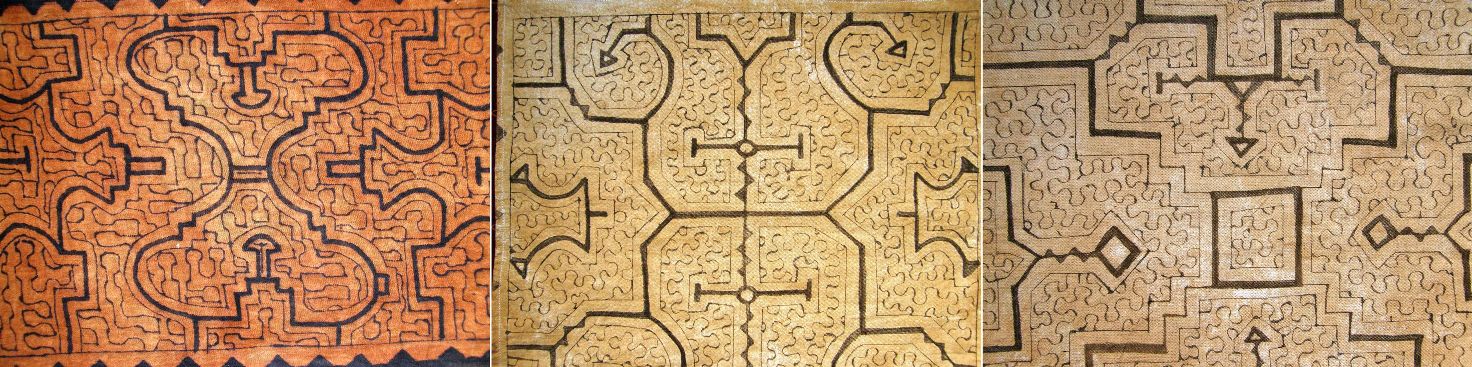
I am reposting this picture because someone asked me about the fabric on which I have posed the woven bag and I wanted to tell you all a little about it. We often forget that apart from the better-known highlands, the countries of the central part of South America also have their tropical lowland areas. In Peru around the city of Pucallpa, (which is, according to Wikipedia a sister city of Miami) in the central eastern part of the country, live the Shipibo people who paint these designs on cotton fabric with vegetable dyes. I am told that rubbing the cloth with a certain kind of mud is also part of the process.

The Shipibo people are also well known for their pottery which is decorated with similar designs. I remember making fabulous plans when I lived in Chile to visit this area which included a three-day river boat trip…don’t know what happened to that itinerary…but I ended up buying pieces of the Shipibo cloth in Quito of all places…

There are two nine-minute long YouTube videos that show the painting process here and here.

And there is something else that I found on Youtube about which I am really excited. It is in Paraguay. I have to tell you that even though Paraguay is a neighbor to Bolivia, it does not make it to my list of places to visit. I would consider flying to Asunción in order to go to Iguasu Falls but that is about it. Well, all that has changed.

I was looking around for information about the Guarani people and their weaving and came across images of what is called the “poncho de sesenta listas” or ”para i” in the Guarani language, the sixty-stripe poncho made by Guarani weavers in the area around Piribebuy in Paraguay. They are basically, as the name suggests, striped, but with a broad patterned woven band sewn around the four edges. They are made from cotton and considered a lightweight summer garment.

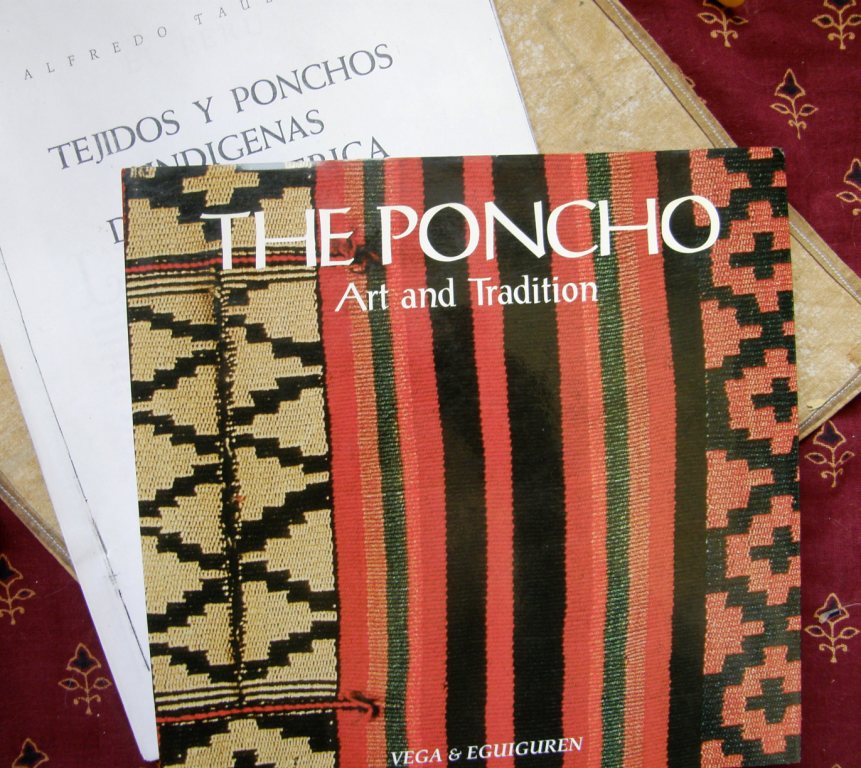
I have a couple of books on ponchos, and although a page is dedicated to the sixty-stripe poncho, the information is mostly historical with barely a mention of the looms used (Creole, it says) or the process.

Thank goodness for the internet. If you use your google translator you can read about them and see a really nice image of one here and it is here that I found out that they are woven on backstrap looms.

How strange, I thought, considering that the Guarani weavers here do not use this type of loom and do everything on vertical looms. Could this be a mistake? I was dying to find out more and then came across this wonderful video…It is lightweight and loads very fast.

The first minute shows scenery of Paraguay and then we get to meet the weaver and see her warping her loom. She warps it end-to-end rather than using a circular or dovetailed warp (which I will tell you about a little further on). Imagine the distance she walks during the three hours it takes to warp. Then see the warp stretched out. I wonder how difficult it is to maintain good tension on such a long warp.

The loom is actually attached to a beam that is fixed to the back of her chair rather than to the weaver herself. It looks like the chair can rock and at one point you can just make out how she rocks forward to take a little tension off the warp to help open the heddles.

Note the stick in the warp attached to rope that she is holding with her foot. I have never seen this before here in South America. The weft is on a little spool which she deftly passes through the sheds. She doesn’t seem to beat very hard either. She must have her cloth somehow clamped and then pulls it through the clamps as the work advances and she seems to be quite comfortable leaning far forward to weave.

And, finally, check out the way the two ladies are making the fringe at the end!

So, when am I going to Paraguay? It is probably as hot and horribly humid there as it is here at this time of year. I might wait for cooler months. I am also waiting for responses from some people I am trying to contact about it.

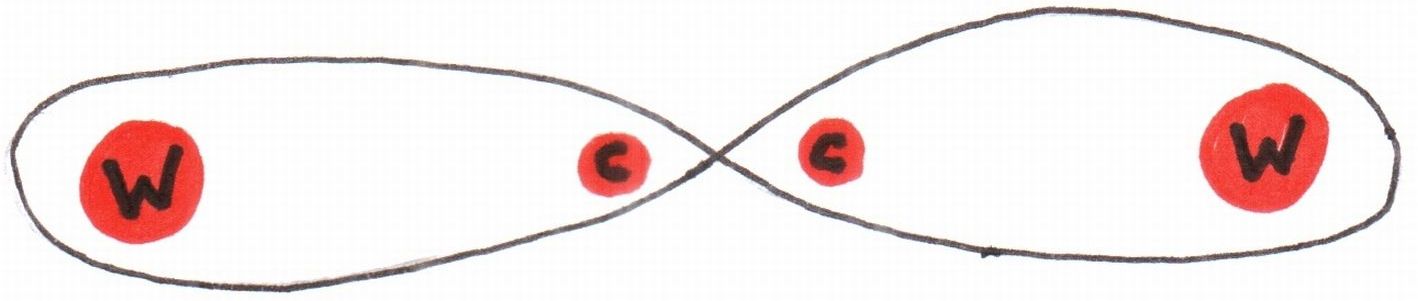
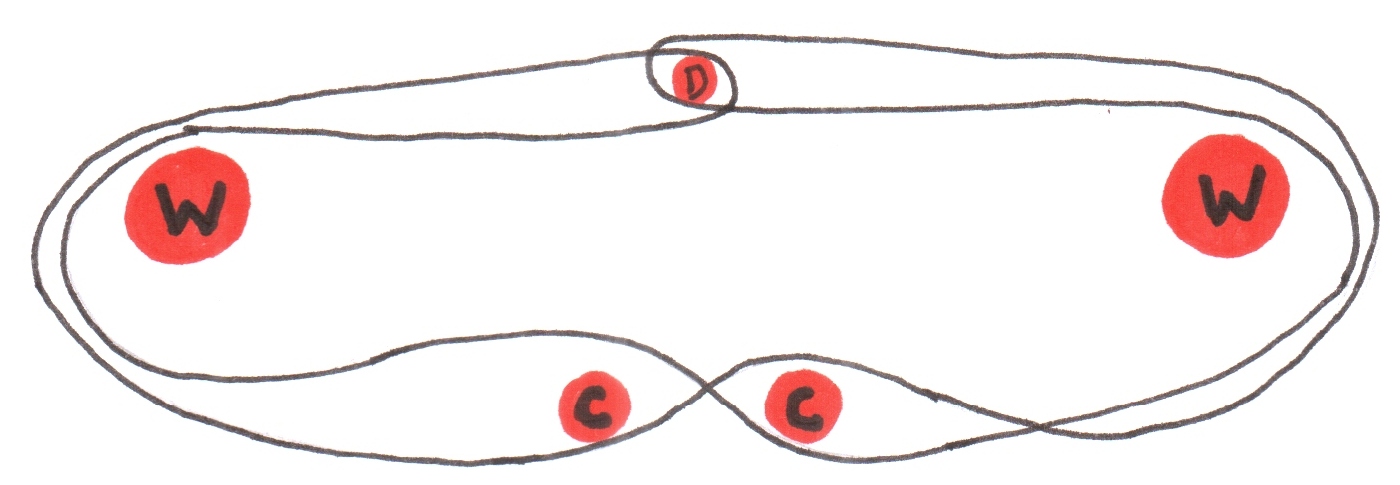
The weaver in the video is warping “end-to-end’ , as I call it…like this:


The warp threads are passed around one stake and then travel to and around the other in a figure-of-eight path crossing themselves in the middle. The length of the woven piece will be approximately what you see in the picture (discounting length lost in take-up of course).

W= warp stake   C= cross stick

Montagnard weavers halve the space necessary in which to weave very long pieces by winding circular warps. This is particularly important to them as they like to use bamboo lengths against which they brace their feet which must be supported against a wall or other immovable object.  This means that they cannot be seated too far away from a wall or other convenient object. Their warps basically look like this:

Trini winds a circular warp on her vertical loom to weave her saddlebags. Pieces woven this way must be cut in order to be opened out to their full length when finished.

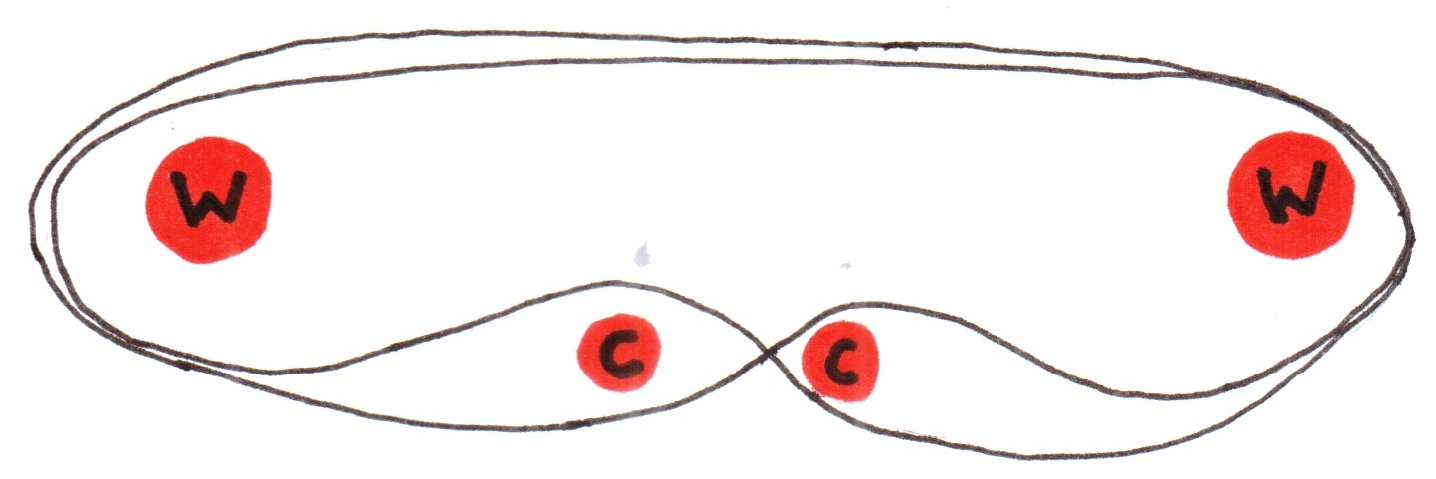
Another option which also halves the space needed to accommodate the warp length is the dovetail method:

Instead of forming a complete circle, the warp threads pass around a third element marked ”D”  – the “dovetail” stick (this is the name that Ann Rowe has applied to it in her writings), which is sometimes replaced by a cord once the warp is on the loom. Once the piece is finished, the cord or stick is simply removed and the piece can be opened out to its full length. In this way, the warp does not need to be cut.

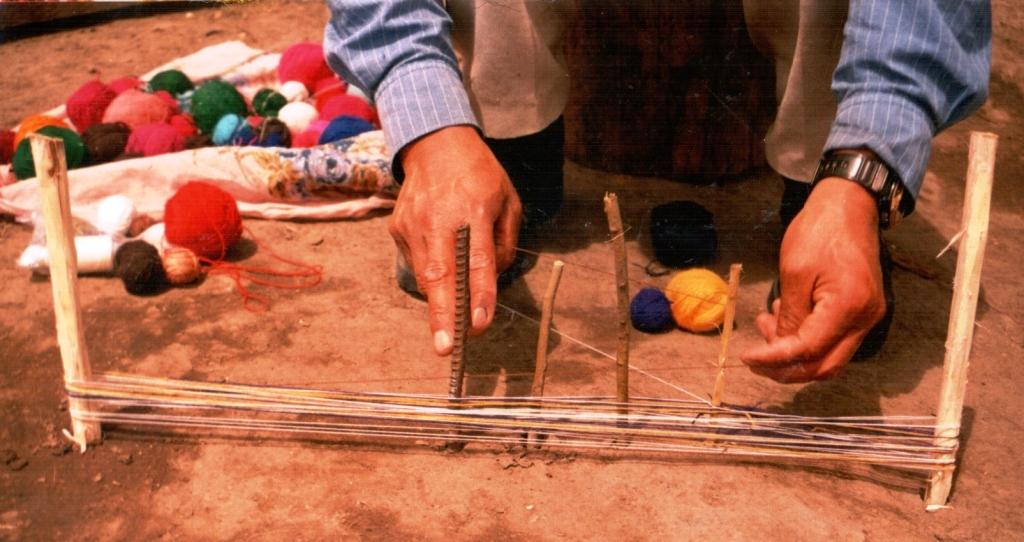
Here in Salasaca, Ecuador, Felipe is teaching me to warp for a backstrap woven belt making a mini warp as an example. The stick nearest his left hand is the dovetail stick. His cross sticks are immediately to the left (our left) of the dovetail stick rather than positioned as in my diagram.

To finish off, here is a video of a woman in Paraguay spinning cotton which will be woven into fine cotton clothing known as ao po’i. Paraguay and its textile arts…so much to learn!


For those of you in the UK, check out the FAQ page on yarns here. Members in the backstrap groups on Weavolution and Ravelry have given me links to yarn sources.

Backstrap Weaving – In my own backyard.

IN MY OWN BACKYARD

My weaving explorations seem to be taking me further and further afield these days…outside my city, my country (Bolivia) and even outside the continent and I have found myself visiting SE Asian weavers in the USA and learning about weavers in the Middle East from books.

Sometimes I forget about the treasures that are here right in my own backyard.

I wrote about the Ayoreo people who live in this area and their looped bags in a post a couple of weeks ago and the difficulties I have had in winning their trust so that I could learn more about them and their crafts. I have given up on that for now but hope that I can pursue it again some day. In the same way I was reminded of a Guarani weaver with whom I made contact here over six years ago.

I used to visit Angela, a Guarani weaver, every Saturday morning over a period of a couple of months about six years ago. She had her loom set up in a handcraft store and was warping to make a hammock.

It was such an opportunity to meet up with Angela like this as it is very difficult to find weavers right here in the city let alone a weaver who has a loom and a place in which to use it . Angela’s hometown of Isoso is about twelve hours drive away from here. Angela would weave in the store twice a week. On my Saturday visits I got to see her warp most of the loom, but missed seeing her setting up the heddles. I saw her start the weaving and part of the designs. The white cotton hammock had three bands of green, yellow and black pick up designs. Angela’s motifs included flowers, geometrics, pineapple plants and scenes of people in their typical daily routine.

The motifs are hard to see on my scanned photos. On the right you may be able to make out two ladies “machucando”, that is, pounding plaintains, in order to make “masaco”, a typical Santa Cruz snack.

I would ask Angela where she lived hoping that I could maybe visit her at home and have some lessons. She had told  me that she had a small loom in her house. She would stretch out her arm and say “leeeejos” (“lejos” means far) as if to discourage me from visiting. Unfortunately, her son fell ill before we could really bond and she stopped coming to the store. Eventually the loom disappeared and now even the store is closed. I did manage to give her a copy of the photo of herself and her baby boy before I lost touch with her.

After Angela’s disappearance, I found bits and pieces about Guarani weaving in books and found that the technique she was using to weave her hammock is called Moisy. They also use a pebble weave which in the Guarani language is called Karapepo. I bought a hammock and bag in the Karapepo technique

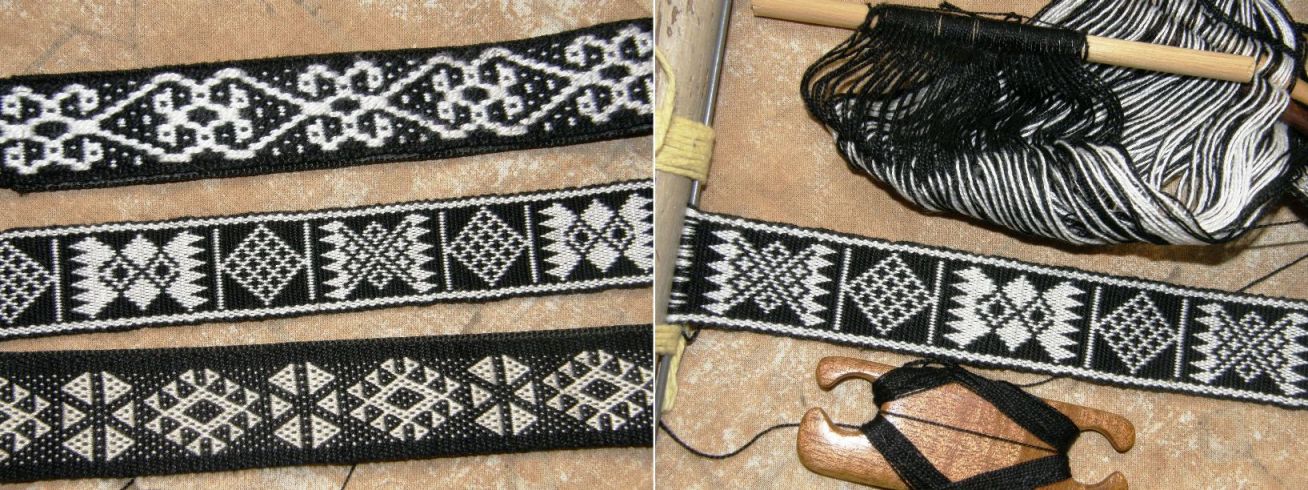
I was able to copy the deigns from the hammock using Andean pebble weave technique and make this guitar strap.

From books I learned that the earth and the cosmos are represented by the star and snake skin designs. These are pretty much the only designs you will see woven in the pebbled Karapepo technique. In the Moisy technique, however, the weavers have a far greater repertoire and the designs are not like any others that you will see any where else in Bolivia. They speak of the lush tropical fruitiness of Santa Cruz! Leaves, flowers, vines, butterflies, animals and people involved in their daily routines or dancing and celebrating carnival are depicted on the hammocks, wall hangings and bags.
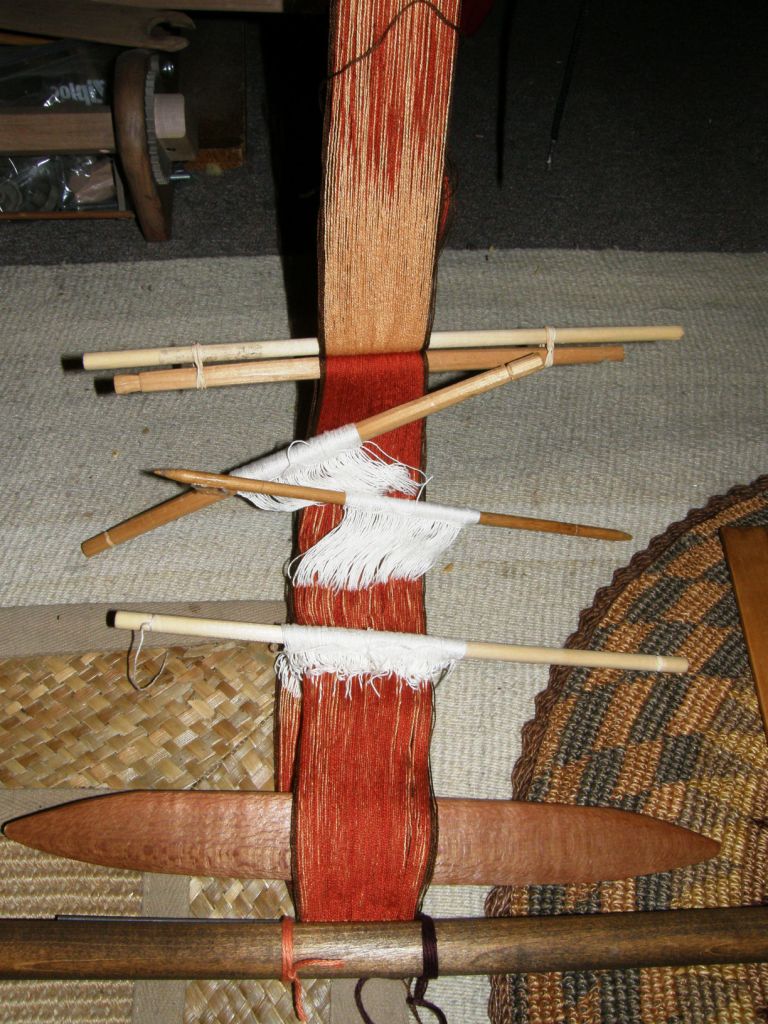
Cell phone pouches made with the Moisy technique with flower and butterfly motifs. A band of horizontal bars serves as the strap and velcro has been sewn on as a closure. A black band was woven and sewn simultaneously to the edges using the weft as the sewing thread to give a very nice neat finish.

And here is the best part of the story…I bought the above cell phone pouches from Angela last weekend at her home. Yes, I found her again, was invited to her home and got to spend the afternoon with her looking at her looms and weaving. The little fellow pictured with her above is now 8 years old and she has since had another son – that makes five sons in all now! Her eldest is married with his own family.

How did I find her? Very much by chance. The English institute where I taught English for eleven years started offering classes in the Guarani language shortly after I left. I recently noticed the loom and weaving pictured at left in the library which had been made and placed there to celebrate the start of the new Guarani program. I asked the receptionists about it they showed me the lovely cell phone pouches that a Guarani weaver had sold them. Fortunately, they had the weaver’s number and it turned out to be none other than Angela.

One of the karapepo cellphone pouches that Angela made for the receptionists – quite a different style to the blue and black ones she made using the Moisy technique.

I was very keen to see how Angela sets up and weaves her pebble weave as well as to learn how to do the Moisy. I was pleased to see that she uses the very same crochet cotton to weave as I do. When I visited her last Saturday, she had just warped up to make a colorful wall hanging on the smaller of her two looms, had just finished a book bag for a university student and was also in the middle of weaving a belt with fighting roosters which had been ordered by a Brazilian business man who mounts the woven pieces on leather and then apparently sells them for a very good price in Brazil. Angela’s enormous hammock loom is there in her patio and she can warp up several small projects on it at a time. She seems to have enough orders to keep her very busy.

She showed us one of her hammocks, the finished book bag, her cell phone pouches, greeting cards depicting carnival celebrations in her hometown of Isoso, pillow covers, belts and purses.

At left, the smaller loom warped for a wall hanging in Moisy technique and at right Angela is warping a narrow band to show me how she sets up for Karapepo technique.

She stretches a cord across the loom around which the start and end loops of the warp dovetail. Except for when she is weaving a hammock, she usually creates a third selvedge by starting her weaving right at the dovetail string.

I filmed her warping, making heddles and weaving the Moisy technique. As usual when I have the camera in front of my face. I find it hard to really absorb what is going on and so I had to come home and watch the movies over and over before I could grasp completely what she had been doing.

I like the way she makes her string heddles chaining them together. You will see her doing this in the video.

Angela’s chained heddles.

She, on the other hand, loved my heddles on their sticks (I had taken my backstrap loom, which she found very amusing, with a double weave piece on it to show her) and so I taught her my way of making heddles.

Here are two short clips of Angela warping using the dovetail string and making heddles. As she makes the heddles she is explaining to me the meaning of the designs on my guitar strap and telling me about the snake skin and how the snake that taught the first Guarani woman to weave in a dream is also embodied in the Parapeti River. Her little boys can be heard chattering in the background in the Guarani language.

In the next video, she is weaving the belt with the fighting roosters in Moisy technique. She has three sets of string heddles and another shed above the cross string. You must see the way she does her pick up. It is quite unique!

The lower of the three string heddles holds a shed through which she simply passes the weft without having to do any pick-up. The two upper heddles hold the separated colors. She pulls on those two heddles working her way from left to right to pick out the colors she needs. Watch her left hand gathering up the selected warps. Her eyes are down at the weaving line watching the design so she knows which colors to pick. Then she opens the shed which the lower string heddle controls. Then she does another row of pick up before opening the shed above the cross string, through which she can pass the weft without having to pick up warps. This shed is a little difficult to open as the warps have become entangled in the string heddles.

So I had to go home and see if I could figure out the Moisy! The best way was to try and reproduce one of her woven motifs. I found that I had to pull the weft really tightly through the shed to have my design look like hers. It makes a very, very sturdy fabric. For those of you who have my Andean Pebble Weave book, I would compare it to the thickness you achieve when you use the three-shed border. In fact, I quickly realized that the three-shed border is the very same structure.

There is my attempt to reproduce the flower on the cell phone pouch. It really helped a lot knowing that we both use the same thread so I knew what width to expect right from the start. I really had to pull the weft tight and force it into that width.

The motif is not exactly the same but I understand the technique.

I tried to chart it and then found my chart was wrong and so ended up just reading it directly off the cell phone pouch which was a really good exercise.

I did notice that Angela is weaving the rooster belt a lot more loosely. .

I confess that, although I started out with my warp set up as Angela showed me with the three string heddles, I found it quite uncomfortable simply because it was so foreign to me…impatient!…  and so I  changed to another set-up after a while with which I felt more at home. I would like to try Angela’s pick-up technique on her vertical loom and hope to visit her again soon. She has invited me to come and see her floral designs on the colorful wall hanging she is making.

In the meantime I will work on my charting as I would like to make a collection of these uniquely Cruceño designs.

###################################

What else have I been up to?

Well I started my double-weave belt using the Bedouin designs that I wove into my wall hanging.


I seem to be gathering a collection of black belts. At least they are all in different techniques with designs from different cultures. The uppermost one is two-color alternating warp floats (my made-up name for it…we could use the Kyrgyz word “terme” for it). The center one is the yet-to-be-finished double woven example with Bedouin designs and the lower one is, as you must all know by now,  Andean pebble weave as taught to me by weavers from Ayacucho, Peru.

I have also been weft twining but using floats this time to make a textured design in one color which is inspired by the alpargatas worked in ply-split darning that I showed you last week.

I am totally unimpressed with the results so far!

I’ll keep at it. Who knows, it may look better as I progress. Maybe I should overlap the floats by two warps instead of just one. What do you think?

What have my online weaving buddies been up to?

Anna, who is cycling down to Tierra del Fuego has turned up in Salta, Argentina and has added braiding to her skills following my instructions for the Margarita braid.

This is one of the two braids that was taught to me by my sling-making teacher in Peru.

I usually advise people to start with the Palma braid first as a skills builder but she jumped right in and, as you can see, has done really well!

I have gathered up all the information on the Palma and Margarita braids that is embedded in various posts here on my blog and put it all together on one page here.

Zacarias in Yanque Peru taught me these two braids which are used to make the typical slings of the area.

Marsha Knox of Pandula Arts Creations has been playing with simple warp floats in two-color alternating pairs on her Gilmore Wave loom and has created some great designs of her own. More designs like these can be seen on the Guatemalan belt in this post.


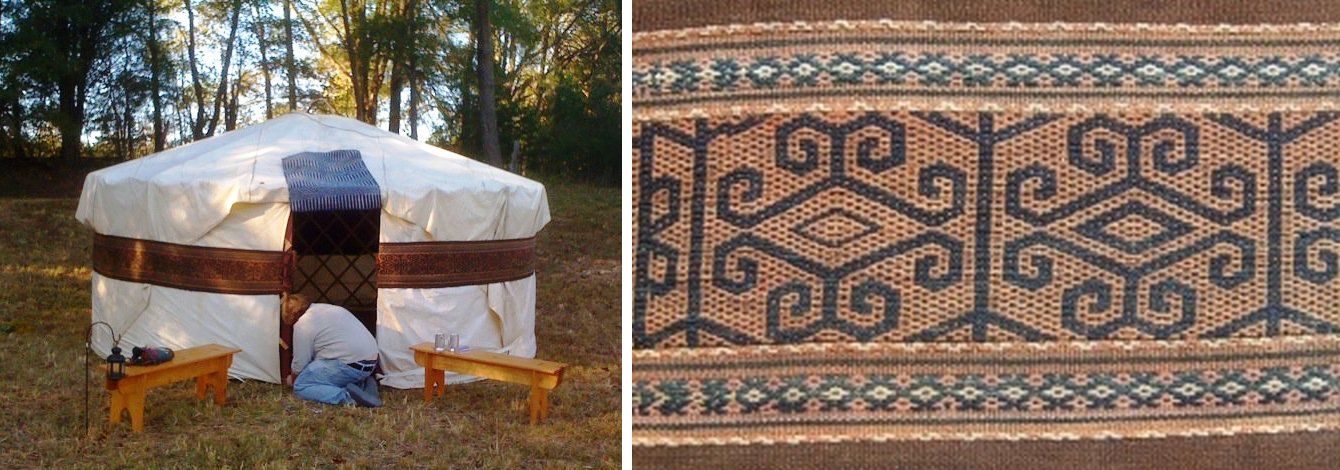
Lisa has been up to her eyeballs in dyeing but took some time out to enjoy a night in her yurt. You will probably recognize the  band encircling the yurt that she was lucky enough to purchase at a reenactment event and which I have shown off many times here on my blog. It is woven in the “terme” technique.

######################################

Finally…you may remember my posting a video some time ago, which had been made in March this year, showing little Melina learning to spin cotton from her aunt in coastal Ecuador. This is the family with whom I stayed in 2007 and learned about the process of weaving cotton saddlebags and the simple warp float technique. I accompanied anthropologist Kathleen Klumpp on this trip and Kathleen has just returned from another trip there with a new video of Melina’s improved skills seven months down the track.

Kathleen tells me that Melina is not yet able to support the weight of the spindle and so rests it on her thigh.

The original video of Melina’s first steps can be seen here. How quickly she has picked up the skills! Aunt Trini and Grandma Luz are master spinners and she is lucky to have such skilled teachers but I think that Melina’s success is largely due to Kathleen’s encouragement. How wonderful too that Kathleen has made and shared these videos so we can all follow this story.

And I have been inspired by a very sweet recent comment from Graciela here on the blog. I don’t know where she is from but she has inspired me to get my act together and put up the tutorials translated into Spanish that I have been promising. Another task for this weekend and I will try try try not to get distracted!

Pssst! There’s a Spotlight article about my backstrap weaving in the latest issue of Handwoven…


Backstrap Weaving – Vietnamese Hilltribe Weavers in North Carolina

VIETNAMESE HILLTRIBE WEAVERS IN NORTH CAROLINA

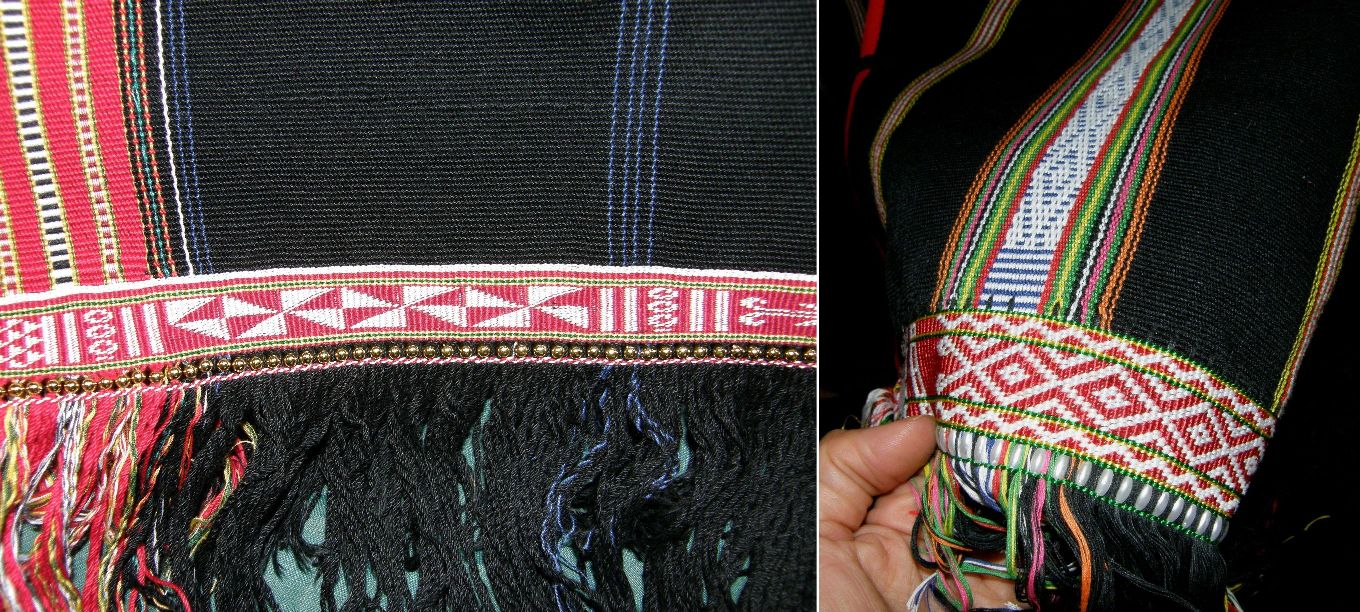
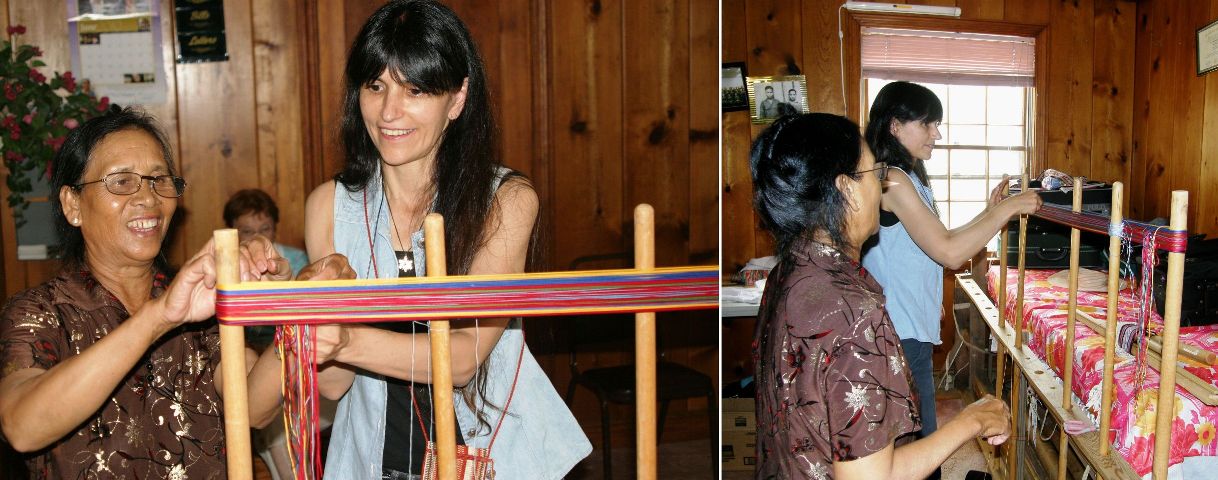
The colors and motifs of the Jarai and Rhade tribes of Vietnam have found their way into my work this week thanks to an amazing visit with two of these Montagnard weavers in North Carolina during the end of my US visit. Montagnard is the name that the French gave to the various hilltribes of Vietnam.

I have had to resist writing about all my fun fiber adventures with my good weaving buddies Lisa and Maurice during my stay in North Carolina and limit this post as much as I can to the two wonderful afternoons we spent with master weavers Ju Nie and Nach Rahlan.

Unfortunately on this trip I didn’t really have time to dawdle in North Carolina but we did manage to pack a whole lot of activity into my short time there.

When not warping four-shaft looms, backstrap weaving, spinning and wrestling with sheets of felt, we went blueberry picking, hung out with the family, made s’mores (first time for me, okay they weren’t made over a campfire but they were still gooood!) and spent time with Maurice who made this warping board and beaters for us to play with.
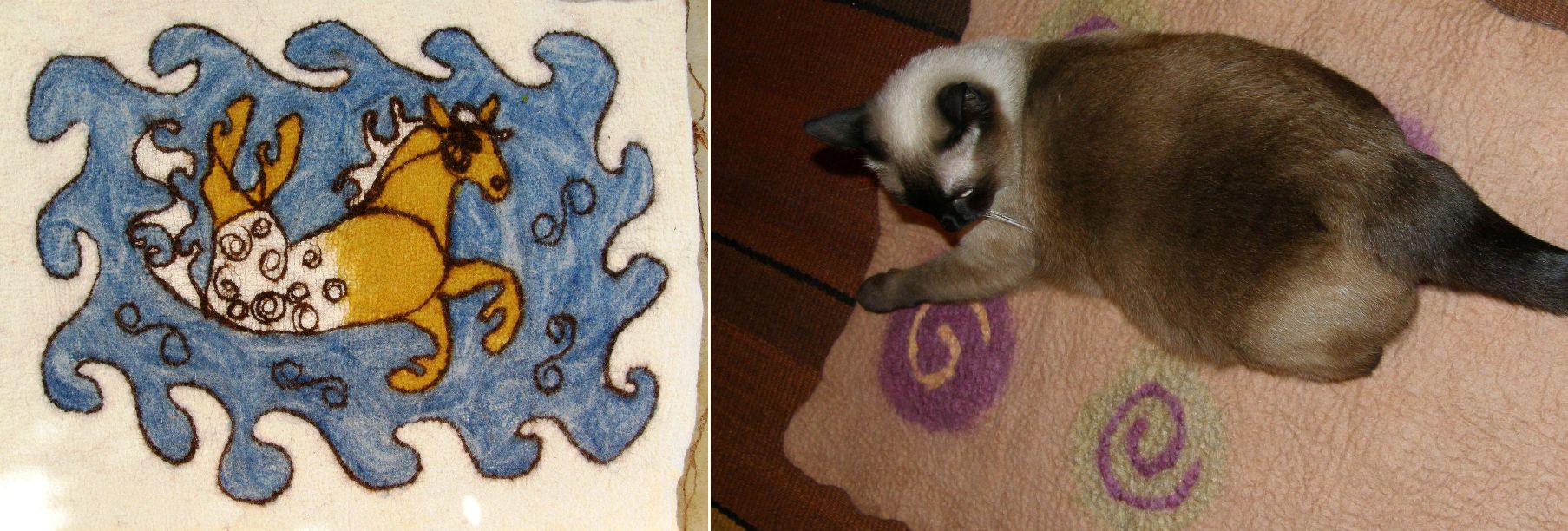
Lisa makes beautiful felt pieces like the one here on the left. She took me through the steps to making my own simple piece on the right. Mine has an animal on it too but not a felted one! I had made felt before when I lived in Chile. Now I realize, thanks to Lisa, that I hadn’t felted it enough and that explains why I have to give it a haircut every now and then. Photos of the fun and physically demanding process will be in next week’s blog post!!
We gathered a group of friends for a day of backstrap weaving. Renate here is showing off her warp while Lisa works on a yurt band design in two-color simple warp floats.

We warped up Lisa’s four-shaft loom to weave a guitar strap patterned with designs in Andean pebble weave. I will have more pictures of this next week too.

And as if that wasn’t enough….

The highlight of this visit was the trip we made to spend time with the Montagnard weavers. I was lucky to have been able to make contact with Betsy Renfrew, at left with weaver Nach Rahlan, some weeks before leaving Bolivia for this US trip. She invited me to her home where she and her husband Andrew arranged for us to meet two of the Montagnard weavers with whom she has been working. Read about Betsy and Andrew and their goals for working with the weavers here.

The first day was a “show and tell”. Maurice, Lisa and I took examples of our own fiber projects to share with weavers Ju Nie of the Rhade tribe and and Nach Rahlan of the Jarai tribe. Ju Nie’s husband Thomas Tlur Eban acted as Ju Nie’s translator at the times when she struggled to express herself in English while Nach’s English was a lot more fluent. I have to say that I was quite nervous on the drive there. Betsy had told me about Ju Nie’s lack of English fluency and had also mentioned that Ju and Nach were from two tribes that did not particularly get on. I envisioned a very awkward gathering with difficult communication and perhaps a cold stoniness between the two weavers. This couldn’t have been further from the truth!

The room virtually exploded from the very start with lots of excited chatter and movement. We were a group of weavers sharing our mutual passion!

I showed my backstrap loom, woven pieces and tools to a fascinated Ju. Lisa took her spindles and soon had both Nach and Thomas trying them out. Maurice showed several of his own floor loom pieces and explained shibori weaving.

And then it was our turn to be shown. The room that was already packed with eight people, filled to overflowing as enormous looms, blankets, skirts, carrying cloths, bags and straps were brought in to cover the floor and every available space. It was overwhelming and it was hard to concentrate on any one piece and hold back the urge to touch and examine everything at once.

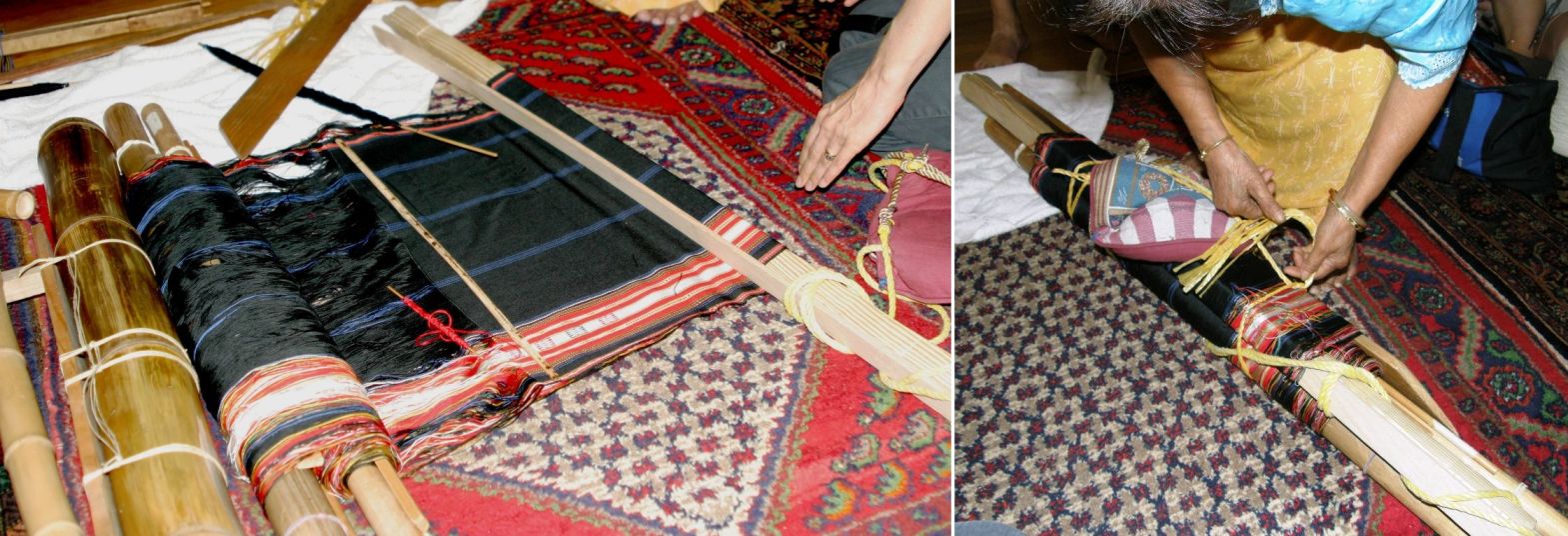
Nach brought in her large loom and unravelled it to reveal one of the panels for a traditional skirt that she is weaving. The design panels on this piece are decorated with motifs woven with supplementary wefts.

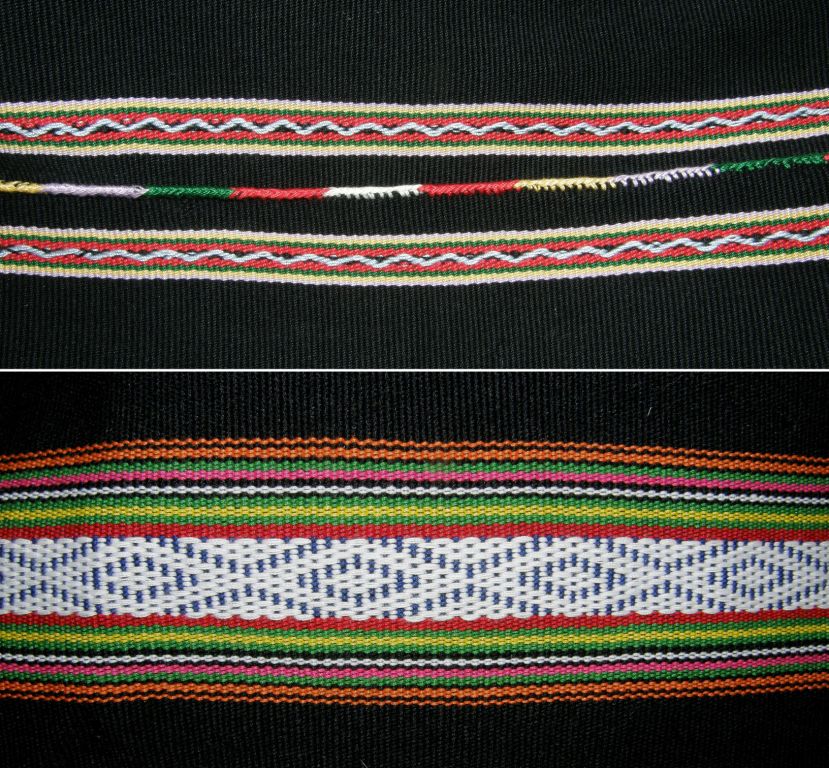
The supplementary weft patterning technique used is the same as that described here. It is a single faced technique and both Ju and Nach were delighted to see Bolivian examples of this. Above you can see how panels of blankets and skirts are often joined using single columns of cross knit looping which I am used to seeing here in Bolivia in double and triple columns to edge coca leaf bags and other items. The lower picture shows simple warp float patterning where single warps are floated over a background of horizontal bars to create this striking pattern.

The most astonishing pieces for me were the ones decorated with a twining technique called kteh. Seen in the example on the right, red and white threads are twined around the fringes at the end of large woven pieces to form intricate patterns and then adorned with beads.On the left you can see gun and airplane motifs which often appear among geometric, human and animal figures.
More fabulous examples of the kteh work.
The weavers have lately been making shoulder bags to sell and experimenting with traditional and non traditional color combinations. They weave straps for the bags placing two warps on the loom at a time (picture at left) as they are not used to weaving such narrow pieces on their enormous looms. Having two bands on the loom at once helps balance things out. At left you can see the tiny temple fashioned from a piece of bamboo much the same as that used by the weavers in coastal Ecuador with whom I studied.
Words and phrases are also woven into the bag straps. Some of these appear to be lines from scripture and a google translation turned up such words as “peace” and “wisdom”
Ju here is showing us how to wrap the baby carrying cloth. This piece was more warp dominant than truly warp faced and profusely patterned with suplementary wefts.
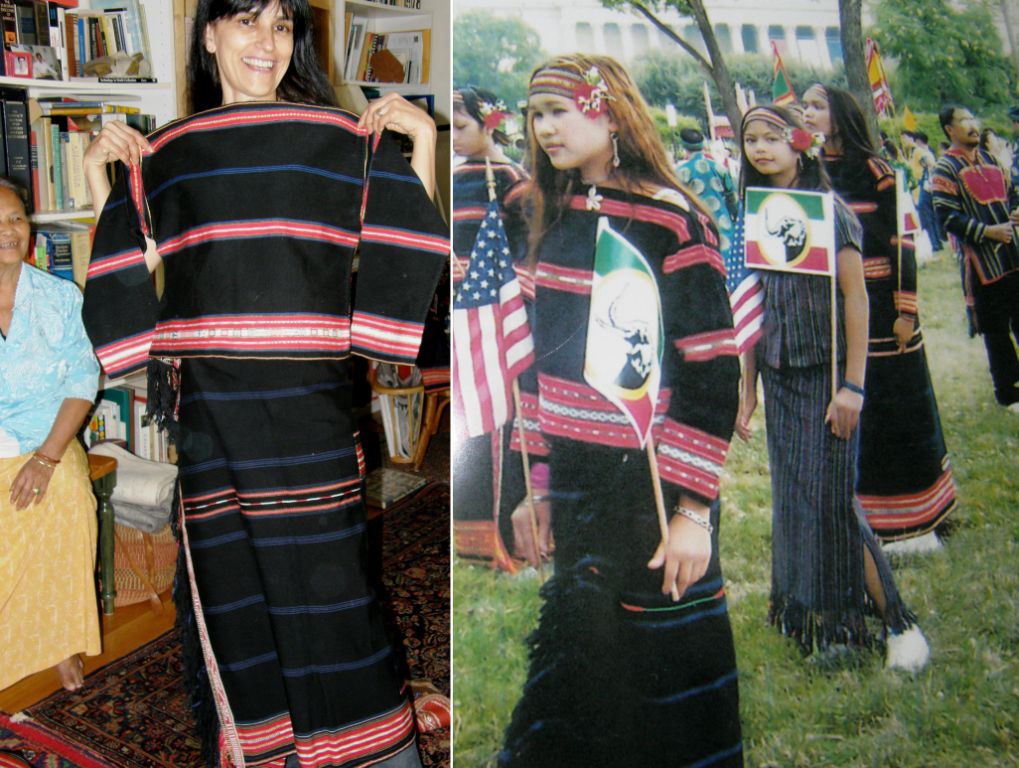
I was coaxed into donning the traditional skirt and blouse. At right is a photo in Ju’s home of young girls in similar costume wearing woven headbands.
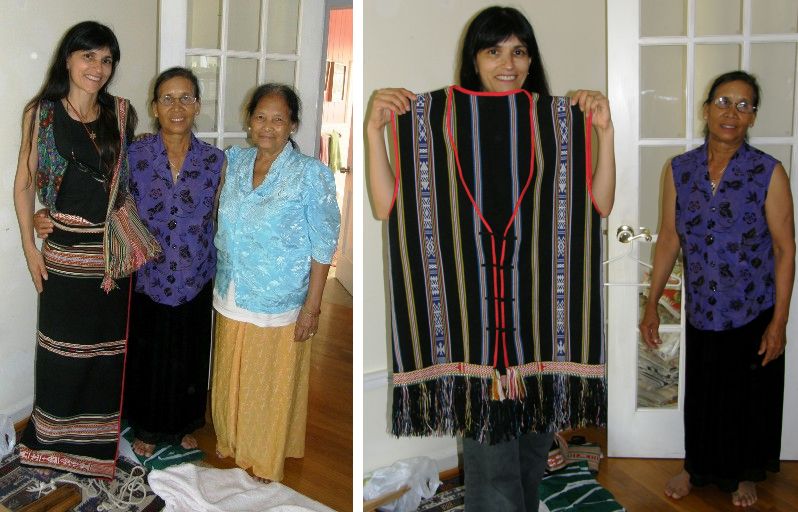
Ju, Nach and myself wearing one of the skirts. It felt beautiful on but it beats me how they manage to keep them up as they don’t wear a belt. It is simply gathered and tucked. And just in case you are wondering, I am not tall! At right another gorgeously patterned garment with warp float patterns and kteh edging.
So, that was day one! I have no idea how much time we spent there but the time just flew by and I arrived home thinking, why didn’t I take a closer photo of that and how did I forget to ask about this? I am very grateful to Maurice  and Lisa who took photos when I was not able and allowed me to use some of theirs.

Are you ready for day two?

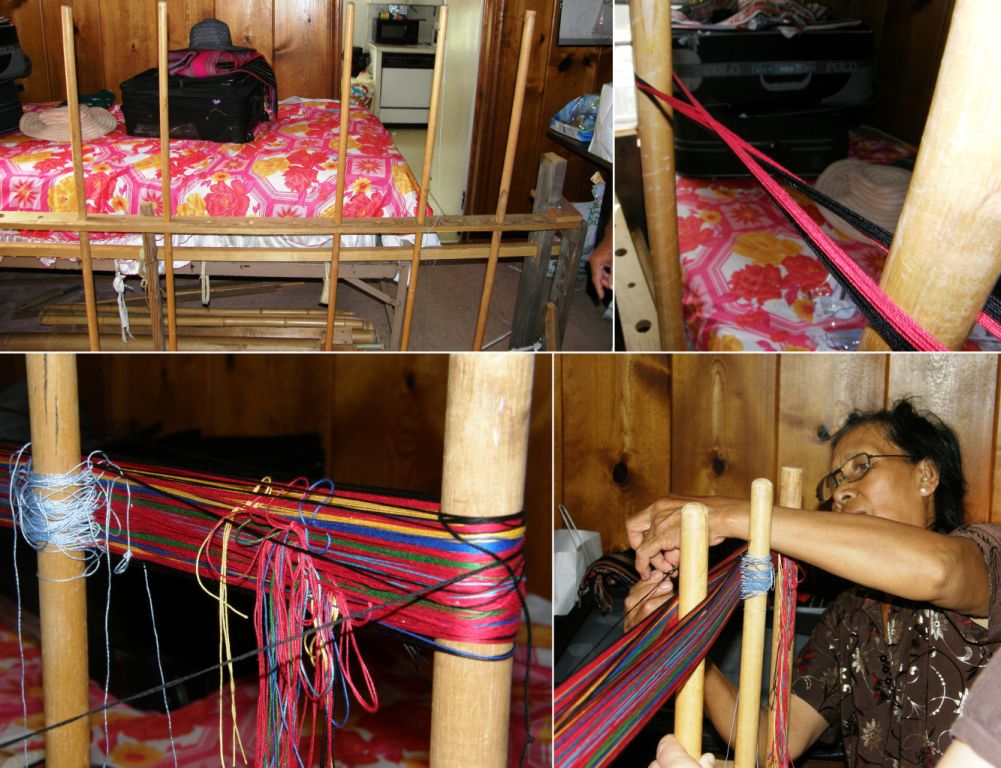
Day two found us at Ju Nie’s home where she was set up and ready to warp. Ju’s husband builds all her tools and he has made her a very nice warping arrangement which fits conveniently in the house beside the bed to which she attaches her backstrap loom. It reminds me of my situation here at home where I weave attached to my bed and warp on the floor nearby.

The warping set up. Five posts are used. One post, the second from the right, acts only as a measure around which the heddle strings are wound. Ju encloses the warps in continuous string heddles as she winds the warp. I was tickled to see that she uses Aunt Lydia’s number 10 mercerized crochet cotton as I have done and uses this same yarn for her string heddles.

In the blink of an eye Ju was off and warping and it was very hard to keep up. Not wanting to interrupt her, as I know how important it is to concentrate when warping, I struggled to follow her quick movements which at first weren’t making sense to me. I had mistakenly thought that the cross was that shown in the upper right hand photo but later realized that it wasn’t. My sketch of the process had to be frequently modified until I finally caught up with her.

Ju makes a circular warp and uses two strands of yarn at once much the same as I do in my four stake warping, separating out the doubled threads only around the cross post and at the place where she pulled the string heddles through. The cross shown above is made of doubled threads and serves as the place where she later inserts her “rolling stick” or “coil rod” as it is sometimes known.

Her movement with the string heddles was so quick that only after having studied the video I had made multiple times am I able to follow it and reproduce it on my warping board here at home. All the warp ends where color changes occur are tied in slip knots which are untied and retensioned once on the loom. This results in an intimidating mess of yarn ends and even the heddles looked loose, uneven and scary! Of course eveything was under control!

Ju was kind enough to let me try warping. I would never let anyone touch my warp!! She, however, took control of the heddle string at each pass but I was slowly coming to understand what was going on.
Warping finished, safety ties were added to the warp and it was slipped off the warping stakes and the rolling stick was put in place. Ju closed the end “cross” around the rolling stick and then put the main loom bar in place which was attached to her bed, just like mine!

Ikat weavers that I have seen in Ecuador told me that the rolling stick helps stop their warps from slipping and blurring their design. I have seen other weavers use it to help space the warps. I imagine it also stops the warp threads from slipping in together as they often do on the far loom bar and keeps them in order.

The weaver’s loom bar seen at left has prongs around which the backstrap cords pass. The sword has a hooked end which is used for picking up threads for patterning. All these pieces have been fashioned by Ju’s husband Thomas. Ju had warped a sample band for us to witness the process. Her loom is normally used for much wider pieces which explains how oversized and unwieldly everything looks.
The thick roll against which Ju braces her feet then had to be placed at just the right distance. Having something against which to brace one’s feet is a big help. I have sheets of wood under my bed which serve this purpose and this helps spread the load of tensioning the warp between one’s back and legs. Once Ju had untied the knots in the warps ends and retensioned the warps, she sent Thomas out into the yard to cut some thin bamboo sticks which she inserted in the sheds to get the weaving underway. She then carefully moved each and every warp into place with the point of a stick before passing the first weft.
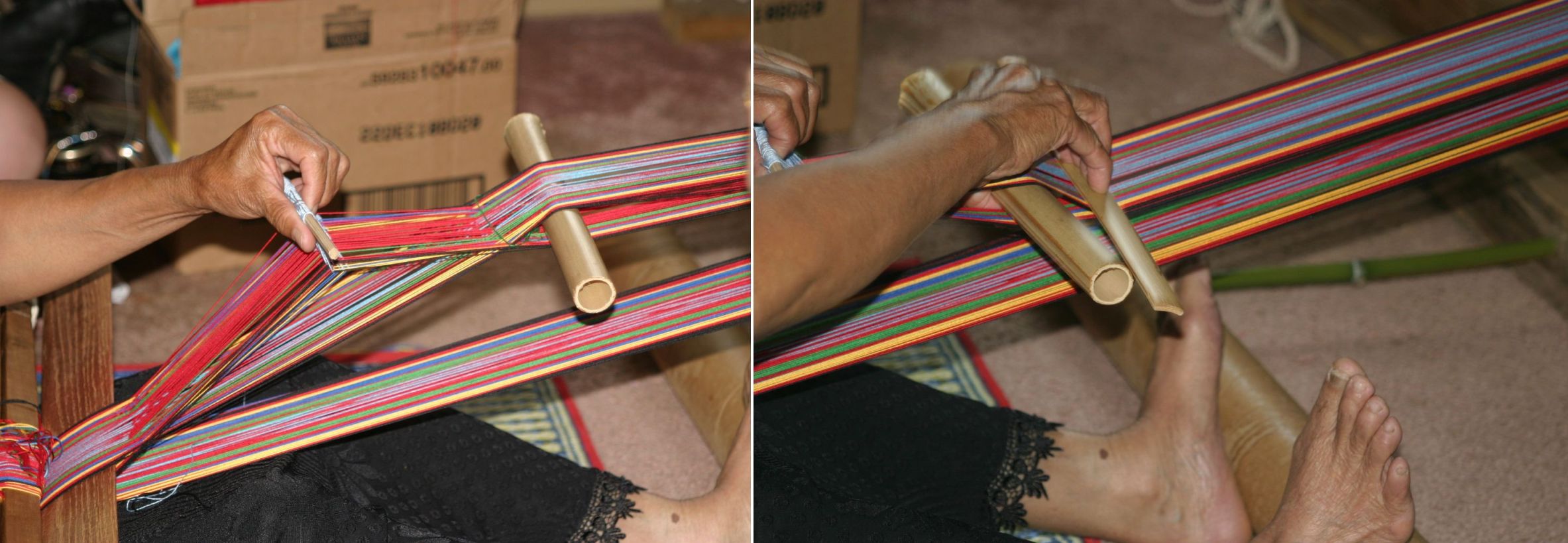
Ju opens the heddles by grabbing hold of the shed roll and a bamboo slat which she places on top of the warp. She then rolls both away from her while pulling up on the heddles.When I use a second cross in my warp, I use this method by rolling the shed rod and the second cross stick together. I enjoyed showing Ju another way that I use to open my heddles by rolling them over my hand. At first she was anxious to show me that I was doing something wrong but then saw that it worked and laughed, pointing and saying “new way”. Her shuttle is a simple stick around which the weft yarn is wrapped. These photos were taken by Maurice Blackburn.

I was dying to get into the loom and finally asked Ju’s permission to do so.

What a wonderful birthday gift! A day spent with a master backstrap weaver! There I am happy as a baby. The picture at right shows my view up the warp!

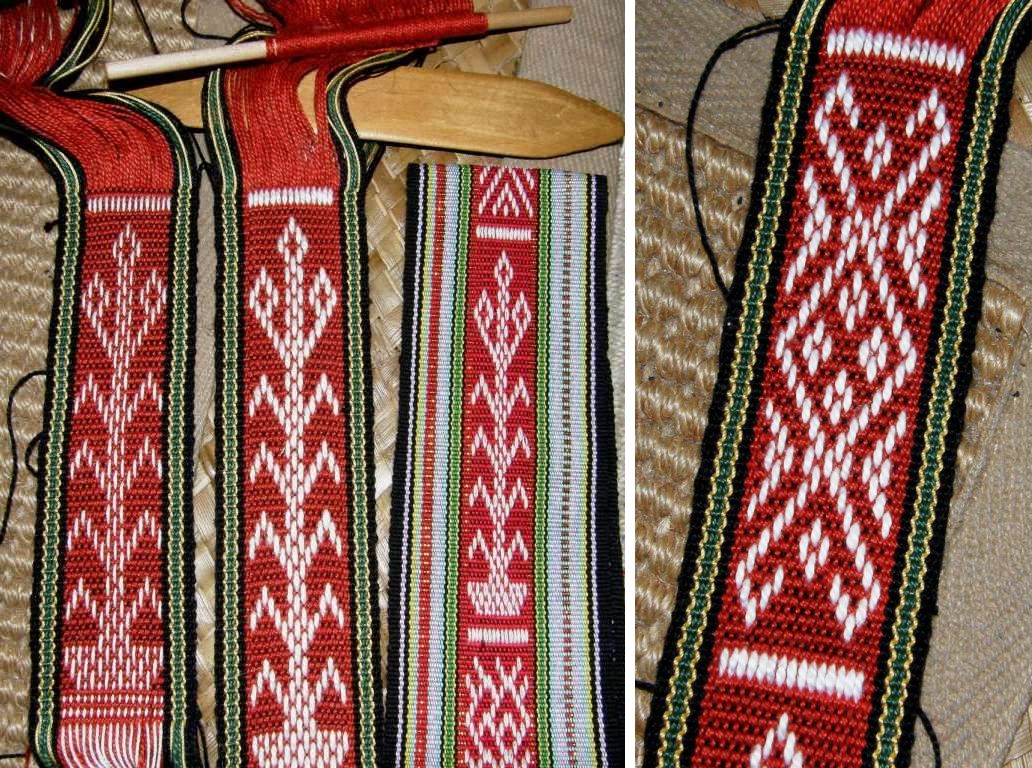
We went home with images spinning in our brains! It wasn’t until I got back to Bolivia that I sat down and went through my notes and sketches, watched the videos and managed to sort it all out. I bought a 12 ft long band from Ju that she had intended using as straps for many bags but was happy to part with. I liked this piece as it gave me many examples of the motifs that they weave with warp floats. I was able to examine it to figure out the technique. This is a new one for me! And so, to work. I wanted to reproduce the structure and make something useful.

First to sample. I could see that Ju’s white and red warps had a 3:2 weight ratio but I wanted to see if I could get away weaving it 1:1.

In the photo on the left, Ju’s band is the one on the right. My first 1:1 sample is on the left and my second sample, in the middle, where I also used a 3:2 weight ratio looked far better than my first attempt.

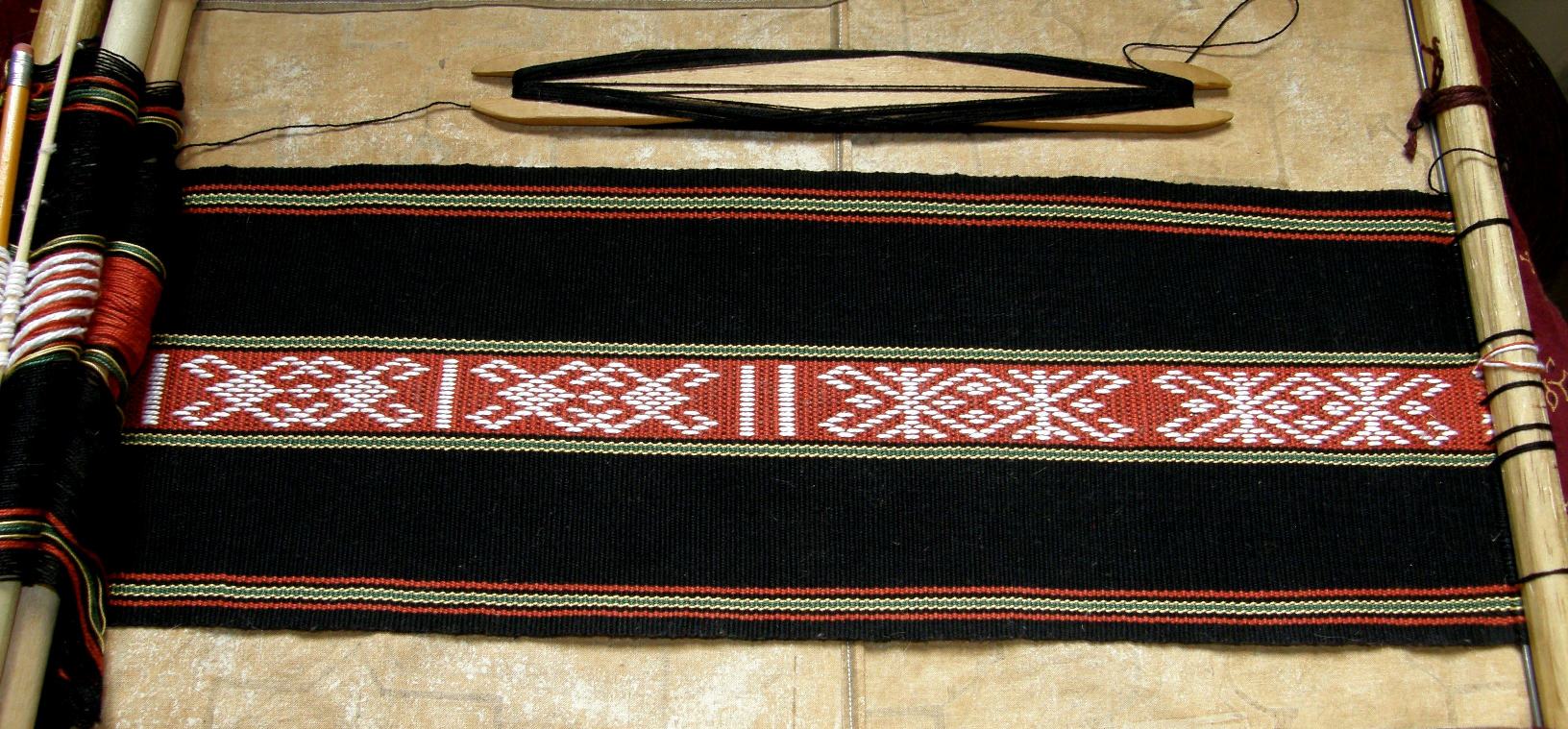
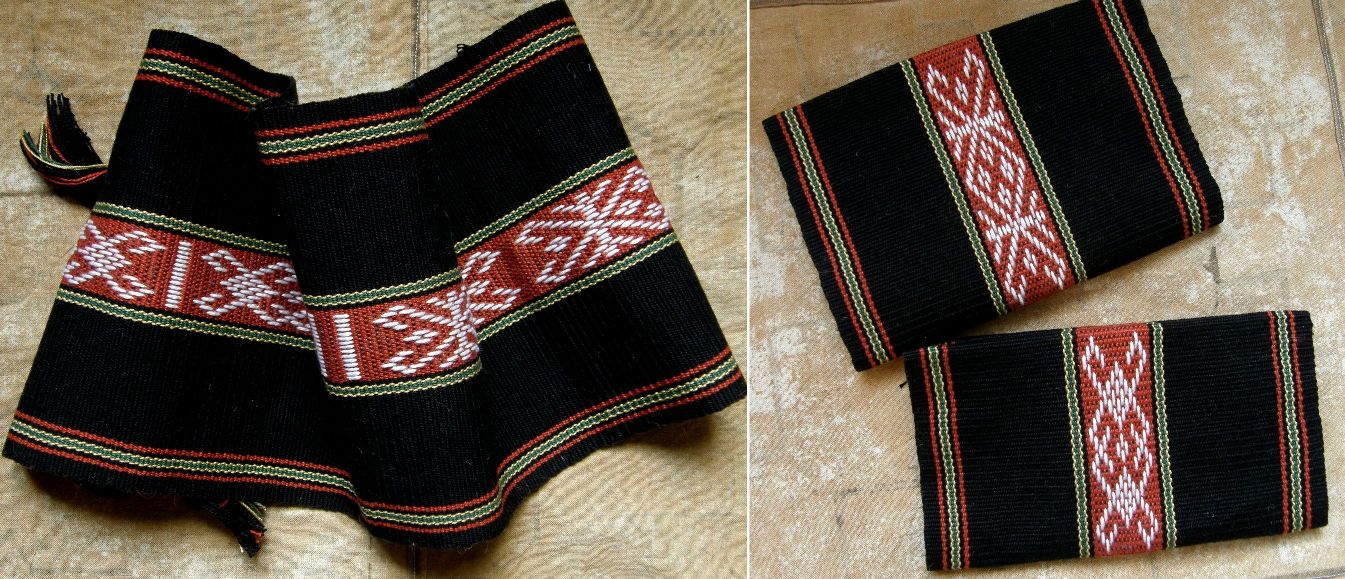
So I went ahead and wove more motifs on this sample band until I was convinced that I had the technique down. I decided to weave a wider piece so I could make a couple of zippered pouches and tried to copy the traditional colors used by my new weaver friends as much as possible. Here is the piece I made on the loom. By cutting between the two white horizontal bands in the center I woud have two pieces which I could fold and sew into bags.

Here is the piece off the loom, then cut and folded. I sewed two lines of stitches in the center of the piece and cut between the two.
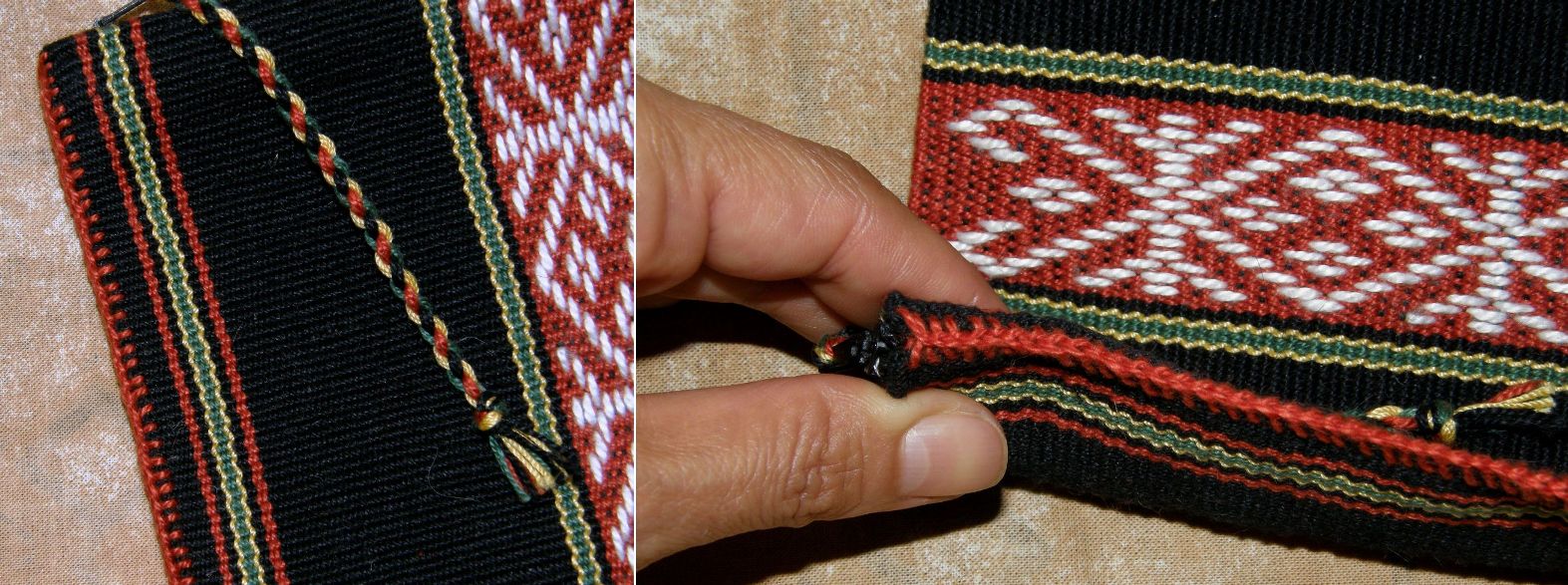
I sewed a single column of cross knit looping along the edges of the larger of the two bags as Ju and Nach also use this for decorative finishes.
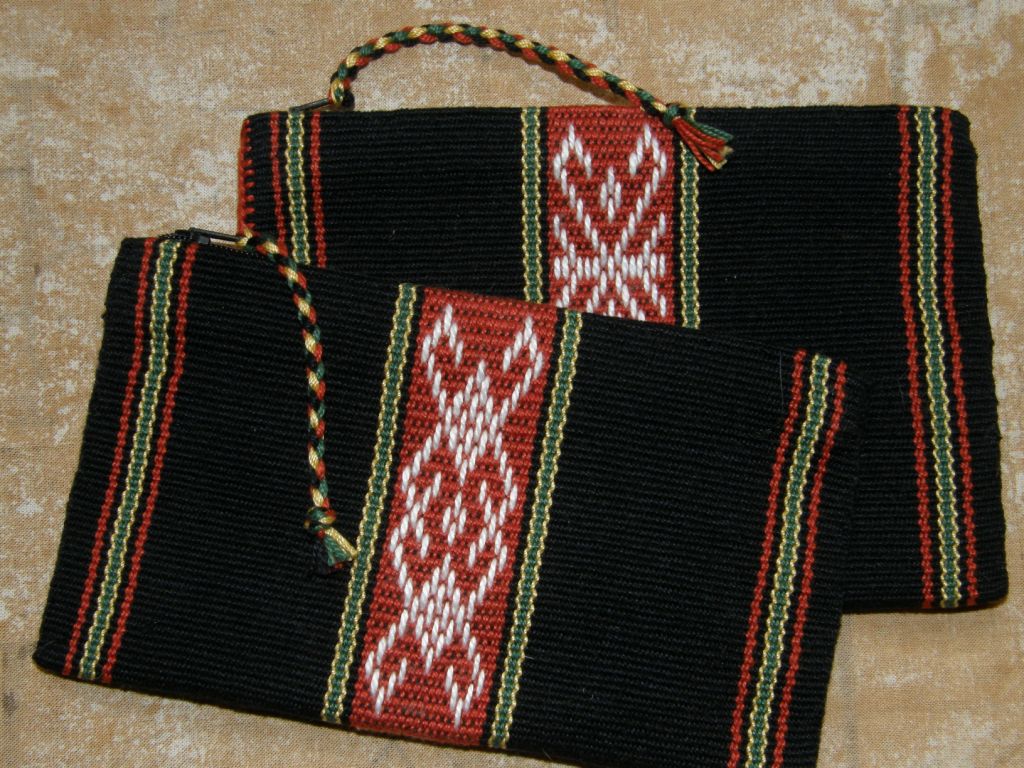
Here are the two bags with zips in place and braided zip pulls. I had yet to sew the other edge of cross knit looping when I took this picture as I wasn’t convinced about using it at all.

Once the bags were made (I kept the cross knit looping in the end and really like it), I decided that I would try to make something using the blue and black color combination that Ju and Nach also use in a lot of their pieces. I warped up for a band in these colors wide enough to make a cellphone case and chose some motifs from my photos.

I had trouble settling on the colors for this band and had to pull out warps and replace them once it was on the loom. I decided to keep it very plain and dress it up later with cross knit looping.
Here it is finished. I am not sure about working the cross knit looping on the flap as well.
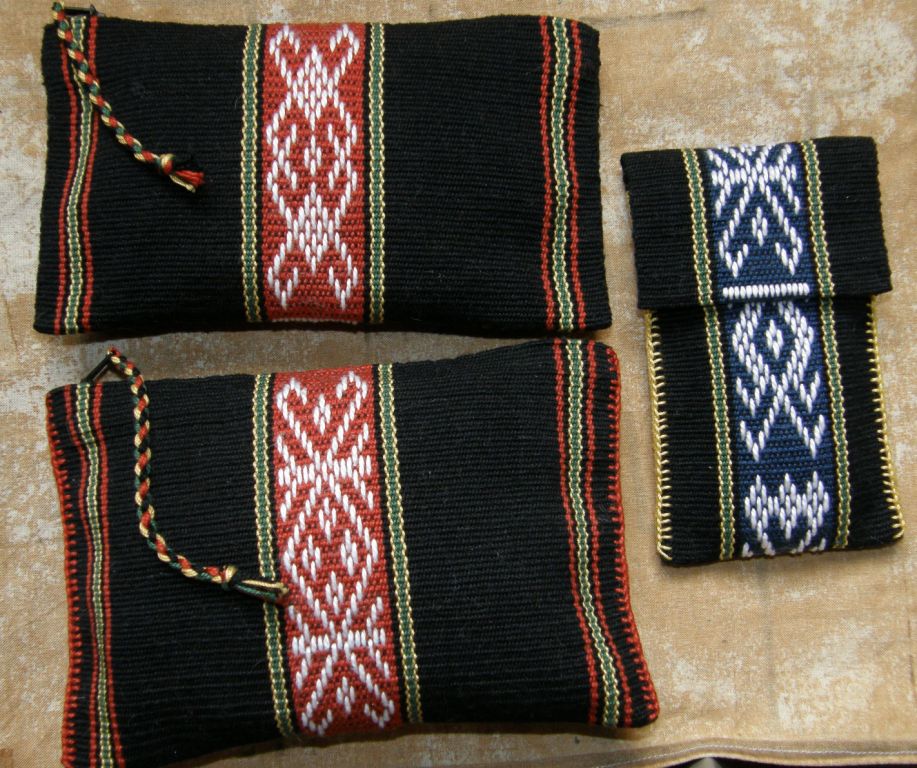
And here is the set almost finished. I would like to put a cord on the cell phone pouch but would like to ask Betsy if she knows if Ju and Nach use any particular kinds of braids in their work so I can use the same.

I can’t thank Betsy and Andrew enough for making this visit possible. The work they have done teaching English to the members of this community and documenting these traditional techniques and processes is wonderful. Together they are building a blog which will document this journey.

I hope that I will be able to contribute something to this project by perhaps helping with the documentation work or maybe helping to develop small woven products that the weavers can sell. This was part of my reason for experimenting with these bags. The other part of the reason was my insatiable curiosity and love of the backstrap loom and traditional techniques! Betsy hopes to inspire younger people in the community to want to learn the traditional weaving techniques.

This article gives further insight into Betsy’s work with Ju Nie and you can view a stunning photo essay on Jue Nie at her loom here.

And once again, the “worldwide weaving guild” that is the internet has led me  to a new weaving acquaintance, Susan Stem, who lives in northern Thailand and who has generously allowed me to use this image of a Rhade loin cloth which has the twined kteh technique.

Let me leave your here with what Jennifer has made on her inkle loom using Andean pebble weave technique.

She has a really nice inkle loom which has plenty of space in front to have the two string heddles controlling the pebble sheds, allows her to use the saver cord and she uses the loom’s heddles to form her picking cross.

Backstrap Weaving- Weavers in New Mexico and a new Mexican weaving

Convergence is now long over and I can’t believe I have left it so long to write up this blog post. You have no idea how hard it was to skip that first post having gotten into the habit of regular Friday posts. Then the next Friday slipped by….The danger with waiting too long to write is that you risk losing that special feeling that you had associated with the event and even forget some of the important details. So here I will try to recreate some of that and I do hope that I don’t leave anything out. I was surprised to have some people at Convergence ask me to please stop posting for a while so that they could have the chance to catch up! I have been relieved to see that readership has only slightly dropped off during these two weeks of madness. So I hope you have, in fact, had time to catch up on things and perhaps revisit some pages because…. here we go with a bunch of new stuff…


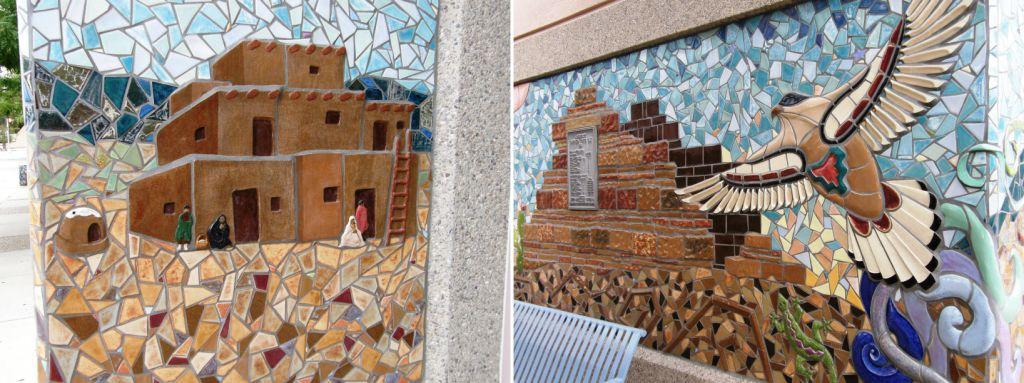
These are some of the colorful murals that decorate the outside walls of the Albuquerque Convention Center. These are probably all the “classic” New Mexico scenes you will see on this blog. Thankfully, this was my fourth visit to this beautiful state and so I was not overly concerned about not being able to get out and about. I glimpsed some hills on my shuttle ride in from the airport and then, as I was staying downtown 8 blocks from the Center, my only view on my walks to and fro were downtown buildings..


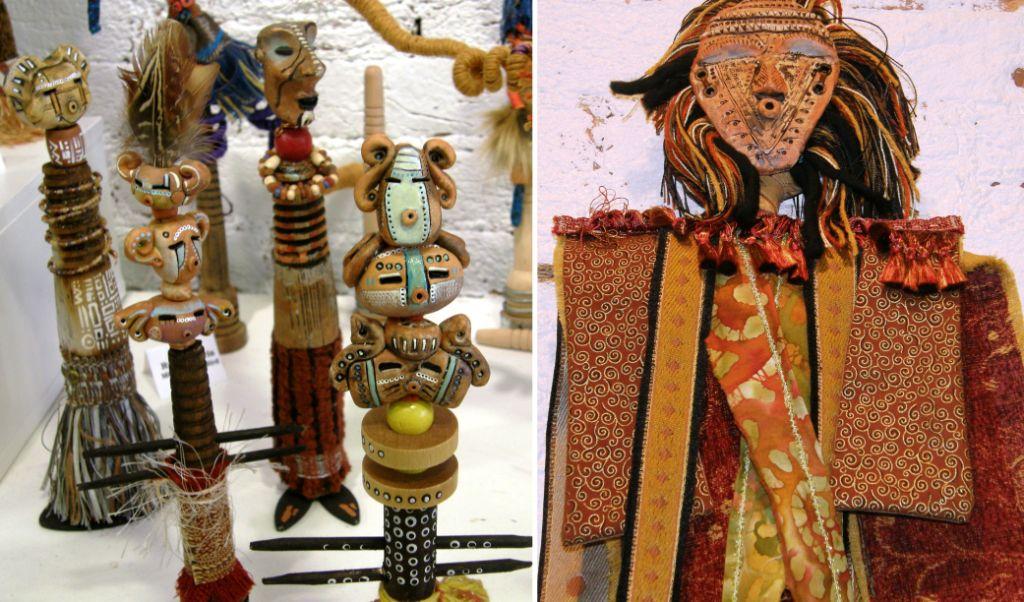
On my first day in town I did manage to get out to see a gallery of Joanne Moore’s double weave pieces downtown and I was fascinated by these wire dolls made by Ruth Morris.


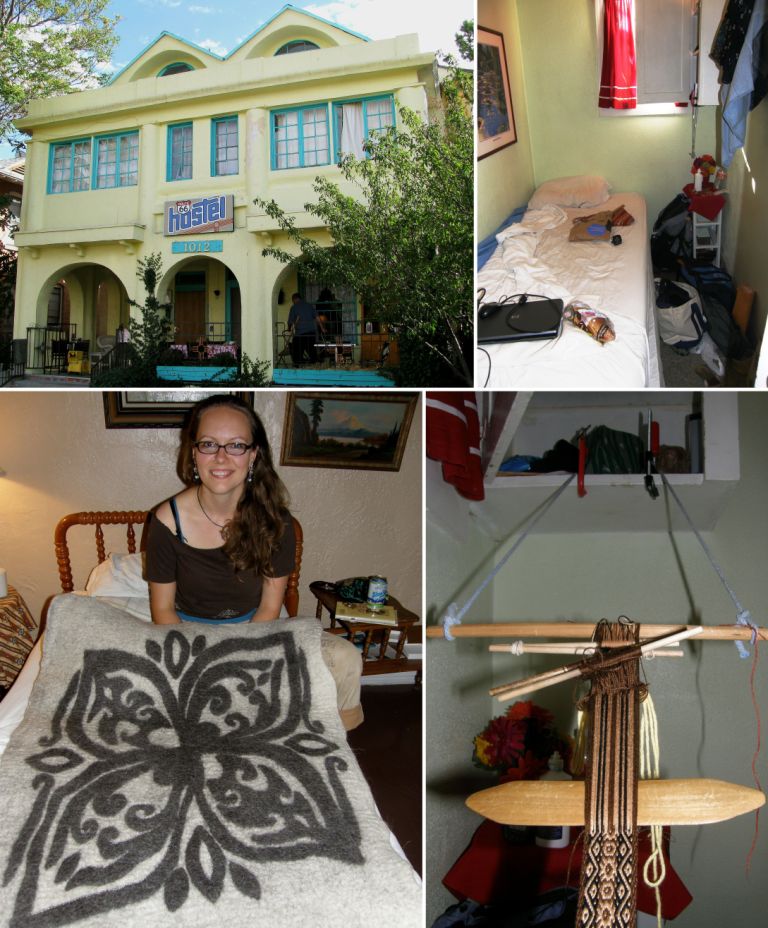
This was my home sweet home for the duration of my stay…Route 66 Hostel…a backpacker style place where I had a wee closet-like room with free wifi and breakfast and a very laid back family atmosphere. The only other Convergence participant there was Jasmine Johnson-Kennedy who had come all the way from Fairbanks Alaska – possible as far north as Bolivia is south! Jasmine took the felting class and produced this gorgeous piece. It was fun meeting up with her at night and seeing her work grow. She had just started outlining her design in stitching to give it a raised three dimensional effect on her last day of classes. Of course I had to find a place to tie up my backstrap loom in my wee abode and, as I had wisely brought clamps, I was able to do so on a little shelf unit on the wall.


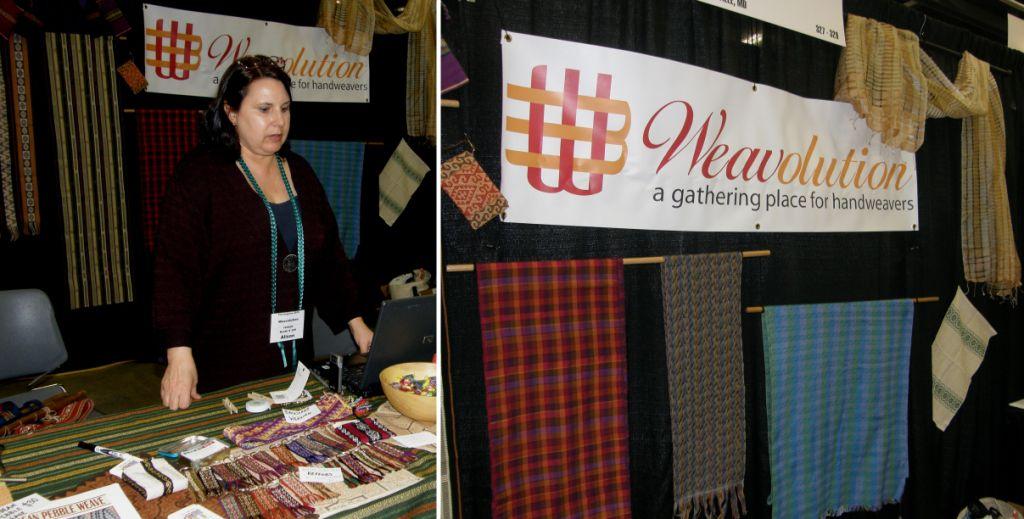
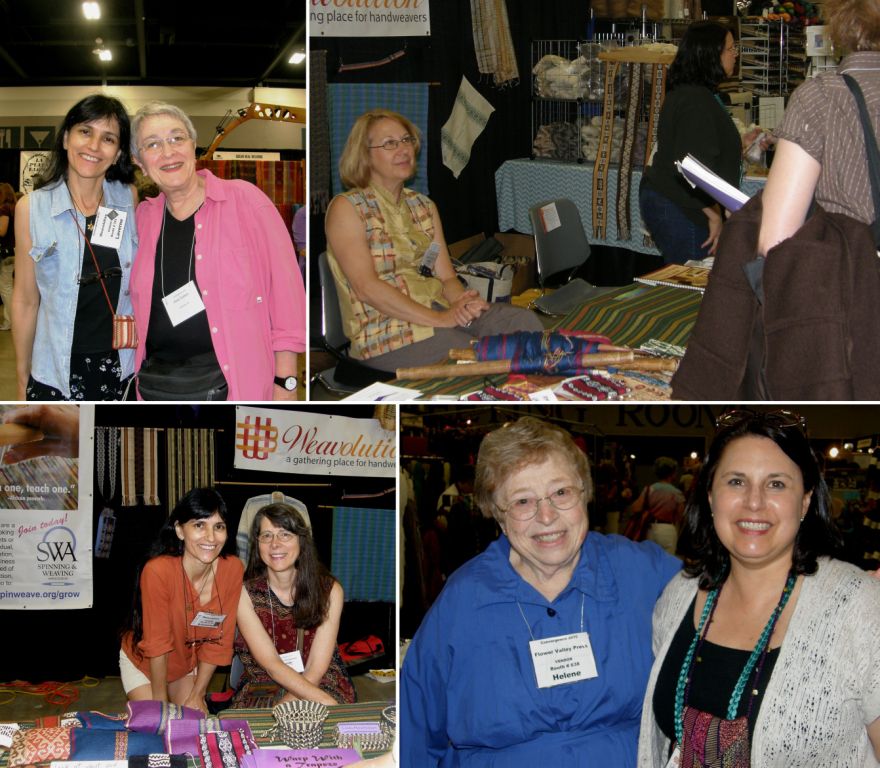
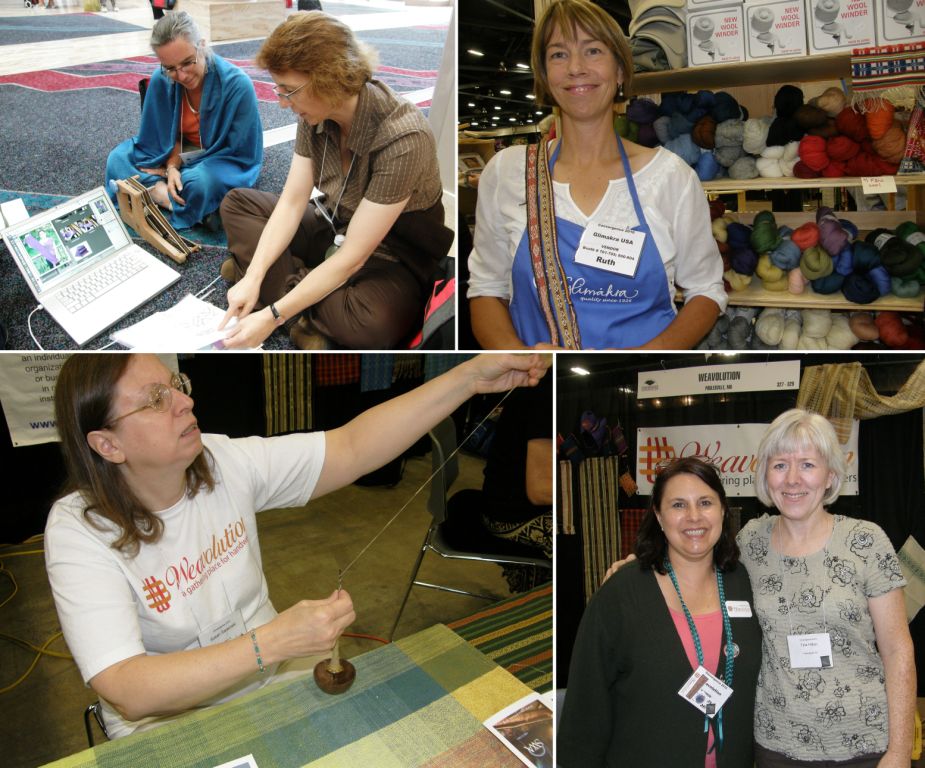
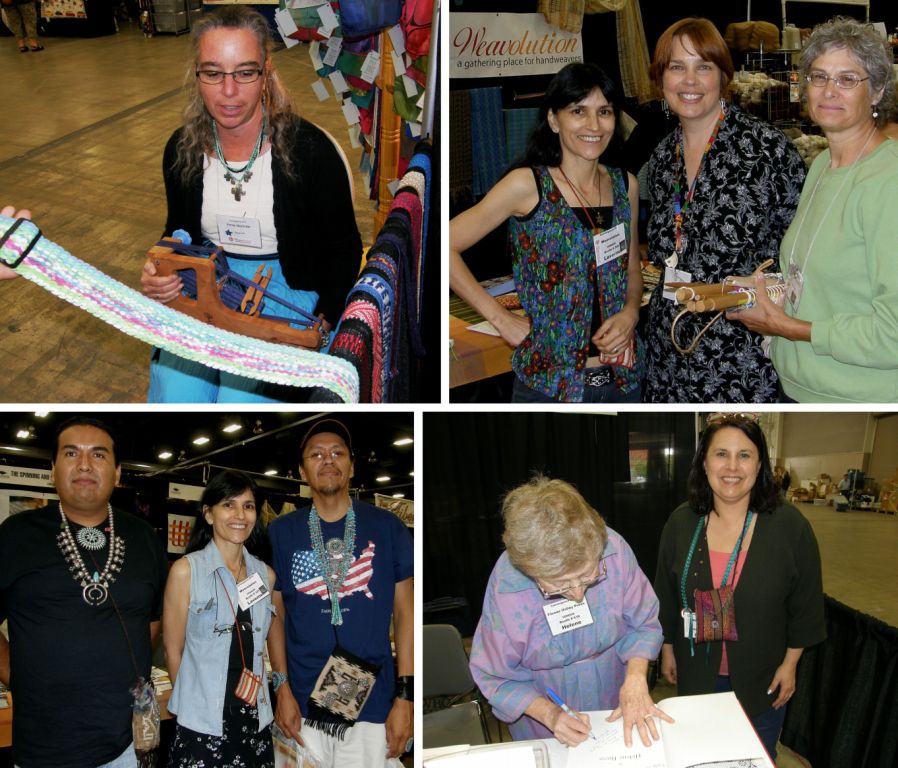
My goals for Convergence were to meet my online weaving friends and hang out and backstrap weave. I was sitting at the Weavolution booth between my wanderings just so that I could give Weavolution co-founder Alison Giachetti a break now and then. The booth was shared with SWA (Spinning and Weaving Association).


Here’s Madelyn van der Hoogt of Handwoven magazine visiting the Weavolution booth. You can see Madelyn above trying out a handwoven jacket she had seen on one of the stands. Tien Chu, one of Weavolution’s founders came by to show her latest project – a beautiful double weave shawl. Patty Graver of Interweave flew by to say hi and I was very happy to have a visit from John Mullarky of TWIST as we had met online at Weavolution while admiring each others’ bands on the Project Pages there.


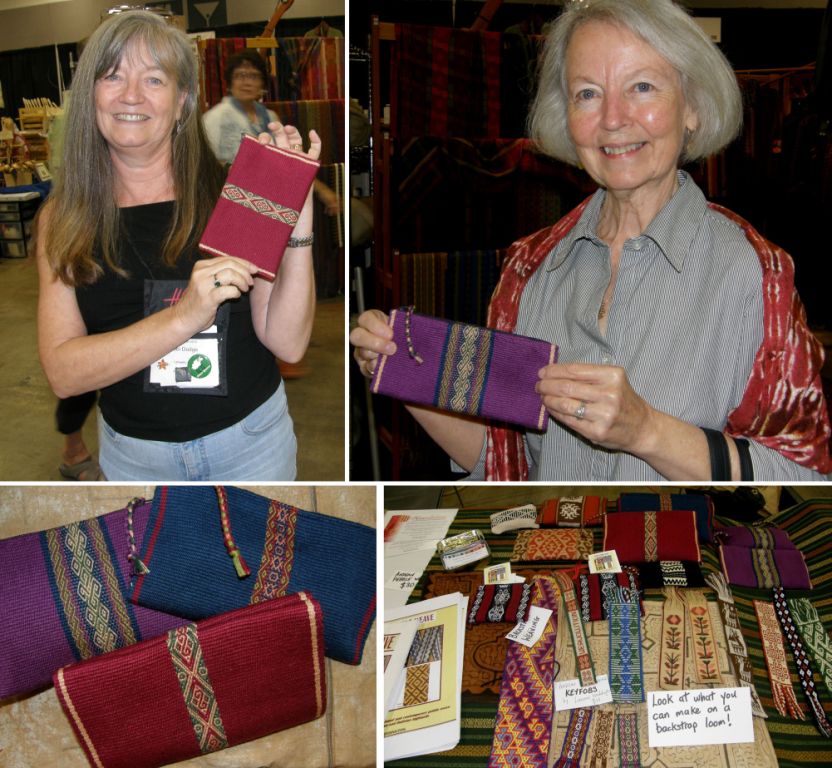
Day One was short as the vendor hall was only open from midday to five pm but it was a nice introduction to the routine we would be following for the next few days. Sally Ogren kindly allowed us to use some of her pieces to decorate the Weavolution stand and I hung a few of mine. Here you can see Alison with a display of my keyfobs and Weavolution goodies.


Day Two started for me with a wonderful surprise visit from my very first dear weaving teacher, Gladys Miller. Gladys taught me Navajo style weaving back in 1995 and had also taken me on two wonderful roadtrips through the Four Corners area in 1995 and 1996. I blogged about this here. Over the years we had lost touch until Gladys saw my name on the Backstrap Basics article in WeaveZine and emailed me. She had not told me that she was planning to come to Convergence and so it was a complete surprise. She stayed a day and we caught up and then she headed to Santa Fe to see the Spanish market with her granddaughter.
I was free to weave, visit some booths and be a bit more helpful on the Weavolution stand. It was a hard decision where to go and be sometimes. All I had to do if I wanted to meet all the wonderful weavers in attendance was stay put at the Weavolution booth. They all came by to say hi. It seemed that every time I stepped away to see something I would miss someone.


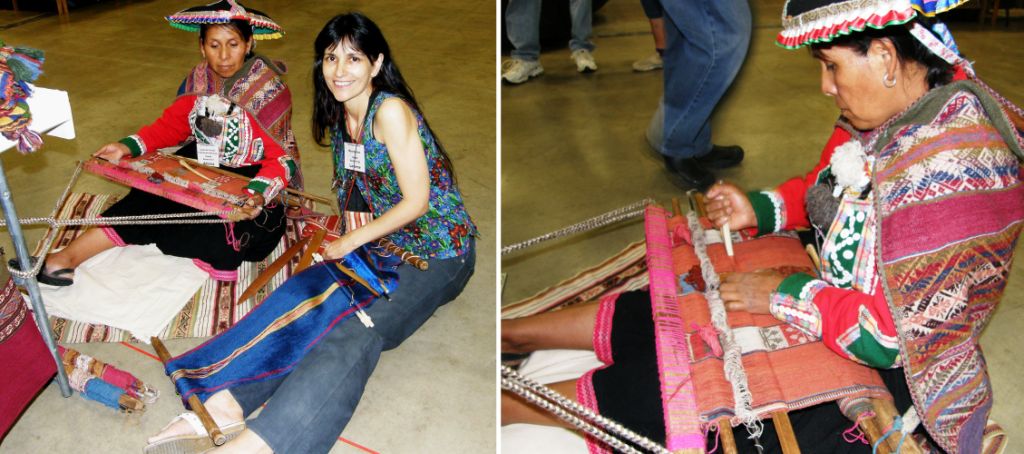
Later Antonia was working on a discontinuous warp piece, something I had never seen before, and a technique she says the weavers of Pitumarca are now trying to revive. Jenny and Antonia had brought several bone beating and pick up tools, called wichunas or ruki, which sold out in a couple of days.


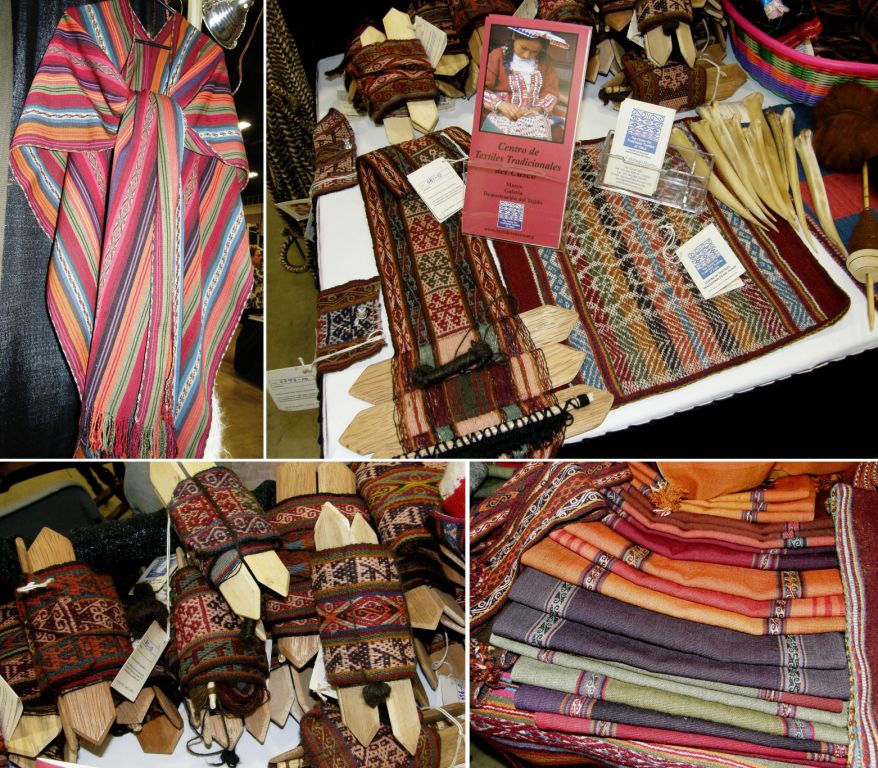
The CTTC (Centro de Textiles Tradicionales de Cusco) stand was a feast of colorful textiles….ponchos, cloths, bags, purses and woven belts still on their looms.


Meanwhile back at the Weavolution booth, we were being visited by Alice Schlein whom I had kind of met in “blog link land”, Daryl Lancaster who came to hang out and chat as well as to do a book signing, Linda Hendrickson, who thankfuly came back to visit several times ( I had gotten totally goofy on her first visit!) and dear Helene Bress.


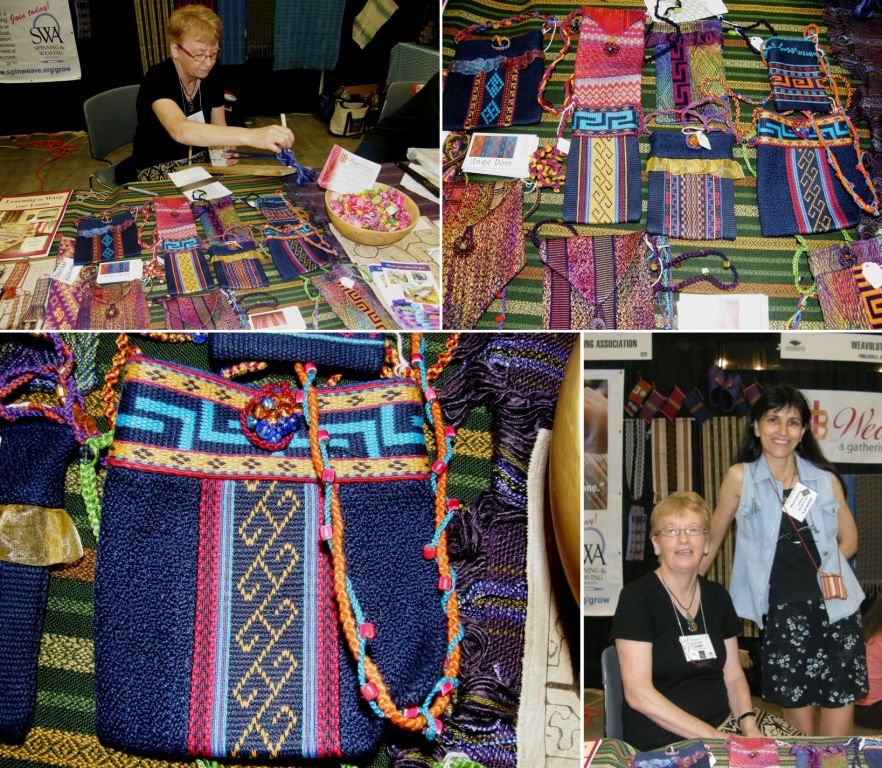
We were privileged to have Inge Dam with us demonstrating her card weaving and selling some of her beautiful pieces.


Betty Davenport and I had connected online through my blog as Betty used to lead weaving trips to Bolivia in the 80s and 90s and enjoyed reading my tales about the places that she had visited and enjoyed. She has always been extremely supportive and especially helpful when I was first planning to write a book.  She brought the new reprint of her Textures and Patterns book.  It was wonderful to meet her in person. I got some impromptu ply split braiding tips from Betty’s roomie, Linda Hendrickson, and got to see some of the pieces she writes about in her up and coming book on the subject. She has certainly changed my mind about three dimensional pieces in this technique which had not previously attracted me although I must admit that the camel girths I have seen in ply split braiding are my favorite examples.


With Linda, I went along to the TWIST (tablet weavers) meeting as I recently joined this group. The TWIST newsletter was where I first read about the Hochdorf technique of tablet weaving which led me to weave Celtic knotwork in Andean pebble weave. I met Shirley Berlin of the Braid Society, another group of which, thanks to Rodrick Owen, I am now a member.


The TWIST meeting ended with a “show and tell”. John Mullarky showed some of his fine silk pieces and the piece above left and I loved the little purse made by Nancy Alegria using a design from one of Linda Hendrickson’s books.


And what about all those Weavolution folks?


Here are some of our members! Annie MacHale (aspinnerweaver) at her inkle loom meets Helene Bress soon to be followed by an encounter with Richard Ashford who had spotted Annie’s inklette. Annie and I had met at CNCH and wove side by side at the Education Booth there. It was wonderful to meet Kathe Todd-Hooker again after our first meeting at CNCH where we had spent a lovely evening looking at her collection of Old Believer sashes. Kathe’s new book, So Warped. Warping a Loom for Tapestry which she wrote with Pat Sparks is now out and she joined us for a signing. It was wonderful to see Kathe’s tapestry take first place in the Small Expressions juried exhibit.
Tapestry weaver Tommye Scanlin, who also had a piece in the galleries, visited on more than one occasion and that’s John Mullarky, wearing his own hand woven jacket, who started the tablet weaver’s group at Weavolution.


One of our many SWA companions was John Colony of Harrisville Designs. I couldn’t have  asked for a better booth mate as John is responsible for the Harrisville backstrap kit which I got to see for the first time. Not only that, he had also met and had classes from Ed Franquemont. Convergence offered what were called ArtSparks classes, one-hour introductory fiber classes, and John taught backstrap weaving to a group. The idea was to show adults how to to teach weaving on a  simple loom to kids. The kit comes with a small rigid heddle segment and is quick to warp and get going. John allowed me to visit his group and take pictures and a couple of the students soon found their way over to the Weavolution booth to watch my demo.


More cool people passing by and stopping for a chat… Annie attracted weavers with her inkle woven guitar straps. Anita Osterhaug from Handwoven magazine dropped by and Pam Engberg. a Weavolution Backstrap Group member brought a warped up loom along to get some tips from me. I had Navajo, Pueblo and Hopi weavers stop to look at my loom and work. These two Navajo guys are weavers and wove the bags they are carrying. They shopped for churro fleece to spin. Helene Bress signed a copy of her coverlet double book set for Alison.


The stand with antique Indonesian textiles, Dancing Threads, was a great favorite of mine…

The stand with weavings and silver ornaments crafted by Chinese minorities and run by Pam Najdowski was a treasure trove and is where I did my spending. Pam was such an interesting person and gave a slide show on the main stage on her many trips to China.


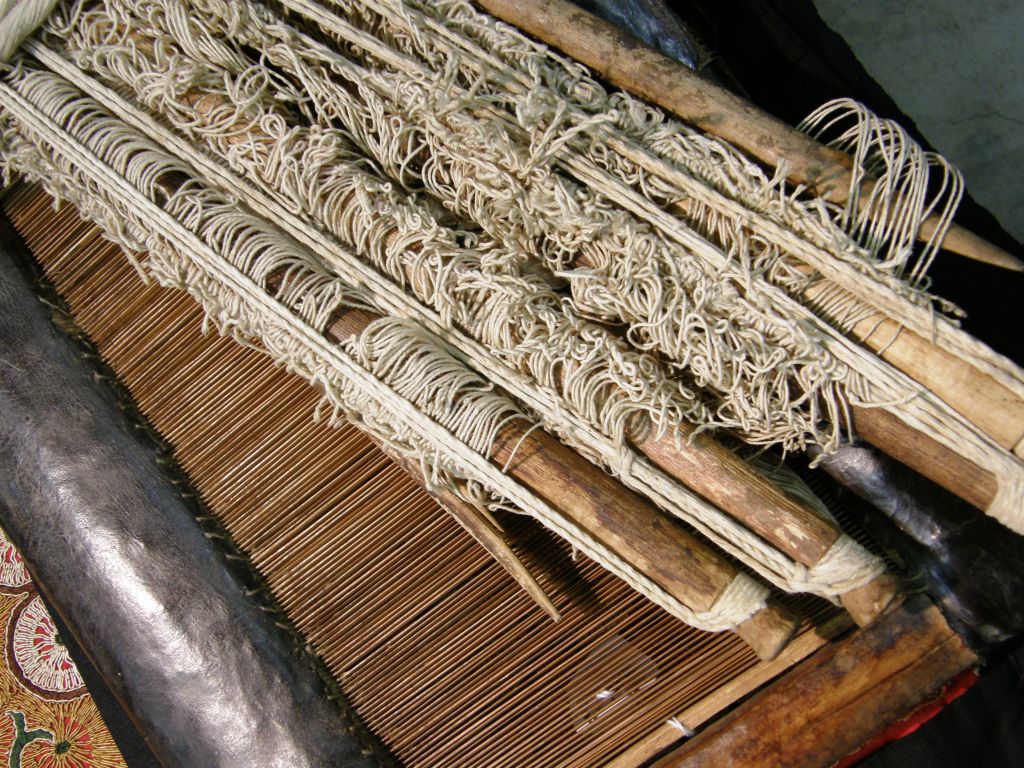
I have been looking for bamboo reeds in a good size for my backstrap loom and thinking about having them specially made in Bolivia. Now I have these two beauties bought from Pam’s Textile Treasures booth. I also got the pair of string heddles which I may use on my loom but which will most likely go on the wall. I just love them!


This backstrap loom, which the weaver tensions with her feet, blew me away. I had to go back and back again to see it. Below you can see the paddle-like pieces against which the weaver braces her feet. I would like to try this. Only once I tried tensioning the loom bar behind my toes but it wasn’t a position I could maintain for any length of time. The patterning on the woven piece was really quite simple and controlled by the several patterning sticks you can see there in the loom.

Another loom which Deb McClintock took me to see…

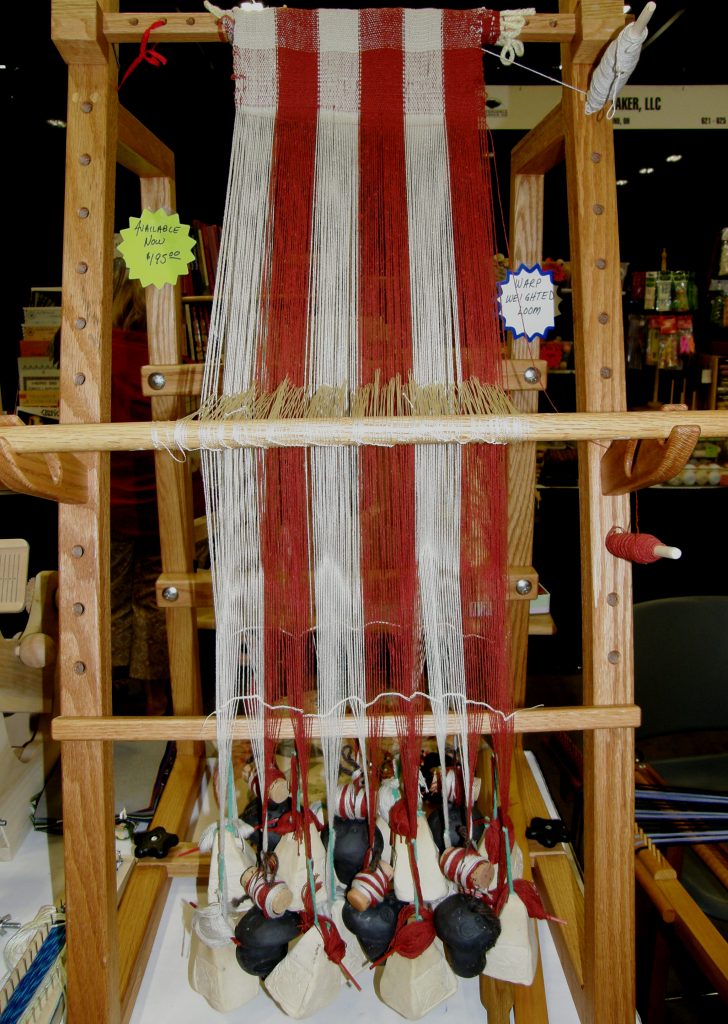
A warp weighted loom above…heard about them, read about them but had never seen one up close.

And one more curiosity at the Textile Treasure stand. I would love to have been able to see this one stretched out. Look at that beautiful reed!


I got some gifts! Kim Hamill of Weaving Southwest, who is also a backstrap weaver and teacher, gave me some yarn that she likes to use and which she dyed herself. Pam from the Textile Treasures stand, knowing my love of all things pebbly, gave me this belt which I am sure to have fun examining and reproducing when I get home. Betty Davenport gave me a crinkle weave warp that she got in Bolivia which I can finish weaving. I have never seen one of these before except in pictures. Above you can see how overspun the commercial yarns need to be before they can be used on a backstrap loom.

Then along came Martha Graham, an anthropologist who has been studying the belt weaves of the Tarahumara (Raramuri) weavers of Mexico. She spotted my display of my largely pebbled weavings and brought along, the next day, some Tarahumara belts that she just happened to have in her car! I got to photograph them and you can probably guess what is on the “to do” list for when I get home…reproductions and a comparison to Andean pebble weave. So this is the “new Mexican weave” that I refer to in the title to this blog post. I had never seen these belts before nor heard of the Tarahumara people and their weavings. Then lo and behold along came Annie MacHale the following day wearing one!! Hers is the one with the colored border above.

More Weavolutionaries!


Annie and Sally Ogren at the meet-up deep in discussion about charting software and inkle bands. Ruth (Ruthie99) from the Glimakra stand has bravely branched out into weaving with wool on her backstrap loom and brought it along for me to tame! She is displaying here on her shoulder some of the pebble weave bands she made following the intructions in my monograph. Craftin’ Susan (Susan Sarwinski) spun silk while helping out at the Weavolution booth and Tina Hilton stopped by for a chat.


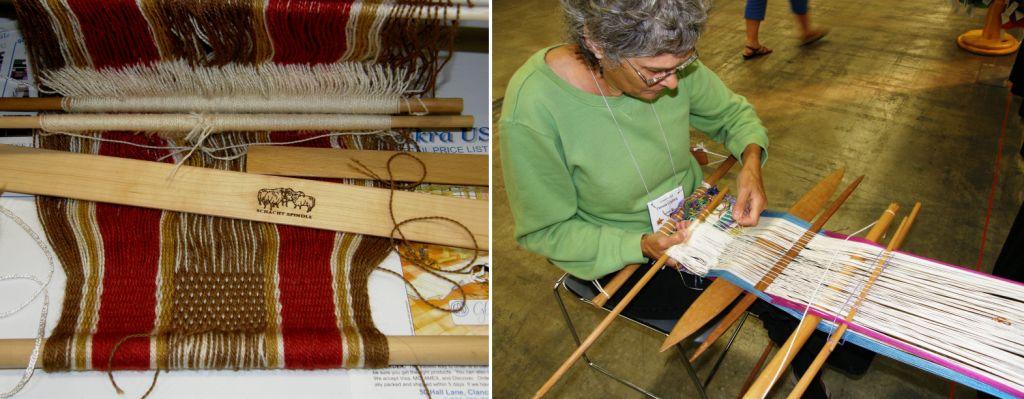
At left, Ruth’s wool warp which she dyed with all natural substances, now under control and ready for pebble weave patterning. Look at the fabulous red she gets from cochineal. She shared her dyeing secrets with me. It is lovely wool that she didn’t respin and it behaves very nicely – Henry’s Attic Crown Colony 2 ply. She uses a Schacht sword, pictured there with the warp, which works beautifully (I took this warp back to my hostel and worked on it) and I think it is a great tool for backstrap weaving if you are looking for a sword. Pam Engberg also brought a warp that needed some attention. She is trying out Guatemalan brocading for the first time and so I helped her improve her heddles and insert a second patterning stick to vary her designs.


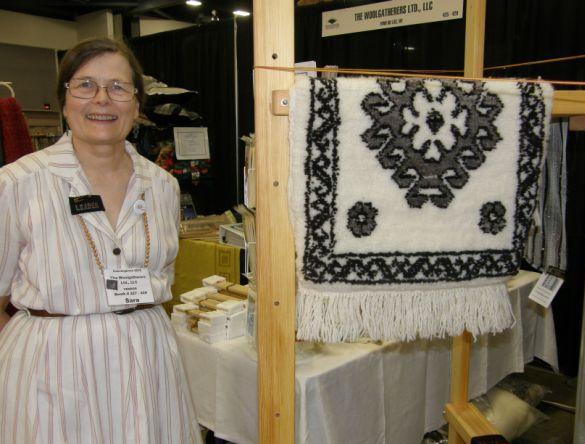
It really was a delight to meet our booth neighbors Hans and Sara Von Tresckow of  The Woolgatherers. I have “known” Sara for some time as a fellow member of Weavolution and she has shown two of her knotted pile projects on the site. It was amazing to be able to see one of them up close. I got to drive one of her big looms – first time ever for me! Quite a treat!


Other cool stuff….marvelous huipiles at the Red Corn stand. Annie’s friend Joanne showed me a carrying cloth in her collection and I was surprised to see a double weave band on it which suddenly changed to pebble weave. I have never seen these two weaves combined like that before. The weaving tools at the Chinese minorities booth had me constantly sneaking back for more. Jeffrey Appleby’s stand had an intriguing array of textiles, books and artifacts including this Turkish spindle and distaff. I bought his book “Traditional Textiles of the Andes” which he signed for me and which contains his personal collection.


I didn’t register for Convergence nor take any workshops but I learned so much! The experience of being in the Vendor Hall and meeting all these wonderful people exceeded my expectations. In a way I was sorry for the people who only had a brief lunch break in which to come into the hall and mingle. As it was, there never seemed to be enough hours in a day for me to weave, look at booths and chat. I only saw a third of the Vendor Hall after 5 days!

It was such a sharing experience.  Betty Davenport wove and gave  me a pebbe weave piece and I was delighted that she accepted my Mapuche purse in return.

Cally Booker, a fellow member of the Online Guild of  Weavers, Spinners and Dyers dropped by. It was great to meet Cally. And then there were the Ravelry folk…CoAlpine, Restless Knitter and Sherie all came to visit.

Meanwhile weavers have been warping up their four-shaft looms to try out Andean pebble weave using the instructions in my book...

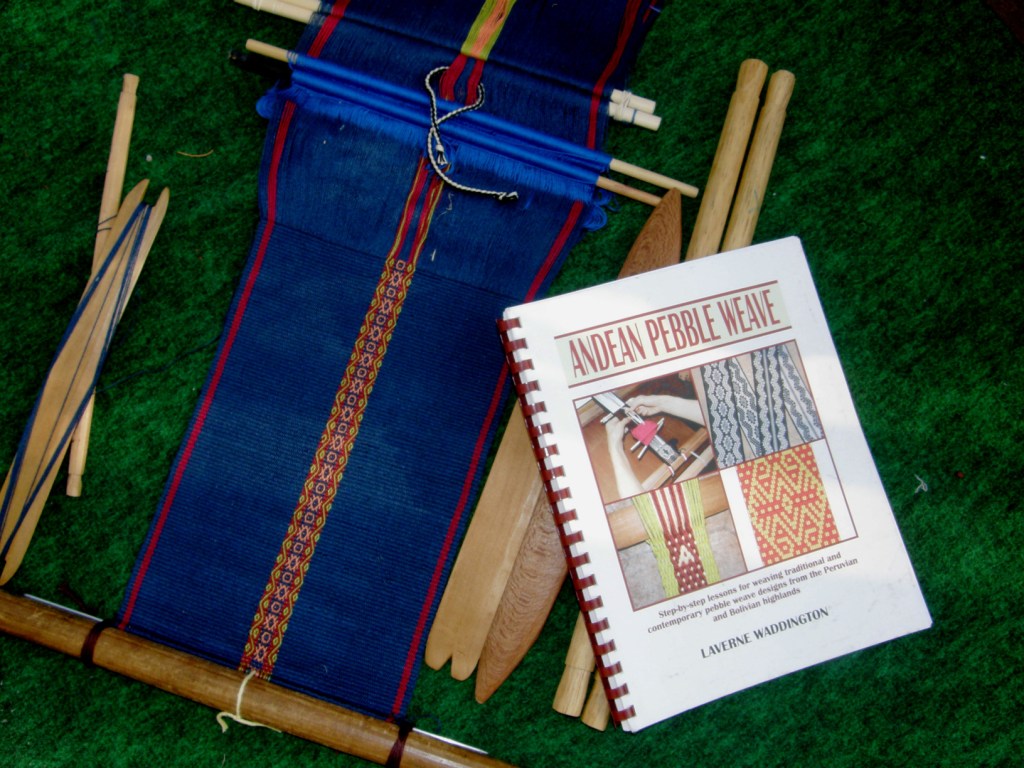
Jeanne from Weavolution is on her way and hopefully we will see this completed band soon and then a wider project. You can buy both the download version or the hard copy of my book Andean Pebble Weave which include the draft and instructions for pebble weave on a four-shaft loom here.


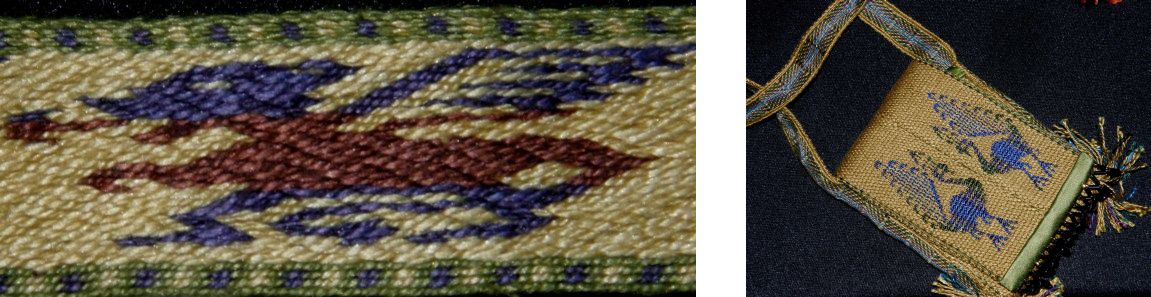
Evelyn wove this little guy using one of the pattern charts in the book. This is a “viscacha”, a small Andean animal with a long tail that resembles a rabbit.


Would you believe I have four tiny video segments of Antonia weaving to post here? I think I will leave those for another time! I am in Maryland now with my friend Claudia where I am being treated like royalty! But sadly it is time to move on and tomorrow I take the train to my friend Lisa’s place in North Carolina. More about the Maryland weaving adventures next week! 🙂