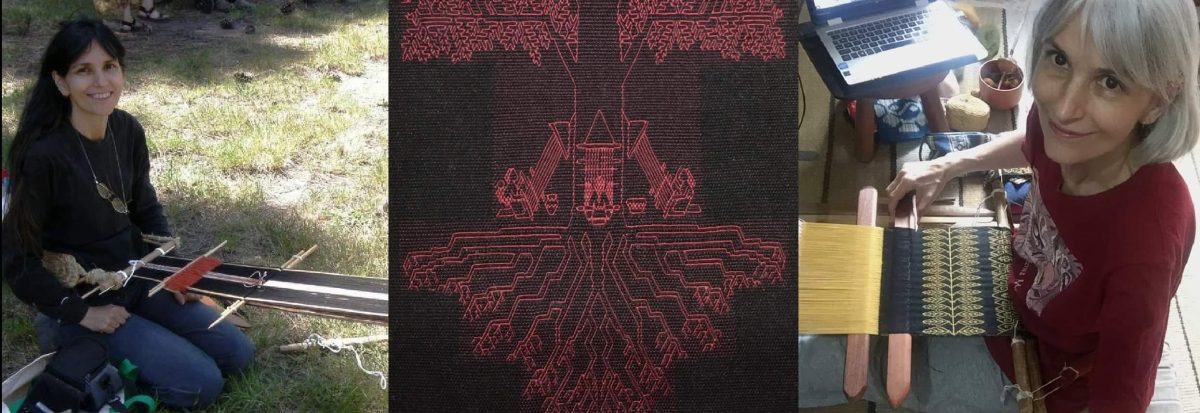
Backstrap Weaving – Over the Hump

I am back home and over the hump. Normally I don’t have a hump to get over because, as soon as I return, I simply jump into a new exciting project at the loom that has been slowly developing in my head during my travels.

This time, however, I did what I normally consider a ”no-no”. I left a major project unfinished on the loom before I traveled. I have found in the past that it is quite difficult to pick up an unfinished project like this, especially when I have been away from it for two months. The flow has been interrupted. I can see on other projects that have been interrupted in this way precisely where I had stopped and then started again. Something changes…perhaps tension or beat…something.

This is the silk project I had left behind unfinished…

There are a mere five inches of patterning to go to match the start but these five inches will be very intense.

I had started the piece with a 3-color pebble weave when I had a beautifully-tensioned, happy rolled-up warp and I now need to match that patterning at the other end. Now that I am approaching the end, the warp is being a bit beastly as variations in tension of the fine silk strands become increasingly apparent. I know how to deal with these variations but when you are working with hundreds of strands of 60/2 silk it can become quite tedious. So, that was the hump that had to be overcome. I needed to sit down and take up the slack on the looser ends and get everything back into that happy place I had so enjoyed for the first eighty inches or so.

Now it is done and I am on my way! Over the hump I go!

I sit down on a cushion on the floor in my weaving space. I can’t see out the window. My view is of the side of the bed.

A question was asked in one of the online groups about how people felt about their weaving space…how inspiring it is and what they would do to improve it. I gave that some thought and concluded that my weaving space is not one bit inspiring. But, I also concluded that it doesn’t need to be. It’s simply cluttered and chaotic!

It seems that I am completely absorbed with what I am doing and living inside my head when I am sitting at my backstrap loom. Sometimes I pause and imagine what I might see outside my window if my room were to be suddenly picked up and deposited elsewhere. I can hear the palm trees rustling outside. Just for a change, rather than a busy, noisy and sometimes smelly street market, perhaps there’s a beach just down the street and the movement of air from my ceiling fan is a nice cooling coastal breeze. I have to admit though that I do love that chaotic street market!

Even though the kind of pick-up patterning I do requires a lot of concentration, I can still pause and let my mind travel. I recall some of the lovely things I experienced on my latest trip away. Like the gorgeous views from the plane as I traveled from place to place…

There was a glorious parade of snow-capped peaks on the way up to Portland. Here Mt Shasta looks like it is floating with the clouds above the blue-tinged landscape.
The beautiful farm and barn in which I weave with my friends in Petaluma. Northern California looked so green, fresh and luscious after all the rain. It looked like a land in the process of healing.
Stunning views of the city of Seattle as we come in to land. As the Space Needle passes by I remember having dinner there with Tracy to celebrate Marilyn’s birthday as well as enjoying the Folk Life Festival with the Space Needle soaring above us.
Enjoying a peaceful lunch with birdsong and the view looking out toward Yosemite at Anne’s place on top of the hill.
Winding warps for my trip to Australia while taking in the view of Betty’s blueberry crop and lovely forested property.

I missed Marilyn’s birthday on this visit to Seattle and I was too early for Folk Life. We found something else fun to do instead.

I was lucky to arrive just in time for the annual Kyoto Sale.

I had never heard of this event before but Marilyn is a frequent visitor. She told me of being able to buy short kimonos for as little as $10 and showed me some exquisite double ikat examples that she had purchased in previous years.

I envisioned having to dig through racks and racks of expensive garments to find the one or two super low-priced items, but no! every kimono on the rack was $10 or $15!

After attending the Seattle guild’s meeting, a group of us set off with flashlights to explore the dark warehouse stuffed with Japanese clothing, lanterns, baskets, chests and ornaments.

And, when our weaving group got together the next day and we told of our purchases at the Kyoto sale, guess where a few of the ladies rushed off to at the end of the day. They appeared wearing kimonos for our second day of weaving.

Here’s my $10 score which looks surprisingly good over jeans…

And there were these…a basketful of obijime…

I caught up with many old weaving friends on this trip and met several new ones. I got to spend time with 7-year old Lily once again when I wove with Lori and the group in northern California. Lily had lost several teeth and experienced an incredible growth spurt since I saw her just six months ago. She also spent the entire day weaving with us when all she could sit still for last time were two or three picks on her pebble weave warp before bouncing away to pick flowers and enjoy the farm.

On this visit we wove a traditional patterned tubular band of the Peruvian and Bolivian highlands. We then wove and sewed a band to the edges of handwoven cloth using the weft as the sewing thread. I bring pieces of cloth that were woven by my weaving friends in the central Bolivian highlands. The handspun wool is dyed using local plants as well as cochineal. The colors and the way the weavers combine them are stunning.

The cloth can be edged with patterned tubular bands…

or, a plain-weave tubular band can be used instead. The piece can be further embellished with various decorative stitches…

The mouth of Ashli’s small pouch is decorated with cross-knit looping…

Here’s Lily sewing a band to her piece of cloth. Tiny hands had to manage the cloth, the needle and operating the backstrap loom all at once. She is wearing one of my woven silk bracelets.

Here is Narciza, one of my Bolivian weaving friends, attaching a patterned tubular band to the edge of a woven bag. At first you wish you had a third hand to help but you soon get the hang of it.

Lily’s activity soon attracted a friend. Oliver took some time out from tearing about the farm on his bike to come and watch…

And, there was still energy at the end of the day for some tether ball…

I got to see the wide project that Lori started last time we got together. Lori plans to make this into a pouch. She finished it on this visit. Like me, me she wants to ponder the finished piece for a while before cutting and shaping and sewing it into the finished product. She then plans to add edgings and decorative stitches.

Lori showed me a beautiful Huichol bag that she had bought. I have seen woven bags in her collection on past visits, woven in the balanced double-weave structure with pick-up patterns that is typically used by the Huichol people. This one is different in that the peyote and deer motifs are embroidered. The entire surface of this bag is embroidered in cross stitch.

The strap is decorated using the same single-faced supplementary-weft technique that I learned here in Bolivia.

It is so wonderful seeing youngsters like Lily being attracted by weaving and I adore this Mothers Day picture taken of my backstrap weaving friend Janet delighting her granddaughter and great nephew with her spinning…

I got to head to far northern California to visit with Janet on this trip too. The ladies up there were still buzzing after having had workshops in sprang braiding with Carol James. Tracy, who often weaves with me on these visits, has been busy making pouches using various sprang techniques.

I fell in love with the second one from the left and so Tracy and I arranged a swap….I’ll weave one of my silk ribbon necklaces in exchange for a pouch.

Janet has taken off in a different direction with her sprang. She is making garments and using her handspun cotton (of course!)…

This sprang tunic is gorgeous. As the sprang structure stretches, this is truly a one-size-fits-all piece. The typical one-size garments that are sometimes sold always make me crazy. They never fit me. Here’s what the back looks like. Unfortunately we didn’t notice that one of the fringe bundles was tucked under…

Janet is using the Ecuadorian-style vertical loom that she constructed after her visit to coastal Ecuador a couple of years ago as her sprang frame…

She has a new piece ready to go in her handspun cotton…

Here’s Tracy working with the frame that Carol James uses with her students…

And, Tracy took advantage of the fact that there are lots of willow sticks at Janet’s to gather some and bend them into shape to make nifty sprang frames.

Ta-da!…

While Tracy and Janet did some carding,

Alli came over with her bub to do some Andean Pebble Weave with me…

She was very comfortable standing to weave with her sleeping baby on her back…so sweet! She could tie the warp to the strap of the carrier.

In Portland at the guild meeting, I got to see my Braids Conference companions Barbara Walker and Linda Hendrickson. Linda gave us a brief run down of her recent trip to Myanmar for her continuing studies of the tablet woven sagzigyo (Burmese manuscript binding tapes). She promises to give a more comprehensive description in a program to the guild later this year.

While on the road, I did a little bit of weaving and study. Marilyn and her husband Rainer are filming a documentary called Interlacements and wanted some footage of me weaving on my backstrap loom. As I hadn’t brought anything with me, I was invited by Marilyn to choose yarn from her stash and create a warp. Just grabbing yarn and creating a large-ish project without much thought or planning is completely foreign to me! But, we had limited time and I set to it. I decided to weave something that I would later give to Marilyn but, at the same time, I wanted it to look like ”me” for the documentary. So, of course, I included what I have come to see as one of my signature patterns…the leaves in supplementary weft. I used Marilyn’s stash of 10/2 perle cotton and embroidery floss for the leaves.You can see the result of not having woven a sample first from which to take my measurements. There wasn’t time for that! I (almost) ALWAYS sample! I didn’t quite get it right when judging the width and so the piece had widened slightly. I will take advantage of that and use the narrower beginning as part of a shaped flap for the bag I will create.

The other thing I had time to play with was trying to find a way to neatly finish off tubular bands when they are woven and  sewn around the perimeter of a flat piece of cloth. When attaching tubular bands to pouches, there all sorts of clever ways to deal with and hide the 20 warp-ends that remain once you have finished weaving the band. It’s not so easy to do that when you place the tubular edging around the perimeter of a flat piece of cloth. Thee is nowhere to hide the ends! You can see the two wrist cuffs that I wove and edged with patterned tubular bands…

On the one on the right, you can see the kind of ugly join where the tubular band starts and finishes (look just above the bottom left hand corner). On the one on the right I got smart and hid the (ugly) join under the button 🙂 The Andean weavers are able to join the two ends of the tubular bands in a way that makes the join barely noticeable. One advantage is that generally the tubular band is dwarfed by the large pieces of cloth to which the are attached and the eye is drawn more to the patterning on the beautiful cloth than the edging band. But, even so, the join is beautifully done.

I decided to work on creating a neater start and finish to my tubular bands when I use them to edge a flat piece of cloth. I needed to figure out a way to hide those twenty warp ends.

The example below is in heavy wool yarn. The join really jumps out at me on this piece but it is a much neater finish than I have been able to achieve so far. I am confident that if I keep playing with this and use increasingly fine yarn, I will be able to eventually create a quite acceptable join. I am really pleased with this! You will see some measurements written down for those who have ever wondered how much warp to measure to edge a piece. These measurements ensure that you have a comfortable amount of space in which to operate the loom right until the end of the band. My general rule is to add 50% to the perimeter measurement but my warping pegs just happened to spaced at 39” (rather than 36”) so I just went with that! 36” would have worked just fine. I have a tutorial on weaving and sewing these kinds of edging bands here.

Lastly, I would like to show you a backstrap that Mary, whom I met and wove with in Alabama on this recent trip, has woven since I saw her.

How gorgeous is that! This was woven using Peaches and Cream cotton. Anyone who is a regular reader of my blog will know that I emphatically steer people away from that kind of cotton when one is a beginner. I always recommend a mercerized cotton for starting out as it is smooth and more resistant to pilling. Un-mercerized, soft, loosely-twisted cotton, like Peaches and Cream, used for warp-faced weaving on a backstrap loom will shed, fluff and pill dreadfully in unskilled hands. Any scraping of the heddles will cause the warp threads to fray and the heddles will start sticking together.

However, when a weaver understands how to use the body to operate the loom, as Mary clearly does, abrasion is reduced to a minimum.

Result: a stunning, thick, cushy strap!

Backstrap weavers use their bodies to relax and increase tension on the warp at will and it is these constant adjustments of the body position that enable them to open clean and clear sheds without having to struggle with or scrape heddles or over-handle the warp threads.

Once these coordinated body movements have been mastered, a backstrap weaver does not have to be limited to only the smoothest, friendliest, mercerized cotton.

These coordinated movements are precisely what I teach in my Operating a Backstrap Loom dvd on Taproot Video. I finally watched it having brought back a copy to Bolivia 🙂

I was thrilled to be present when people responded to my last blog post and ordered the dvd while I happened to be at Taproot Video in Seattle. It was fun being able to sign copies and go along with Marilyn to mail them. Thank you so much! Of course, Marilyn and Rainer at Taproot Video continue to sell and ship my dvds along with Joan Ruane’s, Kris Leet’s, Marilyn Romtaka’s and Linda Hendrickson’s.

I will show you more projects from my online backstrap weaving friends next time.


Backstrap Weaving – Highland Fling Part 2

Here’s Part 2 of my post about my recent trip to the Bolivian highlands. Read Part 1 here.

Huancarani! Whenever I have written about Huancarani on this blog and about Dorinda, her PAZA organization and the weavers in central Bolivia I have always had to go to Dorinda’s web page and check how to spell, and therefore pronounce, the name of this tiny highland settlement. It just wouldn’t stick. Quite often I would leave out the first letter ”n”. Now I have actually been there and spent an entire day weaving with all the ladies whose names had become so familiar to me. When I order woven bands from the group, the orders arrive with each piece labeled naming its weaver and Dorinda would send me a document with little stories about each one of them. I have often shared those stories on this blog. It was delightful to be able to meet the weavers and shake their hands at last. I know I will never forget how to spell Huancarani ever again. The community and the day I spent there have now become a very special part of my weaving experience.
group-photo-huancaraniHere’s a mini group photo taken at the end of the day taken in the same beautiful spot that Dorinda has shown on her website and which I had so often admired…so green and with those lovely hills in the background.

Unfortunately, a few of the weavers had gone home at this stage. Narciza, in the center with the blue skirt and spindle,OLYMPUS DIGITAL CAMERA had grabbed my attention right at the end of the day to have me help her weave a new pattern. Everyone was waiting to get together for the group photo but Narciza kept pleading ”unita mas!” (one more!)…that is, one more row of pattern, as she was so determined to weave a full repeat so that she could carry on and copy it on her own later. I totally get that kind of focus and obsession and was happy to oblige. Her joy at learning the new pattern was infectious. However, many of the weavers simply had to head home. There were animals to round up and herd, families to attend to and meals to be prepared. Special arrangements had been made by many to have a day off from chores to spend a whole day out on the ”green” outside the church to spin, weave, chat and have lunch together.

After the group photo, we separated and Dorinda, Maxima and I headed back to town an hour away. My hand was firmly shaken, I was given gifts of food and I was even hugged by some of the ladies. Maxima expressed surprise at that as it is not generally their custom to hug. I take orders from my backstrap weaving students for the bands that these ladies weave and they were expressing their appreciation for this much needed source of income. May I pass on their gratitude to all my students who have placed orders. Thank you!

examining a woven sample to copyAfter lunch, Narciza and Felicidad had wound a warp of 56 ends (that’s a whole lot of ends to be holding on just fingers!) determined to copy a pattern on one of the bands that I had brought to show. It just happened to be the pattern I was weaving on the backstrap loom that I had brought to demonstrate to the ladies. Narciza spotted the motif first thing in the morning, asked me for the thread count and set to work after lunch. In the morning she had learned a simpler pattern with me.

narciza and felicidadYou might be able to make out my sample band sitting on the Felicidad’s skirt. Narciza and Felicidad were puzzling it out together with the suggestions of others peering over their shoulders from time to time. However, time was running out and so I was called over to help before I could take back my sample and leave. I talked her through one repeat but I ended up leaving the sample with her in any case after having had my arm very tightly twisted!

charts-and-samples

narcizas new patternThere’s the pattern taking shape. Some of you might recognize it from my second book. Narciza has enough information now to be able to continue weaving this motif.

It was an action-packed day with lots and lots of weaving going on. There hadn’t been any kind of plan for the visit, as far I had known. I was simply being taken to Huancarani so the weavers could meet me and Dorinda thought that they might like to see my backstrap loom and some of my weaving. The ladies had offered to provide lunch. Apparently I was known as ”La Laverna”…the lady who gave them orders for weavings from time to time.  Maxima had wisely thrown all the cones of cotton that Dorinda had back at the house into her bag and brought them along. She must have known that everyone would want to weave and would most likely not have thought to bring any of their hand spun yarn. They had, of course, all brought their spindles!

They enjoyed looking at my samples.  Maxima, who is currently working on a wide piece on her leaning vertical loom with strips of double weave patterning, enjoyed looking at my double weave sample and picked out bird motifs that she would like to copy.

the small group first thing in the morningThe ladies arrived in a slow trickle, one by one. I set up my backstrap loom while Maxima took out the cotton and started winding a warp. I had taught Maxima one new pattern the day before and Adviana another. Maxima wanted me to teach her the pattern I had taught to Adviana and I was happy to do so. However, once the brightly colored cotton was out, everyone wanted to try some and there was a frenzy of activity as warps were prepared on fingers and toes everywhere I looked!

casimira warpingWho needs warping stakes when an index finer and big toe do nicely?

teaching momentI love this wonderful teaching moment as one of the elders starts a warp for one of the younger ladies. Dorinda told me that she had never seen this young lady before and that she was not part of the weaving co-op. She has high hopes that she may now join. I sat with her and got her started on a pattern and got the impression that she was not an experienced weaver. She was having a difficult time working the sheds and asked for my help. Who knows…this may have been her first time actually weaving although she would have been exposed to it all her life..

weaving generationsI love seeing the various generations represented in this picture. The older lady isn’t wearing a hat as she had insisted on my wearing it. I was out in the sun with the first group of ladies to arrive while she very wisely sat in the shade.

I took my very first selfie so I could see how I looked in that hat. I like it!

selfie with hatEveryone wound a warp with the same number of ends as Maxima had and they all wanted to learn the same pattern! How was I to manage that? There was only one tiny sample in fine 20/2 wool to pass around and one pattern repeat was 25 picks! There wasn’t enough time for me to weave samples right there and then so that small groups could each have one to examine.

eulalia figuring out the patternI asked Dorinda to copy the pattern chart I had made for Maxima. After working with one of the younger ladies, I could see that the youngsters quickly understood the chart and were able to weave on their own after I demonstrated just 4 or 5 rows. They still pleaded with me for ”unita mas!” but I left them to weave on with the chart and they got on just fine. Of course, the more experienced weavers would be able to sit, figure out and copy a woven sample with few, if any, problems but we only had one such sample to pass around. Above, you can see Eulalia. This lady blew my mind. I don’t know how many times she caught a glimpse of the tiny sample as it was being passed around but she sat and started weaving an almost perfect copy of it.

She soon gathered a fan club and I was the biggest admirer of all!

copying the patternYou can see Maxima in the center starting a warp for the lady seated next to her with pattern chart in hand. Narciza in the foreground has her own chart and is on her way. Narciza is a real ”go-getter”. I enjoyed meeting her a lot. And, that’s Eulalia in the background with her fan club. People learn in so many different ways. Of course, pattern charts are completely unknown and foreign to these weavers and it was interesting to see how eagerly the younger women took to them. If I had known that the ladies were going to be so keen and determined to use our time together to learn new motifs, I would have brought a dozen samples in heavy yarn for them to copy. I really hadn’t had any idea of what to expect.

copying the fish motifMy hat companion took my band of fish motifs and set about copying one of them on a band that she had brought with her. My fish are woven in heavy cotton and she could easily see the pattern to copy.

colorful woven bandsSome of the weavers had brought bands on which to work and the widest band had just enough ends to accommodate the fish motif.

maribel and daniel with dorindaIt’s not fair to have favorites but I had mine. ..19-year old Maribel and her toddler, Daniel. Maribel was the first one to arrive and should have had top priority to learn the new pattern. However, she sat by patiently while some of the older ladies got started and then sweetly asked me to teach her. She then took herself off to a quiet spot away from everyone else so she could concentrate and happily wove her band. Dorinda is seated next to her making more pattern charts.

maribels patternAfter lunch, she was happy to sit near one of the older ladies and talk her through the pattern in Quechua. She had me won over!

And, she was excited to be able to copy some of the patterns in my book that require the same number of ends. I think she went home one very happy weaver.

maribel-collecting-patternsMaxima and I were kept really busy helping everyone who wanted to learn. If only we could have taught everyone but there simply wasn’t time. I’ll be better prepared next time. I can’t wait for next time!

max-starting-another-weaver-offMaxima is starting the weaving for one of the ladies while she looks at the chart.

max-helping-another-weaverAnd then the student took over and you can see her pattern emerging. Once she has a full repeat woven, I know that she will be able to continue on her own simply copying what she has already woven.

Lunch was a”pot luck” of rice with chili sauce, potatoes, corn and sheep and goat cheese. Some ladies just kept weaving as everyone wanted their chance to learn.

pot luck highland lunch

lunch breakAfter lunch it was even more fun as it started raining and we had to cram onto the church porch.

church huancarani

weaving on the porch after lunchThere’s Maribel weaving with Daniel between her legs. Dorinda is making yet more charts. Maribel is calling out the pick-up to the lady seated on the other side of Dorinda. There was lots of talk and laughter in Quechua. I loved listening to Maribel call out the moves in Quechua to other weavers. Every now and then I would hear a word in Spanish. As I had suspected, there is no word in Quechua for ”blue”. They use the Spanish ”azul” or ”celeste” for light blue.

weaving-on-the-porchI learned that if you leave the circle someone will quickly wriggle in to take your place!

There were many ladies who simply didn’t manage to spend enough time examining the sample or get one-on-one instruction. They sat and wove anyway, chatted and laughed with their friends. Dorinda said that these ladies never have time to do this kind of thing. Maxima says that in their youth they would go out herding their animals and look for their little friends and neighbors so that they could sit and weave together.

I had to stop every now and then and look around and take it all in. I couldn’t believe how lucky I was be able to spend this day with the weavers doing what we all love. Even just looking at all the different hats in this one tiny settlement was interesting. The one with the woven hatband is especially cool…

cool-hat

admiring-patternsOne lady wove a pretty hook pattern and was happy to show it off to me.

comparing-patternsHer neighbor also admired it and I wonder if it was a new pattern for her. Perhaps she then tried to copy it.

ccopying a neighbors patternThis lady liked the pattern her neighbor said she had just invented and now she is setting out to copy it.

In the late afternoon weavings got put away and spindles came out as everyone prepared to stroll across the ”green” to the fabulous photo spot for the group photo.  Narciza, reluctant to stop weaving, looked at me and said ”unita mas?!” How could I resist?

I told you in my last post that Narciza hitchhiked into town two days later on market day hoping I was still around so that she could learn more. She and her sister Maxima wove together at Dorinda’s place. I had left two woven sample bands with Maxima plus my book and I think they had fun with that. Maxima is showing off her new patterns in this photo that Dorinda sent me but I can’t quite make them out.

narciza-and-max-learning-new-figuresWhen I got back to Santa Cruz, I wrote emails to some my backstrap weaving friends and was able to deliver a new order of bands to Dorinda for the ladies.

bands paza

Here they are warping for the very first one.The weavers from Huancarani come into town on Sundays to bring their produce to market. They often go to Dorinda’s place for tea and cake (Dorinda loves to bake!) before returning to Huancarani. They ask if there are any orders. She had good news for them last Sunday.

warping-for-the-orders

The area is so green and pretty now that the rains have come. Every night during my stay there was a downpour at around 4am. We would wake up to clean sparkling freshness and the delicious aromas of Dorinda’s lovely garden.

dorinda

And, finally, a picture of dear Dorinda walking me to the bus stop on the day I left. I did try to take a selfie of the two of us in Huancarani but I apparently need more practice with selfies. Dorinda has worked so hard with the weavers over the years and has lots of stories to tell of the ups and downs during the establishment and development of the weaving co-op, the handcraft club, the girls club and her relationship with the weavers. There is plenty to read on her PAZA Bolivia website and an opportunity to donate if you would like to help.


Backstrap Weaving – Highland Fling Part 1

I am back from the highlands. I know I have told you in past posts about how wonderful it is when I receive my box of woven bands from the co-operative of weavers high in the mountains of Cochabamba. Each year they supply me with beautiful bands woven with their hand spun wool which is dyed with local plants and cochineal.

cochabamba bandsThe box would arrive filled with the colors and aromas of the highlands which would then fill me with a longing to return to the places where my various highland weaving teachers live. This year, I managed to find time to give in to that yearning. I went up to the highlands, at Dorinda’s kind invitation, to collect my order in person and meet the weavers whose names have become so familiar to me over these years. Each band in the boxes I received would be labeled with the weaver’s name and I soon started to be able to recognize the characteristic style of certain weavers in the way they arranged their colors.

1904164_673142246065156_786812346_n

1904220_858639230848789_236114645782676326_n

It was easy to see when a new weaver had joined the co-operative and was weaving bands for my orders. Her style would be just that little bit different to what I had become used to seeing.

Here is the latest order laid out in Dorinda’s yard in the highlands. Dorinda has been working for many years with the weavers helping them to recover lost natural dyeing techniques, encouraging youngsters to learn, helping them to design products that are attractive to foreign markets and to manage orders and accounting. I use these bands in my workshops when I teach tubular bands and finishing techniques and these workshops often generate more sales for the weavers. My students are always more than happy to buy more cloth for making pouches and practicing the finishing techniques they have learned. The fact that their purchases help support the weavers is an added bonus.

latest order of bands

max-and-me-with-bandsThere I am with my teacher and friend Maxima who is the head of the association of weavers. Maxima and I first met at the first Tinkuy in Peru. She, Dorinda and I were roommates. I got together  with her another time when she came into the city of Cochabamba and gave me some weaving lessons.

On this trip, Maxima and I spent three amazing days together hanging out and weaving. She normally teaches me but, on this trip I got to watch her teach three teenagers from the town and I also got take on the role of teacher and show her some new patterns. It was a blast. Dorinda and I spent 4 days together as we had met and traveled up from Cochabamba together on the bus. We left at 5am  for the 7-hour trip and wound our way up from the valley floor to skirt the mountain tops on dirt roads up and over 14,000-foot passes to then descended to the lovely town of Independencia at 8,000 feet. It was a wet and muddy trip and we were delayed 2 1/2 hours when a truck that had gone off the road had to be winched out.wet trip to IndependenciaClouds spilled over the mountain tops and mist crept upwards from the valleys. There was not much that could be seen through all that on the way there but I was blessed with beautiful weather and gorgeous views on the way back. On the return journey, we stopped for llama crossings rather than fallen trucks.

llama crossing

road to independencia
OLYMPUS DIGITAL CAMERAWe passed by tiny settlements and people flagged us down and joined us along the way…

OLYMPUS DIGITAL CAMERAIndependencia is a lovely little town…one of those places with an altitude that allows it to enjoy eternal spring-like temperatures. Rainy season downpours in the very early morning hours left everything clean and fresh by sunrise. The hillsides were green and lush.

OLYMPUS DIGITAL CAMERAHere, it’s Sunday morning, 6:30am and the market is in full swing with ladies already making their slow way home up the steep cobbled street with their purchases.

Dorinda and I plodded up the hill to her home from the bus stop. I had my luggage and the altitude to deal with while Dorinda had all her purchases from her monthly visit to the city of Cochabamba. We stopped a few times along the way!  That was some hill. I spent the first afternoon exploring her extensive garden, getting acquainted with the 11 cats that reside there (they belong to her landlady) and  investigating her workshop areas and store rooms of yarn, sewing machines, looms and art supplies.

The workshop room had this wonderful poster that Dorinda had created which records the natural dye plants the co-op has been using and the various tones that have resulted from the use of different mordants…

natural dye colors of Cochabamba highlands

These lovely hand woven pillow covers were on my bed, a woven rug was on the floor and large hangings adorned the walls.
woven pillows with handsun wool and natural dyes colorsOutside my bedroom window, pieces of the leaning vertical looms that are typically used in this area were standing against the wall. I got such a rush seeing those… I was going to be with weavers soon…I couldn’t wait!

leaning vertical loom pieces Bolivia

The first day was ”Club Day” and three of Maxima’s teen-aged students who are members of the ”Club de Chicas”came to learn to weave patterns on bands. Of course, the tendency these days is for youngsters not to learn to weave at all as all eyes look to the large towns and cities for higher education and work. Many men in the community associate weaving with poverty and do not want their wives and daughters involved with that. It is wonderful that Nelva, Abigail and Veronica had decided that weaving was precisely what they wanted to do during their summer school holidays.

first weaving lessonFirst, the youngest, Nelva, was set-up to learn the ”linquito” pattern. Maxima would call out the color sequence to her as she picked up the threads to form the pattern. Then Maxima wove a new pattern and called out the color sequence to Veronica and Abigail row by row. They wrote it all down in their notebooks….two black, four white etc. This was Veronica and Abigail’s second band and they already know very well how to create sheds, form the picking crosses and select the threads. Weavers in this area use a technique where they form a cross, called the picking cross, using two fingers of one hand. They then select threads from this cross with their other hand to form their motifs. There are no sticks or swords or beaters involved.

learning to weave BoliviaThe girls helped me write the words for numbers and colors in Quechua in my notebook even though they preferred to note everything down in Spanish. I remembered the words from the time I had spent in Potosí with my weaving teachers. Remembering those Quechua words came in very handy the next day when I went out to one of the outlying communities to weave with the ladies there.

With notebooks on knees and heads down, Veronica and Abigail settled down to weave and the race was on. I sensed a healthy competitiveness between them. They were very methodical and never lost their way in the instructions. We hardly heard a peep from them for the rest of the day!

OLYMPUS DIGITAL CAMERANelva’s ”linquito” pattern was coming along but her younger age and, perhaps the lack of a competitor, showed when she got easily distracted and often lost her way. Maxima was there to set her back on the right path.

OLYMPUS DIGITAL CAMERA

Once the girls were up and running, I showed my backstrap loom and some woven samples I had brought to Maxima, Antonia (who also weaves bands for my orders) and Adviana. Adviana, now 21, had learned to weave at age 16 in the Club de Chicas. I think they all politely watched my backstrap loom demonstration but what really got them excited was not the loom, but, rather, the pattern I was weaving along with those on the samples I had brought.demonstrating-my-backstrap-loom They liked the softness and smoothness of the cotton I use and the fineness of the wool samples I had. Adviana immediately wanted to learn a new pattern for a wrist cuff after seeing mine. Maxima chose a wider and more complicated pattern.We stopped and went our ways for lunch and Maxima returned with spindle in hand adding twist to some of her hand spun wool so that she could learn the new patterns.

max adding twist to her yarnWhen it was clear that adding twist to the three colors she needed was going to take too long, she went into the store room and brought out a bag of cones of perle cotton. I was surprised to see that. These had been donated by Cotton Clouds one time when Dorinda was in the USA at a WARP conference. No one had put them to use until now. There was a certain sense of urgency. Maxima knew that I had only a few days there and she wanted to learn everything she could in that time.

Adviana wound a warp for the wrist cuff and the new pattern she wanted to learn.adviana winding a warpNo need for warping stakes. You just throw off a shoe and wind around your index finger and big toe. I love it!

I explained to Maxima that her pattern was much wider and that it would be very difficult for her to hold all those threads on two fingers.She would need to set this up on her leaning loom. I figured she would relent and decide to learn a narrower pattern instead. But, no, before I knew it, out came the leaning loom pieces and Antonia and Maxima were seated rolling the cones of cotton back and forth to each other creating the warp. Then it was my turn to get excited. I hadn’t expected to get to watch them warping.

Normally, they roll balls of yarn back and forth to each other and years of practice have them smoothly and efficiently launching the balls with just the right amount of force. Rolling the cones was a different story. They simply would not cooperate but things had certainly improved by the time they got almost to the end of rolling and winding.

warping-the-leaning-vertical-loomAdviana finished first and made her heddles and I set about teaching her the new pattern that she liked. Her patience was put to the test when her youngest little boy wanted attention, swinging off her braids and throwing himself on her back at regular intervals.

aadviana weaving her patternI had spent the lunch break drawing out a pattern chart for her. That way I could demonstrate the first few rows, teach her to read and mark the chart and then move on to teach Maxima. There just wasn’t time to weave the full 24-row repeat of the pattern for her to copy and my wool sample was too fine to easily read. She really took to the charts and came two days later and happily sat and copied several pattern charts from my book. You can see her band taking shape above.

I had a hard time convincing Maxima, that, although I set up my backstrap loom very differently to the way she sets up her warps, (I use two sets of string heddles and one permanent picking cross while she uses one set of heddles and two temporary picking crosses), she could still weave the new pattern using her methods. We both weave the same structure but just use different ways to create it.

Because she lost confidence after her first attempts to copy the pattern from my cotton sample, she asked me to set her loom up the way I do and to weave one complete repeat so that she could watch me.

with-max-at-leaning-loomSo, I did. After I had woven one half of the pattern, Maxima took over and finished it off, feeling more confident as she started to recognize familiar shapes.

maximas-turn-at-the-loom

She then wove another motif almost completely on her own and had just started a third when it was time to stop for the day. She is really motivated to weave a new aguayo, or carrying cloth, with this new motif. I left her my cotton sample which has three other new patterns. You can see Adviana in the background of the above picture, copying pattern charts into her notebook.

max learning a new pattern

max at her loom

OLYMPUS DIGITAL CAMERAI could just stroll about at this stage with everyone happily engaged at their looms. Abigail and Nelva had gone home but Veronica was determined to finish her band that very day…

Veronica finishing her bandShe was not able to weave with her leg extended any more. She could have just added some string to end of her band to extend it so she could continue weaving with a straight leg. Well, she’s 13 and supple and I don’t think she was experiencing any discomfort sitting like that. She was far too absorbed in finishing the band. My knee and hip ache just looking at her! She didn’t finish that day but showed up two days later to show it off with its ends nicely braided. She said that her grandmother was very proud of her and had shown her how to do the braiding.

Where will this young lady be headed next with her weaving?

vero-with-finished-bandMaxima and Adviana also came over on this day to learn even more patterns. These particular motifs are not unknown in this area and have, in fact, been used by some of the weavers on the bands that I ordered. But, not all the weavers know all the patterns and it seems to be that they are not in the habit of getting together to teach each other motifs once they are adults.

This is the band that Maxima wove with two new patterns that she wanted to learn from me. We continued using cotton as time was short and no one wanted to wait until yarn could spun. Plus, I think they really enjoyed trying out cotton for the first time.

maximas new patterns

That morning I had risen early to wind a warp and weave a narrow band with more tawa chinito, or 4-pair,  samples that I could leave behind for Maxima. I pounded some stakes into the ground for that. You can just see the tip of it next to Maxima’s band above. I can’t wait to see if some of these motifs show up in my next order of bands.

If I wind using four stakes rather than just two, I can eliminate one of the steps in the setting-up process as I can separate my two colors into two sides of the cross as I wind. When you use a finger and toe as your warping stakes you don’t have the opportunity to add two extra ”stakes” in the middle. I don’t live in a place where pounding stakes into the ground is possible and I welcomed this chance to get down and grass-rootsy at ground level.warping

I scouted about the garden and found a stick to break into pieces. Of course one of the resident cats had to come over to inspect the intrusion, approve it, and then claim it as its own.

OLYMPUS DIGITAL CAMERA

At lunch time, I went up to Maxima’s place to see the latest piece she has on her leaning loom. It is one of the two panels that she will weave to make the new aguayo that she wants to use at the Tinkuy in Cusco, Peru this November. It has two strips of warp-faced double weave patterning along with two strips of pebble weave. That’s a lot of pick-up! I love feeling the firmness of the cloth which is the mark of a good weaver in these parts. She is using the brightly colored fine synthetic thread that is sold in the market and I was surprised to see the Cotton Clouds cotton being used for the heddles. She likes the way it behaves.

maxima's doubke weave and pebble weave aguayo

That evening, I discovered a supply of dyed hand spun wool in the store room that belongs to the co-op. This is sold to the weavers who have run out of certain colors and who would like to weave for one of the orders.  Generally, each weaver has a stash of yarn that they take away from the communal dyeing days. Maxima allowed me to buy some and I am keen to weave something. I have woven with this tightly twisted yarn before but, this time, I would like to experiment with it by taking out some of the twist.

natural dye hand spun wool Cochabamba

I have described our activities over two of the three days that I spent up in the mountains….the first and the third days. The second day was something else again when Dorinda, Maxima and I traveled about an hour away to the settlement of Huancarani and met with the weavers there for a ”weave-in”. That event will have to wait for my next post. There is so much to tell! Many thanks to Dorinda who supplied some of these pictures.

When not weaving,  I had lovely peaceful times chatting with Dorinda sitting out on her ”stoop”, swapping travel tales, enjoying her garden and her fabulous home cooking. She makes do with so little…no fridge…everything is fresh, and she loves to bake! Morning break on Club Days is spent eating her freshly baked muffins and cookies. She always has something tasty ready for visitors from Huancarani  who come into town on Sundays to sell their produce at the market. We took walks around the town in the evenings, greeting her neighbors and local shopkeepers. Everyone seems to know her by name and they show their warmth in their kind greetings.

I am already making plans for my return. I’ll continue the stories in the next post. Now, to get back to my silk weaving!


Backstrap Weaving – A Highland Holiday

I am heading up to the highlands for a quick visit with Dorinda, my weaving teacher Maxima and other weavers in the co-op. It will be nice to escape the lowland heat and humidity and breathe some mountain air although the mountains are in their rainy season and so there won’t be any lack of moisture. I just hope the bus doesn’t get stuck anywhere along the way.

Dorinda with the weaving group at Huancarani - what a gorgeous area she is working in!
Dorinda with the weaving group at Huacarani – what a gorgeous area she is working in!

So I won’t be around for my Thursday night post. I thought I would give you a quick update today on the long long silk warp that I recently set up.

Here it is off the warping stakes and with coil rod installed….

long silk warp in living room backstrap weaving

Starting to make the continuous string heddles…

making heddles long silk warp backstrap weaving

And now, I have the first bit of heavy-duty pick-up patterning finished. I did a reversible 3-color pebble weave pattern with motifs in supplementary weft on the side. The three colors are brown, gold and red. On this face, the gold separates the brown and red. On the other face, the brown and red end up being adjacent. This gives a much bolder look. I prefer this face which is much more delicate.

silk 3 coloe pebble weave backstrap weavingI am going to simplify the pattern for the body of this piece so I can move along much faster and then I will duplicate this 3-color pebble pattern at the other end. The 3-color pick-up is quite slow but it’s amazing how quickly I got into this new rhythm and pace. It soon started to feel quite ”normal”.

After winding the warp and then sitting at my loom to look all the way down its length, I had experienced quite a few ”What was I thinking?” moments as I contemplated the amount of time it was going to take to weave this project. But now that it is underway and I am pleased with the way it looks, I am calm and content and looking forward to planning each new section. I did some backing up when my color arrangement wasn’t coming out well and un-wove a 1/2” before getting back on track.

I’ll finish this section with some gold weft-twining before moving on.

I took a break from this to weave some small pieces in 3/2 cotton for a project which must remain under wraps for now. After having worked with the 60/2 silk thread, the 3/2 felt like thick sausages in my hands! It was lovely to be able to zoom along on those for a couple of evenings.

So, I’ll have some time away and lots of bus hours to think about what comes next. There certainly won’t be any lack of color inspiration when I get to meet up with Maxima and the other weavers and see what they have been creating lately with all their gorgeous naturally-dyed hand spun wool.

cochabamba bandsI’ll tell you all about it when I get back.


Backstrap Weaving – Big Hands, Little Hands

I am back home after two months on the road. Back at my loom…yay. It’s always nice to come home to projects that are set up and ready to go. That’s always a nice way to ease back into things. I had taken two projects with me to weave in free time. I didn’t get a lot done! I think I showed this one with the word ”backstrap” completed before I left and all I got to add while away was the word ”weaving” and a little flower….
backstrap weaving lettering projecttwined words for weaveIt is a band in 60/2 silk that I am weaving to sample letters. I want to weave a strap for a pouch showing the word for ”weave” in different languages.

The last time I attempted such a project, I created the letters in weft twining and I was only able to fit six words onto the strap for my loom bag (at left). I hope I will do better this time.

If you look at the black background in my picture you will see the texture that Bolivian weavers created by using both s and z-twist warp yarn.

Yes, 60/2 silk is some crazy stuff to be handling no matter what size your hands and fingers are. When I am using fine thread like this. I change the way I do my pick-up and set up the warp so that I can use a pick-up stick rather than having to hold threads in my hands. That is the beauty of having worked with backstrap weavers from so many different places. I have a variety of techniques from which to choose according to the kind of yarn I am using or the kind of structure I want to create. I just love getting my fingers in among the threads, but sometimes a smooth pick-up stick works better for me. It is not only about the size of the thread. You might know how silk thread wants to catch on every little imperfection in the skin of your hands and fingers!

silk cuff on loom backstrap weaving

The other project I took on the road was a three-color reversible pebble weave. I am using tapestry wool for that which I bought at the Australian Tapestry Workshop. I had bought the wool for practicing the braid that had I learned with Rodrick Owen at the BRAIDS 2016 conference last July and I thought this wool would be a nice souvenir of my visit to Melbourne. Then I thought….what the heck, let’s try it for band weaving. It doesn’t stand up to warp-faced weaving too well and I am afraid that the off-white thread won’t be lasting  much longer. The green, on the other hand,  has a totally different character and is performing beautifully.

3 color pebble weave backstrap weavingThree-color pebble weave isn’t something I do all that often and so I am weaving this piece to remind myself of the steps as I plan to make something much larger in silk. Of course, a silk sample will have to follow. I can’t wait! I can easily handle these threads with my fingers and I love feeling the wool in my hands. When I make my silk sample, I will come up with another way to handle the threads.

My goal of weaving wider, longer and finer continues…

Talking about hands and fingers and size…

san diego zooMy weaving friends Deanna and Margaret took me to the San Diego Zoo. Yes, you can get this close to the gorillas! It so happens that one of the gorillas’ favorite places to hang out is right up against the public viewing window. I am sure that the window must block sound as the gorillas would otherwise be driven crazy with the constant outpouring of ”ooh and ahs”, and laughter and squeals from the public. There the gorillas were reclining and napping. The bored baby gorilla pounded mom’s belly like a drum as she tried to sleep. I found this gorilla’s hand fascinating.

lily-7-years-old-andean-pebble-weaveFrom there, let’s look at some little hands in among the warp threads.

I got to visit with my weaving friend Lori and her family again on this trip.

Lily, now seven years old, is doing Andean Pebble Weave in the way I was taught by my teachers in Ayacucho, Peru, that is, with two sets of string heddles. She picks up her pattern threads at the cross sticks and knows just how to operate those two sets of string heddles.

It has been fantastic watching her progress over the years. I now have video clips of her weaving at 5, 6 and 7 years old. Such fun!


Take a look at her doing some pick-up and working those heddles!

This is the pattern that she is weaving…

lililys warp backstrap weavingLily is left-handed and was taught by her left-handed mom. Of course, she doesn’t stay put at the loom for too long. A group of us were weaving in a barn on a farm and there was a whole field of beautiful wild flowers outside just asking to be picked. After a few weft picks Lily was skipping off to pick some flowers.

That was such a great weekend out there on the farm! Lori got a group of friends together and we wove. Most people wanted to try their hands at creating wider warps that could be used to weave cloth for a small pouch. They all chose to use the Andean Pebble Weave structure for the patterns.

asymmetric warpI loved the asymmetric warp that Jennifer created. I am such a slave to symmetry so it’s always nice when someone shows me how naturally asymmetry comes to them.

open-field-farmThese beautiful fields in their misty valley greeted us each morning. We had the whole barn that the farm’s co-op uses for selling its produce to ourselves.

barn for backstrap weavingThere were so many interesting possibilities for attaching warps.

barn backstrap weavingweavingOnce the fog lifted, it was glorious outside. Kate brought a warp she had obtained in Guatemala with leno in progress. She wanted to get the hang of  opening the sheds on such a wide piece and was comfortable outdoors enjoying the sunshine and mild temperatures..

Kate with Guatemalan warpHere’s one of those busy tables that I so love. Much of the first morning was spent with rulers and calculators measuring samples, planning colors, picking patterns and figuring the number of warp ends as well as practicing warping…yes, practicing warping…I insisted. And, I think everyone agreed that it was a worthwhile exercise.

busy table for backstrap weaving

lori's backstrap warpLori’s beautiful purple and gold warp just happened to match the dried flower arrangements that were scattered throughout the barn. This piece will become a small pouch.

Making string heddles…

Lori making string heddlesOLYMPUS DIGITAL CAMERAHere’s her warp set up and ready for weaving. She is setting the width. We calculated how many warp ends were needed using samples and got to within 2/16” of the planned width on all the projects. I was really pleased with that.

loris-warp


karen making backstrap loom sticksKaren had brought sticks from her garden and would just pick one up and cut it to size when she needed a heddle rod or cross stick….love that!

angela weaving backstrapThat’s Angela at work on her pouch fabric….hands in warp threads…love it!

weaving in the barnRose, Cynthia and Sharon are hard at work weaving. The warps were wider than any they had ever made before but not terribly long. They had small pouches in mind and they had enough length of warp to allow them to weave the planned length of fabric without being crammed right up at the end beam trying to weave the last inch or so. I can’t wait to see how these projects turn out. Lori organizes regular gatherings with these ladies so that they can work through problems together or simply enjoy weaving side by side.

Here’s Cynthia’s beautiful warp…

Cynthia's backstrap weaving warp

Back at Lori’s home, we played with ñawi awapa tubular bands…

lori weaving nawi awapaOnward to another group of weaving friends and  another delightfully chaotic table! This is another group that organizes regular backstrap weaving gatherings… this time in Phoenix.

This was a sewing day as we practiced sewn tubular edging bands and other embellishments for finished cloth….

Caroline is weaving and sewing a plain-weave tubular band to the edge of some gorgeous handwoven cloth made by my weaving teacher and friends in Bolivia.

collyer-tubular-bandCollyer decorated one edge of her cloth with coil stitches and also wants to add a ñawi awapa tubular edging to a felted purse that she recently made. You can see the wool warp that she prepared. It matches the felt so well.

I created some excitement when I brought out my double weave samples. I think we will get together and play with double weave next year!

az-and-san-diego-6My friends in San Diego wanted to do just that this year….double weave. Rocio was so pleased when the steps started making sense and her first patterns emerged….

rocio double weaveLook at the nice cushy armchairs some of the group got to sit in and weave! We just about filled Deanna’s living room and sometimes I have no choice but to crawl under the warps to get from one person to the next!

az-and-san-diego-1The weather was gorgeous and we got to chill in Deanna’s gazebo at lunch time…

az-and-san-diego-9

Deanna double weave backstrap loomDeanna quickly slipped into the rhythm of warp-faced double weave. There are some unusual moves to be made but, once you start understanding the ”why” of it all, the steps become easy to remember.

Meg charting double weaveMeg discovered how easy it is to chart patterns from cloth and took advantage of my sample selection to add to her collection of charted motifs.

Deanna later sent me a picture of her progress. She added an I Ching hexagram to her band…

deanna-with-heartAs always, it was a fun spending time with Deanna. This time we had a little extra time up our sleeves and we went to the Zoo and also to the Mingei Museum in Balboa Park. Balboa Park is an amazing place! The historical buildings from a couple of world expositions in the early 1900s are spectacular. The park is packed with museums, theaters and gardens.

The Botanical Building Balboa Park San Diego

balboa park

spreckels organ pavilionThis building is the Speckels Organ Pavilion. The organ, one of the world’s largest in an outdoor setting, was donated in 1914 and has 5000 pipes ranging in length from a pencil to thirty-two feet! On Sundays, the door rolls up for free concerts. We were lucky in that it seemed that an audition was being conducted and we could enjoy hearing (and feeling!) some moments of music.

At the Mingei I was quite taken with this quirky collection of Japanese dolls made with eggs. This one is clutching a copy of Time magazine. Others held burgers and even a surfboard!…traditional clothes meet modern times, I suppose.

mingeiA visit to my friend Diane in Grass Valley was possible on this visit too. Of course, we wove. Diane invited others and six of us sat together and worked on all kinds of things. That is when I got to weave a bit of my lettering band.

Diane wound a warp for a backstrap with an Andean Pebble Weave pattern from my second book...I hear it has been progressing well since I left. By the way, a new Andean Pebble Weave pattern book is underway!

Diane's backstrap projectShan, Jane, Stephanie and Janet brought pebble weave and double weave bands to work on. That’s Shan’s on the left and Jane’s on the right…fingers and hands in threads and sheds…

shan-and-jane

OLYMPUS DIGITAL CAMERAI got to go to the guild meeting where the Jane above, Jane Milner, presented a program on her years studying basket weaving. She placed an extraordinary number of baskets on the display tables…all so different…in shape, material and technique. She included special pieces that she has collected over the years. Each basket had its story. It was a fascinating presentation…

One of the baskets that Jane recently made.
One thing that Jane mentioned during her program which,while being onvious is not something I had previously contemplated....every basket you ever seee was made by hand. No machine has yet been created that can replicate these woven structures. I like thinking about the hands, small and large around the world and throughout history working all kinds of natural materials into these magnificent containers.
One thing that Jane mentioned during her program which, while being obvious, is not something I had previously contemplated….every basket you ever see was made by hand. No machine has yet been created that can replicate these woven structures. I like thinking about the hands, big and little, around the world today and throughout history working all kinds of natural materials into these magnificent and useful pieces of art.

And, guild member Bhakti, whom I had met way back in 2010 at Convergence in New Mexico, turned up with a fabulous Karen backstrap loom to give me! It has a circular warp on it that the Karen weavers had created to teach her how to use a backstrap loom. It uses hefty split beams to sandwich and anchor the cloth. I always end up with terrible problems trying to get everything back to Bolivia in my luggage. But, I didn’t care if I went home without clothes….this loom was going home with me! It had a large piece of pvc pipe as the shed rod. I left that behind and I will replace it with something of my own here at home. I can’t wait to sit down and study the patterning and heddle set up. I love the rice sack backstrap! The warp is extremely long.

Bhakti shared with me a picture of two of the Karen ladies at their looms. It is interesting to see how high up on their bodies they place their backstraps.

bhakti-photo-karen-weaversSo, the loom got packed into one of my bags in among the skeins of 60/2 and 120/2 silk that I got from Red Fish Dyeworks.  The ladies at Red Fish did an amazing job filling an order over which I had been dithering for weeks. Ginny and Mary helped a lot by letting me examine their samples. They even gave me some of their silk. It is so hard to order colors from those you see on a computer screen. I am really excited about the luscious colors. This will be used for one of my big Bolivian summer projects.

I finished my visit in the northwest. I visited friends Elinor and Einar in Skagit Valley. Elinor helped me with some sewing and I helped her with some weaving. A good deal! She is making this striking Andean Pebble Weave belt for her husband for Christmas. This is one of the patterns I adapted from komi knitting for my second book. Oh, did I happen to mention that I am working on a new Andean Pebble Weave pattern book?

elinors-belt

But I spent most of the time in Seattle with Marilyn. There’s a lot to tell about that and that will come in another post soon!

It was a very special visit. I will give you a hint… I spent a lot of time in front of a camera while there rather than behind one.

During the visit, Marilyn also took me to a gathering of her tablet weaving group in Seattle. It was nice to see many familiar faces…people with whom I have woven while visiting the area in the past and people I met at the recent BRAIDS 2016 conference.

There was Show and Tell of beautiful tablet-woven bands and discussion of future themes for study. It was an impressive study group that got down to business and achieved a lot in their time together.

By the way, expert tablet-weaver, Kris Leet, wearing the dark top, has been spending some time in front of a camera too…

I’ll tell you all about these ”in-front-of the-camera” happenings in my next post!…It’s pretty exciting stuff 🙂