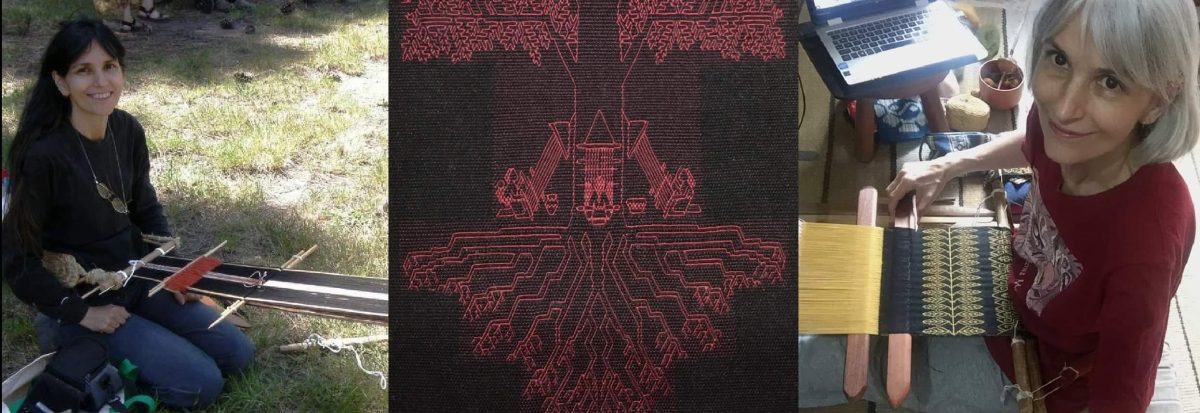
Backstrap Weaving – Making the Most of It

Back when I was doing my training to be a teacher of English as a foreign language, I remember being told over and over to make sure that any original materials that we created were designed to be multi-functional. Why go to all the time and trouble to create something that would be used once in only one context?

I loved creating my own materials for English-teaching. Back then when I didn’t have much time for weaving, it seems that I poured all my creative juices into doing that. It was multi-functional in that I got to be creative while at the same time providing some welcome fun time for my students away from the text books. And I got better and better with using the same material in different ways with a variety of groups in a variety of contexts at different levels in their learning. And, as a bonus, it gave me a reason to buy stationery. I discovered that I have a thing for stationery.

Give me a chance to draw and paste and sticky-tape and color and I am happy as a baby.

When it comes to weaving, I have folders and closet shelves piled high with charts that I have created for projects. They got used once and then filed away, like the mega chart that I created for my Shipibo-inspired project that you can see above. Sometimes I wonder why I keep them. But then you know how that goes….about a week after you throw something away, you find that you need it, right?

My cat always enjoyed my get-down-on-the-floor-to-chart time.

So, with all that in mind, I am pleased that I have been taking the hummingbird charts, over which I have long labored, and using them in a variety of ways…making the most of all that time and effort. And, I am not done yet. I have a theme in my head for a future project…something that I wish to express, and all this sampling is hopefully leading me there. It’s all just a vague idea at the moment and I am still waiting for the light bulb to come on. In the meantime, I’ll just keep weaving hummingbirds.

I wanted to see what my hummingbird motifs looked like in a large format. I had completed my piece in 60/2 silk. In that fine thread, the stepped nature of the lines that form the various diagonals and curves is not all that noticeable. But what about in something much heavier? Would those lines then become clumsy and ugly? I combed through my stash and found that the only thing I had that would work in terms of having two high contrast colors was 8/2 Tencel and so I created a short warp for sampling. Some particularly high-twist crochet cotton made pretty heddles for warp-faced double weave.

What a dream it has been to weave with this heavier thread! Firstly, the Tencel is gorgeous to handle. It plays well with the crochet cotton heddles and is so easy to see when doing pick-up compared to to the 60/2 silk…no surprises there. I do think it is a shame to use Tencel, which is so much appreciated for its draping qualities, in a dense structure like warp-faced double weave but it was the only option in my available stash for this experiment. I promise that I won’t do it again!

Because the theme that I have in my head concerns embellishment and also the lack thereof, I decided to embellish my king-sized hummingbird to the max. I really enjoyed planning those “hippy bandanna” curls and swirls and I think they add to the playfulness, the love of life and joy of flight that hummingbirds always suggest to me. The hummingbird will be my new signature pattern.

I felt that the curve-like lines and stepped diagonals looked fine. I certainly did not feel distracted by the fact that the steps in these lines are more obvious than they are in finer thread. In fact, I would have to say that I was pretty thrilled with the whole thing.

So, what was next? I could see that 8/2 in warp-faced double weave in something of this width (3″) would simply not be useful for much…too wide for a sturdy belt or bag strap and much too thick and heavy for anything else. So I turned once again to my stash for something a little finer. I happen have, courtesy of my friend Deanna, a good supply of natural-colored 30/2 silk along with a small quantity of it that I had dyed in a color called “rye” for an ikat project I wove last year. The problem was that I did not have any other color that would allow me to weave pick-up patterns in double weave. Yes, I could dye some but…sigh…I wasn’t in the mood!

Solution….use supplementary weft to create the patterns. Bonus: for the supplementary weft structure, I can use the same chart as I do for double weave. I like to use several strands of a finer thread for the supplementary weft which gave me a nice selection from which to choose in my stash of 60/2 silk. I went with rye warp and teal supplementary weft.

The pattern color that you see in the double weave version on the right comes from warp threads that do not float as opposed to the silk piece in which the pattern is formed by floating weft threads. I love the added dimension that the supplemental weft threads give to the cloth. Bonus: I only made one set of heddles for this structure as opposed to four for the double weave piece. The double weave bonus: I can create horizontal lines of any length I please which I can’t do in the supplemental weft structure as the weft floats need to be limited to a certain practical length. That meant that some parts of my original charts needed to be modified. Long horizontal lines for wings needed to be transformed into sweeping curves. It took some time but wasn’t difficult to do and I am really pleased with the way they turned out.

While I wait for that light bulb to come on which will enable me to figure out how exactly to compose the themed piece that I have in mind, I will weave these embellished hummingbirds into something useful. I think I will use my embellished hummers with some indigo-dyed cotton from Guatemala that I have and use it to make journal covers as I have in the past. That will involve an outing to the stationery store to find a nice sized journal. I want something quite big so that I can squeeze in a lot of hummingbirds. I am hoping to get something that has paper that is nice for sketching.

The indigo and champagne colored Guatemalan thread along with the initial width sample that I wove for the first journal.

I used this 30/2 cotton in the past for mini-journal covers which I have given away as gifts. I wove my friends’ initials into the spines of the books…no re-gifting allowed!

For these, I used embroidery floss for the supplementary weft but I can tell you that removing strands from the slightly twisted six strands of floss is a royal pain if you are wanting to use very long lengths. I like to split all six strands and then lay them back together again so that all twist is removed. That way they lie flat and ribbon-like on the cloth just the way I like it. Yes, it’s a pain and so I might use silk instead. Combining threads to create multi-stranded weft is so much easier than pulling stands apart.

In the meantime, Zoom time is still spinning-and-plying time and progress is ever so slow. It gives me lots of time to think about how I would like to over-dye some of these colors and what I would like to weave with them. The planning is all the more important when using one’s own handspun and I already blew it by over-dyeing a really nice green with black the last time I used this handspun to weave some cuffs.

I also have another idea for an ikat project developing in which I combine it with three-color reversible pebble weave. I am sure that it will happen long before this handspun is ready for use.

And so I keep myself busy and out of trouble and keep my spirits lifted. Book sales at Taproot Video are keeping me afloat and I am hoping that the cooler temperatures in the northern hemisphere mean more cozy time at home weaving for those who live up there and maybe time to try some of the patterning techniques that I teach in my books. As always, thank you all for your support!

Backstrap Weaving – Between Science and Magic

Between Science and Magic….I have copied the title of this week’s blog post from the title of an article by Maria Popova that my friend Susan sent me on a new publication about the amazing and magical hummingbird…a subject which has been dear to my heart as I weave my way through my series of panels called Within These Walls. The article is accompanied by beautiful pieces of artwork such as this one created by John Gould in 1861 and states that…

There is, indeed, something almost magical to the creaturely reality of the hummingbird — something not supernatural but supranatural, hovering above the ordinary limits of what biology and physics conspire to render possible.

The magically larger-than-life hummingbirds that I created for my first three panels played a fantasy role as messengers, friends, guardians and helpers as I wove my way through pandemic maze and, while poking around online, I found that it is not unusual to assign magical qualities to these little creatures.

I found an article which described the role of a single hummingbird in Andean textiles as being a messenger between the three levels of Andean existence…..the underworld, the heavens, and all that lies between. Hummingbirds are often depicted in pairs in highland textiles with their beaks connected and are said in this case to represent nurturing and new life.

Which makes me even happier when I think back to 1996 and the fact that the very first motif I was shown by my backstrap weaving teachers was a hummingbird….although I had not recognized it as such at the time. It also amazes me that I first came to see it as a individual figure flying straight towards me in its role as messenger and that only years later I was able to also recognize it as two mirror-image figures with beaks connected. I find it magical that this one figure can, at least to my eyes, be seen in both these ways.

In 1997, I returned to Peru where I learned to make sling braids with a gentleman in Yanque in the Colca Canyon. He later introduced me to a weaver friend of his in Cabanaconde. She taught this bird figure to me along with others in a supplementary-warp structure. This is the actual band that I wove with her. I wonder if this too is meant to be a hummingbird.

Here’s another excerpt from Maria Popova’s article…

Essential as pollinators and essential as muses to poets, hummingbirds animate every indigenous spiritual mythology of their native habitats and are sold as wearable trinkets on Etsy, to be worn as symbols — of joy, of levity, of magic — by modern secular humans across every imaginable habitat on our improbable planet.

In the first panel in my Within These Walls series the magical hummers are valiantly fighting their way through the chaos to bring me (caught in a window between worlds….do I try to get back to Australia or stay here in Bolivia?) messages of comfort and solidarity as well as practical items….yarn and sticks for my loom.

In the second, they help me build the walls of my safe space and create a new normal within, planting saplings as a way of bringing pieces of the natural world inside. They even warp my loom for me.

In the third, while I remain safe within the walls, they stand as guardians hard at work trying to maintain some kind of a connection between the four disjointed pieces.

Which brings me to the fourth and final panel in the series which the drawing at bottom right in the image represents.

This one is my vision of a post-pandemic world and one in which the hummingbirds’ work is done. I figured that they should shrink back to what could be called a “scientifically acceptable” size in this final panel.

I got out my sampling band to see if I could create a tiny, yet still recognizable, hummingbird figure. The tiniest that I could create was still the length of the little weaver figure’s face and that was okay because I read that the largest species of hummingbird, the Patagona gigas, grows to eight inches (in some reports 9.1″) in length and is native to western South America. Perfect!

In the fourth panel all the pieces are connected into one smooth shape. This shape, which I create using ikat techniques, is filled with a tree around which three tranquil backstrap weavers sit at their looms.

In my last post, I showed you the root system of the tree. It is unusual for me to weave a newly-created pattern without first having sampled it. I paid the price by having to un-weave and make several adjustments to those roots. I didn’t sample the foliage either but got luckier this time and only unwove to fix mistakes.

A big part of the challenge is fitting all the pattern into the ikat-created shape, not allowing any parts to overflow and disappear into the solid black areas. I wanted the shape of the foliage and the roots to still give the impression of the stair-stepped figures that I used in the other three panels without having them look like hard-edged confining walls.

I enjoyed designing a baby and placing it on the back of one of the backstrap weavers. The hummingbirds are yet to be seen in this image. They are flying high being normal hummingbirds doing hummingbird stuff.

I love how the sheen of the unwoven warp has been captured in this picture. I am again using doubled 140/2 silk for this one. Three threads broke this time…one mysteriously and the other two through my own carelessness. I am impressed by the way this fine silk stands up to this warp-faced structure on my backstrap loom.

Here’s the finished tree. You can see the hummingbirds in this one. I had been wondering just how high hummingbirds fly off the ground in their search for nourishment and read that they have been known to fly as high as the balcony of a 14th-floor apartment to sip at a feeder.

Pale-bellied Hermit Hummingbird. John Gould 1861.

This fourth panel is still on the loom as I have yet to weave the horizontal band of pattern across the top. Of course this leaves me wondering what comes next. First of all, I will get out the good camera and see what I can do to get better photos of these pieces. So far, I have been using my tiny iPod. My good camera has never much liked red so we’ll see how that goes.

My internet wanderings in search of information on hummingbirds have taken me to unexpected places. In one such place I found inspiration for a possible future project in three-color Andean Pebble Weave. If that materializes, I’ll tell you more. One of my online weaving contacts suggested I weave a wrist cuff with my hummingbird figures and the new backstrap weaver. That might happen too. Perhaps the hummingbird is becoming another signature pattern for me. It might be fun to combine my favorite leaf pattern (another I consider a signature pattern) and the hummingbird in one piece.

Thank you for following the progress of this project. I hope that you have enjoyed the developing story. I’ve been working on it for several months now and it is not something I would have considered taking on if I had still been traveling three times a year.

Until next time, I’ll leave you with this beautiful image by Australian-born photographer and filmmaker, Christian Spencer. You can see a whole ballet of his hummingbird photos if you chase him up online.

Backstrap Weaving – Unraveling

No, I am not the one who is unraveling. I am still riding the pandemic roller coaster with all of you and my grip is still good and firm. In the title of this post I am referring to the unraveling of parts of the chaos and uncertainty that these last eighteen months have brought to our lives. This is something that I wanted to represent in the second of my four-part series of panels called Within These Walls in which the hummingbirds are busy unraveling the chaos lines that I had woven into Panel 1.

This Unraveling image showed up in my Facebook feed recently. It had been shared and shared again and although I followed it back for some way, I was unable to find the original source of the image, a title or even the slightest hint as to what its creator might have been trying to convey. (Edit: Pamela in New Zealand wrote tell me that she has tracked down the image to Rebecka Carléns. She has a Pinterest board that she has named Surreal Photography and an Instagram account. Thanks, Pamela!)

It shows lines being unraveled and wound into a ball of yarn carried by birds…the similarities to some of the activity in my second panel made me smile. I guess we can interpret it any way we please. Which reminds me of the little hummingbird motif that I included in one of my posts a while back. I posted a picture of it on Facebook recently without revealing what my teachers called it and asked people to comment on what they saw. Here are some of the answers…..

a devil with horns, a dog, a fox, a bat, an alien being, a folding chair, a butterfly, a spider, a mouse, an angel, a bird (only one person said it!), a bear, a jedi master with a double light saber, Princess Leia with puffy sleeves, a six-legged insect, a person in ceremonial dress, pizza, a hyena, a chalice on a stand.

I mentioned in my last post that I had decided to add a fourth panel to the series. Panel 3 shows me settled within my walls and making what I can of this new normal. All the while I am able to think about how we are all in this together and imagine other weavers seated at their looms in the very same way within their own walls in other parts of the world.

But I didn’t want to leave things there. I wanted to show that I believed that there will be a way out eventually.

I got my first dose of vaccine yesterday. It’s the Chinese Sinopharm one. It’s not the most effective one but it is the one that Bolivia has been able to acquire and that’s the end of that. It helps me feel that a few more strands of suffocating uncertainty have been unraveled. I have not experienced any side effects. The jab site is not even sore. Members of an ex-pat group that I am in will tell me, in their typical cynical and joking style, that this means that what I got was probably a fake! The markets here are full of cheap big-brand rip-offs of all kinds of products. I remember getting someone to try and fix my Toshiba air conditioner. He looked at it and said “Wow, it’s an original. Okay, this is worth trying to fix”.

So, I added the layout of Panel 4 to the drawing that I had initially put together to roughly plan out the Within These Walls series….

In Panel 4 the pieces of the main shape are no longer disconnected. Disconnection is certainly something that we have all felt during the pandemic. The shape is now connected and extended. The central bar is the trunk of a tree. The lower shape will contain the root system of the tree and the upper one the crown. And there will be three backstrap weavers sitting around the tree at their looms.

I went one step further in designing one of the three backstrap weaving figures. In my last post I showed you version 4. I decided to beef up her arms a little. I have been working out during the pandemic and am up to forty-five full body pushups now. I think I deserve those sturdier arms! Version 5 is the one on the right. It requires a tiny bit of tweaking.

Here’s the root system taking shape….

I am actually beyond this point and have added the backstrap weavers. They look very sweet sitting around the tree. The one on the left has a baby on her back. I’ll show them to you next time when I have finished the tree. In the meantime, here’s a picture to celebrate backstrap weavers gathering to weave together on the island of Flores in Indonesia…

This was another picture that was shared on Facebook with absolutely no information to give it context. Fortunately, Sue Richardson, who is an expert in Indonesian textiles, was able to help out. Sue knew that this picture had been taken at a special event in 2015 when over 1000 backstrap weavers gathered to celebrate the textile traditions of the Sikka Regency and attempt to create a record. This is the translated information from an article that Sue found:

“Due to its high historical and selling value, the Sikka Regency Government is very supportive of all its development and preservation efforts. One proof of this government’s support is by holding a national event of the 2015 Ikat Weaving Muri Arts Record and winning because it can be represented by a thousand Sikka district female weavers. This victory was announced and the certificate was handed over by Mrs. Mufidah Yusuf Kalla on November 11, 2015 in Sikka Regency.” Although, according to another source that Sue also provided there were 1057 weavers.

I am currently back to paper and pencil, charting the crown of the tree. I charted but didn’t sample the tree roots and so there was a certain amount of unweaving that had to be done while I adjusted the chart. I always unweave and then walk away from the loom to engage in a completely different activity. That way, I can return and pretend that the unweaving never happened! It somehow helps. Hopefully the crown of the tree won’t involve that many adjustments.

I am happy that weaving friends and guilds, while getting more confident and occasionally meeting face-to-face, are continuing to offer opportunities to meet via Zoom. Zoom time has become my time for spinning and plying while watching and/or listening to programs on topics such as the ikat textiles of Borneo, textile travels through Indonesia, mathematics and sacred geometry in weaving, and warp-faced bands of Iran.

While enjoying these programs I have a produced a nice bowl of singles which will be plied. I still have a lot more spinning to do. The wrist cuff on the right was a sample I wove with this plied yarn to see how well it stands up to warp-faced weaving on my backstrap loom. Even though this was just a short sample, I could tell that the yarn would do well in larger projects. The annual Tour de Fleece spinning event has been creating chatter on Ravelry. I might have a project that will allow me to participate this year although I usually get tired of it after a week.

And so, with the topic of trees on my mind as I once again get down to the enormous sheet of charting paper, I will leave you with some tree-related images.

It’s fall here in Bolivia but in the tropical lowland part of Bolivia in which I live, the change of season is barely noticeable. Today’s temperature is 29 degrees Celsius/ 84 degrees F and the Toborochi trees are in full bloom across the city….not the kind of thing that immediately springs to mind when one thinks about fall or autumn. Last weekend I took a picture of this gorgeous Toborochi which is just a half block from my home…

One thing that happens in the fall that distinguishes this season from summer is that every now and then we get a wave of cooler dry air that comes up from the south. With that, the normally humidity-hazed sky turns a deeper blue. This shot comes from my rooftop on one such day. I love the sharpness of the lines of the buildings against the sky. On this day I was in the sun getting some Ds because the cooler temperatures made that possible. This rooftop is my nightly star-gazing spot (cue The Drifters and James Taylor). There’s a ladder that allows me to sit up even higher on top of a water tank.

And finally, I’d like to share with you another fabulous bag project by Allyne Holz. This one is tree-themed. She creates her bags using a tapestry crochet technique and has used leaf patterns to decorate it. She then weaves a strap on an inkle loom with a similarly-themed pattern for the strap. This time she has used one of the patterns that is charted in my Warp-faced Double Weave on Inkle Looms book and it makes me so happy to see the book being enjoyed and used this way. I also love Allyne’s use of a Dorset button on the end of the drawstring.

Here’s hoping that some of the uncertainty is also unraveling in your world. I am resolved not to get carried away by over-confidence. Santa Cruz is actually in a third wave right now. I guess that means that the Chinese vaccine will be put to the test.

Take care and continue to stay safe, please.

Backstrap Weaving – The Story of the Hummingbird.

I am busily weaving the third panel in the Within These Walls series and having quite a lot of fun with it. After all the pick-up that I had to do on the second panel to create that sensation of chaos, I am enjoying the wide open spaces in this third piece and feel like I am zooming along. In this piece the friendly hummingbirds play a major role in building the transition from the chaos and darkness of Panel 1 to the harmony of a newly established normal in Panel 3.

I am using doubled 140/2 silk for this one as I had run out of my red 60/2 silk. It’s a rosier red and I love it even though much of it ended up being covered by black dye. It did mess with my head at the start when I kept counting the doubled threads as two threads instead of one when I was doing the Andean Pebble Weave pick-up. I am well over that now.

It’s funny to think that the very first motif I ever wove with my teachers in Peru was a hummingbird. This year of 2021 happens to mark the 25th anniversary of my first trip to Peru during which I had my first experience learning to weave on a backstrap loom. I know that I met my teachers some time towards the end of August 1996. My birthday is in mid-August and I remember quite clearly spending that day alone in Ayacucho. I was so sick and had been for weeks after having eaten something that had been fried in bad oil. I decided to move on to Huancayo and find a place to stop still for a while so that I could give myself a chance to recover. It was either that or head back to Chile. Thankfully, the abuela who ran the hostel at which I stayed made it her mission to make me well again. She made me dandelion and papaya smoothies every day which she said would clean my liver.

I have been thinking back on that experience and those little bands of fine threads that I wove with one end of the warp connected to my waist with string and the other end tied to a bush in the yard. Before my teachers arrived with their thread and sticks I had no idea what motifs we were going to weave, what structure I would be learning or even what kind of loom we would use.

The very first motif the ladies started demonstrating looked like it was gong to be a simple triangle flanked by a couple of inverted ones. I thought that it was very sensible starting with some basic shapes like that. However, just as I started to get my head around that, hoping that I could then predict what was to follow, things changed and I was lost. I thought that asking what the figure was meant to be might help. I was told it was a hummingbird. That didn’t help because I simply could not relate the little figure on the band to anything that looked like a hummingbird to me!

Even after returning to Chile with all my little bands with their clearly recognizable dog, llama, puma, human and various bird motifs, I simply could not make out how that little figure was supposed to be a hummingbird. The figure you see above is my replication of my teachers’ motif woven with a lot of their help which mostly involved their pushing my hands out of the way and taking over every time they saw that I was lost or about to make a mistake. You can tell from the wonky selvedges that this was not their masterful work.

And then I thought that perhaps I had misinterpreted what my teachers called “picaflor”, which is not the official Spanish word for hummingbird. Perhaps that’s their nickname for bees. But nope, I still couldn’t see it. In any case, I have since learned that picaflor is indeed another name for hummingbird.

Here are some more figures from my learner bands from 1996…

And then one day, it occurred to me that perhaps the black outlined triangle in the figure is the bird’s beak and the bird is looking straight at me. That would make the red line and two little bumps directly above it the top of the bird’s head and two eyes. The main red triangle is the bird’s body and the sides are its wings. Can you see it? The bird is flying straight towards me. I was delighted! How unusual to depict a bird head-on lie that! Once I could see it, I couldn’t un-see it. The band was glued into my journal and I never wove it again. It was quirky and interesting but I didn’t like it enough to use it in any of my projects. Later, I found another hummingbird motif on a band from Taquile Island and now I have created my own original one.

Just the other day on a Zoom call I pulled out my learner bands because I wanted to tell my weaving friends about my 25th anniversary. I had long ago removed the bands from my journal so that I could photograph them and show them in my workshops. I started telling them The Hummingbird Story and showing them the little figure. Literally as the words were coming out of my mouth, I suddenly saw it! The figure is TWO hummingbirds in profile facing each other with connected beaks. Of course! How did I not ever see that? I am sure that you saw it right from the beginning and must think that I am mad.

I was actually a little disappointed about this new discovery. I had quite enjoyed the unique idea of depicting a hummingbird flying straight towards the viewer. Oh well.

The little hummingbirds that I created in my Within These Walls series are depicted in profile. Some are solid and some are outlined. You can see one of them in my latest panel busily unraveling the chaos lines that had covered the previous panel…

Others are collecting sticks and plants with which they will help me build my own world within my walls. I am quite accepting of the fact that I shall most likely remain within these walls for the rest of the year. The supposed roll-out of a vaccination plan here has been carried out in the true Bolivian style that I have come to expect…utter chaos and confusion. I gather that it may not have been much better in some other more developed countries. And, I know that with limited resources this can’t be an easy task.

Some of the supplies have already mysteriously “disappeared” according to a newspaper report today. Every time I turn around there is a new website on which we are supposed to register. I have signed up to three so far with no sign yet of when anything will actually start happening for the general public..

I have advanced quite a lot since I took the picture of Panel 3 above. I am just about to reach half way and my thoughts have started turning to what I might weave after this project. I am still deciding about whether to weave a fourth panel in this series. If I don’t, I hope to weave something with my handspun wool and have decided that all Zoom time from now on should be spent spinning. I would really like to do some more of this three-color reversible Andean Pebble Weave. Here you can see the technique on two wrist cuffs that I wove last year.

I also have these two strips that you can see below (they’re both about twice the length that you see here) that I wove from my handspun llama fiber years ago, probably back as far as 2005. I sewed them onto cotton cloth that I had also woven on my backstrap loom and made shoulder bags. The black bag with the grey strip got used a lot and the cotton part ended up looking rather shabby. I have since removed the llama part which looks good as new and thrown away the cotton cloth. So, I want to weave new pieces to create new bags but, this time, in my handspun wool. I am never short of projects! The brown one was my attempt to replicate a scrap of band that I had bought in Cusco on that first trip in 1996.

The fabric for the bags will be in warp-faced plain weave and I’ll weave straps in the three-color reversible Andean Pebble Weave. On a strap, the different ways that the three colors position themselves in this technique on the two faces can be appreciated. The two faces can look quite different…

While on the subject of spinning I wanted to tell you that tinyStudio Creative Life Magazine is now offering subscriptions to its magazine in print form. I have seen Suzy Brown and the team showing off the print version of the latest issue and it looks luscious. There are 120 pages of content beautifully bound in such a way that it always lies nice and flat on the table. You may remember that Suzy asked me to contribute to issue 9 (below) with a bit of a story about my learning to weave with my indigenous teachers. Hopefully, once subscriptions have taken off, she will consider printing some of the back issues too. Subscription includes free shipping for the four issues per year from New Zealand. Here is an excerpt from the website which will give a better idea of what this magazine is about:

Mindfulness, simplicity, and a conscious approach to fiber crafts. These are the foundations of an inspirational magazine! tinyStudio Creative Life Magazine is created especially for fiber artists of all kinds, spinners and yarn artists. We aim to enhance your fiber life with projects, patterns, creative rituals, fiber artists’ stories and articles, ideas for storage and decluttering, ways to reuse and recycle, and articles on fiber producers who themselves adhere to conscious and caring processes. The ultimate lifestyle magazine specifically for people like us, who have a passion for all things fiber!

I actually have a lot more to show and tell you about things I have been seeing online in forums, Zoom lectures and via backstrap weaving friends about backstrap weavers on the Tibetan Plateau, on the island of Yap, the Himalayas and in Costa Rica but I think I will keep those for a post all of their own soon.

To finish, I would like to share with you another part of the continuing story of Maribel. You may remember that I first met her back in 2017 when I went to the central Bolivian highlands to meet the ladies in my teacher Maxima’s co-op. Nineteen-year-old Maribel had been the first one to show up at the gathering with her toddler Daniel, eager to get involved, put the weaving skills that she had been observing but not practicing her entire life to use and become a paid member of the co-op. She asked to learn how to read my pattern charts and after starting to weave one of the patterns set about copying charts from my book.

Some weeks later, she showed up at the co-op with her first woven band in naturally dyed handspun yarn using the pattern that I had taught her via the chart.

You can see that it was accepted and labeled by the co-op ready for sale. I so wish that I had bought it!

Next came her first faja

That has been followed by her first aguayo, completed with the help of her mother-in-law. This piece was not destined for the co-op but is most likely for her own use. These ladies much prefer the finer synthetic threads with their bright colors when they weave for themselves.

Dorinda tells me that Maribel is now Secretary of the Association of Artisans in her community of Huancarani. Such good news! I can’t wait to see what she weaves next.

March 31st marks the end of another quarter of business on the Taproot Video website where I sell my books and video class. Thank you so much to all of you who continue to support me by buying my books and telling weaving friends about them. I have been enjoying meeting new pick-up weavers and re-uniting with past students in my Zoom workshops and love running into some of you here and there in the social media forums.

Take care everyone and stay safe, please.

Backstrap Weaving – Within These Walls

2021…..Yes, it’s a new year. No doubt there will be new and better things on the horizon but I don’t expect things to change too much in the life I am living within these walls. I don’t mean that in a gloomy way. My loom and Zoom have chased away the gloom. They have been my best friends during the pandemic along with a little help from my Kindle and camera. I have stayed safe, healthy and well-fed in both mind and body and I guess I can be grateful for being at an age when getting things done just doesn’t seem as urgent as it used to be. I have the time to do some in-depth study of certain weaving techniques and, thankfully, people are still interested in what I do which often leads them to purchasing my books.

One of the 1992 adventures: Starting the first non-snow leg of the Mt Hood climb.

In a Zoom call with my 29-year-old nephew, I was trying to recall what I was doing when I was his age and trying to imagine how I would have reacted to having all my plans suddenly shelved by a pandemic. I was single, I had quit my job, and my plan had been to hike and backpack around the USA for six months starting in the month of April of that year. So, of course, there was a sum of money in the bank that would have allowed me to do that.

I hate to think how I would have reacted to being stopped in my tracks by a pandemic…. jobless and stuck at home spending that travel money just to get by while looking at my four walls. At that time, my life was all about the outdoors. Stay put and weave for a year? Unthinkable!

I can still remember waking up in my bunk bed in the Honolulu Youth Hostel, which was my first stop on that trip, smiling and closing my eyes, smelling the ocean, hearing the waves and thinking about all the possibilities for adventure that lay ahead. There have been a few times over the years when I have actually said to myself…stop, drink this in, remember this scene, the sounds, the smells, and how you are feeling because it will be fun to be able to recall this exact moment some day in the future. That moment in Honolulu was one of them.

I am so impressed by the way the much younger people in my life are handling this situation. These are also times to stop and drink in and imprint in the mind. Some time in the future when things are better I am sure that it will be occasionally useful to be able to recall the sights and sounds of our surroundings and the way we were feeling in this difficult period. 

So, within these walls, I have been busy planning a weaving project that somehow captures the idea of creativity within confined spaces. I like the fact that this idea still allows me to play with ikat. I try to do other things but keep getting drawn back to it.

I am using the ikat to create the confined spaces in the warp within which all the activity is taking place. Once the warp is dyed, all that lies outside those spaces will be dark and will represent the unknown.

This is the ikat warp that I showed you in my last post. Tape is wrapped to form the pattern on the red warp. This goes into a black dye bath. The taped areas (hopefully) resist the dye. I seem to have come to grips with my technique in that part of the process and my plastic wrappings don’t leak. This gives me a nice sharp pattern on my warp which I try to keep as sharp as possible as I weave. 

So, that’s me at my backstrap loom, within my walls, imagining the world outside.

This required some large pattern charts. Juggling balls are there for scale…yes, I’m still juggling.I am still a pencil-and-paper person and drawing charts sprawled on the floor is a big fun part of the process for me. Of course, I could have downsized the blank pattern charts but I wanted everything to be large enough to be able to simply glance down to read the pattern. There were, after all, six hundred threads to be picked in the widest part of the pattern. (The warp has 1200 ends of 60/2 silk.) I didn’t want to have to be squinting at a small chart or moving an image of it around on my laptop screen.

The first half finished….So far, so good, as far as keeping the ikat image sharp. But, you can never tell how things are going to progress. That aspect of working in ikat is still fairly unpredictable for me.

Here’s the finished main section of the Within These Walls piece. The warp threads behaved and gave me nice sharp outlines for my walls. This is the only shot that comes close to showing the richness of the red color in the silk thread I am using.

I would like to make a series of three pieces in this Within These Walls theme. They can be framed and hung on the wall in a future home. Unfortunately, after winding the warp for the second piece, I realized that there wouldn’t be enough red for a third. I do, however, have loads of black 60/2 silk and quite a lot of a similar red in 140/2 silk. The third piece could be a non-ikat one using black warp with red pattern in supplementary weft. I am actually really enthusiastic about planning that one and making it work with this theme. Necessity is the mother of invention, right? I have no choice but to work with what I have on hand.

But that is way down the track. I have only just wound the warp for the second piece and mounted it on the frame so that I can start wrapping it with tape. There’s going to be a whole lot more wrapping on this one and that will keep me occupied for a couple of weeks, I should think. With the summer humidity, that will mean two weeks of walking around with stray hair-like strips of ikat tape clinging to my body, turning up in my food and washing off in the shower! With the ceiling fan going, those stray strips go everywhere.

I sit on my bed and have one edge of the frame leaning against the edge of a table with the other end on my knees. That works quite well. The hard skin that I developed on my finger from the last session of wrapping and which was really annoying while I was weaving (getting itself caught on the fine silk threads), has finally worn itself away back to smooth new skin….just in time for this next wrapping session…ha! I have seen photos of ikat artists in India working with some fingers wrapped and wonder if they are avoiding this same problem.  

I’d like to finish by thanking all of you who have been buying my books. I hope this new year gives you time to explore them and hope that the free time that you have available to devote to it is on your own terms rather than being forced upon you due to yet another lockdown.

Here’s something that Mary Spanos has been doing within her walls….a beautiful Andean Pebble Weave pattern in 20/2 cotton using one of the patterns from my More Andean Pebble Weave Patterns book. This particular pattern has the over-under look of weaving leading someone to point out that it’s like “weaving within weaving”.

Outside my walls, our entire city has been shut down this weekend…no vehicles or pedestrians are allowed to circulate, no shops or businesses allowed to open, no alcohol can be consumed…everyone has to stay home while a brigade of seven thousand covers as many neighborhoods as possible in two days to assess the extent of the current second Covid surge. Very few people get tested here…they can’t afford to…and so this is the government’s way of trying to reach and assess the needs of those who remain in darkness about their condition and have no choice but to ride out the disease at home. 

So, we are all staying within our walls this weekend.

Take care and stay safe, please.