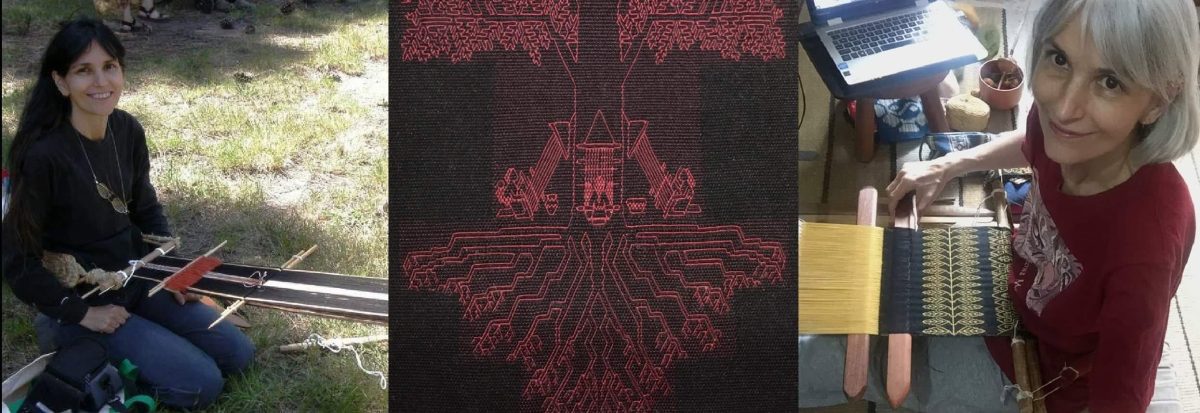
Backstrap Weaving – Racking up the Miles

From sunset in Phoenix….

to Jacaranda season in Sydney…

I am back in Australia after visiting with backstrap weaving friends in the USA. Why am I back here again? Well, I did something quite mad when I was last here in August…I went and booked a weft ikat workshop in Bali at the end of this month!

As you know, I have been dabbling on and off in warp ikat with varying degrees of success these last few years.

I started with these first tiny strips on a piece which got turned into  handbag…

I used small strips of warp ikat in this piece to learn about the technique.
Then I started to get more adventurous with these pre-columbian bird figures.
After dyeing the warp black, I wove and filled in the white ikat shapes with pick-up patterns.
Some more experiments with pretty pleasing results.

I love it when my experiments can be turned into useful things. This is the draw-string bag for my Kindle.
An attempt to create a circle in ikat and fill it with pick-up pattern. Due to take-up, my circle got flattened as I wove it!

The workshop in Bali seems like the perfect chance to learn about weft ikat so that I can perhaps start putting warp and weft ikat together to create double ikat pieces. We will be using natural substances for the dyeing and combining two colors…exciting! I have done one experiment with ikat in two colors in which I over-dyed parts of the first dyeing in terracotta with dark blue. I didn’t end up with dark blue as you can see. It turned out blue-ish dark chocolate brown. The blue part in the middle was spot dyeing damage control!

The two-color sample made a nice book cover.

There is a community on the island of Bali that specializes in double ikat and I hope that I can also spend some time with the weavers there. The other interesting thing about weft ikat is that the cloth must be balanced and I am always curious to know how backstrap weavers create balanced cloth on their looms. Do they use a reed? If so, I hope that I will be able to buy one for myself. I already have some bamboo reeds but would be very happy to acquire another of a different sett.

On the other hand, if they don’t use a reed, I would love to learn how they manage to maintain an even sett without one. I am not sure how weft ikat will look in balanced cloth…quite sketchy, I should think…but I really want to learn how to plan and lay out a pattern and then place the weft in sheds for a minimum of blurring. I want to use what I learn to help me create some very simple double ikat one day.

It’s a beautiful mild spring here in Sydney and the jacarandas are putting on a glorious show. I think I will have to rename the color in my bracelet after these pretty flowers and weave something new that the color has inspired…

My last days in the USA were fun times spent with weaving friends. I got to see what some of them have been doing since my last visit.. Here are some of the pieces that my friends in Phoenix were working on using some of the finishing techniques that we had studied…tubular edgings, cross-knit looped edgings, braids and coil stitches. The pouch on the left has plain-weave tubular edging and coil stitches along the flap. The one on the right is edged with a patterned tubular band and has coil stitches along the bottom and cross-knit looped stitches along the top. The strap is a square braid.

The pieces are sitting on a beautiful piece of Bedouin weaving that Nicole brought to show.

Here’s Collyer’s pouch under construction…

The fabric for the little pouches is from my weaving friends in Bolivia. They are woven from naturally-dyed hand spun wool. Several people in this group ordered more fabric in varying widths from the ladies in Bolivia. This is the gorgeous piece that arrived for Diane…

One of my weaving teachers, Maxima, heads the co-op that produces these beautiful pieces of cloth. She is headed with fellow co-op member Justina and Dorinda to Peru this week to attend the Tinkuy in Cusco, the gathering of weavers of the Americas, that is run by Nilda Callañaupa’s Center for Traditional Textiles.. Maxima and Justina will give one of the presentations at the conference. With Dorinda’s help Max and Justina have put together a Power Point presentation…such a big step outside their comfort zone. I know Max as a very shy lady. I hope they get to present early on the first day so that they can put away their nerves and enjoy the rest of the conference.  You can see Justina, at left, with the ch’uspa she wove to wear in the opening parade.

Many of my weaving friends have gone to the Tinkuy including one of the ladies with whom I wove last August here in Australia. I can’t wait to hear how it goes. I opted to take the workshop in Bali instead and it is hard not being there in Peru this time.

This picture came up in my Facebook Memories this morning…

This young fellow was only 10 years old when I  watched him weave at the first Tinkuy in 2010….7 years ago! I wonder where he is at with his weaving now at 17 years of age. I wonder if he will be there at this year’s Timkuy.

I met with other weavers on my recent trip to the USA and once again we worked with some of the beautiful Bolivian cloth…

Here is a piece of the cloth next to some hair braids that Janet made using a crossed-warp technique. The yarn is her own handspun.

We played with tubular bands and decorative stitching to finish and embellish pieces of weaving.

We wove the ñawi awapa pattern into tubular bands and Catherine mistakenly wove one orange eye on top of another connecting the two into ”cat’s eyes”. Rather than unweave it, she decided to weave the whole band that way weaving pairs of eyes instead of single eyes as is the traditional pattern.

I love it and have named the new pattern ”michi ñawi” because the word for cat in Quechua is michi (and cat can be a short form of the name Catherine) :-).

I have started wearing this ñawi awapa necklace as a tripled bracelet and much prefer it that way. It is really sweet in 20/2 wool…

One of the Phoenix gatherings was all about double weave and we wove Andean Pebble Weave together in the other.

Here I am demonstrating embedded double weave. I really like the colors in this warp (influenced by my friend, Lori!)…

Nicole got into charting quickly and started weaving some of the little bird figures that I had learned in my first ever experience with double weave with my teachers in Potosi, Bolivia back in 1997…

The little llama figure was popular.

We wove at Sarah’s place where she showed us a beautiful vest made from Shipibo painted cloth and handwoven panels that her husband had bought in his travels in Peru in the 70’s. What we couldn’t figure out was what the little wooden implements, which were acquired at the same time, could have been used for. Any ideas? We thought that they could be inked and then rolled to print a pattern.

Here’s some double weave work from my friends Cynthia and Kate in northern California…

Hopefully the weaving provided a nice break from all the worry and concern over the fires that had ravaged the area. We couldn’t help but pass one of the affected areas on the way to Sonoma to shop one day…no words :-(.

I bought a device that allows to me to post to Instagram…I feel so modern! So, if you are into Instagram, please look for me 🙂

The air had cleared of the terrible smoke by the time I got to the area and we enjoyed a  couple of days out at the barn weaving….

Lori’s 8-year old daughter Lily was there as a fully participating group member. I just love watching those little fingers manipulating the threads, picking up patterns and expertly making string heddles on a  stick…

If you have been following my blog for some time, you will know Lily well. I have been watching her learning to weave at a backstrap loom with her mother’s instruction and then with some of mine since she was five.

I got to accompany the family to Lily’s Feis (Irish dancing competition) in the bay area the following Sunday. She entered nine dance categories and won first place in eight of them…what a day!

Lori had a new Huichol bag that she had bought to show me . The jaguar is brilliant in orange on the purple background. This is the Finnweave version of double weave pick-up in which certain shapes are slightly altered on the ”back” side of the cloth.

While in Phoenix, my friends Annie MacHale (aka Aspinnerweaver) and husband Rick drove over from New Mexico to visit.

We spent the day at the MIM, the Musical Instrument Museum in Phoenix. It’s awesome but probably needs three separate visits to take it all in. There was lots to inspire in terms of patterns on the musical instruments and folk costumes. The headsets we were given tuned in and out of each display as you moved around and allowed you to drift between exhibits at will, lingering at each one for as long as you chose. There were lots of people standing around tapping their toes to the various rhythms at each display.

Because the decoration of musical instruments is often closely linked to a culture’s broader sense of aesthetics, it was sometimes possible to guess the origin of a piece from its ornamentation. It was fun trying to do that. The pattern on a gourd percussion instrument looked familiar and when I learned that it was from Panama, I remembered that I had seen similar Mola patterns.

It was entertaining recognizing familiar textile patterns in many of the instruments and costumes.

A Sami framed drum with beater, a goblet drum from Iran, a plucked lute from Saudi Arabia and a dancer’s dress with nanduti lace from Paraguay.

I found the lowland Bolivian instruments, in the picture below, fascinating. I have yet to see or hear one of these bajunes being played n Santa Cruz. They belong to the unique Baroque-mestizo music that is part of the history of the Jesuit missions that were established in the second half of the seventeenth century in the jungle areas of Santa Cruz where I live. They are made from ”Kusi palm leaves, wood and leather”. While I have been to several of the Baroque music concerts in the city during The International Festival of American Renaissance and Baroque Music that is held in Santa Cruz every two years, I haven’t managed to see one of these being played. I need to get myself out to the jungle towns instead of racking up miles across the globe! They are a mere 90 km away from my home…a mere 2-hour drive in red dust…but that can turn into 14 hours if it rains!

I can imagine being in one of the Jesuit Mission churches at night listening to one of these concerts accompanied by the sounds of the deep jungle…

Image from Boliviabella.com

In this Youtube video you can see a performance of one of the Bolivian groups that performs at the Festival. The bajunes are there but I can’t distinguish their sound at all in the first piece but then…yes, in the second one, I think I can!…

Meanwhile….my inbox and various online groups have shown me what some of my online backstrap weaving friends have been up to…Carlos Vargas in France wove a belt using the intermesh technique that I teach in my second book. This structure produces a really sturdy band and allows faces with two different solid colors. Carlos could have woven red motifs on a blue background and vice versa using this technique, if he had wanted to.

Bob Seymour in the USA sent me this picture of various structures he has been studying using tutorials on this blog as well as in my books.

Christine in South Africa wove another project on her inkle loom using my new book on Complementary-warp Pick-up. She used the 4-thread patterns as attractive borders for the 8-thread hook motif and made a belt.

Julie wove this 18-thread pattern on her Gilmore MiniWave loom using a pattern and instructions in my latest book as well as this lovely wide piece with two columns of a 9-thread pattern. By flipping the pattern, as she has, you can create nice ”ram’s horns”.

KatyCat on Ravelry wove one of the 6-thread patterns. I can see that she is using some of my friend Terri’s lovely swords from her MagicalMoons etsy store. Contact Terri if you would like swords made in any size you like.

Wendy in Australia has been weaving some patterns from my second book. Here we see her set-up which involves attaching her warp to her floor loom. That’s a nice sturdy anchor for a backstrap warp.

I hit the ground running when I got to Australia last week…no sign of jet lag! We were out and about the next day at the Sculptures by the Sea exhibit at Sydney’s beautiful Bondi Beach. There is lots to show you about that but I will leave you with just a couple of pictures. This first one is of a sculpture that took my fancy simply because the large wooden Y shapes made me think of backstrap looms and the forked tankas that are used in some warps in Peru to hold the cross. Seems I always have backstrap looms and weaving on my mind!

This next one just captures the feel and sparkle of that gorgeous sunny day at the beach! Luckily I was small enough to be able to crawl inside this sculpture along with the kids and look out and up…

I also found some time to put together a little slide show promotion for my new book on Complementary-warp Pick-up. I want to thank everyone who has bought it so far and tell you that I so appreciate all the feedback I have been receiving, especially the feedback that comes in the form of pictures of bands on looms!

If you have already bought the book you might enjoy this little slide show anyway for the zippy music I chose. Plus, it might remind you that the file is on your desktop and nudge you in the direction of your loom :-)! Thanks, everyone! Sending hugs to all my friends who are at Tinkuy 2017. It’s weird being on this side of the world while you are all over there!


Backstrap Weaving – Windows

I can tell when I have had a particularly full travel schedule when many of my photos have been taken through windows. Scenes fly by out of plane and train windows. I grab my camera and try to take a shot out of the car window as something amazing flashes by or I curse the fact that I left the camera in the trunk with the rest of my stuff. Sometimes in the dying light of a day I arrive at my new ”home” and just manage to take a picture out of the bedroom window. Windows open and close giving me glimpses of people, places, life styles and personalities.

I am nearing the end of the Australian visit. In a couple of days I’ll be making the long trek home. It feels weird saying that I will be going ”home”. On this visit, Australia has felt more like home than on any other I have made in the last 24 years. On other visits I have watched the places where I grew up become less and less recognizable. Sydney had become strange and foreign to me. A whole new younger generation had appeared in my absence and I was on the outside. This was especially true after my mother died in 2013. I came to realize that she was actually what represented home to me. She seemed to be the one comforting constant while everything and everyone else had changed and moved on.

I guess I have adjusted my idea of what it is about Australia that represents ”home” to me because I really felt different about it all on this visit. I won’t attempt to figure out what has changed. I’ll just enjoy the warm feeling and be grateful for now having two places in the world in which to live that feel equally familiar and welcoming.

My dvd Operating a Backstrap Loom has been making the rounds visiting all the places in which I have stopped and woven on this trip…

I guess the background to this picture could be one of any number of places around the world. Gum trees turn up in so many countries and I am always surprised and happy to catch that wonderful aroma of eucalyptus in the breeze when I am in certain parts of South America. It immediately transports me back to Australia. The gum tree in this picture is special as it seems to be the favorite hangout for a trio of baby kookaburras. I only managed to photograph two of them together at any one time…

I wove with friends in Sydney. We tackled warp-faced double weave. We had woven together on several occasions in the past and so everyone was up for this more advanced technique.

We arrived early trying to shake off the Sydney winter chill. Lunch time would find us outdoors soaking up the warmth of the midday sun. Weaving warp-faced double weave on a backstrap loom involves a few more steps than those that are normally used to create pick-up patterns. This is what makes it a more advanced workshop topic. It is the method, rather than than the structure itself ,that makes it that little bit more challenging. Once the steps are mastered, students can move on very quickly to creating their own patterns. I call it ”doodling on plain-weave”. It is, after all, just two layers of plain weave on which we virtually ”draw” patterns. There aren’t any floats to consider. You can literally decide on the spur of the moment which of the two colors  you want to pick without having to be careful about not creating a warp-float that is too long.

Susan designed and wove gum leaves while Brenda, who loves to knit celtic knotwork patterns, did the best she could with the relatively few threads with which we were working to design and weave some cross over lines that could later be expanded into knotwork motifs. Tapestry weaver Marie Clews also took the class and told us about her recent visit to New Zealand where she took a workshop from visiting Peruvian tapestry artist Maximo Laura. Here is the sampler that she wove in his workshop…

Jen brought in a tablet-woven band that she had bought on a visit to Uzbekistan. I had marveled at these bands that were being used to edge the magnificent Uzbek ikat garments that I saw at the International Folk Art Market in Santa Fe. Jen had bought her band in a street market in Uzbekistan. It is quite long and wider than the edging bands that had been used on the garments. I wonder what for what it was intended.

Seeing these bands in Santa Fe had inspired me to weave one to use as the closure tab on a shoulder bag I was weaving.

The piece in the middle is a wrist band that I bought at the Santa Fe market…a precious example that I could take home and study. On the right, you can see one of my first attempts to replicate it in heavy thread and, on the left, the final piece that I used on my bag. Because my piece was so short, I didn’t use tablets to weave it. I just set up a warp on my backstrap loom and twined the warp threads by hand rather than using tablets to do so. I only needed a few inches of band for my project.

It was nice to be able to handle and examine one of these tablet-woven bands once again.

My good weaving friend Emerald joined the group for the class. She usually invites me to her home in Sydney so we can weave together and it was nice to have her join the group this time. She bought my dvd Operating a Backstrap Loom and has returned home full of energy and ready to tackle wider warps. One of the topics on my dvd is about how to set up and operate a backstrap loom for wider warps. This seems to be just what Emerald was waiting for! Look at the gorgeous warp she has made…Emerald seems to get in quite a lot of practice between my visits. She was certainly the one who most quickly and efficiently made her heddles in the double weave class. She made heddles using nylon on her latest warp. Lots of weavers use nylon and love it. I have to confess, and you will have heard this before, that I really hate using nylon for heddles! I have nothing against the use of synthetic thread. I just prefer thread that has a bit of ”tooth” and grip.

Emerald sewed together several of the bands that she has been working on to learn the various techniques and has made a really cool and unique backstrap…

I got to weave with Brenda again today. I joined her in Epping with a group of weavers, knitters and spinners. She and I attached our warps on each end of a small table and spent a few happy hours weaving our bands while listening to the other fiber-y conversations. Brenda was weaving a double weave band that she had warped and set up herself. She also designed the pattern. I wove off a few of the sample bands that I use to demonstrate techniques in my classes. Here’s Brenda about to create a pick-up shed on her double weave band…Brenda’s backstrap is a finger woven band and the cords that attach it to the beams are kumihimo braids. I love this wonderful combination of techniques…

Pictures of other backstraps have been appearing in my inbox and Facebook feed. This one was made by Tara, who wove with me in Seattle…

There’s a lot to be said for weaving a backstrap in plain weave. I love the flowing rhythm of plain weave. I think it is a great learning experience for the first steps in working with wide warps. Many people long to have a backstrap that is covered with pick-up patterns. That can come later. The first backstrap you weave will tell you a lot about what will be the ideal length, width and weave structure for the next one.

Cornelia, who wove me more recently in the Bega Valley, sent me a picture of her backstrap and some tools. I love this picture…so many natural materials and interesting textures…

Other weaving friends in other countries have been taking up the challenge of creating wider warps. Here are my Arizona weaving friends, Christine and Caroline, at one of their study group days. It is nice to see Christine here after having spent time with her in Canada recently…

Caroline’s warp looks great! I hope I will get to see it in person this October.

A couple of days after the Sydney workshop, I took the train up north to Maitland to do some complementary-warp pick-up with a group of weavers who were taking their first steps in using a backstrap loom.

I awoke to pretty mornings of heavy frost and fog drifting among the hills. I was nice and warm in Kerry and Graham’s beautiful mud brick house. The mud brick house was awesome! I don’t think I have ever been in a place where warmth was so evenly distributed. We spent happy snug evenings looking at the photos and textiles from Kerry’s recent trip to Bhutan.

Magpies competed with kookaburras and rosellas to greet the day. I spent a good part of the early morning trying to record all that lovely birdsong before we headed out for a day of weaving.

Galahs came to feed and a satin bower bird had built its impressive bower and comically decorated it will all kinds of blue objects. Painters tape, yarn and bottle tops, all of them blue, were among the treasures collected and strewn about to attract females to the harem.

There’s my fabulous Maitland group. They were all there to greet me when I arrived and came in extra early on the second day so we could get even more done. No dawdling over lunch! Everyone wanted to pack in as much as they could on those two days…and we certainly did that! Di came down from the Gold Coast in Queensland to join us. Amanda came over from Tamworth, Liz came over from Morisset and Raelene traveled up from Canberra. Kerry, who hosted me in her home, will be going to the Tinkuy in Peru this November. If you are going, make sure to say hi to her for me. I think I might have helped her make the final decision on that one :-).

Kerry took me around to see as much as we could of Newcastle before I got my flight south to Melbourne. Growing up in Sydney, I really didn’t know much about Newcastle. I knew that coal was mined in the area and so I guess I always had a picture of a bit of industrial and mining ugliness. So sorry about that, Newcastle! It was great to have this little window of opportunity to banish those images from my mind and see Newcastle for myself . This beautiful view is from the ANZAC War Memorial cliff-top bridge.The sky on my day out and about with Kerry was so pretty with clouds that looked like soft strokes from a painter’s brush. The lines seemed to draw your eyes outward and beckon you away. This is an observation tower down on the banks of the Hunter River backed by that lovely sky…

From there I headed to Melbourne and Raelene followed me so she could have another class.

I was excited about flying over and actually being able to see Australia’s Snowy Mountains where I had spent six ski seasons working many, many years ago. For all of you outside Australia who raise your eyebrows when I mention skiing in Australia, I took this shot for you :-)…

Another window, another lovely view. They are not exactly the high rugged peaks that one might get elsewhere but I can tell you that the backcountry skiing on that range is superb!

Melbourne: you may remember that I had woven with members of the guild in Melbourne last year. I had some familiar faces in the workshop as well as a bunch of new ones.

I was happy to be back staying with Ruth in North Carlton surrounded once again by all those gorgeous terraced houses with their wrought iron railings and fences. That reminds me that a plan to weave some of the wrought iron patterns is still on my list of things to do.

The late evening arrival gave me a pretty sunset view over wrought iron spires from my bedroom window. The other window in my bedroom looked out over the Melbourne skyline.

Last year, we had two three-day classes on Andean Pebble Weave and this year we decided on complementary-warp pick-up.

Raelene was coming from having just taken that very same class in Maitland but I had plenty up my sleeve to keep her challenged.

We had two first-time weavers in that class…not just first-time backstrap weavers. They had never done any kind of weaving at all and they did so very well!

When not weaving with a backstrap loom at the Guild, Ruth showed me how she has been doing pick-up weaving on her inkle loom. She took the Andean Pebble Weave class with me last year and has been continuing to make bands using her Ashford inklette. It’s interesting to see Ashford’s new version of the inklette with its sliding tensioning system rather than the one that used a paddle.

She has one loom, the nearest,  set up for Andean Pebble Weave (she is weaving the little pre-columbian bird motif that is charted in my first book). The other loom is set up to weave the intermesh structure which she learned from my second book.

Here she is doing some pick-up on the intermesh warp..

This picture was taken late on the second day of our workshop when energy can sometimes be flagging. Everyone is very absorbed with getting the new wider and more complex patterns started on the fresh warps that they had created and set up themselves.

It’s always exciting seeing a new pattern appearing and then it’s hard to stop! So, here’s Raelene continuing to weave on her train ride back up to Canberra…

She doesn’t have much room left to weave on that particular warp but she has several more bands that were started in the two classes to complete.

Glenys, from the Canberra group, sent me a picture of one of her completed bands…

And, while I am showing finished bands, I’ll show you Claire’s from Hobart (Tasmania was my next stop after Melbourne). Claire chose a different pattern to weave on the warp she wound herself…

Jeanne in the Bega Valley sent me this picture of one of her finished bands…

Here’s Caitlin in Hobart showing that she can not only weave a hook, she can also flip it back and forth…

But, I am getting ahead of myself! First stop in Tasmania was up north in Launceston. From there I headed a bit south-west to weave with a group in Deloraine. I stayed with Jutta and Heinz in the pretty village of Chudleigh. It was cold in Tasmania…but of course! I didn’t get to see the surrounding hills on the first morning because of the cloud and fog but I was blown away by the magnificently clear night sky when I arrived. It was lovely seeing the Southern Cross way overhead among the stars of the Milky Way. In Santa Cruz Bolivia where I live, the Southern Cross appears just above the horizon.

The tails of fog drifting along the fields and hugging the hills in the early morning were really attractive. After class on the first day, Jutta drove me around to see the pretty dairy pastures that surrounded Chudleigh village.

After two days spent with the weavers in Deloraine, it was time to head on down to Hobart. Jutta made many stops along the way to show me around. We visited Launceston and its Design Centre. There we saw an interesting exhibit of wood that is being reclaimed from the bottom of valleys that were long ago flooded for hydro-electric schemes. Massive tree trunks are being turned into furniture by Tasmanian artists. In the gift store, Jutta bought and gave me a shawl pin made from Tasmanian huon pine. The point of the pin makes it a perfect little pick-up stick. I had bought a kitchen implement made from Tasmanian sassafras wood which I hope to have modified into a sword.

One of Launceston’s cathedrals…

We visited a few historic sites along the way like the Callington flour mill in Oatlands which was built in 1837. I wasn’t expecting to see a windmill in Tasmania!

As we approached Hobart, Jutta kept pointing out the mass of heavy grey cloud behind which she promised was an impressive mountain called Mt Wellington which dominates the city of Hobart. I had to wait a few days to get to see it in all its glory. It peeked out now and then as I came and went from the guild rooms at the start and end of the day. Here you can catch a glimpse of the organ pipe rock formation near the summit…

The Hobart guild has its rooms in Battery Point, an absolutely gorgeous part of the city full of pretty Georgian stone cottages and houses made from convict brick. The houses were built for early-Hobart workers and merchants of the port. The guild rooms have a shop, a library and spacious well-lit rooms for workshops and gatherings. My group surprised me with a lovely gift…a needle case made out of Tasmanian myrtle.

I got to stay on Mt Nelson with Margot which gave me pretty views of the river and bridge and then I swung over the river to Lindisfarne to stay with Jillian. Her historic home offered views of the bridge and the famous mountain that was slowly emerging from its shroud of cloud and fog.

Jillian does all kinds of weaving but has spent a lot of time on tapestry. She shared some of her works with me. I was really taken by this miniature that she wove while seated in a botanical garden. I have seen people with their easels painting outdoor scenes or sketching or using pastels (I have always been so envious of those skills!) but the idea of weaving a scene like that, painting with yarn what is right before your eyes, just blows my mind.

I had a whole day free in Hobart to wander about and so I arranged to meet up with a friend. If you have been following my blog for years you may remember stories about Anna who was bicycling from Alaska to Ushuaia with her boyfriend, Alistair back in 2010. They took a detour to come to Santa Cruz so that Anna could weave with me. We have been in touch with each other ever since. Here we are together in 2010 at my place doing some spinning…

It was a very happy reunion seven years later!

I was tickled to see the fob on Anna’s car key. This is an Andean Pebble Weave band that she had warped and used to learn to weave with me at my place back in 2010. This last remaining shred of band is now her keyfob!….

Here is she is at my place in 2010 learning on this very same warp…

And here are her first steps in double weave…

And, look what she has been doing with those double weave skills!

Much has happened since we met in 2010. Anna and Alistair got married after their three years of bicycling through North, Central and South America, moved to Tasmania and now have two little ones.

Anna and I strolled around Battery Point together catching up while looking at the historical houses.

Anna pointed out the convict-made bricks to me…

I love all the tones of white and grey in this next picture…

Of course, we had to go up Mt Wellington. We almost made it to the top. The roads still get icy and dangerous towards sundown at this time of year and we got turned away before we could reach the summit. That led to a really nice hike out to Sphynx Rock at the highest point we could safely reach…

Hobart has over 300,000 inhabitants and I felt like I could see the homes of each and every one of them from up there!

There’s that elusive summit….at last!

Meanwhile, while I stand there rugged up in a down jacket and vest, folks have been enjoying a summer of backstrap weaving on sunny desks and porches in other parts of the world. Here’s Anne weaving on her deck in California with a little winged visitor…

Alison, with whom I wove very recently in Canada, has been weaving on her porch in British Columbia…

I know that Deanna, who lives in southern California, often weaves outside in her gazebo. She is getting re-acquainted with double weave…

She plans to make bracelets with I-Ching hexagrams.

I’ll end this post with a picture of a curious magpie checking out my dvd. Well, I’ll confess, it was only there for the crumbs. 🙂 The song of the magpie is, for me, the sound of my Australian home. Here is a little clip of birdsong in Australia, much of which I recorded on cold crisp mornings when I was in the Hunter Valley at Kerry’s place…


Backstrap Weaving – In the Bush

At the loom and in the bush…what a perfect mix of activities. Hiking! This used to be so much a part of my life and something I have been neglecting since weaving became such a major part of my daily activity. I have been out and about in Australia enjoying yet again the soft colors of rural sunsets, this time on the far south coast of NSW…

…colors that inspire projects on my backstrap loom…

And now I have a whole new palette of colors from the Australian bush to work on. While on the south coast I met Tabitha who came to weave with me. Tabitha has yarn spun from the fleece of her Lincoln Long Wool and Awassi sheep..”100% Bega Valley yarn” she tells me.

She told me that those long locks are from lambs. She spins a 3-ply yarn and I bought several dyed balls and one natural to try on my backstrap loom. It will be a nice souvenir of that part of my Australian visit…

There among the balls of wool you can see some other little treasures that I picked up in my travels around the southern tablelands. We stopped to take a look at Longbarn provincial antiques. Owners Gary and Jane Kendall travel to France every year to pick up new pieces and it was fascinating picking through their rustic store. As you can see, I found a spindle which I am actually planning on using as a shuttle and two small wooden things that look like shuttles. These ”shuttles” were part of a large fishing kit and are actually not shuttles at all. My traveling companion, Cornelia, bought the whole kit and shared some of the pieces with me. What look like shuttles are, in fact, small fishing reels. They came complete with line and sinkers. Now they will carry yarn for me as I weave on my backstrap loom. They are full of character. They have traveled all the way from France to Australia and will now head to Bolivia.

We also spotted this in the store and hope it goes to a good lace-making owner…

The hard case around the lace-making pillow has a hollowed section at the back which is filled with bobbins and a few pattern sheets.

I wove with two groups when I was down on the south coast.

The place where we gathered was nestled in the most gorgeous sheltered bay and while we wove we could watch its changing moods as the tide came in and out and the sun crossed the sky.

One moment there would be fierce crashing waves on the rocks and at other times sublime serenity.

On the last evening, we had a bit of rain which with the low evening sun created a spectacular double rainbow.

In one of the serene moments, the dark clouds and the golden light of the setting sun painted quite a picture…


The winter sun was so pleasant that Karen and Maeve decided to weave outside, each one adopting the position in which they felt most comfortable…

And here ‘s Maeve indoors getting the hang of using multiple swords…

There’s one of our happy backstrap weaving groups. A couple even have their bands still attached to their waists and have slung them over their shoulder so they can get straight back to weaving!

I loved the far south coast and had some time to take a look around. Karen and Rachel took me out to see some sights around the various bays, beaches and harbors. We lunched on fish and chips at my request, browsed cute stores that carried works by local artisans and strolled among the majestic Norfolk Island Pines on the sea shore….

The Gallery and workshop of Aboriginal artist Merryn Apma.

Driving here and then from town to town there were blissful rural scenes of cows contentedly grazing. This is prime dairy country. In late afternoon, cow-dotted fields would be replaced by ones dotted with dozens of kangaroos. You can tell I am a city girl, right? It was heavenly!

I was happy to meet British weaver and braider Helen Deighan who came to weave with us fresh off a flight from England. She has written books on braiding and dyeing and studied with Rodrick Owen. She always brings exciting and fresh activities to share with the local fiber group and I know that she has come this time armed with many foam discs to share her kumihimo braiding skills and knowledge. She enjoys giving to the group and has been particularly enthusiastic about having the opportunity to weave on a backstrap loom with us.

She went right out and made herself a cloth backstrap and fashioned some swords from wooden spatula handles. She also has one of Terri’s (Magical Moons) cherry wood swords.

I think she is really enjoying operating the backstrap loom without necessarily doing any pick-up. There really is something magical about the rhythmical body movements that are used when doing plain weave. More than ever you become aware of the fact that you are part of the loom itself. Here Helen is doing plain weave with a ”threaded-in” pattern. Using weft in a contrasting color adds yet another attractive design element.  I am guessing that this wide piece will become a backstrap…

John was the only male member of our group and he has been working on his pick-up skills since I left. It takes a while for the mechanics of operating the loom, handling multiple swords and developing strategies for chart-reading to all fall into place and it all seems to be coming together nicely for John.

And I just now received this photo from the group of their first backstrapping get together since my visit. A warm winter’s day allowed people to be outside weaving. Apparently too much good conversation and food kept some of them from setting up their warps and weaving.

While out and about once again, I loved seeing the ”cathedrals” of spotted gums that are so typical of certain parts of this southern region…

I was lucky to be able to stay with Delma and Doug Roseman. I had seen one of Doug’s hand crafted weaving benches in one of the stores that supports local artisans and I asked him if he would consider making me a couple of swords using Australian wood. He was happy to do so and made me four!

From left to right, these are made from manna gum, forest red gum, spotted gum and NSW blackwood. What amazing souvenirs to have from this part of New South Wales.

Here’s the loom that Doug built for Delma…

It’s the result of a collaboration with Australian Master Weaver Kay Faulkner. The plate on the side of the loom names this one as the fourth Faulkner Loom to be made. I think Doug has made nine of them so far.

I had a whole other day away from looms to explore the area. A group of us decided to climb Mount Gulaga at 2644 ft (formerly named Mt Dromedary by Captain James Cook). From Wikipedia…

Gulaga is the place of ancestral origin within the mythology of the Yuin people, the Indigenous Australians of the area. Gulaga itself symbolises the mother and provides a basis for Aboriginal spiritual identity; the mountain as well as the surrounding area holds particular significance for Aboriginal women. For the Yuin people it is seen as a place of cultural origin. The mountain is regarded as a symbolic mother-figure…..

We were lucky to have Bernadette and Richard with us who shared a lot about the local flora. That’s Bernadette below telling us about the Rough Tree Ferns which were my favorite things along the way.

After lunch at the saddle we followed an unmarked trail…thanks to Mog and her local knowledge… to a large section of strangely shaped and balanced granite boulders, or tors, or ”standing stones”. To the Yuin people, the boulders represent guardians of time that are interlinked with the well-being of the mountain and of the people. While the boulders are looked after by the Aboriginal custodians, the guardians will look after the mountain.

It was a place where I felt that I needed to talk in whispers and I lagged behind on my own for a bit. There was certainly something very spiritual and even eerie about it. I wasn’t the only one to find that I had pan-pipe music in my head as I wandered about the giant stones reminiscent of the soundtrack to the 1970’s Australian movie Picnic at Hanging Rock. Take a listen and you will find the hair on your arms standing on end! What weaving will come of this?

This was one area where the bush was open enough to give us views of the ocean below…

It was a fabulous day…thanks so much for making it possible, Mog, John, Sue, Bernadette and Richard. My calf muscles reminded me of the ascent and the scrambling for several days after when I got out of bed in the morning!

Visiting Canberra was lovely. My gosh, the weather has been kind to me! I have been seeing lots of activity from some of the ladies who wove with me in Canberra since my return to Sydney. I am so happy to be leaving behind enthusiastic backstrap weavers. It certainly isn’t absolutely everyone’s cup of tea and I am happy that people have followed their curiosity and have wanted to try it out.

Double-pocket saddle bag.

Pam brought this lovely weaving still on the backstrap loom from the Piura province of Peru to show us. This is an area where cotton double-pocket saddle bags are typically woven. The weavers use a single-faced warp float pick-up technique and their work is unique in the way they use small pieces of  supplemental weft to add splashes of color. I was once shown a completed saddle bag (at left)  from this region when I was traveling in California.

The piece that Pam brought has been left on the loom and has been obviously made as a souvenir of the township of Catacaos. It is interesting that the weaver has used two sets of string heddles…one holding all the red threads and the other the white ones…rather than one set of heddles and a shed rod as backstrap loom weavers would most often do.


Kristy has been busy since the class checking her local yarn stores for suitable and yarn and weaving a backstrap. The yarn is Katia Bombay and it comes in a beautiful range of variegated colors…no solid colors that I could see on the website. This plain-weave backstrap has come out beautifully.

Jo has finished off two of the three sample bands we started together…

If I had had a wee bit more time in Canberra, I may have managed to visit the National Gallery and see this beauty…

Some pieces of literature say that The Bronze Weaver is from Indonesia while others say possibly Borneo. It was collected in Flores, Indonesia and dates to the 6th century. Isn’t it wonderful how she remains seated, being the loom, while she suckles her infant. I love the detail in her hair and backstrap in this view…

Here is an excerpt from the National Gallery of Australia’s description of the piece…

The woman, feeding a young baby who touchingly clutches her other breast, is clad only in a calf-length skirt, typical of everyday wear of the more remote regions of Indonesia, especially Borneo, until recent decades. In contrast her carefully braided hair and plait are most unusual. While her necklace is simple, the large bold earrings, probably plugged earlobes, strikingly frame her serene face. The figure is seated at a simple loom. The foot-braced body-tension loom depicted has not been observed in Flores in historical times although local looms, where the warp beam is braced by poles, are very closely related. Identical foot-braced looms, however, have survived in remote districts of Vietnam, Laos, Cambodia, Taiwan, and Hainan Island in the South China Sea. The creator of this sculpture was obviously very familiar with loom technology as the apparatus and the loom patterning are accurately depicted. The circular warp, the cloth and warp beams, the shedstick, the weaving sword and the delicately rendered plaited back strap speak of an era when bronze casting and textile weaving were already prominent gender-specific arts.

You can read more here.  

Cornelia made a trip to the National Gallery to buy me a postcard of The Bronze Weaver while I was weaving.

From there it was back up to Sydney, away from the loom for a bit and into the bush with my brother, sister-in-law and friend. I love the Blue Mountains. This will be where I settle the day I decide to come back to Australia.

This was yet another day of amazing colors and textures in trees and rock with wanderings through canyons and glow worm tunnels among enormous Rough Tree Ferns…

From the cool depths of canyons we looked up at a piercingly blue sky with the sunlight bouncing off sandstone walls…

We spotted a lyrebird…the first I have seen in the wild…look closely!

Here’s our view of a little piece of fern paradise from within the old railway tunnel which now houses hundreds of glow worms.

Many thanks to Wayne and Debbie for supplementing my photos and for making the trip possible.

I’ll be weaving this weekend with Sydney friends including Emerald with whom I always weave on my Sydney visits. She made a trip to her homeland, Myanmar earlier this year meeting up with U.S tablet-weaver and ply-split braider Linda Hendrickson. I am looking forward to hearing about it. I was lucky to be able to spend a morning with Linda on visit to the USA in May.

There will be more travels to follow….time at the loom with friends new and old and, hopefully, some more time for the beautiful Australian bush!


Backstrap Weaver – Vistas

I like to think that the colors in latest piece on which I am working were inspired by early morning and late evening skies that I have been lucky to see in my travels. Maybe last year while I sat watching the snows of Mt Rainier glow gold and rose in the setting sun and its rocky outcrops cast deepening purple shadows, these colors made some kind of imprint in the creative corners of my mind.

Sunset on Mt Rainier during the Braids 2016 conference in Tacoma.
A Vermont sunset seen from Mt Philo during my visit a few years ago.
Sunrise at the Florida Tropical Weavers Conference that I attended a couple of years ago.
Sunsets over the Pacific.
California sunsets around the Sierra foothills.
And, most recently, while traveling after the ANWG 2017 conference, I watched Mt Hood starting to pull on its evening shroud of rose, purple and gold.

So, I am working with purple, rose, copper, gold and blue. The linked diamond patterns have been fun to weave. I have enough room left on this warp to repeat the first pattern section and then I will figure out what to make of this piece of fabric for Marilyn. I can’t wait to wash and press it. The fact that there is a lot of supplemental weft sitting between the layers of warp has made the cloth quite stiff. It is hard at this stage to imagine it having any kind of appealing hand. However, I am sure that it will soften and relax after the wet-finishing process.

Purples, roses and golds….I had quite an extraordinary view of a sunrise on my recent flight to Australia. QANTAS airlines has a camera installed on the tail of the plane which transmits video to each passenger’s personal video screen. We took off from Los Angeles at around 11 pm and I waited many hours through the night for there to be enough daylight to enjoy the view from the tail camera just before we landed in the early hours of the morning two days later (we crossed the international date line along the way). Unfortunately, just when it gets really interesting and we start losing altitude to circle Sydney harbor and the city, we are required to put away the video screens. In any case, it was really amazing sitting there in the cabin and seeing the view from the tail as we sped along.

And, I was able to experience yet another extraordinary view before leaving the USA when our backstrap weaving party in Oregon was visited by a friendly drone which took photos and video of us from way up high.

Can you spot the ring of happy backstrap weavers down there?

Here’s a closer view…

I love this shot because you can see the shadow of the drone in the upper right-hand corner. People have asked me to what we have attached our warps. It is a basket on a pole that is used for Frisbee golf.

The days were long, gorgeous, hot and sunny and we didn’t last too long out there. We soon found ourselves back under the pop-ups where it was cooler and more comfortable.

Weaving outdoors is always my dream but not so comfortable in Santa Cruz, Bolivia where I live…too hot and too many bugs to swat.

Nine-year old Wendy, one of Maxima’s granddaughters, learns to weave figures on a band while Emily watches the herd. Photo from Dorinda Dutcher.

The day-time weather in the central highlands, where my friends Dorinda, Maxima and the ladies of the Huancarani co-op live, is often described as ”eternal spring”.

I think everyone sets up their leaning vertical looms outside in a covered area of their patio or they weave with warps hooked to their big toes while sitting outside on the grass as 9-year old Wendy is doing at left.

Dorinda recently posted to her PAZA blog and I was excited to see  a picture of Beatris using the demo loom at Dorinda’s place to weave some patterns from my book.

I had left a copy of my book for the group when I visited last January. I taught Maxima to read the charts and promised to send another copy of the book just for herself which Dorinda was able to deliver recently. I was hoping that Maxima would teach some of the new patterns to other ladies that showed interest and it looks like she has been doing a great job.

Maxima and I had woven together using patterns in my book on my visit earlier this year.

I can see two patterns from my book on Beatris’s band in wonderful red, black and white. I am intrigued by her sword/beater as I have never seen one shaped like that. I can see that shape being very useful when one wants to beat with a rocking motion. I hope I get to meet Beatris on my next visit at the end of the year. It’s been a busy year for me travel-wise and I can hardly believe that almost a year will have passed when I next get to visit these ladies in the highlands.

More vistas and looms with a view…

Halyna Shepko showed us this picture of the backstrap loom she set up under the pier on her family beach holiday. That’s quite a view she has. Doesn’t that look idyllic?!

Meanwhile, my current view is one of the backyard at my brother’s home in Sydney where fourteen cheeky sulphur-crested cockatoos are perched on the roof and in the trees. They are beautiful but terribly destructive. As I sit here I hear the ”crack-crack” as they chew their way through branches and toss them to the ground below for no other reason, it seems, than to make their temporary perch more comfortable.

It’s winter here in Australia and it is hard to get used to the early darkness after the long summer days in the Pacific northwest that I just experienced. Weaving conferences, fiber festivals and reenactment events are in full swing in the USA and I wanted to show you this picture of my weaving friend Tracy at an event called West/An Tir War. You might remember that I  showed pictures of my backstrap buddies Janet and Tracy during a visit last spring. They had recently taken a sprang braiding class with Carol James and were busy putting their new skills to work. Here’s Tracy putting together one of several sprang frames made from bent willow branches for events at which she teaches.

And here she is in her beautiful historical garb…

She is wearing a sprang coif on her head that was made by Carol James and a sprang pouch at her waist that she made herself. I find those pouches simply adorable! The bands on her dress are Estonian checkered bands. There is so much beautiful handwork here.

Let’s keep the superlatives rolling…

This just takes my breath away. Katrin Kozevnikov MacLean designed and wove this on an inkle loom using a supplementary warp on the kind of ground weave used in Estonian and Baltic band weaving. She worked hard to design the leaves so that her warp floats did not span more than seven shots of weft and she has done a brilliant job. I would normally choose to weave something complex and  irregular like this in double weave which does not have warp floats to consider. However, having warp-floats gives the leaves so much more texture and interest. And, the colors are spectacular together! She has opened my mind to many possibilities!

Lynne, with whom I wove in Portland, sent me a picture of the pouch she finished after our gathering. We used cloth woven by my Bolivian friends to make pouches and then applied various decorative finishes. I like how Lynne has added woven tubular bands in two colors which meet in the center in a tassel. The motif she chose for her pebble weave strap closely resembles that used by the Bolivian weavers in their cloth. It is interesting how she has placed the hooks within blocks along the length of the strap.

I wove with Mary in Alabama last spring and she has been finishing the samples we started together as well as creating her own warps to try new patterns. This band makes a lovely fob.

Alison, who took my three-day workshop at ANWG, has set up to continue her backstrap weaving on her porch. Her backstrap is a red scarf. She tells me about the wildlife ”traffic” that accompanies her while she is weaving out there in that serene space…the sight and sound of a doe with twin fawns, a family of California quail, a rabbit and a trio of racoons. Imagine!

And, the north west backstrap weaving study group met again to gather around Marilyn’s ”village tree”…

Another Marilyn, this one in Alaska, has been studying my free Basic warping for Backstrap Looms video in which I show how to wind warps to create vertical or horizontal stripes. She has combined the two methods in this piece to experiment with various arrangements of stripes and bars and plans to make a few pouches with the fabric.

Susan wove with me in two sessions at the ANWG conference and has gone home to finish her samples. I am so pleased to see this. She has three lovely complementary-warp pick-up bands completed as well as a ñawi awapa tubular band.

And speaking of marvelous things that have been happening since the ANWG workshops, you may remember that I showed you in my last post the bamboo reed that Tracy made in her workshop with Bryan Whitehead. She put in the hours to get her reed finished during her stay and I am excited to tell you that it is already dancing on cottolin warp and helping her create beautiful balanced cloth using her own hand spun cotton wool weft.

Tracy describes the cottolin warp as having ”rustic calm”. I think this entire project exudes rustic calm. I can imagine the serene rhythm of creating plain-weave cloth with these clean and simple materials.

And now for some final vistas from a day out with my brother in the serene Australian bush and Blue Mountains…

Waist-deep in lush ferns surrounded by the dramatic rock walls that are so typical of this area.

Further on at Maiyingu Marragu, which was a meeting place for Aboriginal tribes, we saw Aboriginal hand prints on the rock walls which are noted as dating from 500 to 1600 years ago. The hand prints are said to be stamps of ownership of the six clans that used the area….

And we enjoyed the views over the Wolgan Valley…

I will leave you as I sit here looking out at the lengthening shadows in the back garden. It’s a serene view but the screeching cockatoos and squealing lorikeets certainly break the silence. Those are happy sounds. Maybe a kookaburra or two will start up in the distance as the sun sinks lower.

I start my backstrap weaving travels along the coast of New South Wales on Friday. I hope to be able to pause and report along the way.


Backstrap Weaving – Many welcomes

Weavers from various fiber guilds that belong to the north west association (ANWG) made great efforts to welcome us to their 2017 conference on the UVIC campus in Victoria B.C with two lovely banners. The conference theme was Treadle Lightly which meant that conference materials, guild booths and displays tended to focus on the use of natural, recycled, low impact and re-purposed materials….tread lightly on this earth.

Our conference neck pouches, which were created by my weaving friend Alison Irwin, were cleverly woven in strips of re purposed paper. Alison taught a class on this technique at the conference and created a wonderful piece in woven paper for the Instructors’ Exhibit which you can see later in this post.


I photographed Terri’s conference pouch when I dropped by to see her Saori weaving class….”Saori Weaving – Adventures in Weaving and Cloth Design”. I was happy to meet the famous Salt Spring saori artist about whom I had heard so much. All the instructors were extremely welcoming. We all offered an open house during the lunch break on Day 2 of the pre-conference workshops and several of my students volunteered not only to stay in the room to welcome visitors but also to weave on their backstrap looms so that people could learn a little about how they work.

The conference tote bag was really special. It was made from an old sail….that task must have required a lot of sail cloth as I heard that conference attendance exceeded 600! The bags were very practical and beautifully constructed. They contained a travel mug for water to reduce plastic water-bottle waste on the campus.

This first banner welcomed us and helped us easily locate the main meeting area and check-in building. It was created using local fleece from Parry Bay Sheep Farm in Metchosin, BC by a spinning/fibre group of the Victoria Handweavers and Spinners Guild.

Once inside the check-in area, this second colorful banner greeted us…

Rosie Kerschbaumer & Toby Smith wove it along with the other members of the GVWSG Block Study Group.

And then there was the First People’s House on the campus of UVIC building with its interesting Welcome Pole carvings…

The First People’s House sits on traditional territories of the Coast Salish and Strait Salish peoples. The site was once a village and holds great cultural and historical significance. The Welcome Post sculptures were created from red cedar by Coast Salish artisan Doug LaFortune. This Welcome Post is titled traditional Coast Salish Wife/Mother. My picture shows the child in the mother’s arms.

This second Welcome Post by the same artisan depicts the Traditional Coast Salish Man…

Victoria Harbor was set up for a warm welcome with pavilions in place to mark Canada’s 150th anniversary. I loved seeing the tiny water taxis zipping about. There was certainly a festive feel as our ferry pulled up at the dock.

The trip up from southern Washington state was long (on top of a 28-hour journey up from Bolivia!) but, who could complain with such scenery along the way?

It was an intense conference….aren’t they all?! I taught for four and a half days and finished with a half day free to cover ground and explore as much as I could of the campus. I wanted to see the totem poles, the conference exhibits, the guild booths and vendor hall. Of course, I had made several hasty and brief visits to the vendor hall whenever I had had the chance where the good people of Redfish Dye Works, Ellfe and Sandy, were happy to re-supply me with more of their luscious 60/2 silk for my next backstrap loom project. Somehow during the nights my ideas for the next project would evolve and I would find myself back at Redfish, maybe to exchange a color or pick out others. I hope to get this on the loom when I return to Bolivia in late August.

This conference had the most extraordinary variety of classes. My good backstrap weaving buddy, Yonat, selected some classes that best represented the local peoples, the local area and the natural materials that it has to offer. She posted a nice picture on Facebook of the various things that she learned. Can you imagine creating all this in the space of one conference? This was her class work but she also attended a seminar on research into a Salish textile. And, there was a class with John Mullarkey too. Cedar bark basketry, Salish color knit work and ply-split braiding!Here’s Yonat in the cedar bark basketry class she took with Joan Carrigan…

And all this in beautiful Victoria B.C with its mountain views and ”Canada 150” celebrations in full swing down at the harbor. We had six days of stunningly gorgeous weather with just the hint of an approaching change as we sailed out of the harbor on our way back to the USA.

There comes the ferry for our scenic 90-minute crossing. Whales were spotted on the return trip….not by me, though.On the trip over to Canada, one of my backstrap weaving buddies, Tracy spotted me on the ferry as I wandered about. She was arriving with another backstrap weaving friend of ours from Arizona, Kristin, with whom we had only had contact online.

You may remember that I showed Kristin’s silk piece in my last blog post.

Tracy and I have woven together before but this was the first time that we were meeting Kristin. There they were sitting together on the ferry spinning.

Those two were inseparable for the rest of the conference and I regret not being able to hang out more with them. They only stayed for a pre conference workshop, the class on making a traditional Japanese bamboo reed with instructor Bryan Whitehead, a Canadian, who has been living in Japan for decades.

Another backstrap weaving buddy from Arizona, Christine, with whom I manage to weave every fall, also took that class. I can’t imagine three people who were more suited to that reed-making class. Bryan Whitehead must have been so happy to have three such enthusiastic students. Of course, I am sure that all his students were just as deeply interested in learning that ancient skill.

I was lucky to be passing by Carol and Sharon’s dorm-room one evening. They heard my voice and called me in. While Sharon worked on the tablet weaving she was learning in John Mullarkey’s class, Carol worked on her bamboo reed and I was so pleased to be able to watch some of the process. Not that I will ever be able to do something like this on my own! I own some fine bamboo reeds and I now have an even greater appreciation for how they were made after watching Carol work and hearing from Tracy, Kristin, Christine and others about the tremendous amount of preparation Bryan put into this class. He cut and shaped hundreds, if not thousands, of slivers of bamboo…just amazing!

The slivers of bamboo are placed within the frame and cord is hitched around the posts to keep them in place. The cord also maintains even spacing between each sliver. Students could choose various epi-s for the reed from 15 to 24, I believe. The size of the cord they used determined the resulting spacing of the bamboo pieces. Each bamboo piece was placed and locked into position with the hitched cord. Then it would be gently tapped with the hammer you see on Carol’s table.

Here is one of the old Japanese reeds that Bryan brought to show to the class. Kristin was able to show it to me one day.

And here is Tracy’s finished reed. From what I could tell from watching the process, it really took some dedication to finish that in the three-day class!

This is an heirloom! There is no reason why this should not be still around and being used by a weaver two hundred years from now. That thought makes my hair stand on end. I can’t wait to pick up the old reeds I have at home (I got mine from a lady who sells textiles and implements from Chinese minorities) and examine them and think about the person who painstakingly prepared and put all those little pieces of bamboo in place. Imagine if they knew that the reed would end up in Bolivia. I will certainly take good care of them and use them. I already have a project in mind that will require the use of one of the reeds. It has been inspired by the conference.

THIS!…

This piece was part of the Instructors’ Exhibit and was woven by instructor Marilyn Robert. I ran into one of her students on the way back to my room. There on her loom was a gorgeous indigo-dyed strip of cloth with a lovely white cross of double ikat. I have dabbled in warp ikat and I think that if I ever have the courage to try double ikat, then these kinds of patterns might be a good place to start. Of course I won’t have the benefit of Marilyn’s knowledge, experience and instruction and I won’t use indigo, but I feel very inspired to try something like this. I will get to use my bamboo reeds to create the necessary balanced structure on my backstrap loom.

While I am showing you things from the exhibits, let me show you the piece that Carol James brought…an awesome sprang garment that just takes your breath away. It is draped with one of Carol’s finger-woven pieces. She taught both skills at the conference.

And look at the beautiful work her students were creating…

And here is the promised picture of Alison Irwin’s unique paper-woven chess pieces posed on her handwoven chess board…brilliant!

I was pleased to be able to see my friend Yonat’s weft-twined piece in the juried show. She showed it once on Facebook and it had blown me away. We had a group of very enthusiastic weft twiners sitting together at breakfast one morning and the idea of having our own little twining study retreat was born. I hope it happens! I love this piece by Yonat…

Alison Irwin took my 3-day pre-conference class on complementary-warp pick-up. She was also my volunteer helper. It was so nice to connect with her again after meeting her at Braids 2016 in Tacoma WA. We had a shared interest in the warp-faced double weave structure that is used in Bolivia and I was happy to be able to introduce her now to complementary-warp pick-up. And, it was nice to be able to inject some backstrap loom enthusiasm into my group of weavers from Canada, the USA and even New Zealand! It was great group of people.

If anyone needed more ideas on what to do with their woven patterned bands, Alison brought along a  pouch that she had made from a band she wove on her inkle loom and which I believe was recently included in an issue of Handwoven. This and her matching paper bracelet are gorgeous. The pouch uses a supplementary-warp technique. Both pieces are so elegantly finished and very inspiring. I love how the pattern on the folded flap so cleverly aligns with that on the body of the bag…all so clean and crisp!

I also taught a one-day class on the ñawi awapa tubular band and then a half-day backstrap loom ”taster”. In this half-day class I teach how to use the body to operate the sheds on a narrow warp and we then learn the basics of complementary-warp pick-up. We had a lovely pattern well underway by lunch time and everyone took home charts for at least five more. I have to say that this particular group was very vocal when I showed them how easy it is to open a clean heddle shed when you know how to move your body. It’s very rewarding and exciting for a teacher when you get reactions like that. I felt like I had pulled a rabbit out of hat or something! Well, yes, it is something like magic when you learn how to ”be the loom”!

I enjoyed my teaching…can you tell? My students are very focused here as they take their first steps in one of the more complex 16-thread patterns. Day 3 of the class has them almost unconsciously and automatically adjusting their body positions to operate the loom smoothly. They have become the loom. They are better able to spot mistakes quickly and deal with them and have developed good strategies for following charted patterns with long repeats.

I was happy to have Jen with her delightful Scottish accent in my class. We had met at the banquet at ANWG 2013. Who knew that we would meet again like this?

This picture is from the ANWG 2017 blog.

Quite a few classes were being held in the building in which I was teaching and on my floor and so I got to poke my head into several rooms on the way to the bathroom but that was just the tiniest fraction of all the conference had to offer. I actually didn’t get to see everything on my floor. I was so impressed that one of the conference organizers, Anita Salmon, with whom I had been corresponding for months before the conference, managed to pop her head inside my classroom every day to check if all was okay. She must have covered some ground! She even brought me a bag of Peruvian textiles that she had collected in the time she lived in Peru in the 1960’s and 70’s so that I could show them to my students…and enjoy them myself!

As always, Robyn Spady’s class was buzzing with energy as weavers took part in a round robin of ”Pictures, Piles, Potpourris and Perplexing Curiosities”. It was amazing for me to see corduroy being produced and it was fun to run from loom to loom and appreciate the tremendous variety of techniques and structures that were being covered in this class. Yes, I had to virtually trot as there was so little time and so much to see in all those classrooms. My eye was attracted to the following piece as it reminds me of the patterning on some pre-columbian fabrics I have seen in books…

Rebecca Mezoff’s classroom was very eye-catching as you were immediately met by a scrumptious display of colorful tapestry yarn.

Her topic, ”Predicting the Unpredictable. Color in Tapestry” sounded fascinating.

My friend Betty, with whom I traveled to ANWG, took a paper and book-making class from Velma Bolyard called ”Fiber, Paper, Textile, Book, Spirit”. Participants created a book using beautiful paper that they decorated with inks. Betty had the idea of the filling her book with the various book-binding and paper-making samples that she created in the class. Participants spun paper into thread and wove four-selvedge ”pages” on tiny pin looms they had made themselves. With the paper weft on a needle, the warp ends were picked up one by one…over, under, over, under… Betty immediately came up with the idea of using the coffee stirring stick that was part of her materials kit as a shed rod. That meant that only every second shed needed to be picked up with the needle. Betty has the Certificate of Excellence in weaving but it was her experience with primitive loom technologies that paid off this time. 🙂

Having seen Betty’s work with spun paper from her class, I am wondering if this has anything to do with the way Sandra Brooks from New Zealand created her extraordinary woven book which was part of the juried exhibit. This four-selvedge woven sheet was folded into pages which were full of interesting textured images and even words. I was really taken with this and I wish I could have done a better job of photographing it. I was happy to be able to spend a little time with Sandra as she had been a participant in my three-day workshop.

Sandra won one of the beautiful handwoven award ribbons for this piece…

My silk piece in the Instructors’ Exhibit made it onto the table next to the lovely cedar bark basketry of Polly Adams Sutton (at the back) and Joan Carrigan.

The guild booth displays were interesting and so varied with themes that closely followed the overall conference theme of ”Treadle Lightly”. The booths were judged by Jacquetta Nisbet and I was disappointed not to have been able to meet her. We exchanged some emails a few years ago and I would have loved to have met her in person.

The friends with whom I traveled to Victoria are from the Portland OR guild and I was pleased to see their booth receive several awards. Their pieces were based on the theme of recycling and my favorite part of their display was the fact that each piece had a card with a personal and entertaining story behind its loving creation. Apart from the visual appeal, those stories really drew me in and helped me get a sense of the people and personalities behind the work.

Here is Eugene Weavers Guild’s booth to show you just one example. Again, TIME!!…so little of it and so much to see!

The fashion show was wonderful. I have misplaced my program and so I can’t tell you how many pieces there were but the show lasted close to ninety minutes  and moved along at a good pace with several injections of good humor which included a troupe of hot male bods modeling what looked like colorful knitted boxer shorts. I do hope the creator of those eye-catching pieces will forgive my inadequate description. We were all somewhat distracted by the models!

Again, I will turn to the ANWG blog for a picture…

And then there was the great Shuttle Race which I caught by accident…yay! There was a nice pot of race entry fees at stake for the winner. I am again taking a picture of the entire field of entrants from the ANWG blog…

Competition was fierce with a number of very close finishes and one dead heat. I think I managed to capture some of the fun and energy in this shot.I believe the viking shuttle was the overall winner. Mindy Swamy, who was the race caller and time keeper, did a wonderful job and gave us all lots to laugh and smile about. She was just as highly energized in my half-day class and I really enjoyed meeting her.

On the final evening, key note speaker Charlotte Kwon of Maiwa Handprints Ltd took us on a journey to India via her superb videos so we could learn all about the concept of ”slow cloth”.

I hope that others write blogs about their ANWG 2017 experience as I feel that I have covered so little! If you do happen to run across other accounts, please let me know so that I can link to them from this post. Look for more pictures on the ANWG 2017 blog. Laura Fry was at ANWG as an instructor but she was also there to present the official invitation to ANWG 2019 in Prince George B.C. Many thanks to the conference organizers and all those wonderful volunteers who made this a conference of ”many welcomes”.

I will leave you with this picture of one of the poles that I found on the campus. It was designed and carved by Charles W Elliott, Coast Salish, and  is a ”History Pole” that depicts the Salish S’YEWE story.