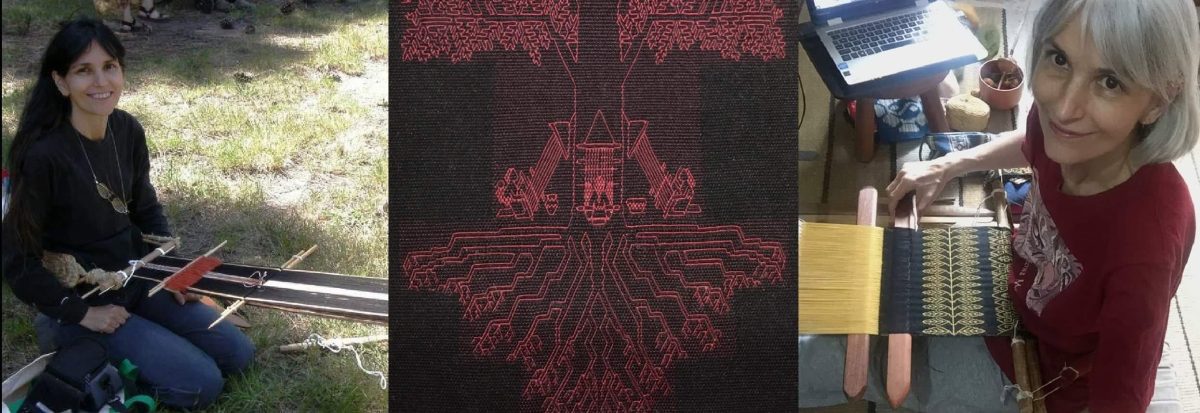
Backstrap Weaving – Mayhem

I am kind of holding my breath here on this Carnival weekend to see what shape the Santa Cruz Carnival 2021 celebrations take in this time of corona virus mayhem.

Carnival is a big deal here…not as big a deal as the one in Rio de Janeiro, of course, but big all the same… with three-and-a half days of non-stop drinking, dancing, very loud music, and the throwing of water balloons and paint, all of which kicks off on the Saturday night.

The city has been placed into full quarantine lock down for the next four days so that people won’t gather in the center and cause a possible super-spreader event. I’m sure that all the downtown businesses have been pleased not to have to go through the usual task of boarding up their shop fronts and protecting their walls with plastic. Residents who park their cars downtown haven’t had to cover them in mud as a way of protecting them from the paint and junk that gets thrown around. The clean-up crews won’t have the task of hosing down streets (imagine all those partying people in streets with no public toilets!) and scrubbing paint off buildings.

  I have always passed a fairly peaceful time at home as all the mayhem generally happens several blocks away. This time, however, might be different and I am bracing myself for three days trapped inside with my idea of hell right outside my door.

Carnival Santa Cruz style. Photo by Steven Sheehy stevensheehy.com

The problem is that the full lock down was only called a couple of days ago. I am guessing that leaves lots of people with ruined party plans…alcohol will already have been purchased along with meat for the barbecue. Yesterday, I was nervously watching a couple of men who live in my condo unloading a vehicle with boxes and boxes of stuff in preparation for their celebrations right here in my Fortress of Solitude. When the truck shows up with the music system and gigantic speakers, I’ll know that I am in real trouble! Normally they would be having these parties at their Fraternity headquarters which is usually a property in a semi-rural area far, far away from me!

I guess, I’ll just shut all the windows, turn on the fan and continue weaving my own version of mayhem at my backstrap loom. If you have read my last couple of blog posts, you will know what I mean by that. I am still working on my three-part wall hanging series. The second panel has a design that is meant to represent the feeling of mayhem and chaos that I experienced at the very start of the pandemic.

I created a drawing that shows more or less what I am aiming for, at least color-wise, in this three part series…

Each piece is only about 7″ wide and 15″ long. I have finished Number Three. Number One, which is the one on which I am currently working, is the exact opposite of Number Three color-wise. The center one shows a transition from the first to the third. I have been creating the shapes in ikat by wrapping bundles of red warp threads in plastic tape before dyeing the warp black. The wrapped sections resist the dye and remain red. That’s basically the way ikat works. I am, however, putting a slightly different spin on it which I believe to be my very own.

Here’s the completed central pattern of Number Three in the series…

Here I am working my way through the chaos section in Number One in the series…

It’s still on the loom. There’s a lot more chaos to go!  I can at least show you what the two pieces look like side by side at the moment. My attempts to photograph these have been very frustrating!

And yes, I will make an attempt to explain what this all means, if anyone is interested, when I have finished all three panels. The series is called Within These Walls. I am using 60/2 silk and each piece has 1200 ends. I mentioned in my last post that I had run out of the amount of red 60/2 silk that I would need for the final piece, Number Two. I am now thinking that I will try to substitute two strands of 140/2 silk, in a similar red, and see how that goes as warp. Wish me luck!

I might take a small break from this when I finish this piece because there’s a small double weave project that has been tempting me all the while. Well…maybe  not a complete break…I don’t want to lose momentum! I might just throw a short narrow warp onto a backstrap loom and try a sample of the double weave pattern that has been teasing me to give me a break when I am wrapping Number Two with ikat tape. 

So, that’s what has been keeping me grounded…that and all the wonderful folk with whom I get to hang out in Zoom gatherings. And, of course, there’s interaction in the various online weaving groups in which I get to meet band weavers and backstrap weavers from around the world.

Roland Polk sent me these images of his latest project on his backstrap loom…

This is a silk warp with his own handspun merino (20 wpi) weft…imagine! He was able to get hold of a bamboo reed to help him produce this beautiful balanced cloth.

I love this picture of his warping set-up on a door! Resourceful!

Emilie Landré wove a length of band which she was able to sew into a neck tie. I love how the motif that she chose so perfectly fits the shape of the point of the tie.

She has also been dabbling in Andean Pebble Weave and wove this lovely tape using a chart from my very first book. I am so grateful that Sandrine translated that first book to French for me.

Mary Spanos wove a strap for her watch on her backstrap loom using an Andean Pebble Weave pattern…..so elegant!

And, this is Lizzie Ruffell’s guitar strap on which she used patterns which are charted in one of my pattern books….Carol Berry wove this beautiful band using patterns that are charted in my Andean Pebble Weave on Inkle Looms book….

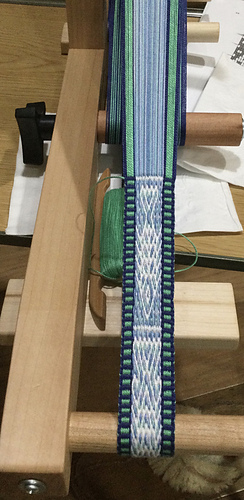
Kathy Olsen is weaving a pretty band of fish motifs in the Andean Pebble Weave structure that are charted in my Complementary-warp Pattern Book. I love those four fish patterns and think that they are fun to weave along with the other River and Ocean-themed motifs in that set. It’s always interesting to see borders that are not solid-color plain weave.
All my books, as well as my video class, can be found at Taproot Video. There are detailed descriptions of each item at Taproot Video with an opportunity to “look inside” at a few pages of each but, if you ever have any doubts about where to start or which book to buy next, please feel free to ask me via a comment on this blog…or find me under my full name, Laverne Waddington, on Facebook or Instagram. I welcome the opportunity to correspond with you. There’s also a short Preview Video at Taproot Video for my backstrap loom class Operating a Backstrap Loom.

And finally, I would like to tell you about the series of awesome instructional videos that my friend Wendy Garrity has made and is generously offering for free on Youtube. Wendy studied the traditional kushutara technique of Bhutan while living there. In this technique, patterns are created on warp-faced cloth via the use of supplemental weft threads. Wendy has created and shared a series of videos called Kushutara Basics. 

I know that many of my backstrap weaving friends are taking advantage of this wonderful opportunity to learn this beautiful and versatile technique.

The last time I saw Wendy was in August 2019 when we enjoyed a beachside dinner while watching the sun set over the Indian ocean in her hometown of Perth, Western Australia. She was helping me celebrate my birthday that evening in the middle of one of my Australian teaching tours.

So, for now, I will leave you hoping that my Carnival 2021 experience will be an unmemorable one! 

Happy weaving and stay safe.


Backstrap Weaving – Within These Walls Part 2

There really wasn’t any other name that I could give to this post except “Within These Walls Part 2” because that is pretty much all that I have been working on in the relatively long period of time that has passed since my last post. It’s partly about ikat. That alone is slow stuff. And, then there’s something even slower going on in this project…Andean Pebble Weave pick-up over 1200 ends of 60/2 silk.

Here’s the first finished piece that I showed you in my last post. It may actually end up being the third in the sequence when all is done. I haven’t quite straightened out my idea for Part 3 and so, who knows in which order the three pieces will end up in the final sequence.

Part 2 is the opposite of this piece color-wise. All the red areas will be black and vice versa. You can see the warp in the picture below after it had been dyed and partially unwrapped. I am using two sets of heddles for the two pebble sheds in the Andean Pebble Weave structure. Yep, that’s a lot of heddles but I love making them!

But really, apart from the time spent wrapping the warp threads with tape and dyeing, the thing on which I have probably spent the most time so far is planning what I am calling the “chaos section”. Coming up with a chart for that had me covering my floor with eraser dust. I wanted something that looked like an impenetrable maze. I drew maze-like patterns on my charting paper but the problem was that they looked like patterns. They made sense. I needed something that looked chaotic and unpredictable and I wanted the dominant color to be red. Once I had decided that what I wanted to see was pretty much “a mess”, it was much easier to get it down on paper. Just doodle a mess. Draw lines every which way. It was fun.

The first section was all about birds. And then came the chaos. I love the sheen of the silk that the camera’s flash picked up in this picture. The silk that I am using generally doesn’t show any signs of sheen until the finished piece has been washed and pressed. It can be disappointingly dull on the loom.

Weaving the chaos section wasn’t so much fun until I came up with a way to color code sections and match those to color markings on the charting paper. Then I also discovered that when you are trying to create chaos, nothing really counts as a mistake unless, of course, it is structural.

So, while I do manage to stick very well to what I have drawn on paper, an occasional line that wanders off to the right when the charts says it should be going left is no big deal at all…thankfully!

There will be some hummingbirds hidden within the chaos. I like how some of the chaos shapes can start to look like recognizable forms if you stare at them long enough…one shape might look like a llama, another like a rabbit, another like a demon, another like a flamingo. If you blink, you lose the spot on which you had been focusing and chances are you won’t find the rabbit again! It’s sort of like when you see figures in fast-moving clouds. 

And so, I am creeping along with this. It’s slow but I would say that it’s painlessly so! There’ll be an addition to the story when I get to the center. Once I get to the main black shape that the ikat tape had enclosed, I won’t be picking up across 1200 ends any more and the number of threads of pick-up pattern will gradually reduce. I am sure to feel as if I am zooming along at that point.

You can probably spot the hummingbirds in amongst the chaos in this shot. They are on a journey, the end of which will be revealed when I get to the center of this piece.

I am still not able to capture the richness of the red in these pieces. Once Part 2 is finished, I’ll put the two finished pieces together and get to work trying to figure out how to photograph them better.

I hope I’ll be able to show where those hummingbirds are heading in my next post.

Zoom meetings are still keeping me good company. I so love being able to get together with weaving friends on a regular basis and my Andean Pebble Weave on Inkle Looms workshops have been going really well with students turning out some really pretty bands, some of which have their own original patterns. By the way, the new book that I am currently writing is another project that has been keeping me busy behind the scenes.

Take care everyone and please continue to stay safe.

Backstrap Weaving – Within These Walls

2021…..Yes, it’s a new year. No doubt there will be new and better things on the horizon but I don’t expect things to change too much in the life I am living within these walls. I don’t mean that in a gloomy way. My loom and Zoom have chased away the gloom. They have been my best friends during the pandemic along with a little help from my Kindle and camera. I have stayed safe, healthy and well-fed in both mind and body and I guess I can be grateful for being at an age when getting things done just doesn’t seem as urgent as it used to be. I have the time to do some in-depth study of certain weaving techniques and, thankfully, people are still interested in what I do which often leads them to purchasing my books.

One of the 1992 adventures: Starting the first non-snow leg of the Mt Hood climb.

In a Zoom call with my 29-year-old nephew, I was trying to recall what I was doing when I was his age and trying to imagine how I would have reacted to having all my plans suddenly shelved by a pandemic. I was single, I had quit my job, and my plan had been to hike and backpack around the USA for six months starting in the month of April of that year. So, of course, there was a sum of money in the bank that would have allowed me to do that.

I hate to think how I would have reacted to being stopped in my tracks by a pandemic…. jobless and stuck at home spending that travel money just to get by while looking at my four walls. At that time, my life was all about the outdoors. Stay put and weave for a year? Unthinkable!

I can still remember waking up in my bunk bed in the Honolulu Youth Hostel, which was my first stop on that trip, smiling and closing my eyes, smelling the ocean, hearing the waves and thinking about all the possibilities for adventure that lay ahead. There have been a few times over the years when I have actually said to myself…stop, drink this in, remember this scene, the sounds, the smells, and how you are feeling because it will be fun to be able to recall this exact moment some day in the future. That moment in Honolulu was one of them.

I am so impressed by the way the much younger people in my life are handling this situation. These are also times to stop and drink in and imprint in the mind. Some time in the future when things are better I am sure that it will be occasionally useful to be able to recall the sights and sounds of our surroundings and the way we were feeling in this difficult period. 

So, within these walls, I have been busy planning a weaving project that somehow captures the idea of creativity within confined spaces. I like the fact that this idea still allows me to play with ikat. I try to do other things but keep getting drawn back to it.

I am using the ikat to create the confined spaces in the warp within which all the activity is taking place. Once the warp is dyed, all that lies outside those spaces will be dark and will represent the unknown.

This is the ikat warp that I showed you in my last post. Tape is wrapped to form the pattern on the red warp. This goes into a black dye bath. The taped areas (hopefully) resist the dye. I seem to have come to grips with my technique in that part of the process and my plastic wrappings don’t leak. This gives me a nice sharp pattern on my warp which I try to keep as sharp as possible as I weave. 

So, that’s me at my backstrap loom, within my walls, imagining the world outside.

This required some large pattern charts. Juggling balls are there for scale…yes, I’m still juggling.I am still a pencil-and-paper person and drawing charts sprawled on the floor is a big fun part of the process for me. Of course, I could have downsized the blank pattern charts but I wanted everything to be large enough to be able to simply glance down to read the pattern. There were, after all, six hundred threads to be picked in the widest part of the pattern. (The warp has 1200 ends of 60/2 silk.) I didn’t want to have to be squinting at a small chart or moving an image of it around on my laptop screen.

The first half finished….So far, so good, as far as keeping the ikat image sharp. But, you can never tell how things are going to progress. That aspect of working in ikat is still fairly unpredictable for me.

Here’s the finished main section of the Within These Walls piece. The warp threads behaved and gave me nice sharp outlines for my walls. This is the only shot that comes close to showing the richness of the red color in the silk thread I am using.

I would like to make a series of three pieces in this Within These Walls theme. They can be framed and hung on the wall in a future home. Unfortunately, after winding the warp for the second piece, I realized that there wouldn’t be enough red for a third. I do, however, have loads of black 60/2 silk and quite a lot of a similar red in 140/2 silk. The third piece could be a non-ikat one using black warp with red pattern in supplementary weft. I am actually really enthusiastic about planning that one and making it work with this theme. Necessity is the mother of invention, right? I have no choice but to work with what I have on hand.

But that is way down the track. I have only just wound the warp for the second piece and mounted it on the frame so that I can start wrapping it with tape. There’s going to be a whole lot more wrapping on this one and that will keep me occupied for a couple of weeks, I should think. With the summer humidity, that will mean two weeks of walking around with stray hair-like strips of ikat tape clinging to my body, turning up in my food and washing off in the shower! With the ceiling fan going, those stray strips go everywhere.

I sit on my bed and have one edge of the frame leaning against the edge of a table with the other end on my knees. That works quite well. The hard skin that I developed on my finger from the last session of wrapping and which was really annoying while I was weaving (getting itself caught on the fine silk threads), has finally worn itself away back to smooth new skin….just in time for this next wrapping session…ha! I have seen photos of ikat artists in India working with some fingers wrapped and wonder if they are avoiding this same problem.  

I’d like to finish by thanking all of you who have been buying my books. I hope this new year gives you time to explore them and hope that the free time that you have available to devote to it is on your own terms rather than being forced upon you due to yet another lockdown.

Here’s something that Mary Spanos has been doing within her walls….a beautiful Andean Pebble Weave pattern in 20/2 cotton using one of the patterns from my More Andean Pebble Weave Patterns book. This particular pattern has the over-under look of weaving leading someone to point out that it’s like “weaving within weaving”.

Outside my walls, our entire city has been shut down this weekend…no vehicles or pedestrians are allowed to circulate, no shops or businesses allowed to open, no alcohol can be consumed…everyone has to stay home while a brigade of seven thousand covers as many neighborhoods as possible in two days to assess the extent of the current second Covid surge. Very few people get tested here…they can’t afford to…and so this is the government’s way of trying to reach and assess the needs of those who remain in darkness about their condition and have no choice but to ride out the disease at home. 

So, we are all staying within our walls this weekend.

Take care and stay safe, please.


Backstrap Weaving – Limbo Land

I don’t like being in weaving Limbo Land. Usually, while I am sitting weaving one project, I have the next one already developing in my head or on paper. I’ll be gathering yarn and charting patterns when not at the loom so that I can launch myself straight into warping once the current project is off and washed and sewn. 

While I had the general idea for the next project sorted out, I hadn’t quite pinned down the finer details and so I found myself in Limbo Land once my current project was off the loom.

Urgh…I dislike Limbo Land. Limbo Land is the place where I do crazy things like suddenly decide to cut my own hair. Fortunately, I decided to spend this little jaunt in Limbo Land in a much better way….starting my next book! And then I suddenly got the little spark of idea I needed to pull together all my thoughts for the next project. I really need to write these things down because I have already forgotten the source of the spark.

The ikat piece that I just finished was about weaving shapes that would allow me to calculate take-up for future projects. I was interested to see how much length was lost in the original ikat shapes once they were woven using warp-float patterning rather than the plain weave that I usually do.

I think I mentioned in my last post that I was getting bored with the pick-up pattern that I had chosen to weave within the ikat shape. Well, I came up with a way to amuse myself for the second half of the pattern. I decided that the bottom half looked like foliage and that I could slip a little hummingbird in among the plants in the upper half. Planning that out was fun and I realized that this was really what I originally had in mind  when I saw the drawing of a hand in that magazine ad that I have mentioned in past posts….weaving pictures within pictures.

So I have decided to weave a series of small silk pieces based on this basic shape filled with pictures. I have just finished tying off a larger and simpler version of this shape in red 60/2 silk again which is now soaking in preparation for dyeing tomorrow. I have a pretty good idea of how I want to fill it. Let’s see where all this takes me.

I suspect there will be some moments of “What was I thinking?” when it comes time to weave and I have to come to grips with all the detail that I have put into the pictures! I can guarantee it won’t be boring to weave!

Another source of inspiration for this idea of pictures within shapes arrived in my inbox just this morning. The Textile Museum in DC announced the arrival of The Textile Museum Journal, Volume 47 and the cover picture fits very well with my latest weaving projects.

This volume is devoted to “color in textiles across time and space” and includes an article by Elena Phipps on “Woven Brilliance: Approaching Color in Andean Textile Traditions.” You can take a look here for more information about subscribing to the journal, this issue, and back issues.

The cover of latest volume of The Textile Museum Journal…what I see are pictures within pictures!

I have actually had a pretty colorful morning all told as I got to attend a Zoom presentation by dye master Dagmar Klos on the basics of dyeing which was simply marvelous. There was plenty of information for me to apply to even the occasional dyeing that I I do for my ikat projects.

This picture of a weaver taking a break from her backstrap loom from the Threads of Life Facebook page really speaks to me. Maybe she is turning over ideas for her next piece.

And, sticking with the subject of color, I wanted to tell you about collections of beautiful backstrap-woven fabric squares that Threads of Life in Ubud, Bali is selling via their online store. I have been signed up for the Threads of Life newsletter ever since my failed attempt to attend their weft ikat workshop back in 2017. They were incredibly understanding about the misfortune that prevented my being there and I have always been very grateful to them for that. Of course they are just one of the many organizations that are being sorely affected by the pandemic and the resulting absence of tourism. They rely heavily on the purchase of textiles from visitors to their gallery in order to be able to continue supporting the various backstrap-weaving communities with whom they work.

From their website:  By aligning with indigenous culture in its fieldwork and marketing, Threads of Life alleviates rural poverty, helps weavers to form independent producer groups, and facilitates their sustainable management of their natural dye resources.

I was very impressed by how quickly the Threads of Life staff sprang into action once the full extent of the pandemic had been realized and came up with new and truly unique ideas for their online store. Apparently, they have been holding onto an assortment of textiles that have been purchased from the weaving communities over the years that, due to having some small flaws, have not been sold in the Gallery. These pieces have been cut into squares and are being sold in beautifully coordinated color sets that can be used in patchwork and quilting projects. They make my mouth water!

The sets include squares of solid-color naturally-dyed cloth in stunning indigo blues and in rust and terracotta tones woven from handspun cotton as well as ikat and batik pieces. The cloth originates from various Indonesian islands and have been placed in these sets accordingly.

Here are some pictures of some of the sets: those blues!!

This is just a small sampling of all the products that they have to offer. There is also a range of large naturally-dyed lengths of fabric in the collection that they call Farmer to Fabric, tablet-woven trim in naturally dyed cotton and heirloom quality textiles and baskets representing various islands and communities.

This link to Threads of Life won’t just take you to their store. I hope that you can take some time to explore the site. There is a nice slide show at the bottom of the page illustrating the steps and time involved in the creation of an ikat textile. There are also tabs that take you to pages with information on the organization’s field work, natural dyes, the artisans with whom they work and the organization’s classes and workshops. 

And, finally, I would like to tell you about the inclusion of an article I wrote in the latest issue of tinyStudio Creative Life magazine….”The Inspirational Publication for Mindful Crafters”.

(I would like point out that I would never have dared to wear shorts if my weaving teacher, Trini, was not also wearing them! This picture was taken by anthropologist Kathleen Klumpp when I accompanied her to stay with Trini and her family of cotton spinners and weavers in coastal Ecuador.)

I met the magazine’s editor, Suzy Brown, when I was in New Zealand last year. We wove together over a couple of days and she later invited me to write about my experience learning to weave in South America. The magazine comes out quarterly and this issue has 126 pages of luscious fibery inspiration and yes, there is quite a lot about color in there too with extensive articles on dyeing with woad and cochineal. It covers topics ranging from sheep breeds to fiber preparation, spinning, dyeing and felting, spinning tools and equipment and includes focus articles on various fiber artists (this issue includes an artist who creates amazingly innovative art work using machine-knit fabric as a base), visits to artists’ studios, as well as instructions for craft projects.

Suzy puts together a fun flip-through video for each issue on Youtube….

With a new ikat project about to hit the dye bath and a new book in the works, I don’t see any more wallowing in Limbo Land in my near future!

Take care and stay safe, please.


Picking up Ikat AGAIN

I have come back full circle to my ikat explorations again. I meandered over to Finnweave for a while and then made a quick visit to three-color double-faced pebble weave. Now I am back in ikat territory and making experiments by adding a twist of my own. Meanwhile, I am planning on paper the large projects in Finnweave and three-color pebble which will be next on the to-do list.

I smile when I remember one of my first ever attempts at ikat. I am pretty sure that I did this after my first trip to Ecuador in 2005. There I had seen that ikat weavers were using strips of cabuya fiber (agave) to wrap their warp threads and I brought back some to try for myself. I found it impossible to use! There must have been some tricks to effectively preparing and/or tying the cabuya that I had obviously missed.

For some reason, I decided that it would be a good idea to use my own hand spun llama yarn as the warp for this first attempt. Bad idea. Even worse was my attempt to dye it with cotton dye. I had no idea about such things at the time. For me, dye was dye and should work with any material. I was mad about the fact that what was supposed to be a strong so-called Mexican Red came out Barbie-pink but I started weaving it anyway.

Looking back on it now, I tend to think that it wasn’t a bad first attempt but it hadn’t pleased me at the time and I abandoned and discarded it. I wish I had kept it now. I suppose the Barbie-pink would have faded and washed out eventually anyway. I have learned some stuff since then!

After giving up on the cabuya, I tried using strips cut from plastic bags but I found that the plastic stretched and often broke as I tried to tie knots. Besides that, it was very hard to cut really fine strips. I remember watching a tv show in which someone was destroying some incriminating evidence on tape. They ripped the tape out of the cartridge and broke it apart. I was thinking…yeah, right, tape is not that easy to snap apart in bare hands. And then it dawned on me that cassette tape might make good wrapping material. That Barbie warp is wrapped with cassette tape. (I learned later that it doesn’t stand up too well to very hot water).

The next attempt was with wool singles that was sold as warp for tapestry weaving. I figured it wouldn’t be as stretchy as my hand spun llama. I am pretty sure that I used hair dye on this one! It was also abandoned because the threads shifted more than I was willing to tolerate once I started weaving. In any case there was and always is something to learn in these ikat experiments.

Let’s try again with something even less likely to stretch. This one was in UKI 20/2 cotton and the appropriate dye (I only owned cotton dyes at that point and was still under the impression that the Mexican red dye that had turned out Barbie-pink had just been a bad batch.)

What was supposed to be a deep ocean blue came out like this…what?! Another bad batch?! No. Here’s a new lesson. You need to scour the cotton thread to make it ready to accept dye. Fortunately, I really liked this kind of blue but this experiment also went to the trash despite the fact that the ikat patterns had come out quite nicely.

This next one on un-scoured cotton (the lesson was yet to be learned) came out a wishy-washy grey instead of black and had me contacting the seller of this 20/2 thread for help and it was he who told me about scouring. Who knew?! I was able to rescue the wishy-washy grey piece by running it through a second dyebath. It gave me something very close to the jet-black that I had been looking for…

And so goes the process of learning on your own!

Hooray, this time I got the color I was expecting. This is 8/2 cotton. These experiments were taking place in 2012.

In 2015 I started playing with creating shapes in ikat and filling them with pick-up patterns as I wove. I used both two-color and three-color pebble weave in the bird series at left. While doing those, I learned that if the proportions of the shape were important (for example, if I wanted to weave a circle rather than an oval), I needed to account for take-up when I wrapped the pattern into the warp. The tied figure would need to be slightly elongated.

Those experiments were in 8/2 cotton. At this point I had been given a roll of Japanese ikat tape which held up well in very hot water, I knew about scouring, and I had learned that there were different kinds of dyes made especially for protein fibers and other kinds for plant fibers. Now I could just concentrate on wrapping warp threads and weaving!

Fortunately, my most recent experiments with ikat in silk, which were started in 2019, have made it off the loom complete and have stayed out of the trash.

Recently, I experimented with leaving some spaces in the ikat pattern to add motifs in supplementary weft as I wove. That was fun and I enjoyed figuring out the exact point at which to start adding the supplementary-weft pattern and choosing a motif that would fit nicely in the available space.

I added just a small motif using supplementary weft to the center of this one…

These latest projects have been about learning to fold the warp in half either horizontally or vertically in order to wrap two layers of threads at once and create instant repeats of the pattern.

It has also been fun seeing the effect of using a multi-colored base warp and making some useful things in the process like this silk cowl.

And now I am back to the experiments in combined ikat and pick-up. I am starting out with a sensibly small project in 60/2 silk. No one wants their silk to end up in the trash!

I am going to revive a picture that I posted back in 2015 when I was first combining ikat with pick-up. This is what you get when you do a Google search for those two terms…

Michelle Nussbaumer’s ikat pickup truck from the Dallas Morning News

In my last post, I showed my latest attempt at this combination on the loom…

Here it is off the loom waiting to be something. Of course, it could just spend its life being a sample but I decided that, although there are some kinks to be ironed out in the process, the finished piece would make a nice second pouch for my iPod.

I added eye-patterned tubular bands to the sides  and made a simple four-strand braid for the neck strap. I didn’t like the blank space at the top of the warp and added a piece of a pair of earrings that one of my students had made. I remember telling her when I bought the earrings that I wanted to dismantle them and use the pieces as pendants.  I had planned on weaving or braiding the necklaces for the pendants. Of the four pieces, I still have three to use as pendants and one which now nicely fills the space on my pouch.

A second experiment with this technique is underway. I am adding a little something more this time. We’ll see how that goes. I am still at the wrapping stage.

So, that’s what I have been up to at my loom. I have also been doing a lot of Zooming with weavers. I feel that we can quite nicely re-create the feeling of a weaving circle via Zoom….not quite like these intimate circles of which I have been a part in the past but I feel that Zoom meetings have been working remarkably well and are doing a wonderful job of creating a sense of together-ness. My Zoom workshops on Andean Pebble Weave on Inkle Looms have been going really well, I feel.

Here we have a group from New Zealand and a group from the USA from back in the good ol’ days. Now we can have individuals gathering via Zoom from all over the world!

In one of our get-togethers, Mary showed me the backstrap that she had just woven. I was so happy to see that the instructions from my tutorial are still being used. I wrote that one way back in 2009. I particularly like this way of making a backstrap because you use the entire warp. The unwoven parts at the start and end are braided and become part of the backstrap. Mary did a beautiful job with her braids.

You can find the tutorial for this backstrap here. It tells you how to weave it on a backstrap loom and what to use as an improvised backstrap as you do so. The article includes instructional video clips.

Todos Santos is approaching when here in Bolivia it is customary for all the family to visit and spend time with one’s departed relatives at the cemetery. Part of the act of remembrance is baking what are known here as tantawawas (bread babies). This picture from the website of Bolivia Bella shows one of the many forms these bread babies can take…

Small ceramic faces can also be bought in the street markets. They are pressed into the dough and then removed before baking. Once out of the oven the faces are fixed to the bread ( in some manner unknown to me). This image is from the bolivianita website….

This year some enterprising folk are selling some special 2020 faces that ae wearing Covid-protecting face masks. I would like to think that they are locally made and not brought in from China.

I am wondering in what creative ways Halloween will be celebrated in this extraordinary year. I’ve seen pictures on Facebook of people creating special shoots via which candy can be delivered while keeping a safe distance way from the kids. 

Until next time, stay safe, please!