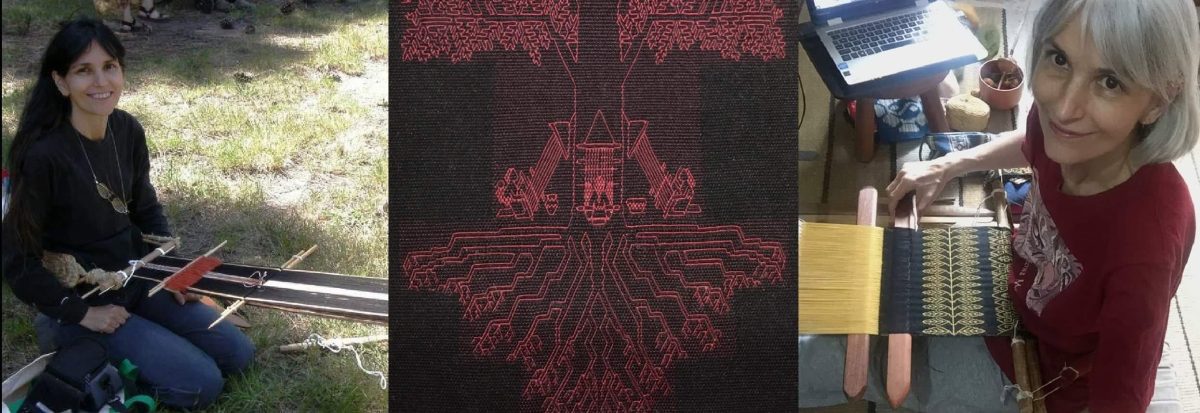
Backstrap Weaving – A Bit of the Blues

I don’t have the blues. In fact, the opposite is true. I have been getting such a lift from the various Zoom events that I have been attending lately and I try to focus on these rather than on the news.

One such Zoom event that I found very uplifting was the annual conference of WARP (Weave a Real Peace) that took place last weekend. My friend Dorinda had given me a one-year subscription to this organization which allowed me to take part in the Members Only social sessions over the course of the three-day gathering. The rest of the conference was free and open to the general public. The webinar style of the panel discussions did not give us the chance to see who else was attending and so the social sessions were particularly nice in that they enabled me to see and chat with many of my “old” weaving friends, some new friends that I have made during the pandemic and meet new-to-me textile enthusiasts via the break-out rooms.

Zoom and loom…they are both still very much major parts of my life.

During the Sunday morning coffee social, Mari took a screen shot to show what we were all working on while chatting. It seems that I am not the only fiber person who finds it hard to sit still with hands unoccupied. I have been using Zoom time to spin on my drop spindle.

I chose to use the word “blues” in my title for this post because I have finally shifted away from the red and black that I have been using for the last seven months. I started sampling my new hummingbird figures in warp-faced double weave on a sample warp of black and gold 60/2 silk. Yes, black again, but I find that sampling in black is handy because I can adjust the patterns on the cloth with a black charcoal pencil before changing my chart. Most of the charcoal dusts off with some coaxing if I want to revert to the original. Now, a variety of blues are creeping into my work.

There is no lack of images of hummingbirds on the internet to help me chart my patterns. I think it must be quite a feat to be able to capture an image of one in flight with its wings showing sharply. I have read that they flap their wings up to eighty times per second. The giant varieties that are found in South America flap at more like ten to fifteen times per second. But even without internet access there was an image available to me right under my nose….

There it is, the picaflor gigante! This new Ten Boliviano bill has been around for a few years now and I can’t believe that I had never noticed this! I am not sure what made me stop and examine the bill just the other day and discover the hummingbird.

It didn’t take me long to fill my black sample band with figures, many of which were multiple re-workings of the same motif and I was still left dissatisfied. Some looked too chubby, some too pigeon-like. Back to the warping board. I could barely face the black thread again!

In the meantime, I found an article about the Guaraní people’s legend of the hummingbird. One of the regions that the Guaraní people inhabit is the part of Bolivia in which I live. I studied for a while with a Guaraní weaver here and while her textiles in the Moisy structure contain images of birds, they are not recognizable to me as hummingbirds. If I ever find my Guaraní teacher again, I hope to ask her about that.

Polytmus guainumbi (source watermarked)

The legend tells of the forbidden love between Poti, (flower in Guaraní), a princess belonging to one of the tribes, and Guanumby, a member of another rival tribe.

When the affair is discovered, it is forbidden and a marriage is arranged with a member within Poti’s own tribe. In her despair she begs the gods to kill her. Instead, they turn her into a flower. The moon tells Guanumby of this and he extends his arms to beg the heavens to help him find Poti. He is transformed into a hummingbird going from flower to flower trying to recognize the kiss of his beloved Poti.

Before I could make it to the warping board, I suddenly remembered a silk warp that has been lying dormant in one of the drawers for a few years. It was the warp that I used to sample my arrangement of paisley shapes before I moved on to the real project. It was all heddled up and ready to go. Brilliant. As much as I love making string heddles, being spared having to make the seven hundred and twenty that have already been made for this warp made me very happy. I loved being able to revive this warp. The rubber bands had rotted but the sticks had not jumped out of the cross. I don’t know if it was a conscious need to be color coordinated when I chose that pretty blue for the string heddles. That’s a DMC mercerized cotton thread in size 60, from memory.

Because the silk threads are so fine and because there are so many ends, I use four sets of string heddles to help me to do the double weave pick-up. Warp-faced double weave can also be done using just two basic sheds which is what enables us to do it on inkle looms. That is the method I teach in my book Warp-faced Double Weave on inkle Looms. It works beautifully when weaving narrower bands using thread of larger girth.

The pattern appears on both faces of the cloth with colors reversed. I find warp-faced double weave a very nice structure for designing and include a tutorial in my book with suggestions on how to go about it. There are no warp-floats to consider which means that anything that you draw on the chart will be structurally sound.

I used a metal rod in the warp ends which is then lashed to the warp beam. This enables me to create a third selvedge. You can see that in the center picture above. Using a metal rod is not traditional and is just one of my own quirky practices! It works for me and makes it easy to remove a partly-woven project from the beam and store it away. These soft colors are so nice to look at after all those months of black!

And so, I continue sampling my hummingbirds and can test my charts of bits of foliage in the process.

In the real project, whatever that might turn out to be, I won’t be leaving all that open space. That will be mostly filled with foliage. It will be quite a busy scene.

This is one thing about warp-faced double weave that should be kept in mind. In places where there is no pick-up pattern, the two layers of double weave do not connect. The two layers of double weave in this piece are bound at their edges by the green strips of plain weave. Wherever there is pattern, the layers are connected. The fabric can feel unstable or even experience a sort of ballooning effect if there are large plain solid-color areas between the figures.

I think that I am pretty happy with these two figures but there’s still some work to be done on the others. I also want to experiment with weaving the hummingbirds as solid shapes rather than as outlined figures. I think that it is fun seeing the birds emerging from the splash of paisley shapes. I enjoy using my ice cream-stick shuttles which are just the right size for this piece

This will keep me busy for a while and in the meantime, I will think of what exactly I want to weave once I am happy with the designs. If you know me at all, you will know that I am really all about the process. The idea for the product may only come once the fabric is off the loom. I agree that it’s a strange way to operate.

And here’s some more gorgeous blue. Lately, I have been creating to-do piles instead of to-do lists and so my bedroom floor is an obstacle course of little piles of yarn, woven samples and scribbled notes to remind me of my intentions. Among the piles is some beautiful indigo-dyed 30/2 (or perhaps it’s 20/2s?…I don’t remember now) cotton from Guatemala that I bought at an ANWG conference way back in 2013, I think. I don’t think that it is possible to buy more and so I must choose its project very carefully. I used some of it to weave a couple of journal covers as gifts. You can see my friend Claudia’s initials in this piece that I wove some years ago which lay along the spine of the book….

At the moment the thread sits in a pile next to my weaving spot simply because I like looking at it. I haven’t yet come up with the idea of what I would like to do with it. Actually, just pausing to stare at this picture on the screen is starting to give me ideas. Maybe it is in fact 20/2s. Hmmm….I have some white 20/2s but do I have dye for cotton?

But then there are all the other piles to consider. There is certainly no shortage of projects to keep me busy for the rest of the year. I know that I won’t be traveling anywhere this year no matter how optimistic some people seem to be in other parts of the world.

I know that one day my life might be very different and I will be wishing that I had more time to weave and so I plan to make the most of the rest of this enforced time at home. What about you?

Until next time…..

Backstrap Weaving – Between Science and Magic

Between Science and Magic….I have copied the title of this week’s blog post from the title of an article by Maria Popova that my friend Susan sent me on a new publication about the amazing and magical hummingbird…a subject which has been dear to my heart as I weave my way through my series of panels called Within These Walls. The article is accompanied by beautiful pieces of artwork such as this one created by John Gould in 1861 and states that…

There is, indeed, something almost magical to the creaturely reality of the hummingbird — something not supernatural but supranatural, hovering above the ordinary limits of what biology and physics conspire to render possible.

The magically larger-than-life hummingbirds that I created for my first three panels played a fantasy role as messengers, friends, guardians and helpers as I wove my way through pandemic maze and, while poking around online, I found that it is not unusual to assign magical qualities to these little creatures.

I found an article which described the role of a single hummingbird in Andean textiles as being a messenger between the three levels of Andean existence…..the underworld, the heavens, and all that lies between. Hummingbirds are often depicted in pairs in highland textiles with their beaks connected and are said in this case to represent nurturing and new life.

Which makes me even happier when I think back to 1996 and the fact that the very first motif I was shown by my backstrap weaving teachers was a hummingbird….although I had not recognized it as such at the time. It also amazes me that I first came to see it as a individual figure flying straight towards me in its role as messenger and that only years later I was able to also recognize it as two mirror-image figures with beaks connected. I find it magical that this one figure can, at least to my eyes, be seen in both these ways.

In 1997, I returned to Peru where I learned to make sling braids with a gentleman in Yanque in the Colca Canyon. He later introduced me to a weaver friend of his in Cabanaconde. She taught this bird figure to me along with others in a supplementary-warp structure. This is the actual band that I wove with her. I wonder if this too is meant to be a hummingbird.

Here’s another excerpt from Maria Popova’s article…

Essential as pollinators and essential as muses to poets, hummingbirds animate every indigenous spiritual mythology of their native habitats and are sold as wearable trinkets on Etsy, to be worn as symbols — of joy, of levity, of magic — by modern secular humans across every imaginable habitat on our improbable planet.

In the first panel in my Within These Walls series the magical hummers are valiantly fighting their way through the chaos to bring me (caught in a window between worlds….do I try to get back to Australia or stay here in Bolivia?) messages of comfort and solidarity as well as practical items….yarn and sticks for my loom.

In the second, they help me build the walls of my safe space and create a new normal within, planting saplings as a way of bringing pieces of the natural world inside. They even warp my loom for me.

In the third, while I remain safe within the walls, they stand as guardians hard at work trying to maintain some kind of a connection between the four disjointed pieces.

Which brings me to the fourth and final panel in the series which the drawing at bottom right in the image represents.

This one is my vision of a post-pandemic world and one in which the hummingbirds’ work is done. I figured that they should shrink back to what could be called a “scientifically acceptable” size in this final panel.

I got out my sampling band to see if I could create a tiny, yet still recognizable, hummingbird figure. The tiniest that I could create was still the length of the little weaver figure’s face and that was okay because I read that the largest species of hummingbird, the Patagona gigas, grows to eight inches (in some reports 9.1″) in length and is native to western South America. Perfect!

In the fourth panel all the pieces are connected into one smooth shape. This shape, which I create using ikat techniques, is filled with a tree around which three tranquil backstrap weavers sit at their looms.

In my last post, I showed you the root system of the tree. It is unusual for me to weave a newly-created pattern without first having sampled it. I paid the price by having to un-weave and make several adjustments to those roots. I didn’t sample the foliage either but got luckier this time and only unwove to fix mistakes.

A big part of the challenge is fitting all the pattern into the ikat-created shape, not allowing any parts to overflow and disappear into the solid black areas. I wanted the shape of the foliage and the roots to still give the impression of the stair-stepped figures that I used in the other three panels without having them look like hard-edged confining walls.

I enjoyed designing a baby and placing it on the back of one of the backstrap weavers. The hummingbirds are yet to be seen in this image. They are flying high being normal hummingbirds doing hummingbird stuff.

I love how the sheen of the unwoven warp has been captured in this picture. I am again using doubled 140/2 silk for this one. Three threads broke this time…one mysteriously and the other two through my own carelessness. I am impressed by the way this fine silk stands up to this warp-faced structure on my backstrap loom.

Here’s the finished tree. You can see the hummingbirds in this one. I had been wondering just how high hummingbirds fly off the ground in their search for nourishment and read that they have been known to fly as high as the balcony of a 14th-floor apartment to sip at a feeder.

Pale-bellied Hermit Hummingbird. John Gould 1861.

This fourth panel is still on the loom as I have yet to weave the horizontal band of pattern across the top. Of course this leaves me wondering what comes next. First of all, I will get out the good camera and see what I can do to get better photos of these pieces. So far, I have been using my tiny iPod. My good camera has never much liked red so we’ll see how that goes.

My internet wanderings in search of information on hummingbirds have taken me to unexpected places. In one such place I found inspiration for a possible future project in three-color Andean Pebble Weave. If that materializes, I’ll tell you more. One of my online weaving contacts suggested I weave a wrist cuff with my hummingbird figures and the new backstrap weaver. That might happen too. Perhaps the hummingbird is becoming another signature pattern for me. It might be fun to combine my favorite leaf pattern (another I consider a signature pattern) and the hummingbird in one piece.

Thank you for following the progress of this project. I hope that you have enjoyed the developing story. I’ve been working on it for several months now and it is not something I would have considered taking on if I had still been traveling three times a year.

Until next time, I’ll leave you with this beautiful image by Australian-born photographer and filmmaker, Christian Spencer. You can see a whole ballet of his hummingbird photos if you chase him up online.

Backstrap Weaving – Unraveling

No, I am not the one who is unraveling. I am still riding the pandemic roller coaster with all of you and my grip is still good and firm. In the title of this post I am referring to the unraveling of parts of the chaos and uncertainty that these last eighteen months have brought to our lives. This is something that I wanted to represent in the second of my four-part series of panels called Within These Walls in which the hummingbirds are busy unraveling the chaos lines that I had woven into Panel 1.

This Unraveling image showed up in my Facebook feed recently. It had been shared and shared again and although I followed it back for some way, I was unable to find the original source of the image, a title or even the slightest hint as to what its creator might have been trying to convey. (Edit: Pamela in New Zealand wrote tell me that she has tracked down the image to Rebecka Carléns. She has a Pinterest board that she has named Surreal Photography and an Instagram account. Thanks, Pamela!)

It shows lines being unraveled and wound into a ball of yarn carried by birds…the similarities to some of the activity in my second panel made me smile. I guess we can interpret it any way we please. Which reminds me of the little hummingbird motif that I included in one of my posts a while back. I posted a picture of it on Facebook recently without revealing what my teachers called it and asked people to comment on what they saw. Here are some of the answers…..

a devil with horns, a dog, a fox, a bat, an alien being, a folding chair, a butterfly, a spider, a mouse, an angel, a bird (only one person said it!), a bear, a jedi master with a double light saber, Princess Leia with puffy sleeves, a six-legged insect, a person in ceremonial dress, pizza, a hyena, a chalice on a stand.

I mentioned in my last post that I had decided to add a fourth panel to the series. Panel 3 shows me settled within my walls and making what I can of this new normal. All the while I am able to think about how we are all in this together and imagine other weavers seated at their looms in the very same way within their own walls in other parts of the world.

But I didn’t want to leave things there. I wanted to show that I believed that there will be a way out eventually.

I got my first dose of vaccine yesterday. It’s the Chinese Sinopharm one. It’s not the most effective one but it is the one that Bolivia has been able to acquire and that’s the end of that. It helps me feel that a few more strands of suffocating uncertainty have been unraveled. I have not experienced any side effects. The jab site is not even sore. Members of an ex-pat group that I am in will tell me, in their typical cynical and joking style, that this means that what I got was probably a fake! The markets here are full of cheap big-brand rip-offs of all kinds of products. I remember getting someone to try and fix my Toshiba air conditioner. He looked at it and said “Wow, it’s an original. Okay, this is worth trying to fix”.

So, I added the layout of Panel 4 to the drawing that I had initially put together to roughly plan out the Within These Walls series….

In Panel 4 the pieces of the main shape are no longer disconnected. Disconnection is certainly something that we have all felt during the pandemic. The shape is now connected and extended. The central bar is the trunk of a tree. The lower shape will contain the root system of the tree and the upper one the crown. And there will be three backstrap weavers sitting around the tree at their looms.

I went one step further in designing one of the three backstrap weaving figures. In my last post I showed you version 4. I decided to beef up her arms a little. I have been working out during the pandemic and am up to forty-five full body pushups now. I think I deserve those sturdier arms! Version 5 is the one on the right. It requires a tiny bit of tweaking.

Here’s the root system taking shape….

I am actually beyond this point and have added the backstrap weavers. They look very sweet sitting around the tree. The one on the left has a baby on her back. I’ll show them to you next time when I have finished the tree. In the meantime, here’s a picture to celebrate backstrap weavers gathering to weave together on the island of Flores in Indonesia…

This was another picture that was shared on Facebook with absolutely no information to give it context. Fortunately, Sue Richardson, who is an expert in Indonesian textiles, was able to help out. Sue knew that this picture had been taken at a special event in 2015 when over 1000 backstrap weavers gathered to celebrate the textile traditions of the Sikka Regency and attempt to create a record. This is the translated information from an article that Sue found:

“Due to its high historical and selling value, the Sikka Regency Government is very supportive of all its development and preservation efforts. One proof of this government’s support is by holding a national event of the 2015 Ikat Weaving Muri Arts Record and winning because it can be represented by a thousand Sikka district female weavers. This victory was announced and the certificate was handed over by Mrs. Mufidah Yusuf Kalla on November 11, 2015 in Sikka Regency.” Although, according to another source that Sue also provided there were 1057 weavers.

I am currently back to paper and pencil, charting the crown of the tree. I charted but didn’t sample the tree roots and so there was a certain amount of unweaving that had to be done while I adjusted the chart. I always unweave and then walk away from the loom to engage in a completely different activity. That way, I can return and pretend that the unweaving never happened! It somehow helps. Hopefully the crown of the tree won’t involve that many adjustments.

I am happy that weaving friends and guilds, while getting more confident and occasionally meeting face-to-face, are continuing to offer opportunities to meet via Zoom. Zoom time has become my time for spinning and plying while watching and/or listening to programs on topics such as the ikat textiles of Borneo, textile travels through Indonesia, mathematics and sacred geometry in weaving, and warp-faced bands of Iran.

While enjoying these programs I have a produced a nice bowl of singles which will be plied. I still have a lot more spinning to do. The wrist cuff on the right was a sample I wove with this plied yarn to see how well it stands up to warp-faced weaving on my backstrap loom. Even though this was just a short sample, I could tell that the yarn would do well in larger projects. The annual Tour de Fleece spinning event has been creating chatter on Ravelry. I might have a project that will allow me to participate this year although I usually get tired of it after a week.

And so, with the topic of trees on my mind as I once again get down to the enormous sheet of charting paper, I will leave you with some tree-related images.

It’s fall here in Bolivia but in the tropical lowland part of Bolivia in which I live, the change of season is barely noticeable. Today’s temperature is 29 degrees Celsius/ 84 degrees F and the Toborochi trees are in full bloom across the city….not the kind of thing that immediately springs to mind when one thinks about fall or autumn. Last weekend I took a picture of this gorgeous Toborochi which is just a half block from my home…

One thing that happens in the fall that distinguishes this season from summer is that every now and then we get a wave of cooler dry air that comes up from the south. With that, the normally humidity-hazed sky turns a deeper blue. This shot comes from my rooftop on one such day. I love the sharpness of the lines of the buildings against the sky. On this day I was in the sun getting some Ds because the cooler temperatures made that possible. This rooftop is my nightly star-gazing spot (cue The Drifters and James Taylor). There’s a ladder that allows me to sit up even higher on top of a water tank.

And finally, I’d like to share with you another fabulous bag project by Allyne Holz. This one is tree-themed. She creates her bags using a tapestry crochet technique and has used leaf patterns to decorate it. She then weaves a strap on an inkle loom with a similarly-themed pattern for the strap. This time she has used one of the patterns that is charted in my Warp-faced Double Weave on Inkle Looms book and it makes me so happy to see the book being enjoyed and used this way. I also love Allyne’s use of a Dorset button on the end of the drawstring.

Here’s hoping that some of the uncertainty is also unraveling in your world. I am resolved not to get carried away by over-confidence. Santa Cruz is actually in a third wave right now. I guess that means that the Chinese vaccine will be put to the test.

Take care and continue to stay safe, please.

Backstrap Weaving – Within These Walls Part 2

There really wasn’t any other name that I could give to this post except “Within These Walls Part 2” because that is pretty much all that I have been working on in the relatively long period of time that has passed since my last post. It’s partly about ikat. That alone is slow stuff. And, then there’s something even slower going on in this project…Andean Pebble Weave pick-up over 1200 ends of 60/2 silk.

Here’s the first finished piece that I showed you in my last post. It may actually end up being the third in the sequence when all is done. I haven’t quite straightened out my idea for Part 3 and so, who knows in which order the three pieces will end up in the final sequence.

Part 2 is the opposite of this piece color-wise. All the red areas will be black and vice versa. You can see the warp in the picture below after it had been dyed and partially unwrapped. I am using two sets of heddles for the two pebble sheds in the Andean Pebble Weave structure. Yep, that’s a lot of heddles but I love making them!

But really, apart from the time spent wrapping the warp threads with tape and dyeing, the thing on which I have probably spent the most time so far is planning what I am calling the “chaos section”. Coming up with a chart for that had me covering my floor with eraser dust. I wanted something that looked like an impenetrable maze. I drew maze-like patterns on my charting paper but the problem was that they looked like patterns. They made sense. I needed something that looked chaotic and unpredictable and I wanted the dominant color to be red. Once I had decided that what I wanted to see was pretty much “a mess”, it was much easier to get it down on paper. Just doodle a mess. Draw lines every which way. It was fun.

The first section was all about birds. And then came the chaos. I love the sheen of the silk that the camera’s flash picked up in this picture. The silk that I am using generally doesn’t show any signs of sheen until the finished piece has been washed and pressed. It can be disappointingly dull on the loom.

Weaving the chaos section wasn’t so much fun until I came up with a way to color code sections and match those to color markings on the charting paper. Then I also discovered that when you are trying to create chaos, nothing really counts as a mistake unless, of course, it is structural.

So, while I do manage to stick very well to what I have drawn on paper, an occasional line that wanders off to the right when the charts says it should be going left is no big deal at all…thankfully!

There will be some hummingbirds hidden within the chaos. I like how some of the chaos shapes can start to look like recognizable forms if you stare at them long enough…one shape might look like a llama, another like a rabbit, another like a demon, another like a flamingo. If you blink, you lose the spot on which you had been focusing and chances are you won’t find the rabbit again! It’s sort of like when you see figures in fast-moving clouds. 

And so, I am creeping along with this. It’s slow but I would say that it’s painlessly so! There’ll be an addition to the story when I get to the center. Once I get to the main black shape that the ikat tape had enclosed, I won’t be picking up across 1200 ends any more and the number of threads of pick-up pattern will gradually reduce. I am sure to feel as if I am zooming along at that point.

You can probably spot the hummingbirds in amongst the chaos in this shot. They are on a journey, the end of which will be revealed when I get to the center of this piece.

I am still not able to capture the richness of the red in these pieces. Once Part 2 is finished, I’ll put the two finished pieces together and get to work trying to figure out how to photograph them better.

I hope I’ll be able to show where those hummingbirds are heading in my next post.

Zoom meetings are still keeping me good company. I so love being able to get together with weaving friends on a regular basis and my Andean Pebble Weave on Inkle Looms workshops have been going really well with students turning out some really pretty bands, some of which have their own original patterns. By the way, the new book that I am currently writing is another project that has been keeping me busy behind the scenes.

Take care everyone and please continue to stay safe.

Backstrap Weaving – Limbo Land

I don’t like being in weaving Limbo Land. Usually, while I am sitting weaving one project, I have the next one already developing in my head or on paper. I’ll be gathering yarn and charting patterns when not at the loom so that I can launch myself straight into warping once the current project is off and washed and sewn. 

While I had the general idea for the next project sorted out, I hadn’t quite pinned down the finer details and so I found myself in Limbo Land once my current project was off the loom.

Urgh…I dislike Limbo Land. Limbo Land is the place where I do crazy things like suddenly decide to cut my own hair. Fortunately, I decided to spend this little jaunt in Limbo Land in a much better way….starting my next book! And then I suddenly got the little spark of idea I needed to pull together all my thoughts for the next project. I really need to write these things down because I have already forgotten the source of the spark.

The ikat piece that I just finished was about weaving shapes that would allow me to calculate take-up for future projects. I was interested to see how much length was lost in the original ikat shapes once they were woven using warp-float patterning rather than the plain weave that I usually do.

I think I mentioned in my last post that I was getting bored with the pick-up pattern that I had chosen to weave within the ikat shape. Well, I came up with a way to amuse myself for the second half of the pattern. I decided that the bottom half looked like foliage and that I could slip a little hummingbird in among the plants in the upper half. Planning that out was fun and I realized that this was really what I originally had in mind  when I saw the drawing of a hand in that magazine ad that I have mentioned in past posts….weaving pictures within pictures.

So I have decided to weave a series of small silk pieces based on this basic shape filled with pictures. I have just finished tying off a larger and simpler version of this shape in red 60/2 silk again which is now soaking in preparation for dyeing tomorrow. I have a pretty good idea of how I want to fill it. Let’s see where all this takes me.

I suspect there will be some moments of “What was I thinking?” when it comes time to weave and I have to come to grips with all the detail that I have put into the pictures! I can guarantee it won’t be boring to weave!

Another source of inspiration for this idea of pictures within shapes arrived in my inbox just this morning. The Textile Museum in DC announced the arrival of The Textile Museum Journal, Volume 47 and the cover picture fits very well with my latest weaving projects.

This volume is devoted to “color in textiles across time and space” and includes an article by Elena Phipps on “Woven Brilliance: Approaching Color in Andean Textile Traditions.” You can take a look here for more information about subscribing to the journal, this issue, and back issues.

The cover of latest volume of The Textile Museum Journal…what I see are pictures within pictures!

I have actually had a pretty colorful morning all told as I got to attend a Zoom presentation by dye master Dagmar Klos on the basics of dyeing which was simply marvelous. There was plenty of information for me to apply to even the occasional dyeing that I I do for my ikat projects.

This picture of a weaver taking a break from her backstrap loom from the Threads of Life Facebook page really speaks to me. Maybe she is turning over ideas for her next piece.

And, sticking with the subject of color, I wanted to tell you about collections of beautiful backstrap-woven fabric squares that Threads of Life in Ubud, Bali is selling via their online store. I have been signed up for the Threads of Life newsletter ever since my failed attempt to attend their weft ikat workshop back in 2017. They were incredibly understanding about the misfortune that prevented my being there and I have always been very grateful to them for that. Of course they are just one of the many organizations that are being sorely affected by the pandemic and the resulting absence of tourism. They rely heavily on the purchase of textiles from visitors to their gallery in order to be able to continue supporting the various backstrap-weaving communities with whom they work.

From their website:  By aligning with indigenous culture in its fieldwork and marketing, Threads of Life alleviates rural poverty, helps weavers to form independent producer groups, and facilitates their sustainable management of their natural dye resources.

I was very impressed by how quickly the Threads of Life staff sprang into action once the full extent of the pandemic had been realized and came up with new and truly unique ideas for their online store. Apparently, they have been holding onto an assortment of textiles that have been purchased from the weaving communities over the years that, due to having some small flaws, have not been sold in the Gallery. These pieces have been cut into squares and are being sold in beautifully coordinated color sets that can be used in patchwork and quilting projects. They make my mouth water!

The sets include squares of solid-color naturally-dyed cloth in stunning indigo blues and in rust and terracotta tones woven from handspun cotton as well as ikat and batik pieces. The cloth originates from various Indonesian islands and have been placed in these sets accordingly.

Here are some pictures of some of the sets: those blues!!

This is just a small sampling of all the products that they have to offer. There is also a range of large naturally-dyed lengths of fabric in the collection that they call Farmer to Fabric, tablet-woven trim in naturally dyed cotton and heirloom quality textiles and baskets representing various islands and communities.

This link to Threads of Life won’t just take you to their store. I hope that you can take some time to explore the site. There is a nice slide show at the bottom of the page illustrating the steps and time involved in the creation of an ikat textile. There are also tabs that take you to pages with information on the organization’s field work, natural dyes, the artisans with whom they work and the organization’s classes and workshops. 

And, finally, I would like to tell you about the inclusion of an article I wrote in the latest issue of tinyStudio Creative Life magazine….”The Inspirational Publication for Mindful Crafters”.

(I would like point out that I would never have dared to wear shorts if my weaving teacher, Trini, was not also wearing them! This picture was taken by anthropologist Kathleen Klumpp when I accompanied her to stay with Trini and her family of cotton spinners and weavers in coastal Ecuador.)

I met the magazine’s editor, Suzy Brown, when I was in New Zealand last year. We wove together over a couple of days and she later invited me to write about my experience learning to weave in South America. The magazine comes out quarterly and this issue has 126 pages of luscious fibery inspiration and yes, there is quite a lot about color in there too with extensive articles on dyeing with woad and cochineal. It covers topics ranging from sheep breeds to fiber preparation, spinning, dyeing and felting, spinning tools and equipment and includes focus articles on various fiber artists (this issue includes an artist who creates amazingly innovative art work using machine-knit fabric as a base), visits to artists’ studios, as well as instructions for craft projects.

Suzy puts together a fun flip-through video for each issue on Youtube….

With a new ikat project about to hit the dye bath and a new book in the works, I don’t see any more wallowing in Limbo Land in my near future!

Take care and stay safe, please.