
PUTTING DOWN ROOTS AND WEAVING A GUATEMALAN TREE (PART ONE)
It is exciting how much interest there is out there in backstrap weaving. Some people are attracted to all the beautiful pick-up patterns they have seen on ethnic textiles around the world many of which have been woven on backstrap looms. Others are attracted to the loom itself – its simplicity, portability and low cost. Some people are interested in the products they can produce using up their yarn stash with this inexpensive piece of equipment while others are more intrigued by the processes involved in the “slow cloth” it produces.
I think that some people may be unaware that most of the pick-up patterning techniques do not need to be limited to the

backstrap loom and can be set up and woven on other looms. I have heard from quite a few people in the time that I have been active in the online weaving groups who have jumped headfirst into backstrap weaving and attempted some of the more complex pick-up techniques as first projects only to become frustrated and disappointed.
A few have managed to succeed and I am always reminded of the Spanish girl who wrote to tell me how she had taken my monograph on a hiking trip, picked up some sticks along the way, and woven a band in Andean pebble weave as her first ever backstrap loom project. She blew me away!
Unfortunately, I have heard more stories of people falling in love with the llama motifs on my blog, getting some dowels for a backstrap loom and attempting double weave as a first project. The poor backstrap loom now sits under dust on the shelf.

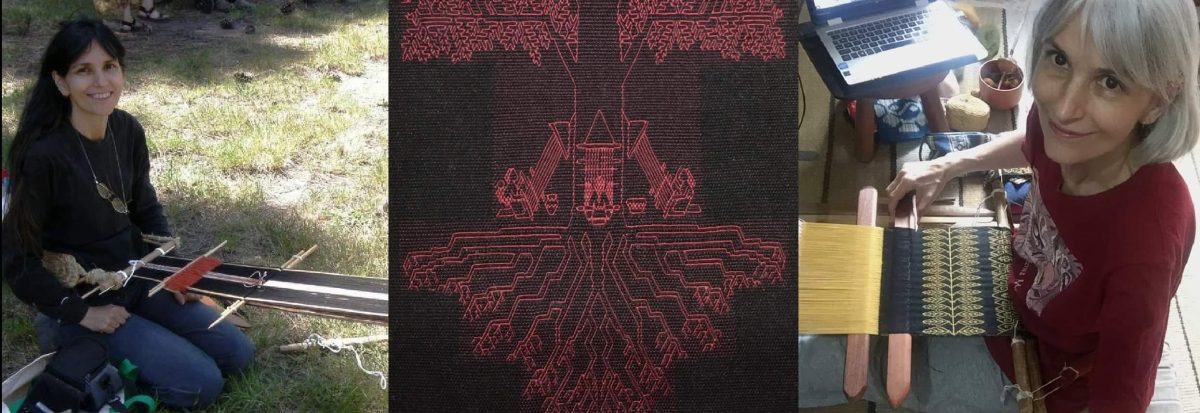
I would like everyone to be as in love with the backstrap loom as I am but, if you are really more interested in the patterns than the loom, why not lash your warps to other looms as I did for my boyfriend above? Now I have to tell you that Jorge had no particular urge to learn Andean pebble weave. He has been listening to me beat away at my loom for many years now with no desire to get down on the floor and join in but I needed to do a timed test run for a lesson I had planned and he kindly obliged – and very well he did too. He even allowed me to post this picture! He is pretty confident that the fellow members of his heavy metal rock band don’t read my blog. 🙂
For those of you who love the loom and want to get down and beat away, I have put together a kind of tutorial on what I would call the “Steps to Success”. It is a list of all the tutorials that I have put out there and the order in which I would recommend doing them. “Putting Down Roots” would be another good name as, taking it slowly, and following these steps will give you a firm foundation, develop your skills and have you well prepared for all those lovely pick-up patterns that we all want to weave. You will find the list here. It is worth checking out as you may have forgotten how many tutorials there were out there amongst WeaveZine, Weavolution and this blog. I have gathered up seven that I would list in the beginner category.

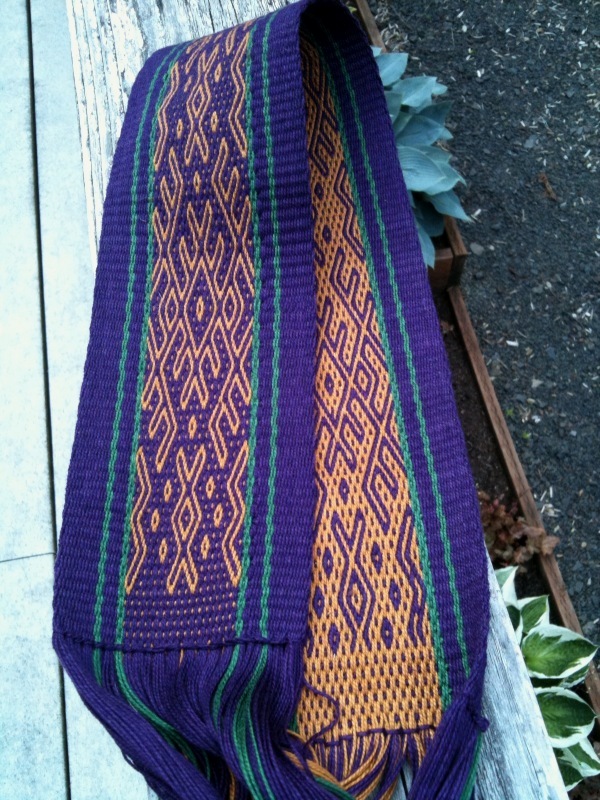
I wove like mad all weekend as I was determined to get two projects off the loom. I have several others churning around in my head and I needed to free up some loom bars. Above you can see the purple fabric that I have been weaving for a tool bag set. This is what always happens when I do pebble weave – I turn the fabric over and then can’t decide which side I like best. Fortunately I have enough fabric to make two bags so I can have one with each of the sides showing. Before I declare this project complete, there is the horrid zipper sewing task to get through. I have one bag finished so far.


###################################################
You may remember that I had planned to go to Guatemala on my way home from my recent visit to the US. I didn’t go as the US trip had been so long and I really needed to get home. It turns out that it was just as well as Guatemala City soon after was affected by a volcanic eruption which caused havoc. I would normally choose to avoid Guatemala during hurricane season but volcanic eruptions can happen at any time of year.
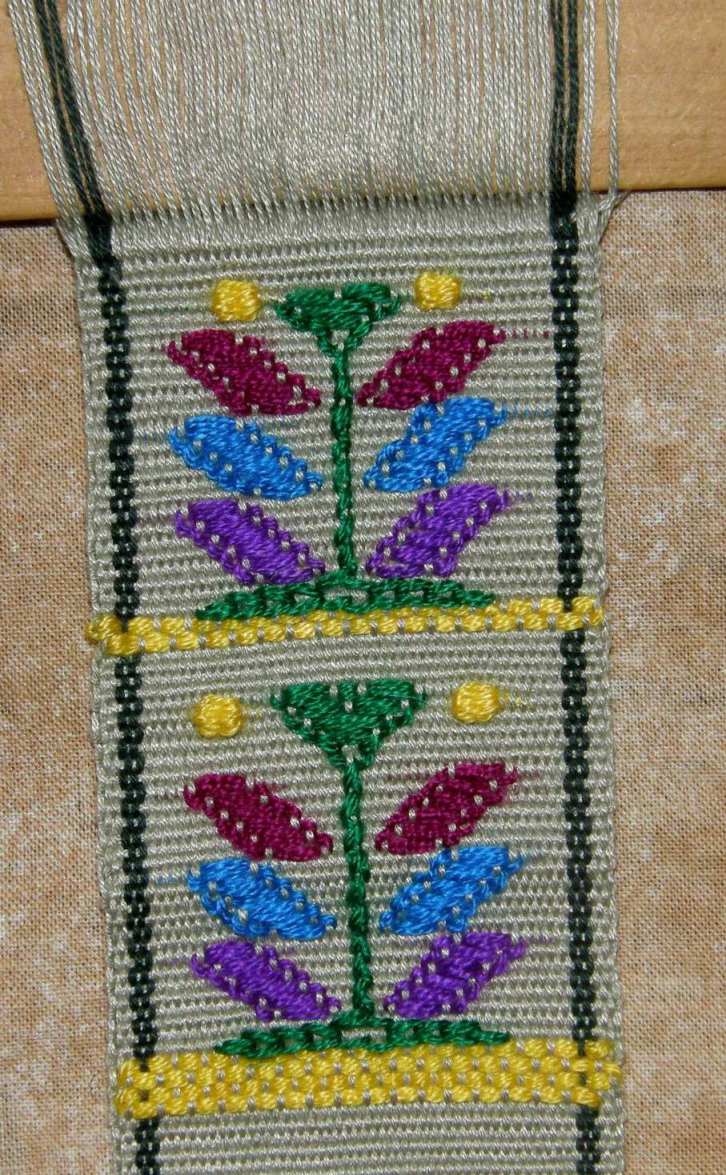
Anyway, I thought that we could do a little virtual trip to Guatemala in the meantime. I still have the bag of bright Guatemalan acrylics on the shelf and am no nearer to getting down to respinning them to use as warp.
I decided I would use them for some supplementary weft patterning, as they were originally intended, instead.
I wove a tree design using the various warp wrapping and inlay techniques that the Guatemalan weavers employ and this was fun as I hadn’t done any of this since 2008 immmediately after my return from my first visit there.
I learned these techniques with my teacher Martine and her daughter Carmen in Santa Catarina Palopo on the shores of Lake Atitlan. I met Martine in Panajachel where she sells textiles in the street market. She took me to her home and spent one morning setting up the loom and then her daughter took over weaving and teaching me for the next week or so. She was a good teacher. Each motif was repeated six or seven times across the cloth. Carmen would show me five times what to do and then would let me weave the last one or two motifs to practice what she had shown.
The weavers set up their looms with great care. Martine was obviously more skilled at doing this and Carmen only took over when everything was set to go. The warp is wound with two crosses. The second cross helps hold the shed rod in place.
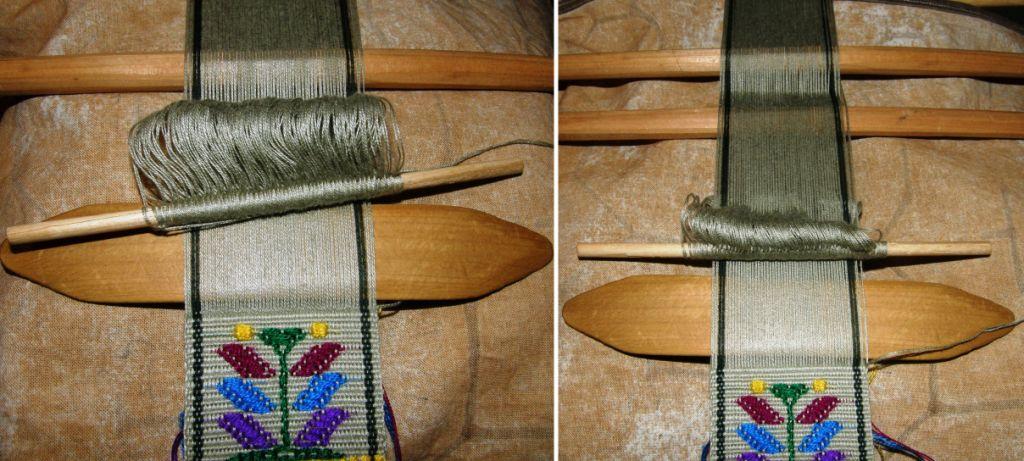
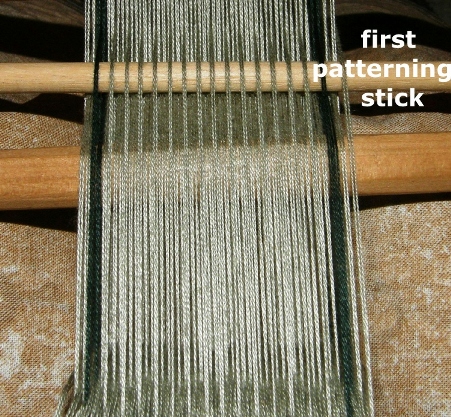
In order to create the patterns, two extra patterning sticks need to be inserted and stored up beyond the shed rod. One is stored on top of the warp and the other underneath.
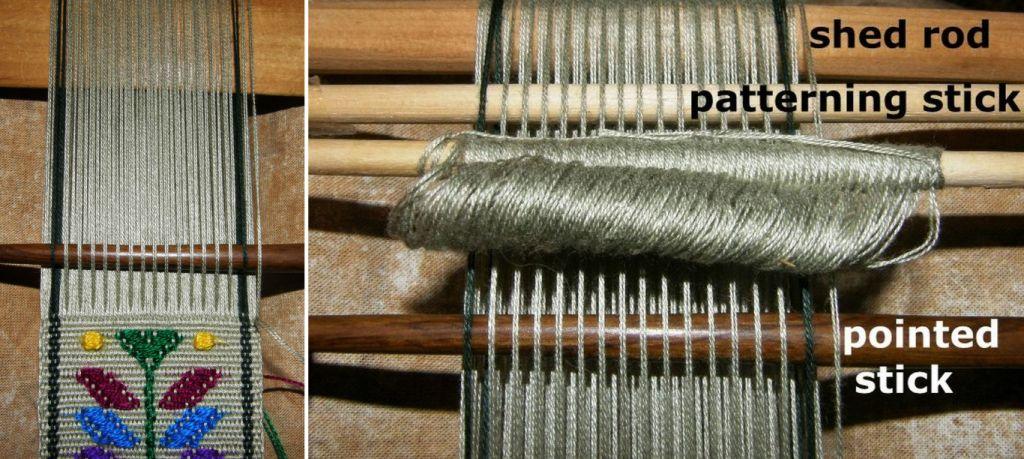
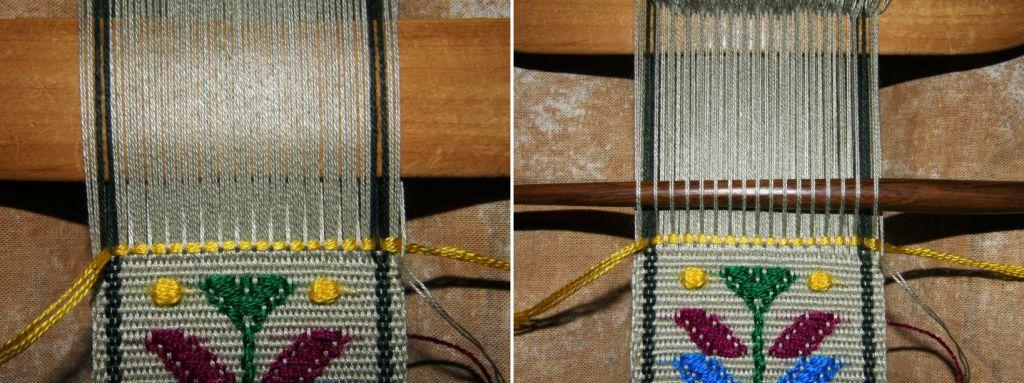
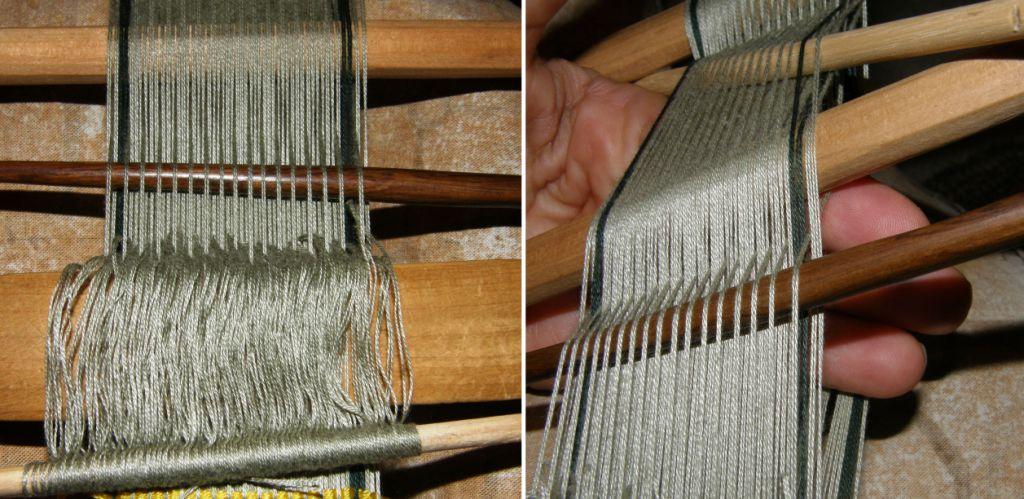


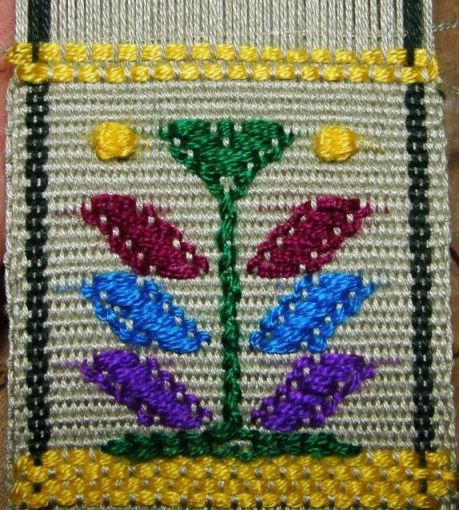 Motifs are usually started and ended with four rows of supplementary wefts in the patterning sheds forming a brick-like design. The colored pattern weft (in this case yellow) is passsed through the pattern shed and then the main weft (in this case light green) is passed through the main shed.




I so enjoy your blog and am anxious to begin backstrap weaving. I just need to finish my loom parts and get some fiber.
Great! Remember to take it slowly and follow the steps and please keep me posted on your progress.
Wonderful lesson, Laverne – thanks yet again!
I’ve been playing a bit lately with single weft double weave (with the brilliant colors I love). I’ll have to take some pictures and share them! I have a question, though – how do I smooth out the uneven ridges in the weaving? Every other weft-pass-bump is high and the alternate ridge in very low. Is it tensioning? Is it beating? Is it how I’m sitting? I can’t seem to smooth it out, even with practice.
Hi Erika,
I would love to see what you are weaving in double weave. Please send me pictures when you have some ready.
As for those annoying ridges…I get them too but never in double weave. They show up when I do plain weave but only at the start of a piece, not in fine yarns and especially on narrow bands. I wish there were some kind of scientific explanation for it but I suspect that it has something to do with tension, that is, too much tension at the beginning of a piece when the warps are stretched out straight and firm. I am only guessing and have not put that much thought into it as it does eventually go away as weaving progresses. Maybe someone who has the scientific explanantion will show up and tell us!
Hallo Laverne! Love your site. May I ask, what camera you use for your close-ups of your weaving? I need to get a new one and I would greatly appreciate your help. You can emails me if you like. Best of health! Jane
It’s an Olympus SP-560UZ.
I am haunted by the rustic cotton woven backstrap piece w added colorful birds that I failed to buy about 15 years ago. It was made of about 8 or 9 vertical strips sewn together and then embroidered.
This was from the market you mentioned on the shore of Lake Atitlan. (I think the eastern side). My daughter was volunteering at a little village on the lake and we still buy coffee from
I am wondering if the women’s cooperative has a website for sales?
I used to have a loom so I always appreciate the art and handling of yarns
I think the community you’re referring to is Santiago Atitlan. I know that the ladies there embroider lots of tiny birds onto their woven fabric. I did a search on Google and found a co-op store that sells textiles from this community online but they aren’t the embroidered ones. They seem to be things that have been specially designed for a foreign market. Perhaps by Googling you’ll be able to turn up something else or at least confirm that this is the kind of textile that you remember seeing when you were there. Good luck!