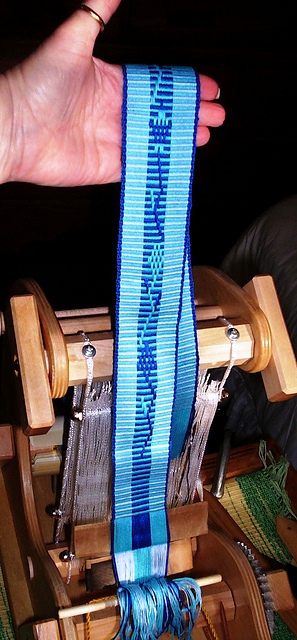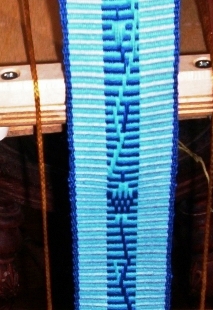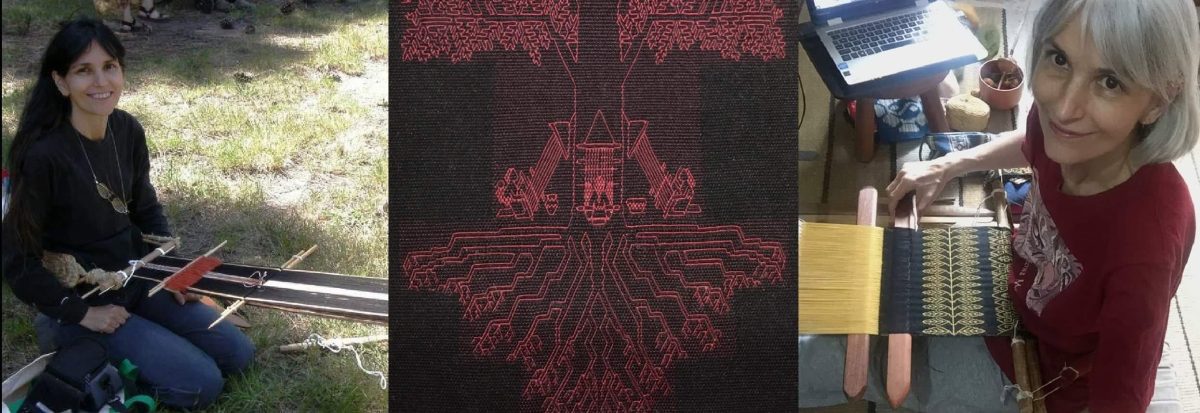
The last stop on this trip is Maryland but, on the way, there was Massachusetts…my first time in this state and here I enter the worlds of Uzbek, Burmese and Japanese Saori weaving.
But first let me show you the beautiful place where I got to hang out for my first week…
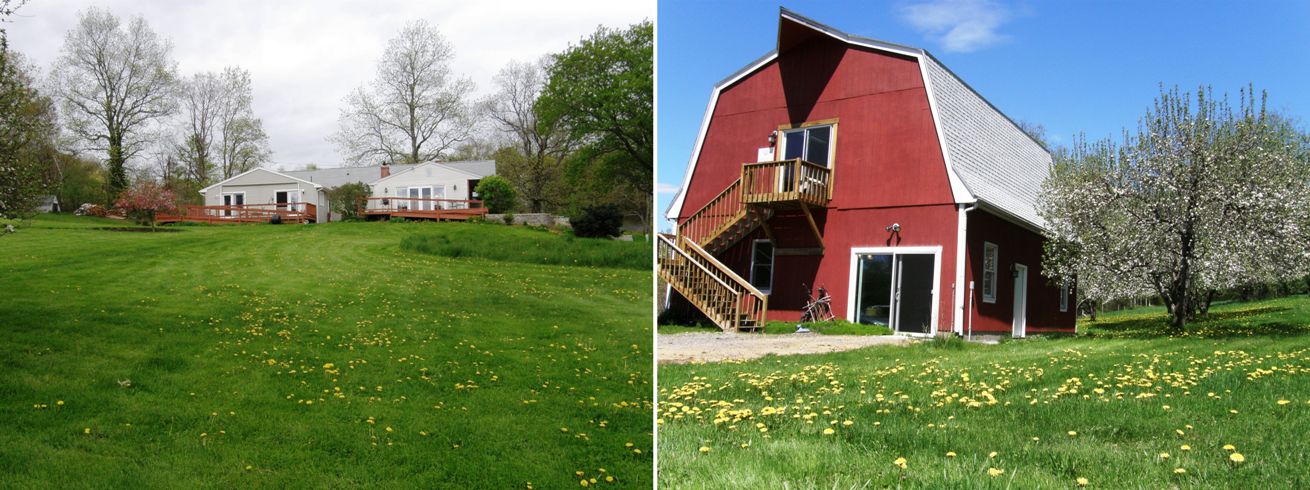 This is the home of Pam Massachusetts. That barn is Pam’s weaving studio where she invites local weavers and spinners to hang out. Pam and I met quite some time ago on Weavolution. Then we got to see each other at Convergence where Pam brought her backstrap loom and we got to weave together. Weaving Today even included a picture of us together in their newsletter.
Now if you are wondering where exactly this pretty place is, it is in the vicinity of Lake Chargoggagoggmanchauggagoggchaubunagungamaugg. No kidding, that is the name it was given by the Nipmuc tribe.
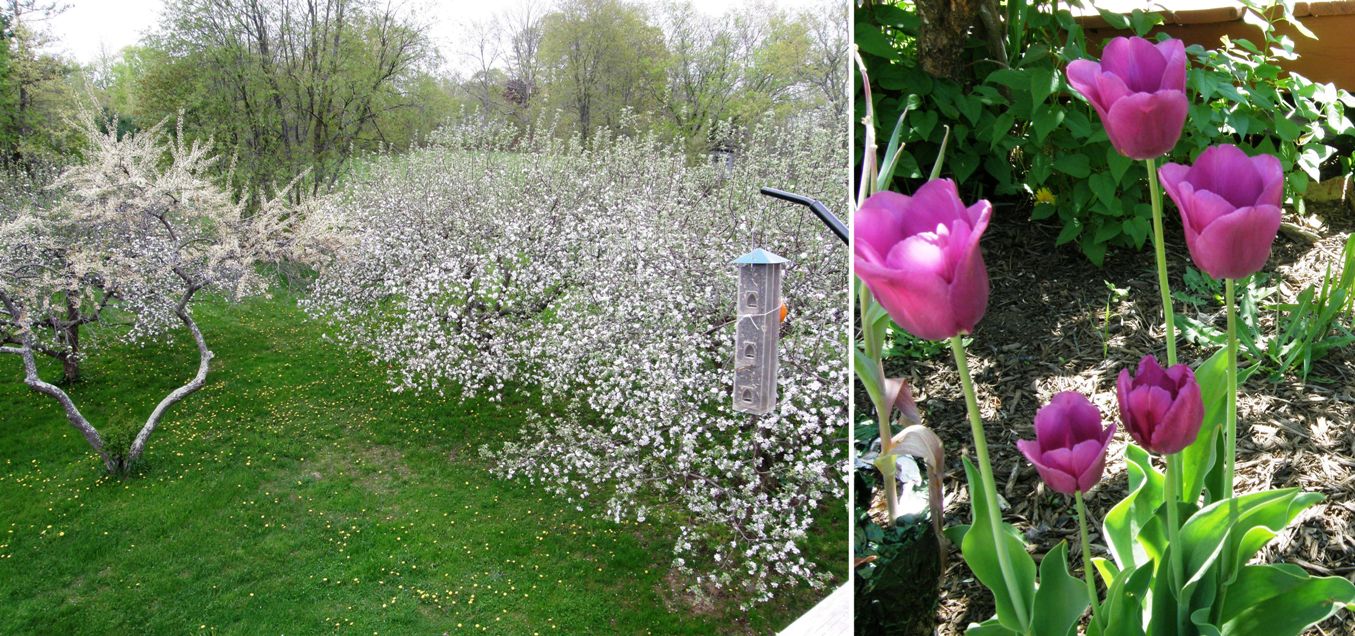
Pam invited me to come out to her place and stay and weave with a group of ladies that we nicknamed the SOWs (sisters of the warp). You can see by the green grass that the spring has been quite wet. I got to enjoy a few sunny spring days before the big wet hit again. It was lovely walking through that lush deep green grass dusted with dandelions on the way to the studio each day and breathing in the scent of the apple blossoms just outside the door.
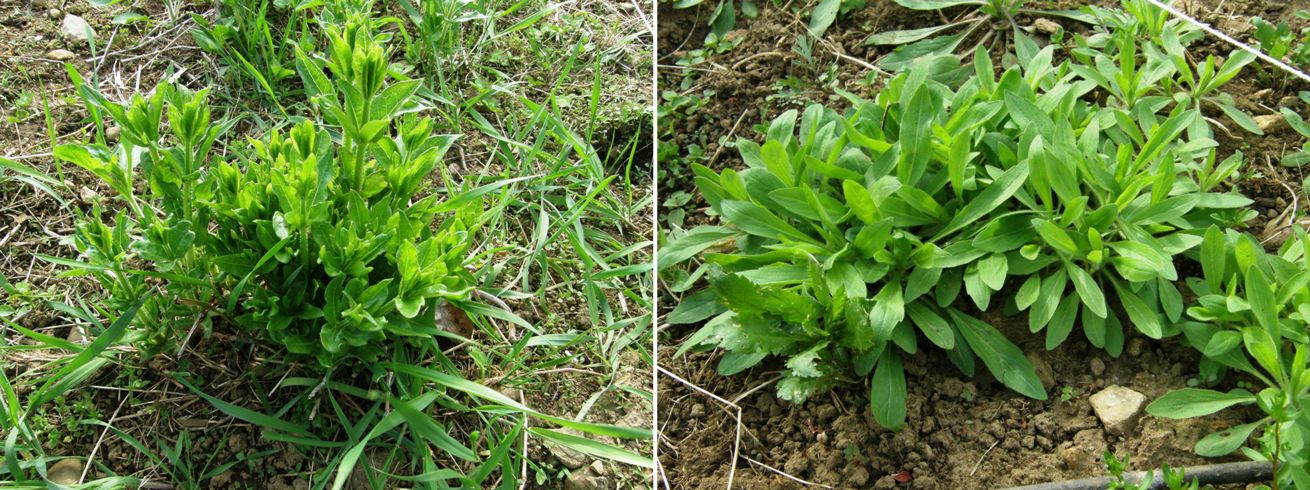
Pam’s garden includes vegetables and dye plants. Above you can see her madder and weld plants with which she will dye fiber red and yellow.
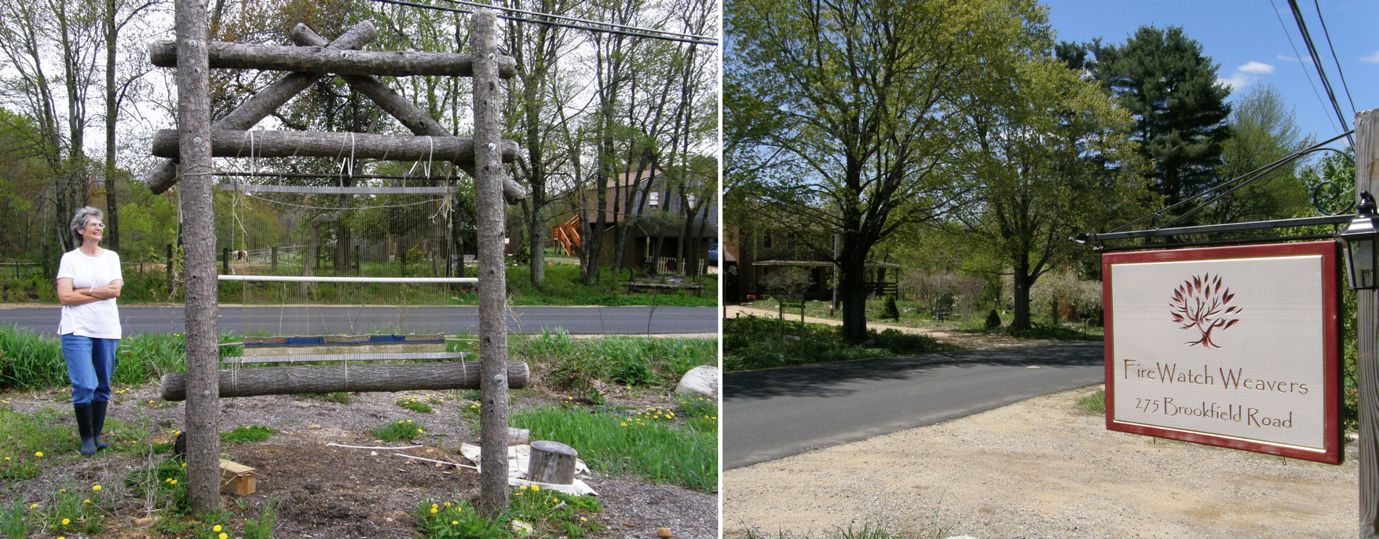 An earth loom with a weaving in progress greet the weavers. Pam is also the local loom “doctor” who is more than happy to make house calls. Her Studio is relaxed and intimate and is an open house with doors open to welcome weavers who just want to come in and use her looms. I found myself running down there one night at 9.30pm after stumbling onto something online that I simple had to try weaving right then and there!
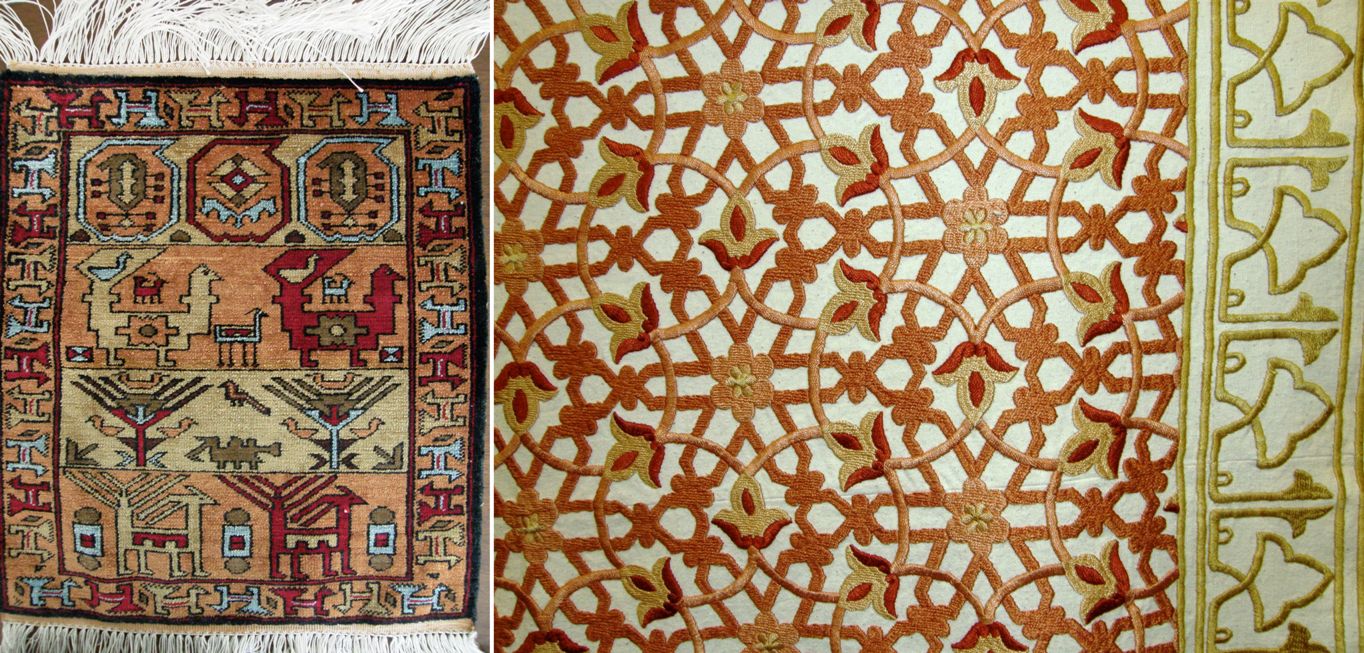
There are something like fourteen looms in her barn studio and it is a lovely space with an antique spinning wheel, an Uzbek rug loom and weavings from many parts of the world amongst its treasures. Pam has been to Uzbekistan three times and her home and studio are decorated with fine pieces that she collected there…fine silk rugs and hangings and embroideries.
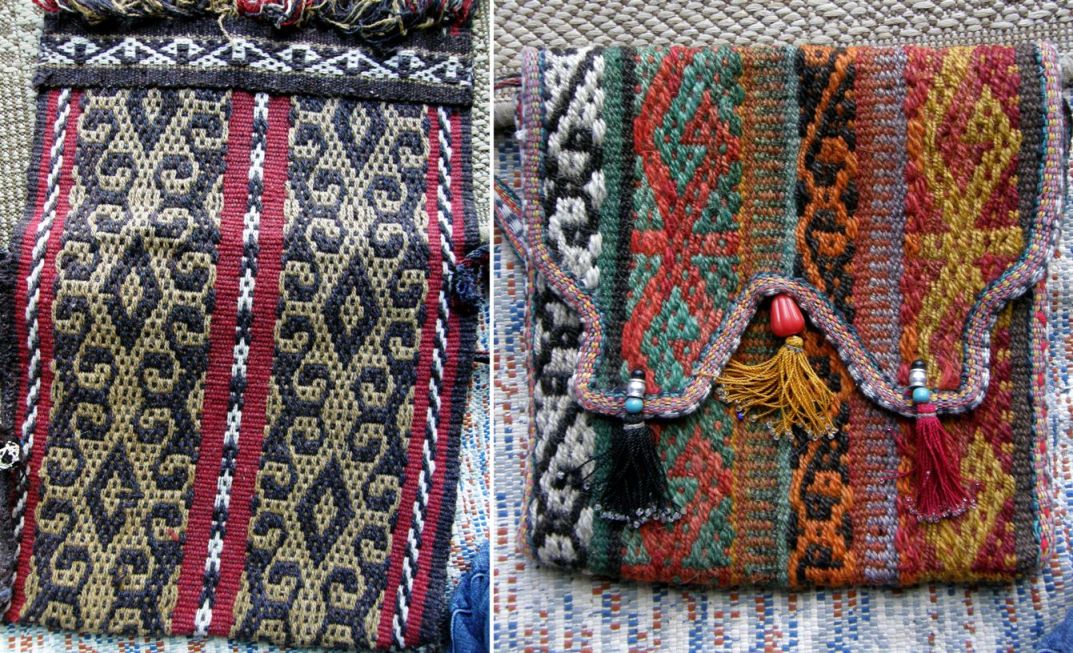
 Bags in coarser wool yarns with those two-color alternating warp floats that I love…not pebble weave and therefore not double faced but just as fun to weave on the backstrap loom.
It was fun seeing these designs “in person” after having reproduced very similar ones from images of yurt bands I had seen online. The design on the piece I made at left is very similar to that on one of the bags in Pam’s collection.
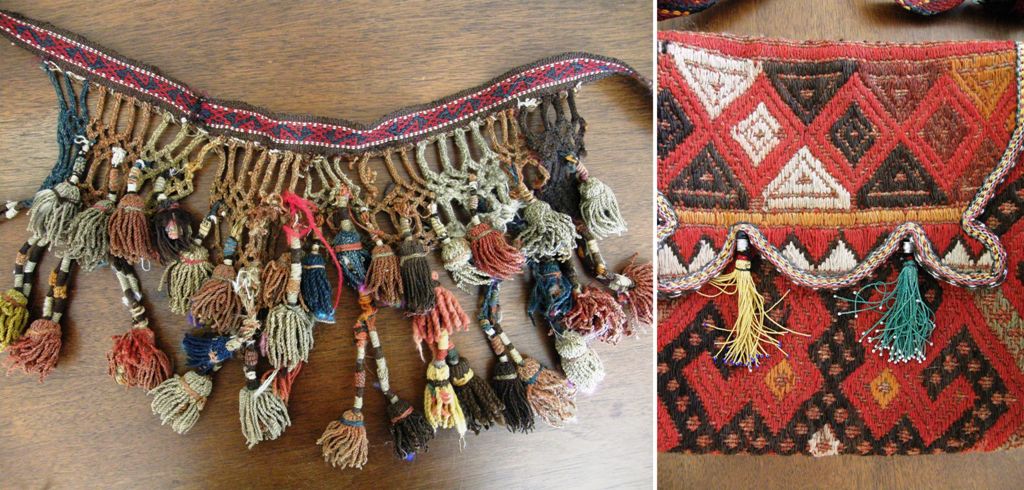 Tassels, warp floats and supplementary weft patterns. It seems that the weaving was turned on its side to make the bag on the right.
 And then there is this Uzbek rug loom which Pam acquired after an exhibit in the US and those marvelous tools for knotted pile rug weaving. My friend Janet in Northern California just took Sara Lamb’s class on cut pile work at CNCH and I can’t wait to see what she makes. She is using her own handspun wool.
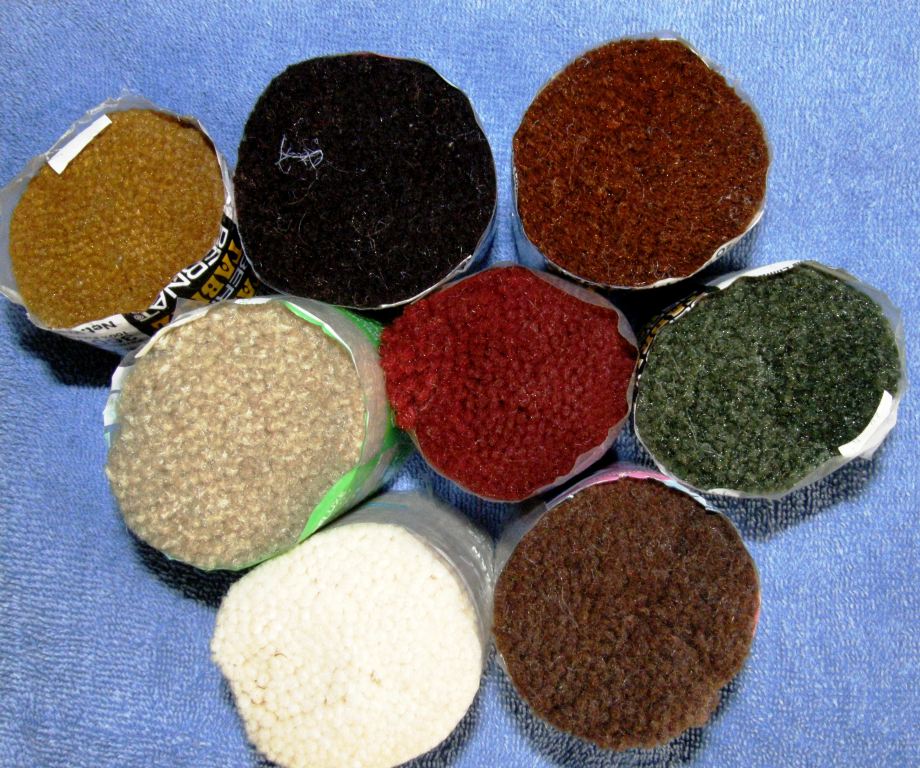 I, on the other hand managed to get hold of ninety packets of that acrylic cut yarn that is used for rug hooking and will somehow lug all that back to Bolivia. It was all free at this cool recycle place, Wachusett Recycled Resource Center, that Pam’s friend Joan took me to. The colors are great!…terracottas and olive greens, burnt oranges…all those colors I love. At least I will have something to practice with until I figure out what is the best yarn to use and then see what I can get in Bolivia. It is not a very woolly environment where I live in the hot jungly part of Bolivia. And yes, call me crazy, but I will be doing it on my backstrap loom.
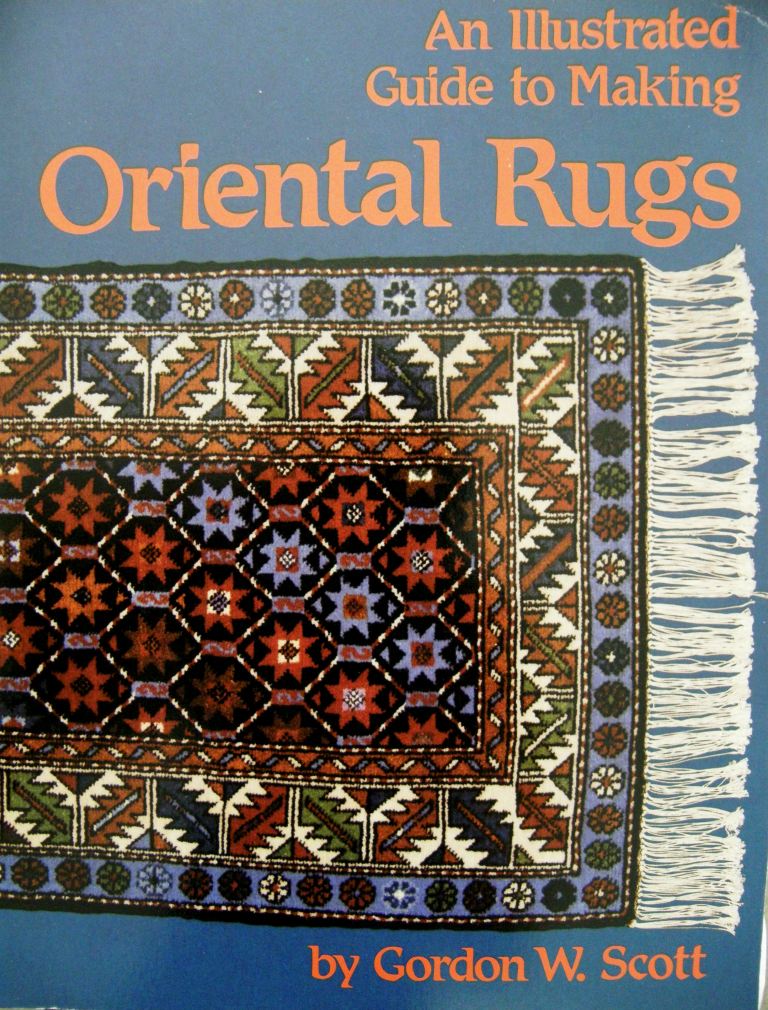 This book which Pam gave me will be one of my guides along with Noreen Roberts and Sara Lamb’s books which I have at home.
Materials are donated to the recycle center by local manufacturers and individuals and the center is open to all to take what they need or can find useful. It has all kinds of paper, fabrics, yarns, containers and various other craft supplies. It was fun going through it all. And if you go nuts and pick up stuff that you don’t really need, you can always donate it back the following week.
So, we had our SOW gathering in Pam’s studio…
 We wove indoors tied up to Pam’s floor looms while Pam herself chose to weave outside on the balcony overlooking the apple blossoms with birds flitting in and out of the bird feeder.
 No fear of Tony the cat upsetting the birds. He chose, as most cats seem to do, to lie on top of my weavings and snooze.
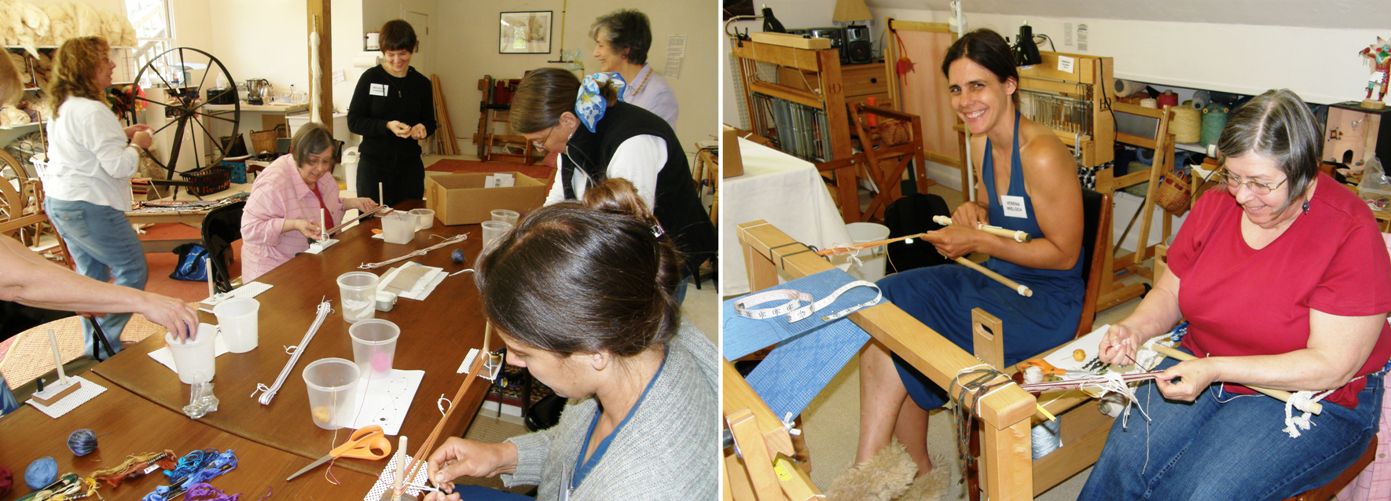 Warping and weaving. It was warm enough at least the first couple of days to break out the summer gear.
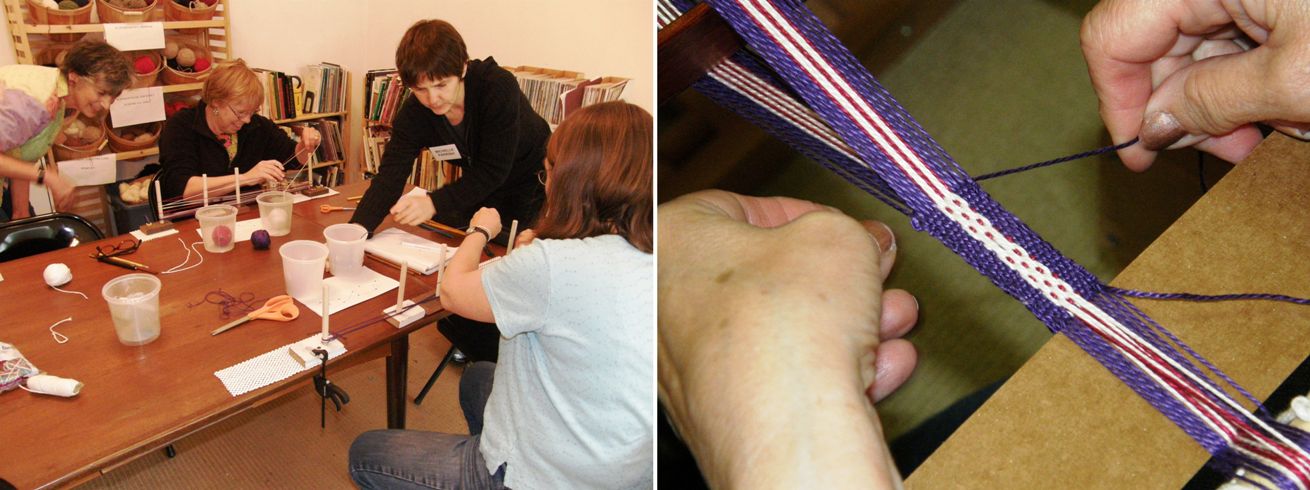 We learned four-stake warping for pebble weave with both handspun wool and weaving yarn.
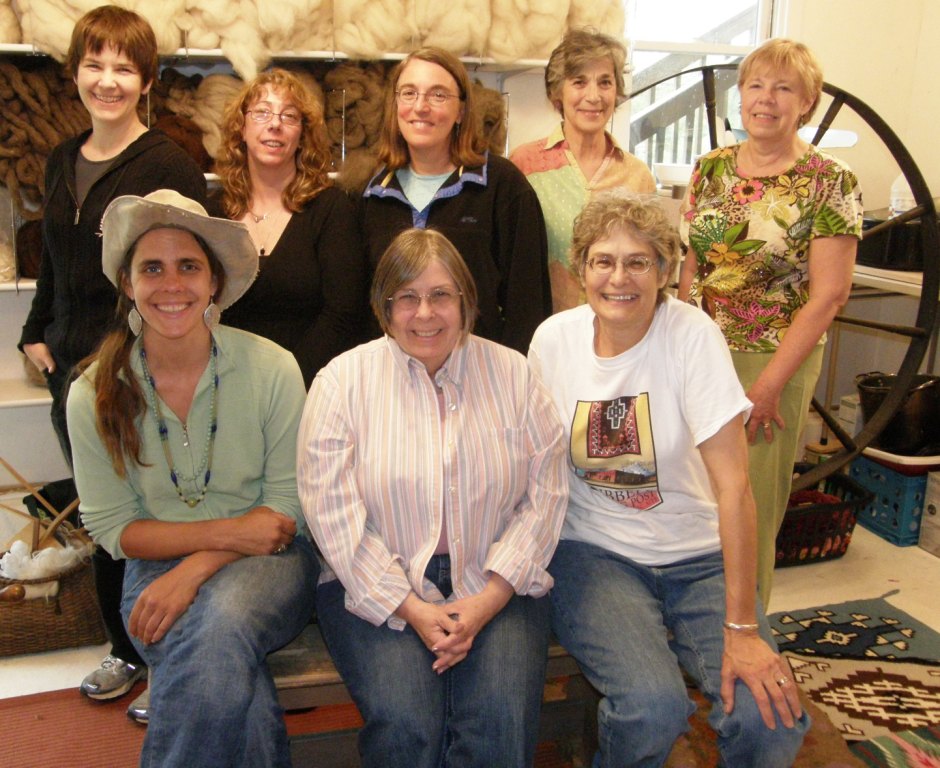 And here is the entire gang of SOWs at the end of the three days.
Pam has woven on a backstrap loom before and has taken classes with Ed Franquemont. She has her own Guatemalan loom and it is nice to see her back in the backstrap and keen to get into this again. Back up at her house she tied up to one of her smaller floor looms which wasn’t working too well and has just found the perfect place hooking to the bottom of her sofa.
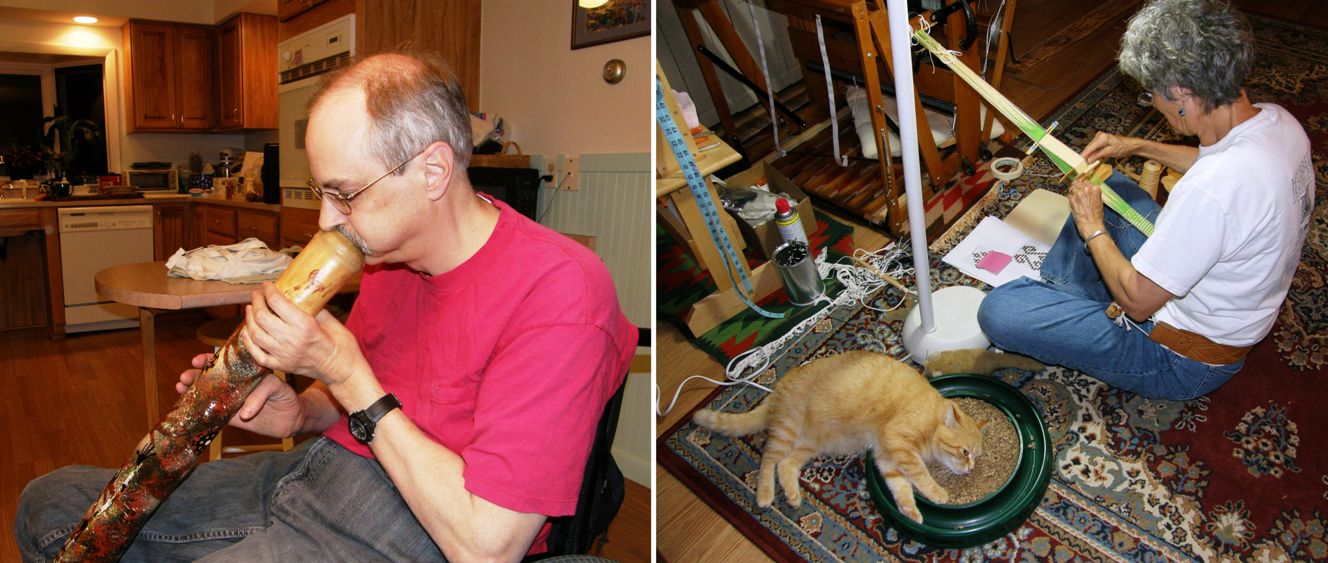 Jim kept us entertained with his didgeridoo skills. Shame on me the Aussie who can’t play a didgeridoo… I am not even sure if I can spell it right.
From there I was whisked off to group member Joan’s home in Worcester, the city of seven hills…now this I can spell right after thinking for some time and even writing to tell some friends that I was going to “Wooster”. (oops!)
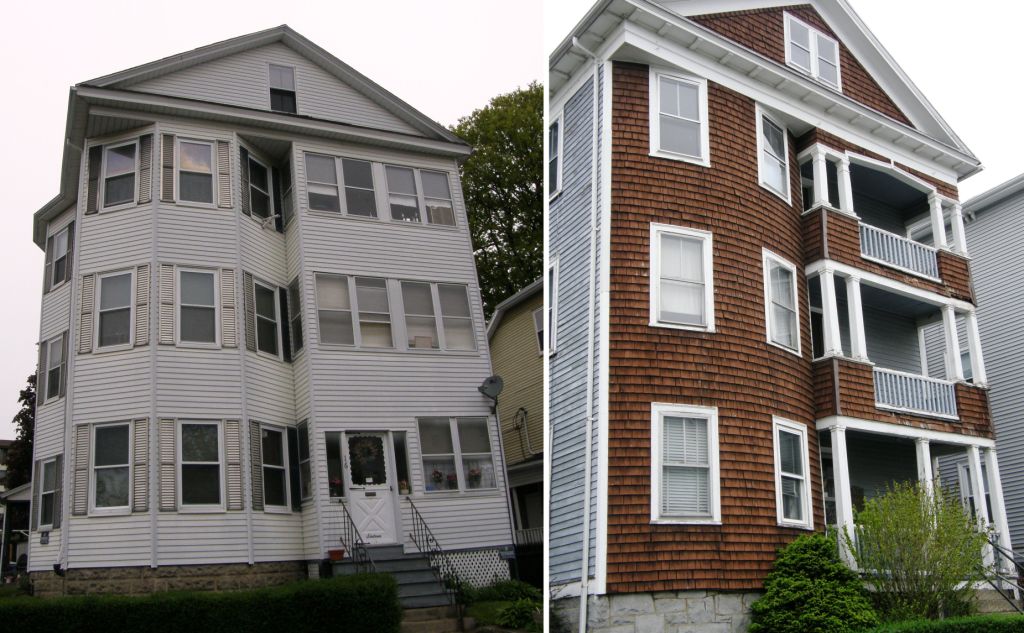
Worcester is home to the “three-deckers”, the three-storey buildings that you see above. They were built to house three generations of families each with their own floor as a solution to a need for increased housing created by industrialization. They date from post-Civil War (pre-1895) to the 1930s. Seven major styles have emerged over the years, some being finished with cut shingles, others include rounded turrets, columns and balconies and there are currently around 4200 three-deckers still standing in the city.
Joan invited me to her home so that I could go visit with a Burmese backstrap weaver with whom her friend Naomi has been working.
But before I get into that I must show you the gorgeous house in which Joan and her husband Attila live. It once belonged to a college fraternity and is full of tales of secret alarm buttons, beer chutes and escape passages and one can only imagine the goings-on within its walls in its heyday.
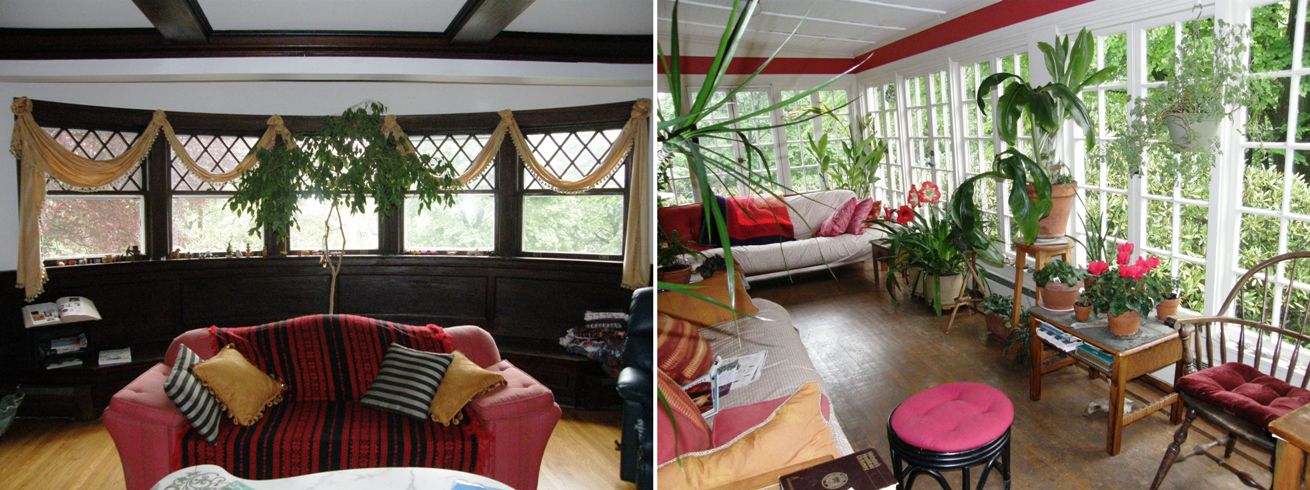 I fell in love with the Florida room at right. I can just imagine backstrap weaving in there on a sunny spring day.
 Even in this urban environment, their garden was filled with birds, plants, shrubs and flowers. Joan is a walking plant encyclopedia and she and her husband also grow fruit and vegetables which they pack in baskets and give to seven needy families in the area.
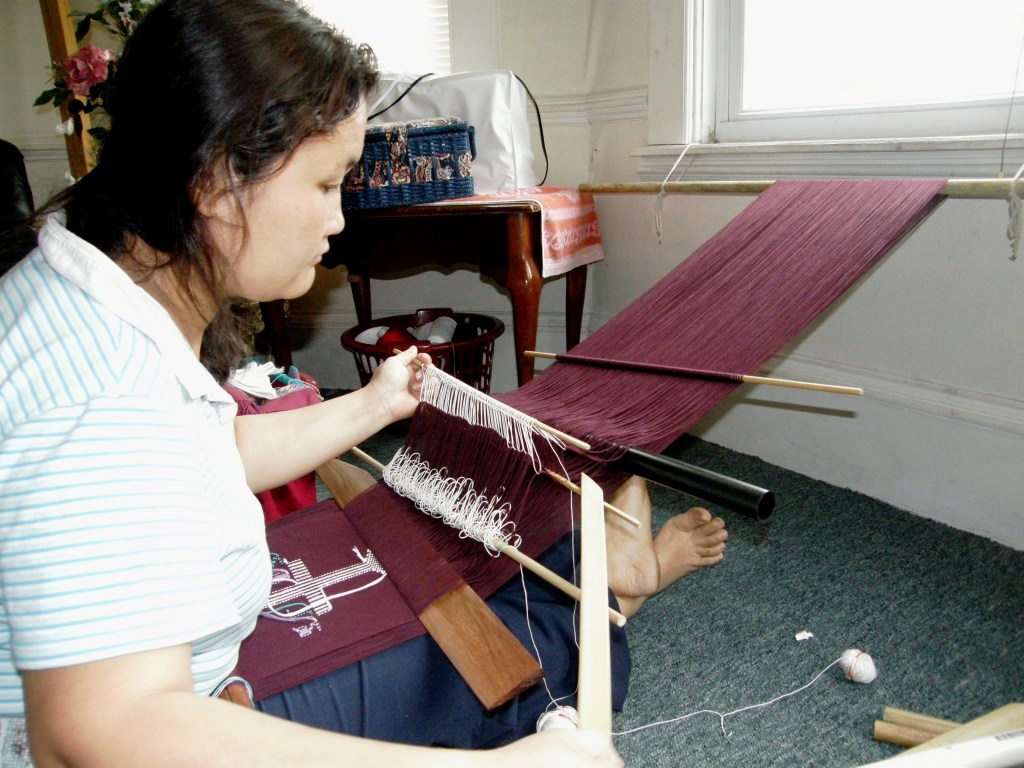 So off we went to visit with Burmese backstrap weaver Dar Ku.
There was some confusion about whom exactly Dar Ku was going to allow to sit and watch her weave and I was expecting someone perhaps a little shy, stern and serious with whom it may be difficult to communicate.
At first we were told that only I would be allowed to sit and watch her weave and that Naomi and Joan would have to wait in the living room.
However, we arrived to find a smiling, cheerful and entirely welcoming woman who was eager to show all of us her weaving and traditional clothes.
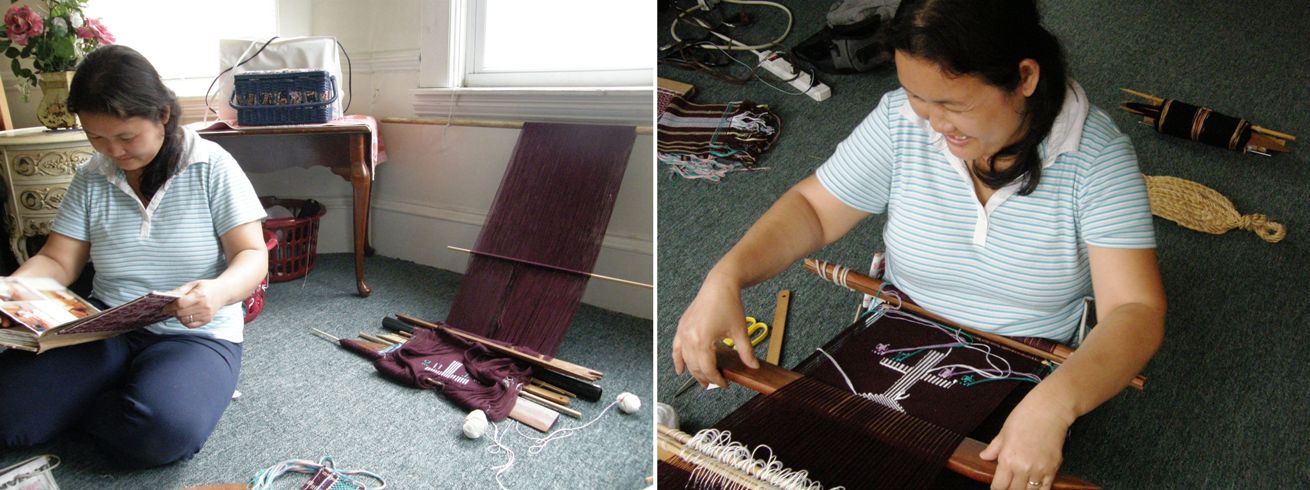 Dar Ku enjoyed looking at the book I made to describe my experience learning to weave in coastal Ecuador. The plants and flowers reminded her of her home in Burma and she was excited to see the cotton plants and told me about how here mother used to spin cotton. She was weaving a piece patterned with supplementary wefts which is destined to be a church altar piece. The piece is woven back side up and all the turns of the supplementary wefts are made on the back of the fabric. After several rows of patterning, Dar Ku would turn the loom over and spread the warps to reveal the motif on its right side in all its glory.
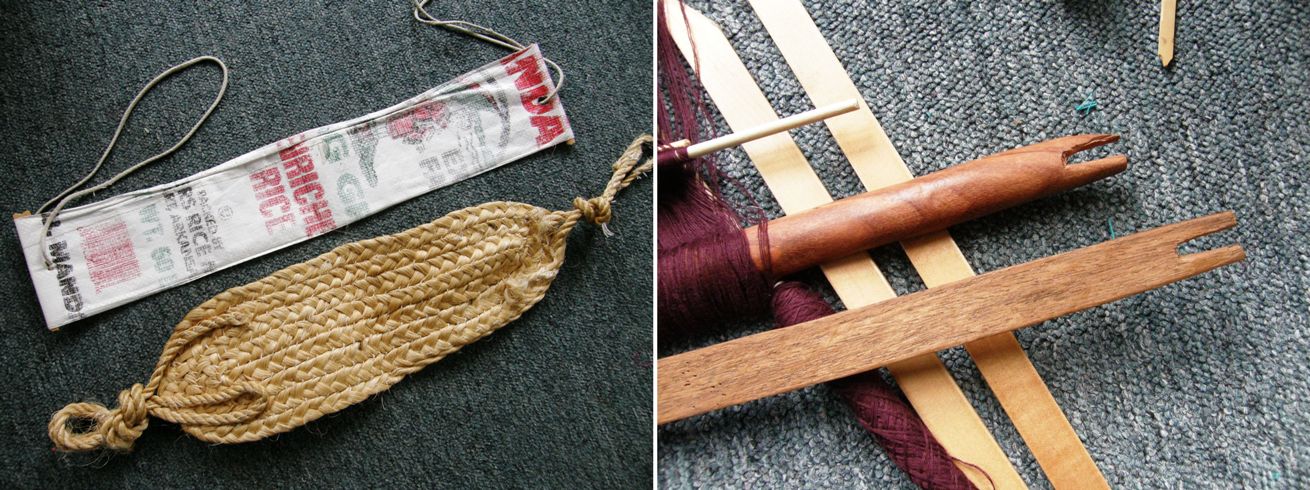 I took one of my backstraps and a pebble weave piece in progress and she was intrigued by the pebble weave pattern which appeared on both faces of the weaving. Her backstrap was made from a simple rice sack with sticks in the sides to which the straps were attached.
Dar Ku’s warp was circular, like an inkle loom warp and she clamped the fabric to stop it from slipping as she beat between the two loom bars shown above. I was in luck and was able to purchase a spare set of bars from Naomi. These bars come from Thailand where many of the Burmese immigrants in the US spent time in refugee camps. Naomi works with an organization called WRAP Weavers (Worcester Refugee Assistance Program).
These Burmese weavers, like the Montagnard weavers that I met in North Carolina, like to use a foot brace against which to push while they weave. Dar Ku did not have one and is learning to adapt and weave without it but I did notice that her beat was rather soft as a result.
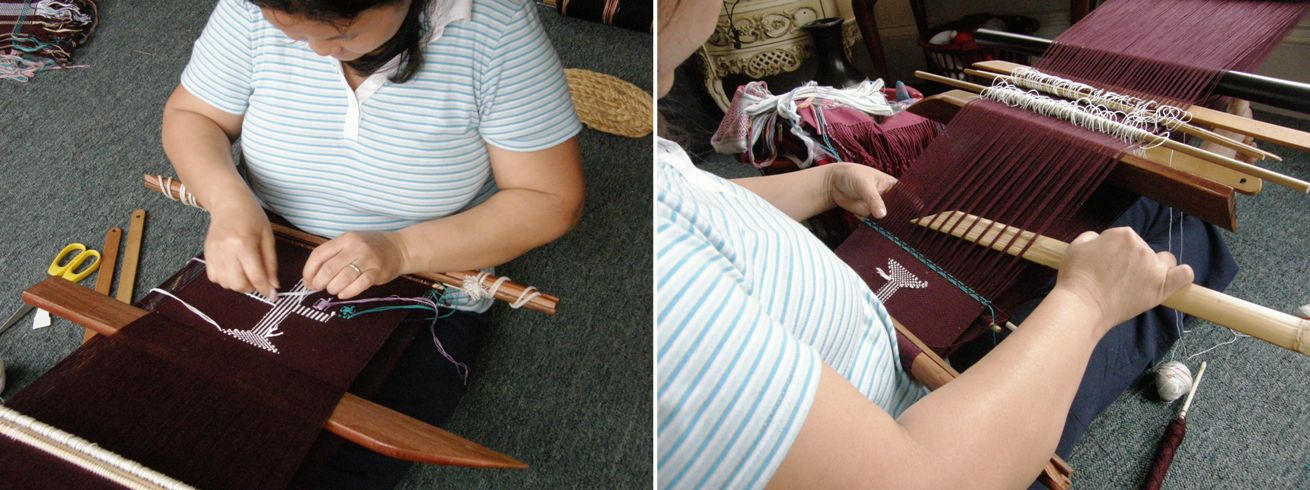 Dar Ku above is working on a supplementary weft pattern. The warps under which the wefts pass are programmed into two sets of string heddles. Other designs are woven by picking up certain warp threads as you can see on the right.
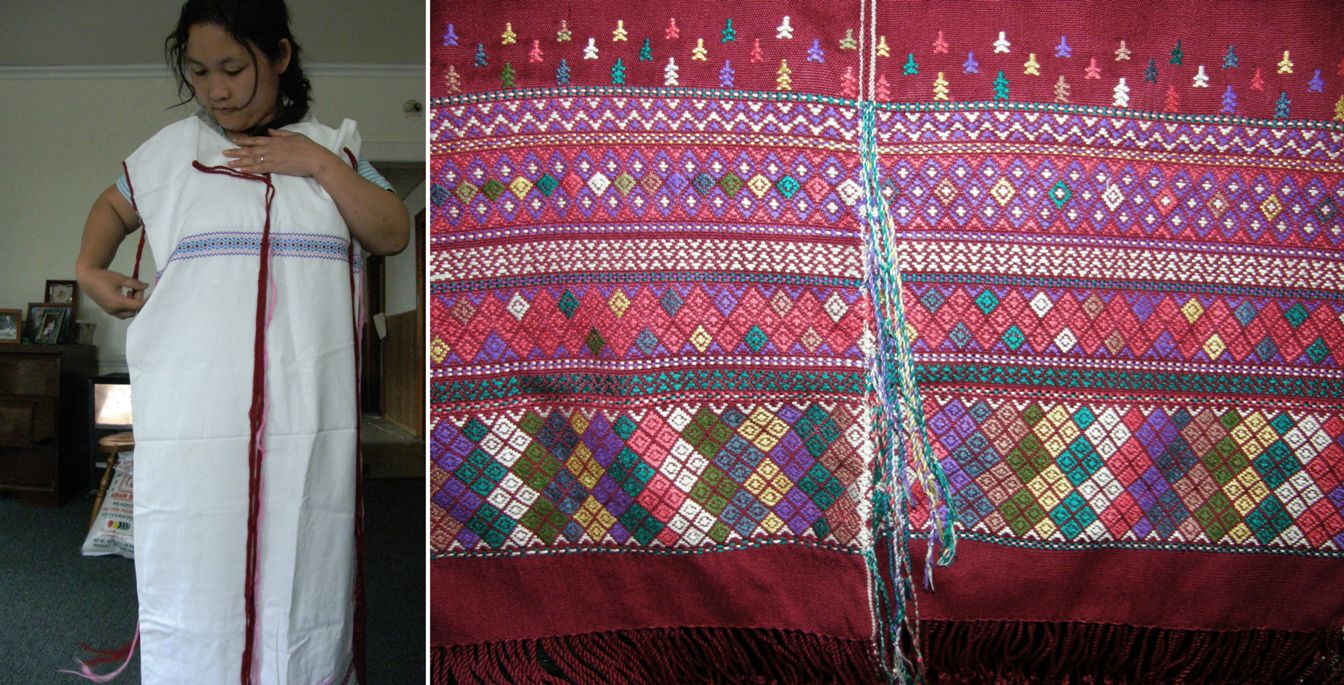 Pam from Firewatch Weavers had donated several cones of white thread to the weavers and here Dar Ku is showing the dress that she wove for her daughter with this yarn. At right is a piece that she made using Thai silk thread.
 Above you can see how Dar Ku spread the warps to reveal the right side of her supplementary weft patterned piece. On the right is one of her warp float patterned fabrics.
Naomi later showed us tubs and tubs of fabric made by Dar Ku and other weavers in the Burmese community which are to be sold at various fairs and events over the summer. It was surprising to see how much they use the simple warp float technique and the interesting color combinations they chose.
 My hostess, Joan, was very generous and had all sorts of gallery visits and sightseeing planned for me but in the end I decided that I really just wanted hang out with her and chose simpler activities to fill our days. Besides, the weather was cold and drizzly and more suited to indoor pursuits.
 Joan got me set up on her Saori loom.
She figured that she had explored my kind of weaving and that I should now explore hers.
She felt that Saori would release me from the constrictions of warp faced structured weaving.
Well, I don’t know if I really get or accept the whole philosophical business behind Saori weaving but I have to say that I did enjoy weaving on the Saori two-shaft floor loom and had fun playing with the bewildering array of yarn that Joan has collected from the recycle center.
She has bags and bags of all kinds of “novelty” yarns and I just grabbed a bit of this and that and pedaled and threw, pedaled and threw the shuttle without any plan at all.
It was the first time I had ever woven anything significant on a floor loom and I thoroughly enjoyed the novelty of it.
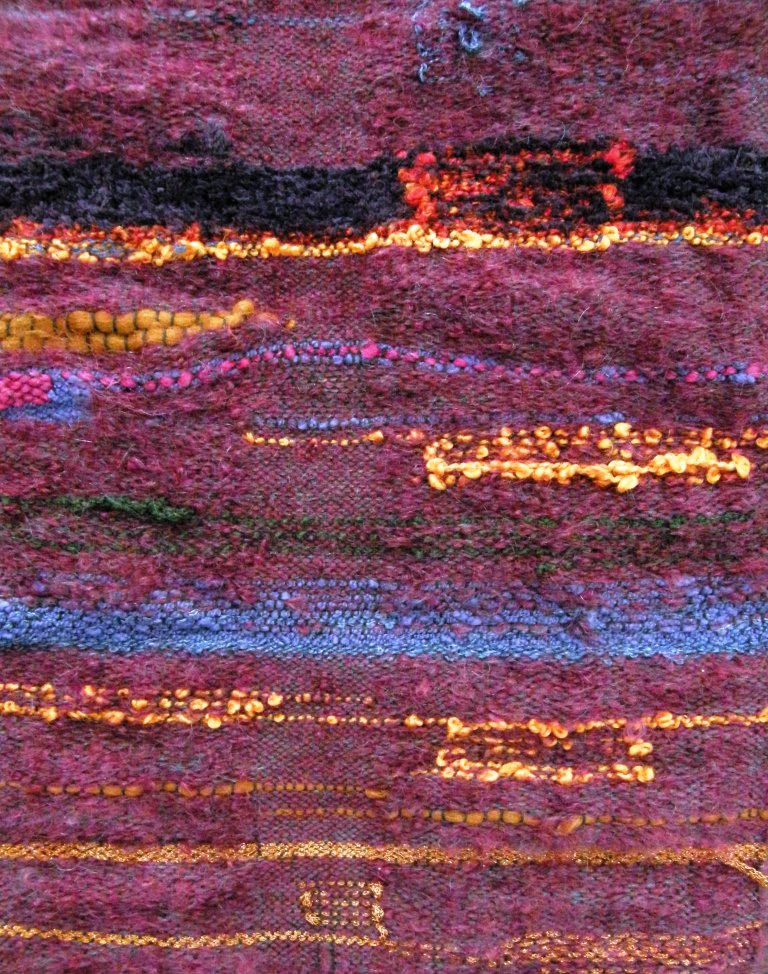 Joan planned a visit to Mihoko Wakabayashi’s Saori weaving studio and I cringed at the thought that she may expect me to take my “creation” (see image at left) along to show. The thing about the Saori loom is that you can take the whole project off the loom and transport it in a neat and manageable package to another place and another loom. Flick a few levers, latch some hooks and turn a few knobs and your project is set to go. Thank fully she didn’t have me take my piece!
At the studio I met owner and Saori Master Mihoko Wakabayashi. She was eager to see my backstrap weaving and it was fun meeting her students and seeing all that they have been doing with the Saori style fabric that they have been creating. While I always say “backstrap weaving isn’t for everyone”, the Saori mantra is the exact opposite.
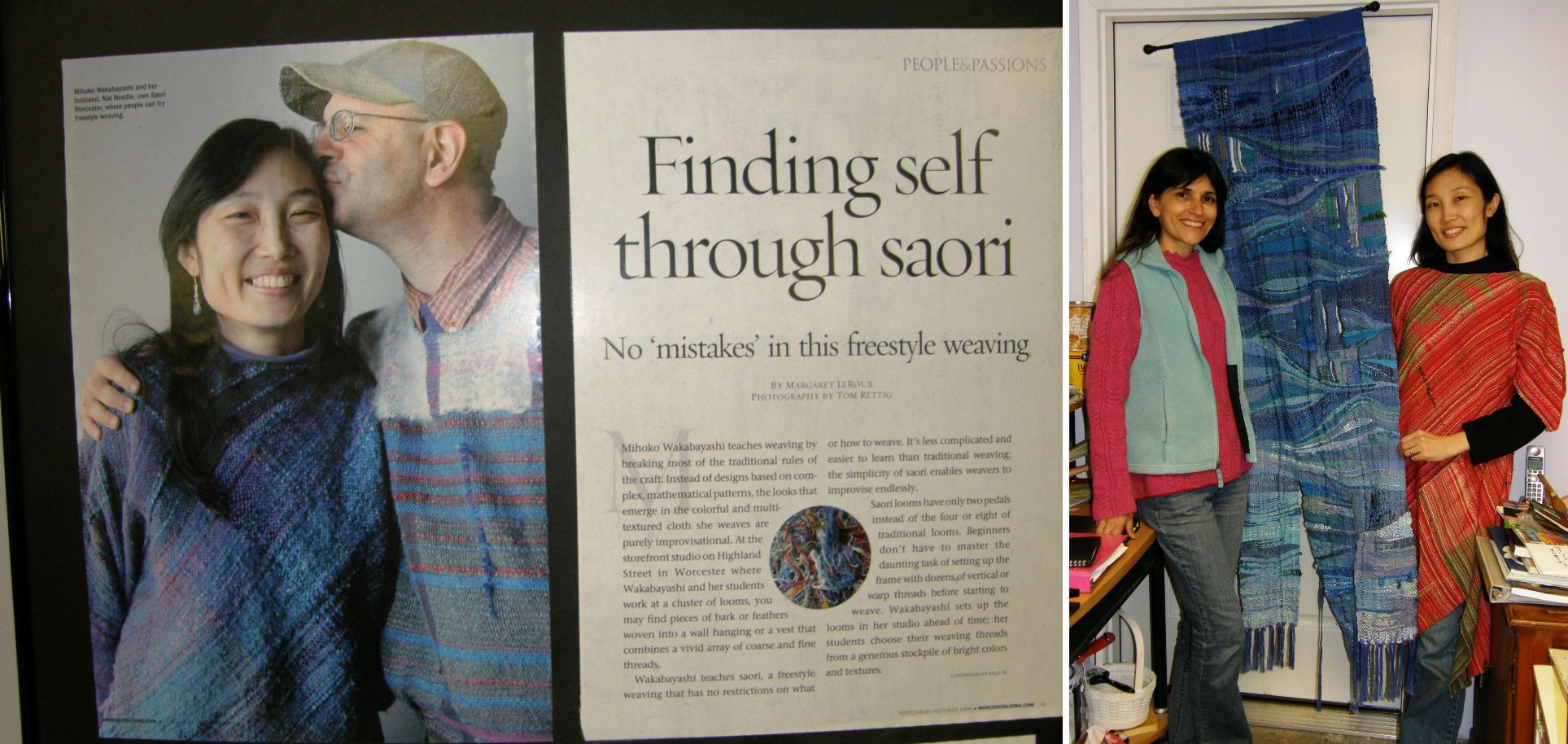 There we are posing with Mihoko’s wall hanging which she is just about to submit to a juried exhibit. The piece she is wearing was woven by an autistic weaver in Japan.
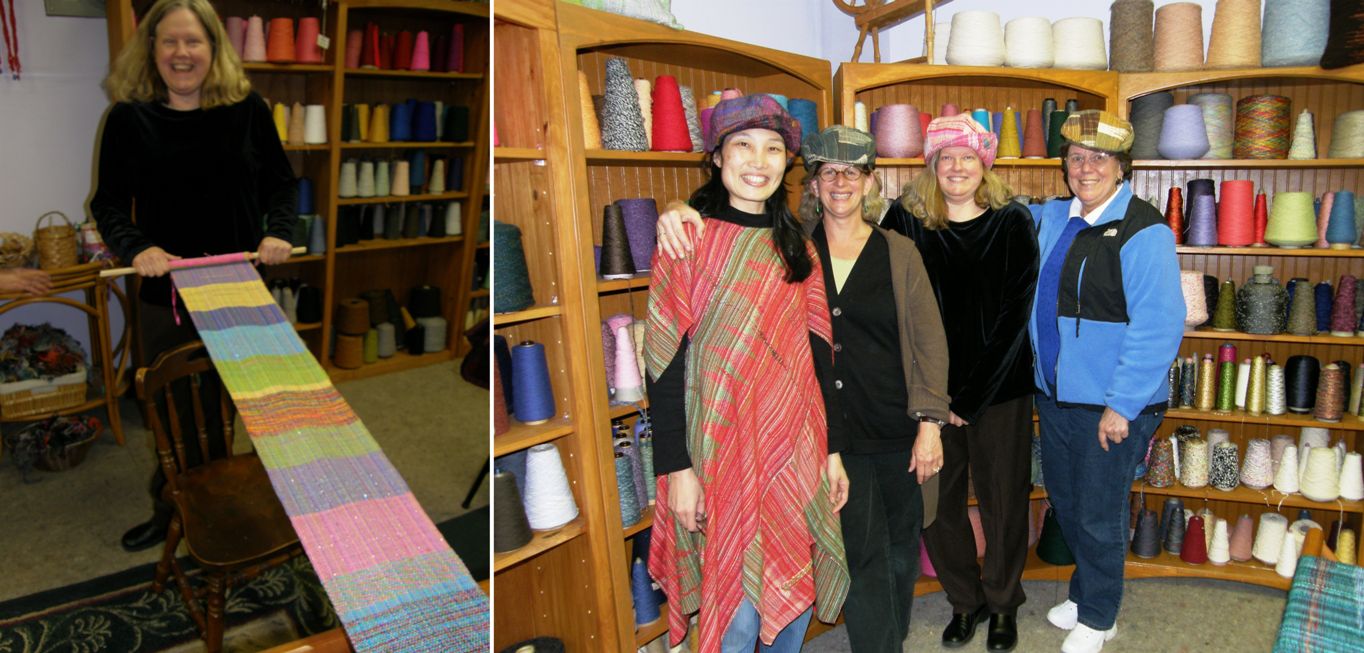 Her students were happy to pose with caps made from Saori style fabrics and show me their work.
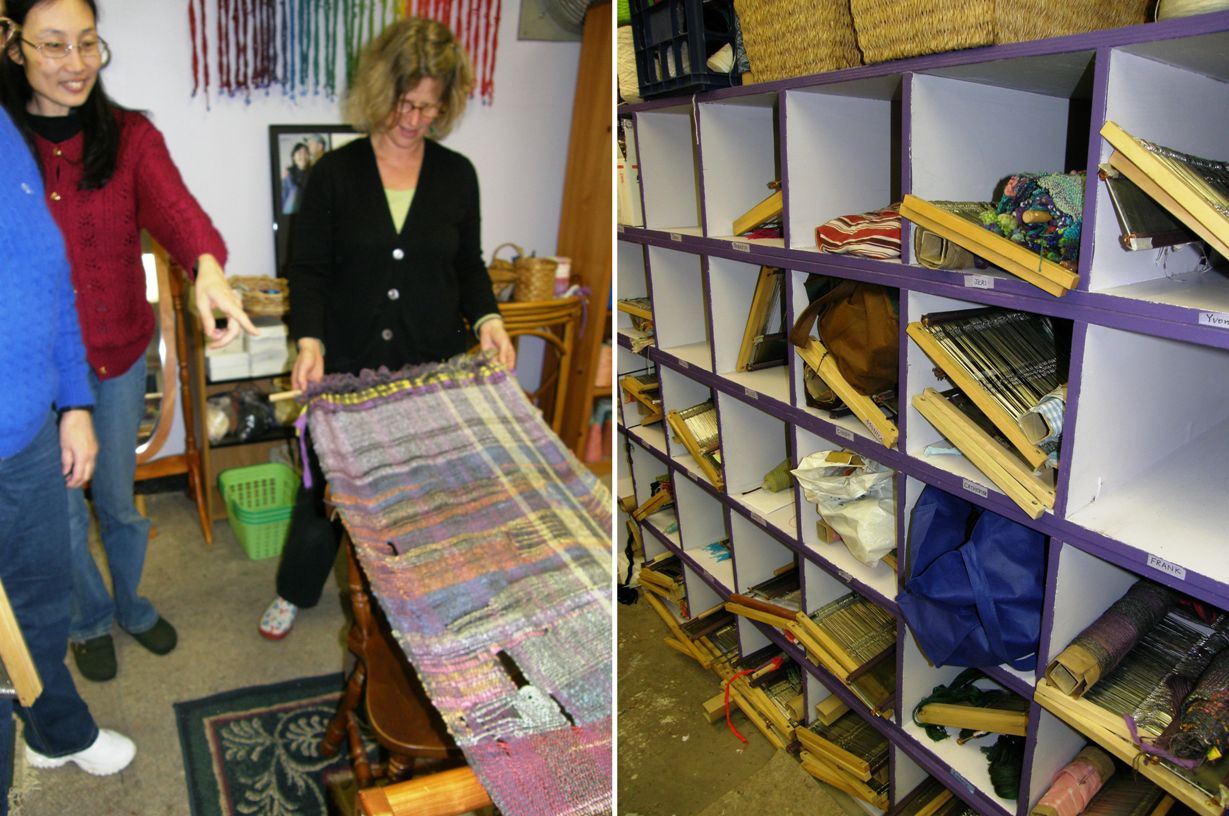 At right you can see the pigeon holes where students keep their projects so that the looms can be freed for others. The projects can be quickly and easily popped off a loom and stored.
Mihoko’s studio was a quiet restful place that evening which is something I kind of needed as Joan had taken me with her for her weekly stint at the Boys and Girls Club that afternoon. Well, I had had no idea about what this entailed. I knew that we were going to teach weaving and crafts to a group of kids but I was not quite prepared for the noise and the onslaught of enthusiasm. I had quite innocently offered to teach finger loop braiding while Joan got the kids going on their weaving projects. This would keep them entertained until they could get their turn at the loom.
Well it was a huge success! Unfortunately I can’t show pictures without releases from parents but there were boys and girls of all ages making braids and loving the craft and the attention. I think the high school volunteers most enjoyed the braids and were planning earrings and all sorts of things with their new fiber skill.
Now I am in Maryland with friends. My trip has reached its end and I can’t think of a nicer home and better bunch of people with whom to take a wee breather before heading back to Bolivia.
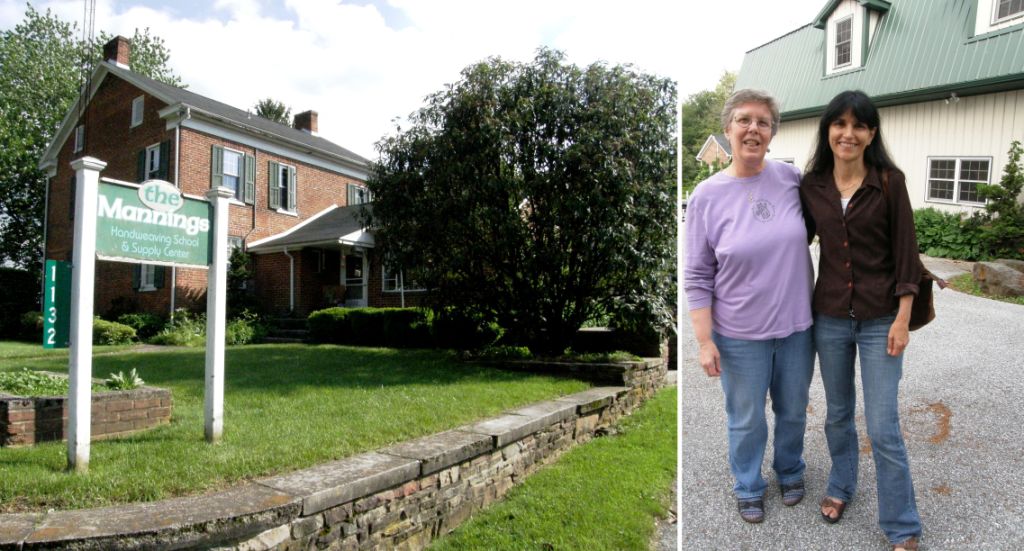
BUT…between Massachusetts and Maryland there was the Mannings, pictured above,….that wonderful weaving store and school in Pennsylvania, another backstrap group to weave with and warm folks like Carol and Ron Woolcock, Helen and all the Mannings staff to spend a peaceful three days with. But not peaceful enough to be able to get my blog post out on time! More about that part of the trip next week but in the meantime I will show you the blanket under which I slept in my cozy Mannings bedroom….
 It is actually a wool/mohair shawl but I just had to drape it across the foot of my bed when Carol showed it to me. It was made by David Xenakis who is a good friend of Carol and Ron’s and was featured in an issue of the Prairie Wool Companion. Named the “Quatrefoil” shawl, Mr Xenakis wove this 34″ wide even-tied overshot project on a rigid heddle loom using two 12-dent heddles, two shuttles and two pick-up sticks.
Now there is something inspiring with which to leave you…..!