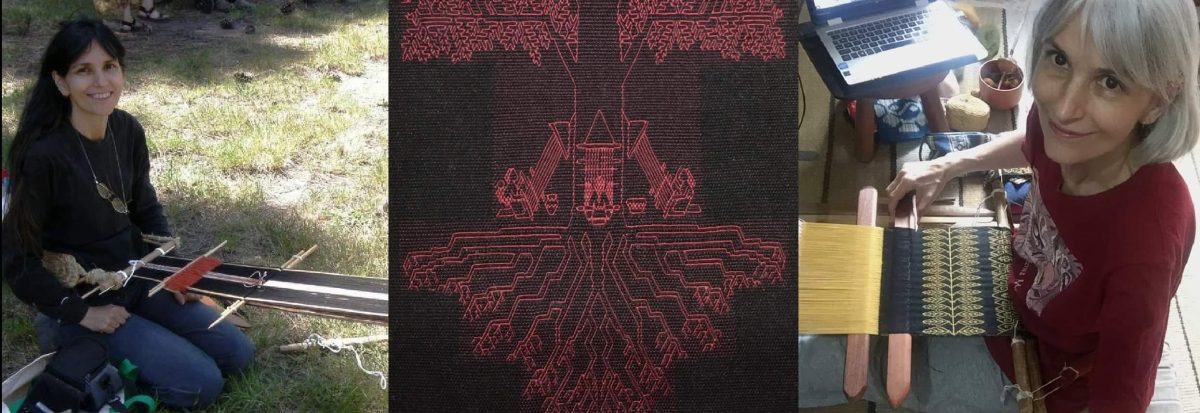
I was thinking the other day about my eventual move to Australia and what my “weaving studio” might look like in my home over there. I will be starting up there with a totally clean slate…no furniture or other household items, not even a cup and a spoon! Ideally, I would leave the space pretty much empty…open, bright and uncluttered…the kind of weaving space that I would not be embarrassed to have people come and visit. However, I’m pretty sure that it will eventually end up in the same kind of state of cluttered creative chaos in which I function quite happily here!


Here are some very different studio spaces that I find inspiring and delightful…


Who knows what my space will end up being. It’s nice to sit here and dream about it.
So, what’s on the loom? I’ve picked through my stash and brought out some indigo-dyed cotton thread that I bought from Mayan Hands at a conference maybe eight years or so ago. I’ve used it in other projects and I found that there was enough left for a little something else. I decided I’d follow one of Handymum’s little purse sewing tutorials.

Even though the cakes of thread have sat on a shelf away from windows for years, the color has faded. My warp shows the unevenness in the blue color and I love it.

This warp is only 9 1/2 inches wide but has 926 ends. So, I followed all the steps that I outlined in my last post for wide warps….warping in small sections and placing each one on beams that were waiting on the floor. I followed my own advice and wound the whole warp in one session. It was interesting to note the difference in tension between the section of light blue 20/2 thread and the other indigo sections. The section of 20/2 was looser. Just the fact that the 20/2 is slightly heavier than the indigo thread seemed to have made that difference. Fortunately, I have some ridiculously fine 0.7mm double point knitting needles and I coiled all the 20/2 threads around one and parked it at the far end of the warp. It did the trick perfectly to even out the tension across the warp. Who on earth uses these 0.7mm dpns to knit? I bought them years ago to use to create third selvedges on super fine warps. I also installed a coil rod across the entire warp so that my cotton cloth wouldn’t take on that corrugated look.
I took the time to make sure that each of the 926 ends was sitting where it should be before I started weaving so that I could create a neat third selvedge.

The layout of the pattern is a little strange but I’ve planned it that way to suit Handymum’s purse design.

I’m going to need to cut into this cloth to make the purse. It’s going to be tough cutting into that lovely blue stuff. I’m using five strands of 120/2 silk for the supplementary weft. These are motifs that I designed a little while back. I have put on more warp than I need and so I’ll just keep weaving and use another pattern on the last bit. I’m sure that I’ll be able to use it for something. I wrote a very basic tutorial on this style of patterning with supplementary weft many years ago. You can find it here.

I’ll finish by showing you a beautiful double weave band that Jan Low wove and has kindly allowed me to share….

She wove it using the instructions and patterns in my book Warp-faced Double Weave on Inkle Looms. The book includes tutorials on how to design and chart your own patterns and Jan has created some of her own for this band. If you’ve already tried some form of pick-up patterning and know that you like this slower kind of weaving, you might enjoy adding warp-faced double weave to your repertoire of techniques. This book is one of eight of mine available as PDFs or as spiral-bound books (shipped from the U.S.A) at Taproot Video.

This will be a lovely piece, I love the way the motifs standout from the cloth. And you are right, the shades of the indigo really add to the look of the piece.
Thank you so much. It’s fun seeing the patterns I designed take shape on the cloth. I hadn’t sampled the plant pattern and was a bit uneasy about how it would look.
Thank you Laverne. I so enjoy your communications and sharing of your magnificent work.
Hi Graceanne! Thanks for dropping by and saying hello. I love knowing that people like you are out there enjoying the posts.
Thank you for sharing the studio photographs! Gives me hope and inspiration.
There are four very different options to inspire you. I think it’s hard to create something that lies between lively and cosy and open and minimal. Ideally I’d have two spaces depending on maybe the season and my mood….the advantage of living alone and using an easily transportable loom.
I’m going to try a version of coil rod on my inkle loom i use for tablet weaving. I sometimes struggle to easily reach forward when advancing the dense warp. It’s not a big move or complicated, but when I need to do it, I don’t want stiff joints hindering me or distracting me.
Thank you also for candid view of studio in untidy state. You made me relax! kj
I seem to thrive in untidy! If you try the coil rod, let me know how it goes if you get a chance, please.
I so love seeing this lovely mind in action. It’s a relief that others need everything around them as they work.
Thank you, Kathleen. I seem to need to have everything in sight from fear of forgetting an idea. I’m glad that you get it and possibly feel the same way.
I live in southern Israel and would love to get in touch with Gonit Porat. Her studio looks like she is in the north of the country. Please could you connect us?
I hope that you can connect! I know her via Facebook where she is very active. I would try there.
Did you manage to find Gonit on Facebook? If not, I can pass your email address to her, if you like, and tell her that you’d like to make contact. Let me know.