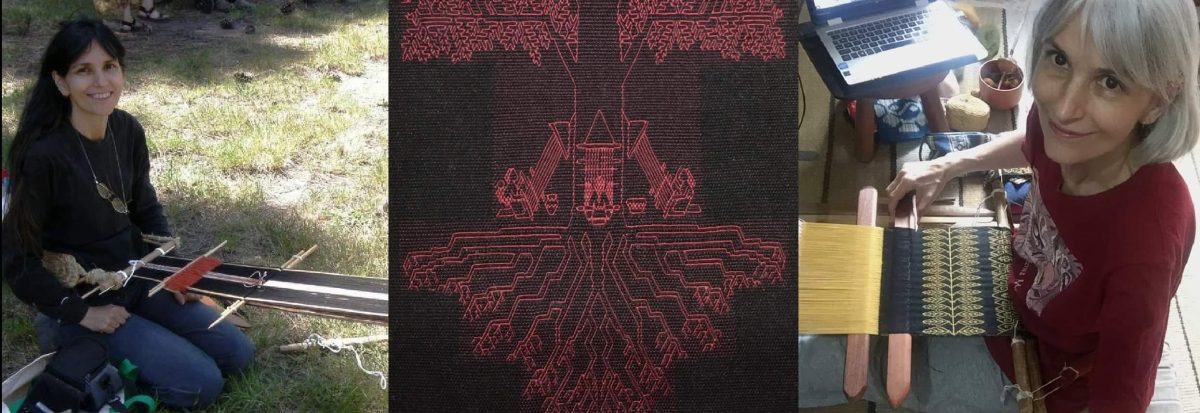
 Spring has sprung in North Carolina! I am spending some time here in Lincoln County with my online buddy Lisa and her family. Lisa’s father owns and runs the local newspaper and is a wealth of information on local history and its colorful characters and has kept me highly entertained with stories throughout my stay over breakfasts and dinners of typical southern treats. He tells me that North Carolina, while being one of the ten most populous states in the US, is also one of the most forested. This town looks like a gorgeous well manicured and landscaped park in which people have been graciously allowed to place their homes – luscious, expansive green front lawns, azaleas in full bloom, majestic oaks, show-case flower beds and vegetable and herb gardens abound. You can barely see the houses amongst the trees and shrubs – so gorgeous!..so spacious! Oh, and I heard a mocking bird yesterday! – To Kill A Mockingbird is my favorite book.
And I have been treated to helping upon helping of southern hospitality. I am so tickled everytime someone calls me ma’am! I was eager to try some typical southern food – all those names that we hear in movies and TV shows and have no clue about – so Lisa’s husband made me a batch of “biscuits” which we enjoyed with Lisa’s homemade berry jams. We have biscuits in Australia but our biscuits are what people in North America call cookies.

We went out for a good southern breakfast. The largest plate in the above picture is mine! – biscuits with gravy, corn grits and country ham. I still can’t believe I ate all that! I asked about chitlins as I have always wondered about those but the general reaction at the table made me think that I would be better off not trying them!
 For something different, Lisa and Ryan took me to their favorite Thai restaurant as I had mentioned that south-east Asian food is something that I miss in Bolivia.
On entering the restaurant, Lisa and I were drawn immediately to the textiles that decorated the walls and tables. The owner was so pleased by our interest in Thai weaving that he gave us each a woven bag from Thailand!
So, what has been planned for my visit apart from eating? – lots and lots of fibery fun! Lisa and I met online  through a discussion on her fabulous yurt band which you may remember from a previous post. Finally my little yurt band border bands get to meet their inspiration. You can see them there at right next to the huge forty-eight foot yurt band. There is nothing like seeing something like this “for real” after having admired it for so long online. The colors are so much richer and I am suprised at how loose and flexible the weave is compared to South American bands which are beaten hard into a stiff firm fabric.
So Lisa and I met on Ravelry where she was trying to figure out the structure of the yurt band weave to see if she could reproduce it. Photos were flying back and forth in cyber space and it was only after seeing the back side of the textile that I finally recognized it as simple warp floats. We then set about weaving a tiny reproduction – the “s” motif on which I made a tutorial here. We laugh about the fact that a chica in South America helped a gal in North America figure out a weave from Central Asia – and all online! And thus a friendship was formed.
By the way, my friend Caroline in Australia has been doing her own investigation into other kinds of yurt band construction which you can read about here. She wove a three-color reproduction band recently.


Lisa is a felter, spinner, knitter, painter, braider, weaver and loom gatherer. In an attempt to clear some space so we could use her four-shaft floor loom, we pulled no less than fourteen looms out of her studio! Now what am I , the backstrap weaver doing on a four-shaft loom? I will tell you more about that little adventure later on.
In the meantime, check out Lisa’s fabulous felt work above. Lisa is in the local fiber guild and SCA group and so her projects tend to involve historical reproductions with her SCA companions as well as work with the fiber guild which gives her an outlet for more contemporary pieces.

The piece above on the left has a Scythian design. The Scythian people existed on the Central Asian steppe around 500 BC and a feature of their animal motifs is the twisted hindquarters.
The piece above on the right is a Viking design.
There are a lot of felted pieces in Lisa’s home. I am seated on a felt cushion with my feet on a felted rug and, hopefully, if time permits, Lisa will teach me to make a felted pouch like the one at left. I will do a South American motif – shock! – and weave a strap on my backstrap loom.

 Did I mention that she is also a terrific spinner? Here are a few of her most treasured spindles – Turkish and Tibetan styles, phangs from Ladakh, a Kundert, which is her workhorse spindle, and sentimentally valuable ones gifted by her husband as well as a bead whorl crafted by 5 1/2 year-old Joshua.
Lisa loves to teach and share and I got to see her in her element at an Earth Day Festival last weekend, where she showed and taught her crafts.

When my weaving tecaher in Potosi taught me a six-strand finger loop flat braid, I would make the braid while she would tamp it down using the side of her hand with a slicing action. So it seemed that two people were required to work together to make the braid nicely. Not so… check out Lisa’s cool foot action in this video!


I wove pebble weave to promote my new e-monograph and it was quite a different experience to weaving at CNCH where my audience was largely weavers.
At this Earth Day event a lot of the people had never seen weaving demonstrated in any form and we attracted quite a lot of onlookers.
Lisa was spinning and explaining the felting process while I knelt on the floor and wove.
Caught up in the excitement of it all, I completely forgot that that kneeling position is not something I can maintain for longer that five minutes at home! I sat there happily for a couple of hours!

The next day I was invited to visit with British couple Maurice and Ursula. Those of you who are on Weavetech may know Maurice and the superbly crafted looms he made for himself. Maurice, on hearing that there was another “British Subject” in town, promptly invited me to tea and then lunch and a visit with his four and eight-shaft floor looms and weaving studio. Ursula’s passion is quilting.

Since putting out my e-monograph on Andean Pebble Weave, I have had a couple of enquiries about whether the technique can be worked on a four-shaft loom. Sadly, I didn’t feel qualified to answer those questions well and so I was determined to get educated about that on this part of my trip and Maurice was extremely helpful. I had never seen a four-shaft loom “in person” and I don’t think that Maurice was all that familiar with a backstrap loom. So together we muddled through and came up with a possible way to get the pebble weave going on this kind of loom if you simply didn’t have any other kind of loom to work with.


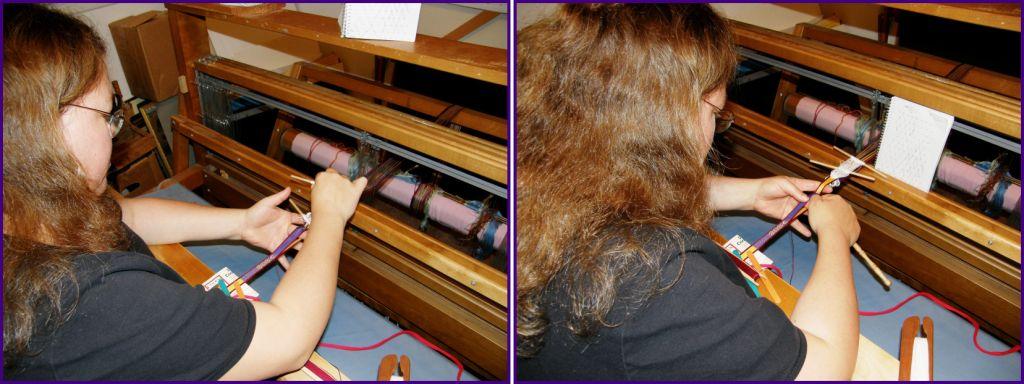
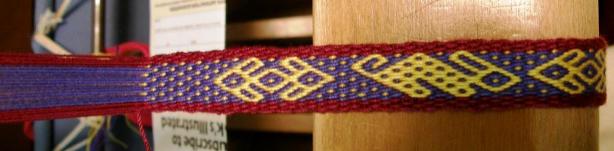

So, we had fun with this. Lisa learned to make patterned bands (she had graciously tested my instructions for plain pebble weave before I published my e-monograph) and I learned a little about the workings of a four-shaft floor loom. What a lovely wide shed those harnesses create with the minimum of effort.
EDIT…..As I get more familiar with this loom and its workings, I have had the famous aha! moment and figured a way to do away with the string heddles and get everything into the four shafts. However it won’t make the actual weaving any faster. It is still, after all, a pick up weave and individual warp threads need to be handled. When I get back here from MSWF and a short stay in DC, I shall get another band on this loom.
Lisa is not the only weaver in this household. Above you can see five-year old Joshua making a scarf on an Easy Weaver rigid heddle loom. The scarf has been finished and hopefully he will find it so I can show it to you here before I publish this post.
I had another encounter with this Easy Weaver loom this week as Brian Jones in England sent me a picture of an Andean pebble weave band he has been weaving following my e-monograph. I can’t tell you all how ecstatic I am about seeing the monograph being put to use!! 🙂

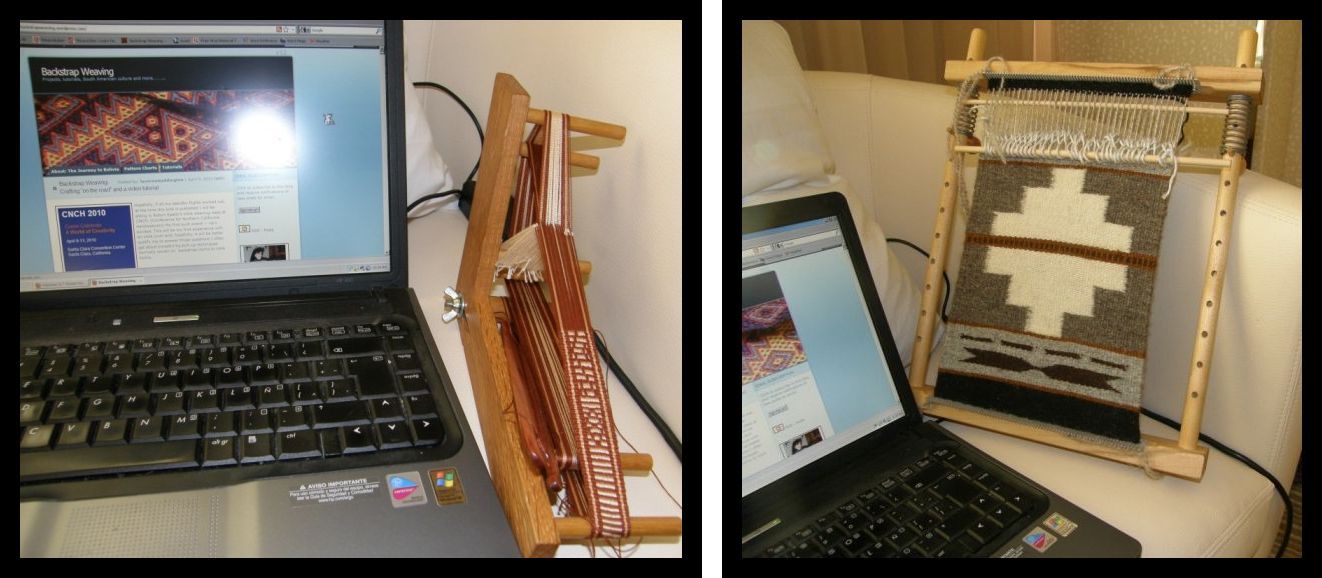
I told you before that Lisa pulled out her collection of looms so that we could get at the four-shaft one and this gave me a chance to play with and think about looms, other than backstrap ones, on which pick up bands can be woven.

 If some kind of tensioning system could be rigged on these so that tension could be eased off as weaving progressed, they would be wonderful. As is, the amount of take up in the warp makes it increasingly difficult to open the shed and pick the warps as weaving progresses.
I set up a warp for Andean Pebble Weave on Lisa’s frame loom to see what it would feel like and wove some pre-Columbian birds. The pattern charts for these are in my e-monograph.
As I warped up quite firmly, I think I will only be able to weave half this warp before everything gets too tight. I think it is a nice loom for sampling and short bands.

 Here are some pick up bands on inkle looms. The one on the left above was made by Karren from the Weavolution Backstrap Weaving Group some time ago. She made this into a cell phone pouch. This motif is charted in my e-monograph.
On the right is Lisa’s “s” yurt band design on her inkle loom. I warped up a narrow pebble weave band on an inkle loom when I was in California and enjoyed doing all manual pick up. I have just started winding a warp for a wider one on one of Lisa’s looms and will use additional string heddles this time. I’ll keep you updated on that.
Above, you can see a picture that Ellen sent me from Denmark where she is weaving one-weft double weave on her inkle loom following my tutorial on Weavolution.


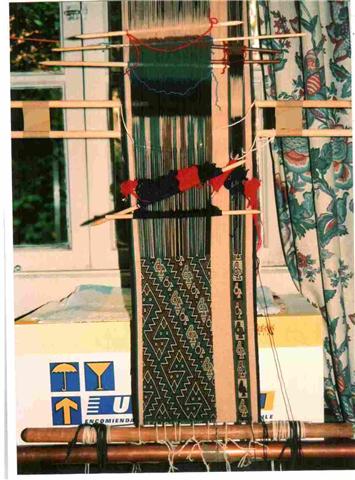 Then there are tapestry looms, or this Navajo loom onto which I lashed a four-color pebble weave warp. My Navajo loom has a tensioning device so I could ease off on the tension as I progressed and, therefore, compensate for the take up.
Lisa’s Mirrix loom on which she has her cut pile weaving would work well for this.
So, all the beautiful pick up weaves that I show on my blog and for which I have provided tutorials, can be set up on a variety of looms. They by no means have to be restricted to the backstrap loom.
 This has been a wonderful learning experience here! Tomorrow we are going to get into some felting. I would like to learn this and make something for myself but probably won’t get to continue with it back in Bolivia as I can’t get sheep wool where I live in Santa Cruz. And then there is the cut pile weaving. I got Noreen Roberts’s wonderful book on the subject but there is nothing like having someone show you in person. Lisa is still in the experimental stage with this but I am sure that she will be able to give me some good tips.
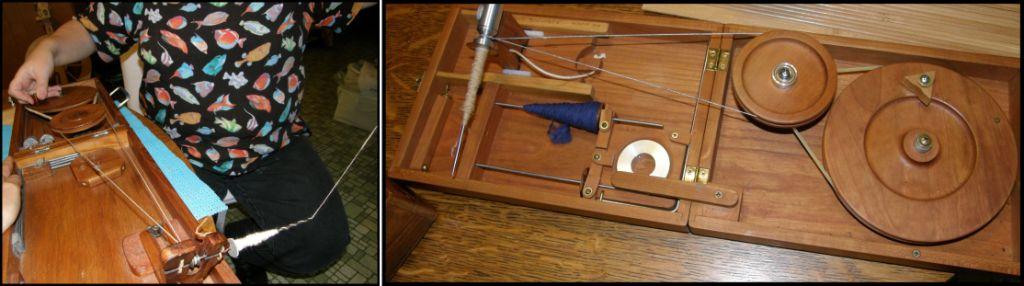
And look above at what she gave me! – a charka from India. I am thrilled to bits to have something like this from my place of birth. Lisa’s fiber guild friend Katherine came over today and showed me how to use it.
 Katherine sews and also makes card woven bands. She made the pin cushions from felt and then embroidered them and the band, I think, is intended for her husband’s guitar.
I would so love to be in a fiber guild and surrounded by all these talented people. Well, I shall do my best to soak up everything I can from Lisa during my stay here although I have to admit that being in Weavolution gives me access to weavers from all over the world – so I can’t complain – and I only need to go up into the Bolivian highlands to be with wonderfully talented backstrap weavers.
###############################################
I have a band to show you from Ann Littlewood, woven from her own design in supplementary weft technique (see my tutorial here). She is going to use this as a bookmark.

 And I also had a fun message over at Weavolution from Marta Madeja in Spain who tells me that she is hiking in the Alpujarras south of Granada and picked up some sticks along the way to make a backstrap loom. She has never tried backstrap weaving before and decided to dive head first into pebble weave and bought my e-monograph. The only “yarn” she had about was embroidery thread and she managed to make a tiny pebble weave band based on lesson 1 in the monograph.
The pin will show you just how tiny this band is. She tells me that she will try lesson 2 with thicker yarn when she gets home. I wonder what she tied up to on the trail. I am waiting to hear more details from her. I think this is really cool!
##########################################
 Finishing here with a million thanks to Lisa, Ryan and Jack-in-the Box Joshua, popping into the photo there below, for an amazing time in North Carolina. We are off to Maryland Sheep and Wool Festival this weekend. If you are going, please drop by and say hi. I will be demonstrating backstrap weaving in the rabbit building at the Weavolution meet up point from noon to one pm on both days.
See you there!

Thanks to all who have written to me about the e-monograph. Keep the projects and comments coming. 🙂