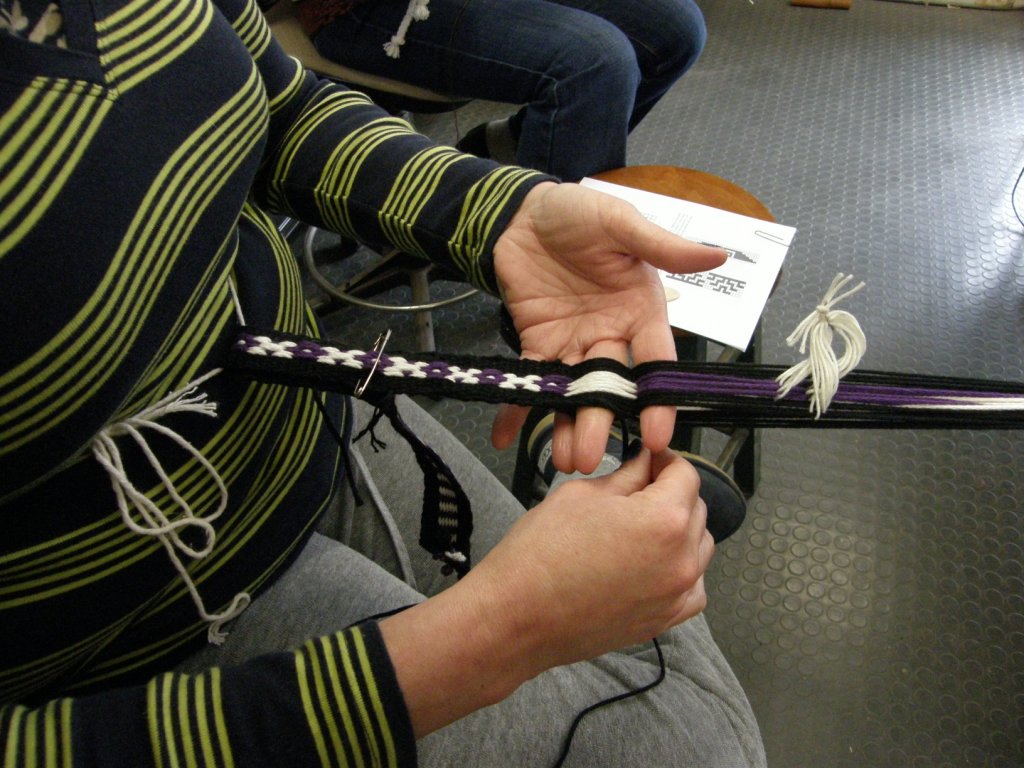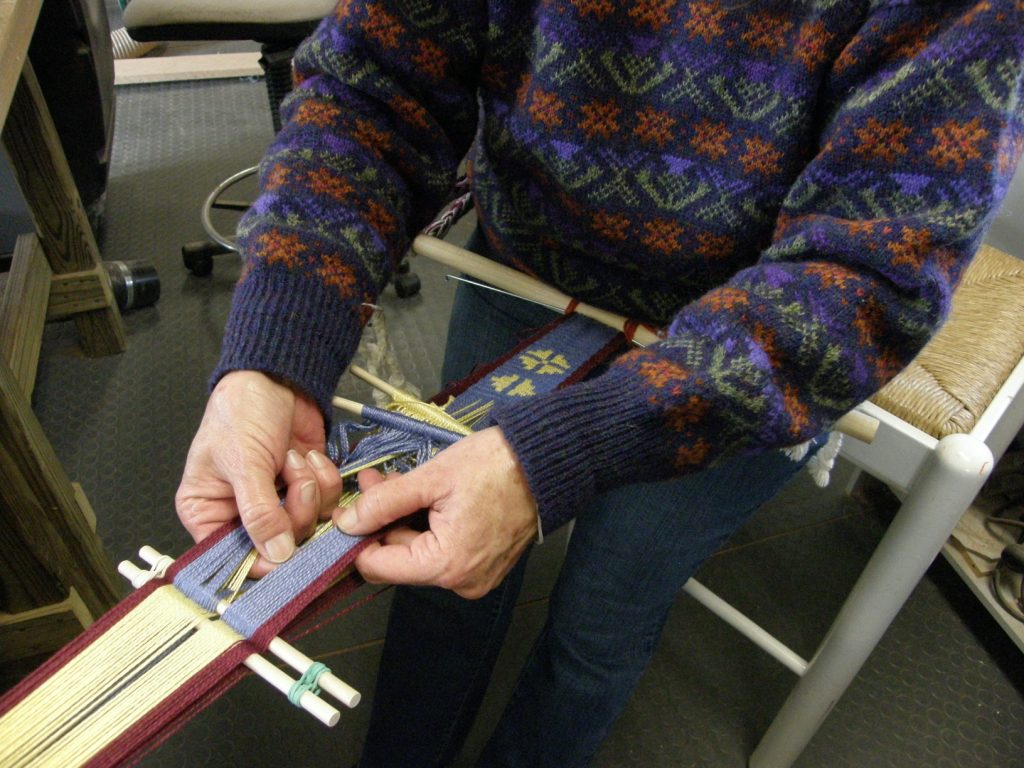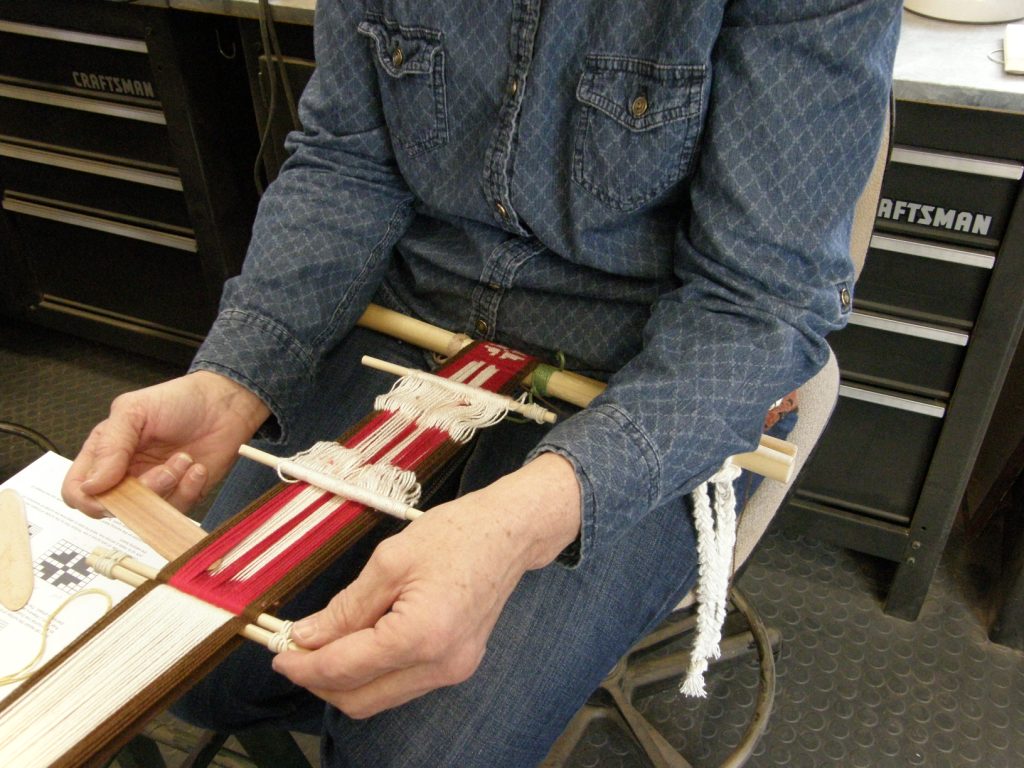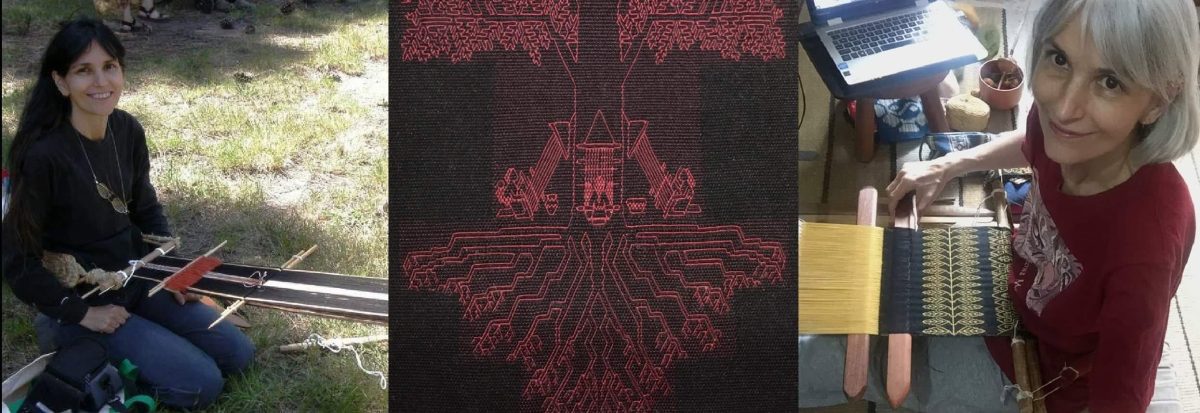
Backstrap Weaving- The Flying Kangaroo

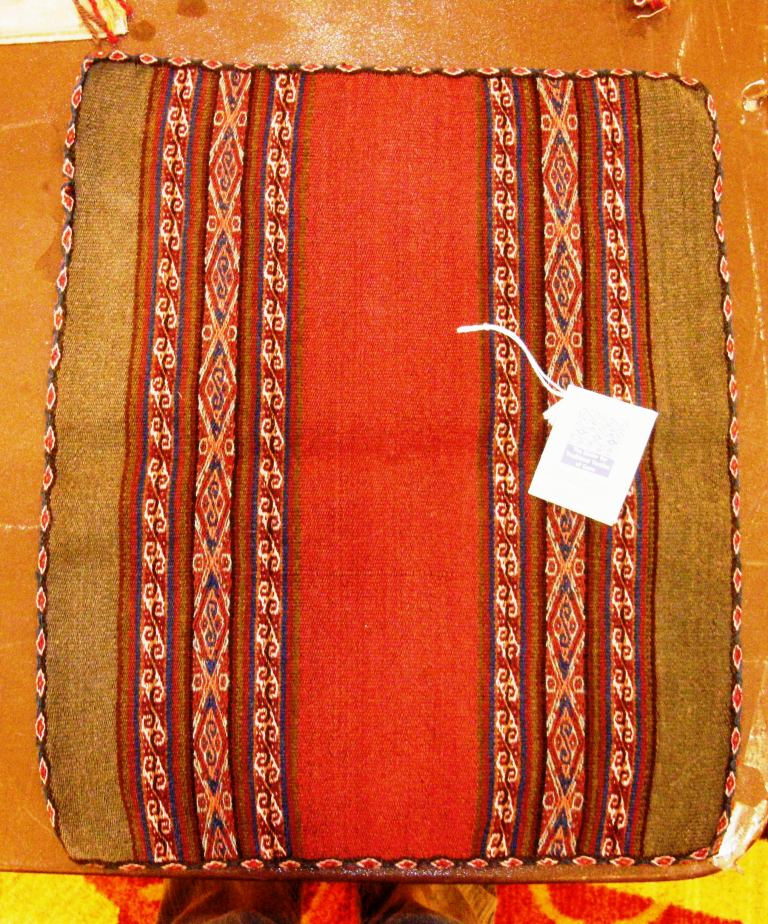
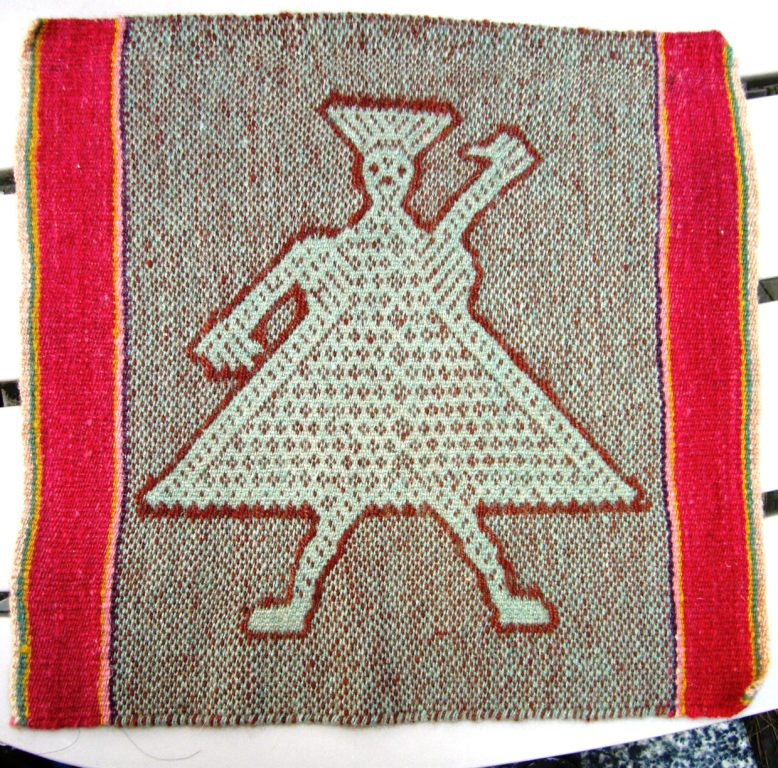
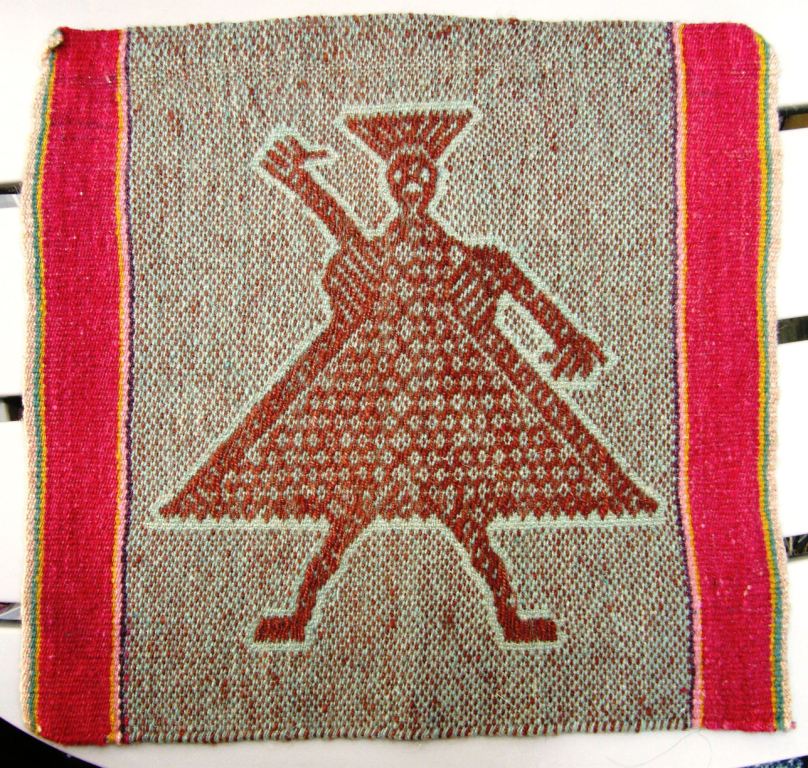
I took pictures of both sides of a lovely little square of weaving that my friend Virginia purchased when she was at Tinkuy 2010 in Cusco, Peru. It was to be part of a piece submitted for the annual weaving competition between teams of weavers from the various communities that form the Centro de Textiles Tradicionales de Cusco.

The competition challenge had been for weavers in each community to weave a series of thirty-six thirty-centimeter squares that would be sewn together to form one large piece. Many squares were woven but only the best selected. Each weaver had to create a perfect four-selvedge square that could be sewn to the others to form a seemingly seamless piece of  fabric. Attempts to include a square that was even ever so slightly off would result in an imperfect overall piece of fabric.

Here are some of the winning pieces from that competitionin 2010….

competition winner bThis entry has squares that were created using the ticlla, or discontinuous warp technique for which the community of Pitumarca has become renowned. Each colored square has a rectangle of pick-up patterning embedded in plain weave, something that only be achieved by using discontinuous warps.

competition winner aThe weavers of Sallac included squares of ikat amongst squares of complex pick-up patterning.
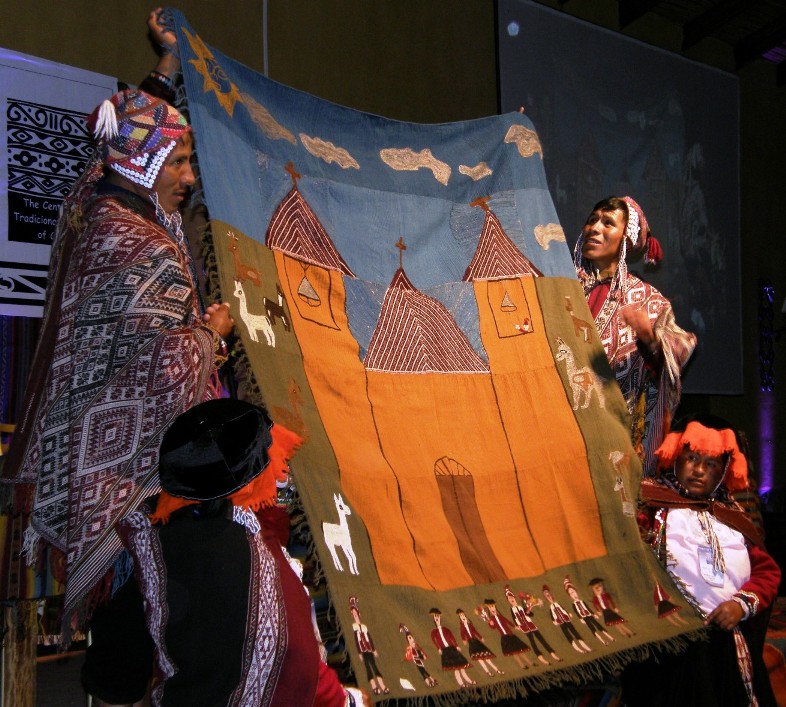
??????????????????????The takers of first place from Chahuaytire presented a deceptively simple piece entitled “matrimonio”. You have to look very closely before you realize that the piece comprises thirty-six masterfully color-matched and pieced-together squares.

Here are some of the pieces from last year’s competition…
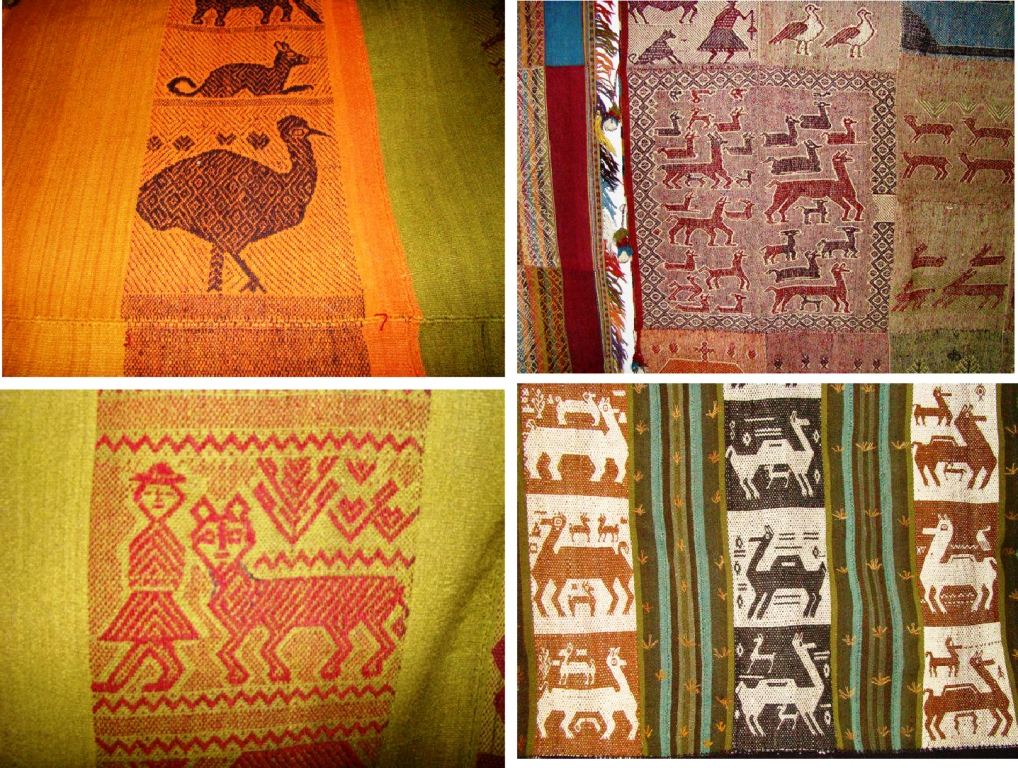
cttc competition 2013But, as I mentioned above, not every square submited by the weavers can be accepted for the final piece. I imagine that there is much frustration and disappointment as hard work and dedication is rejected.

The sweet piece that Virginia had bought back in 2010 was actually one such rejected square. At least it managed to find an appreciative owner and a good home and the weaver was compensated for her hard work. I love the figure on this piece. To me, it looks like she is hitch hiking. She looks strong, bold, and independent yet, friendly and good humored.
??????????????????????

??????????????????????It is such clever and creative use of the supplementary-warp technique. I am amazed at how each and very finger on both hands is clearly defined and at how nicely the legs have been shaped.

I am guessing that this figure was supposed to be just one small part of a story told in the finished piece with its thirty-six squares. I am intrigued by this and wonder what role this humorous lady played. What is she doing….what is she saying? What is that “hitchhiker’s” thumb indicating?

Maybe someone who was at Tinkuy 2010 took a picture of the entire piece. I would love to hear from you if you did. These pieces were hung in the co-op store in Chinchero and I somehow missed this one. Quite likely if I had seen the entire piece I would not have even noticed this one female figure and would have been captured by the piece as a whole rather than by its individual parts.

Other pieces that Virginia shared with me during my stay with her at South Lake Tahoe included this very colorful ticlla piece with three-color complementary-warp pick-up patterns. The four selvedges in each half of the cloth were created without having to abruptly interrupt the pick-up pattern.

??????????????????????There were also pretty tubular bands woven independently and as edgings…..

??????????????????????And sprang bags from the tropical lowlands of Peru…

??????????????????????And a reminder that not all highland weaving in Peru has gone the way of the textiles that are being produced by the Centro de Textiles Tradicionales de Cusco with their fine handspun naturally dyed yarn and intricate pick-up patterns. Cheerful pieces with relatively simple patterns made with heavy yarn and bright synthetic colors are still very much in use in many places…..

???????????????????????????????Needless to say, I thoroughly enjoyed my stay at Lake Tahoe and the group with whom I wove there. From beautiful mountains…

???????????????????????????????

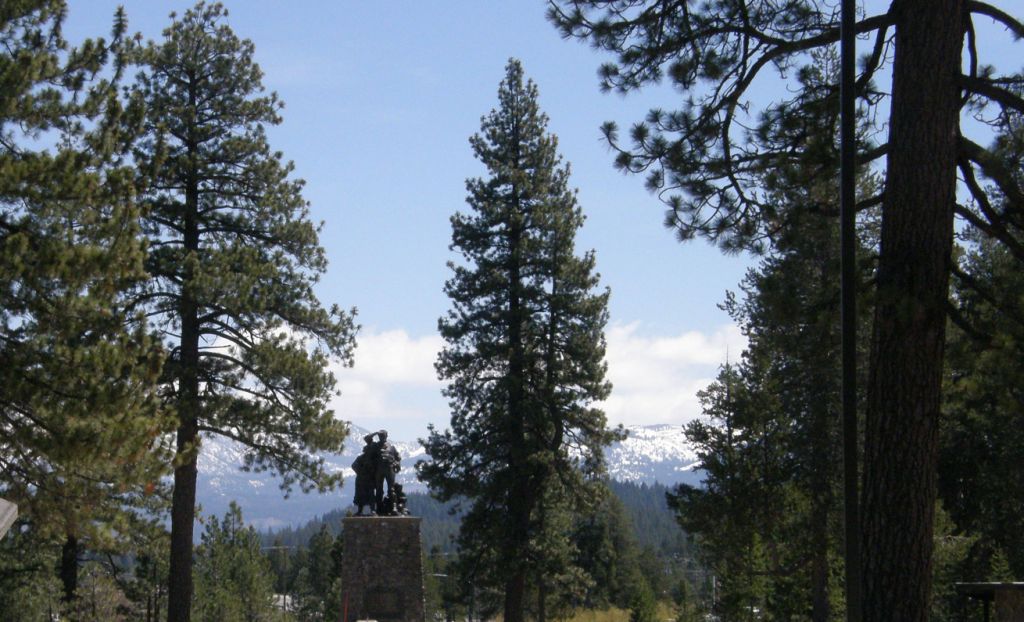
….to  Donner Pass and tales of the ill-fated expedition after which it was named…(Suzanne showed me around the Truckee area)
??????????????????????

….to the glorious lake itself…

??????????????????????Virginia took me out on a boat crossing and it was spectacular!

??????????????????????And what about the weaving?….three days of Andean Pebble Weave in a resort on the lake shore…what fun!
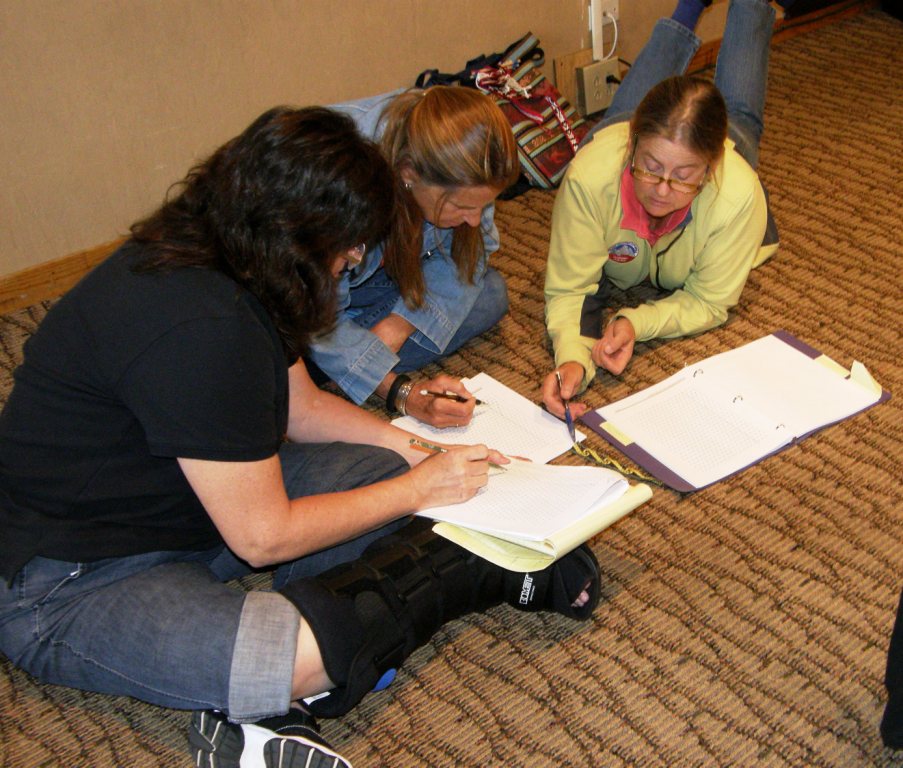
??????????????????????There were ladies who liked to get down on the floor for a session of “team charting’, broken leg and all! Several members of this group had been playing with pebble weave on their four-shaft looms using the instructions in my Andean Pebble Weave book. They were now keen to set it up on a backstrap loom and found that the backstrap loom has a few advantages over the floor loom especially when it comes to saving sheds and creating pick-up shortcuts.

Here is a gorgeous bag that Jen put together from fabric she wove with pebble weave patterns on her floor loom…

jens pebble weave bagAfter the gathering, I stayed with Jen and her sister Elizabeth in Reno with this gorgeously distracting view from the kitchen window…
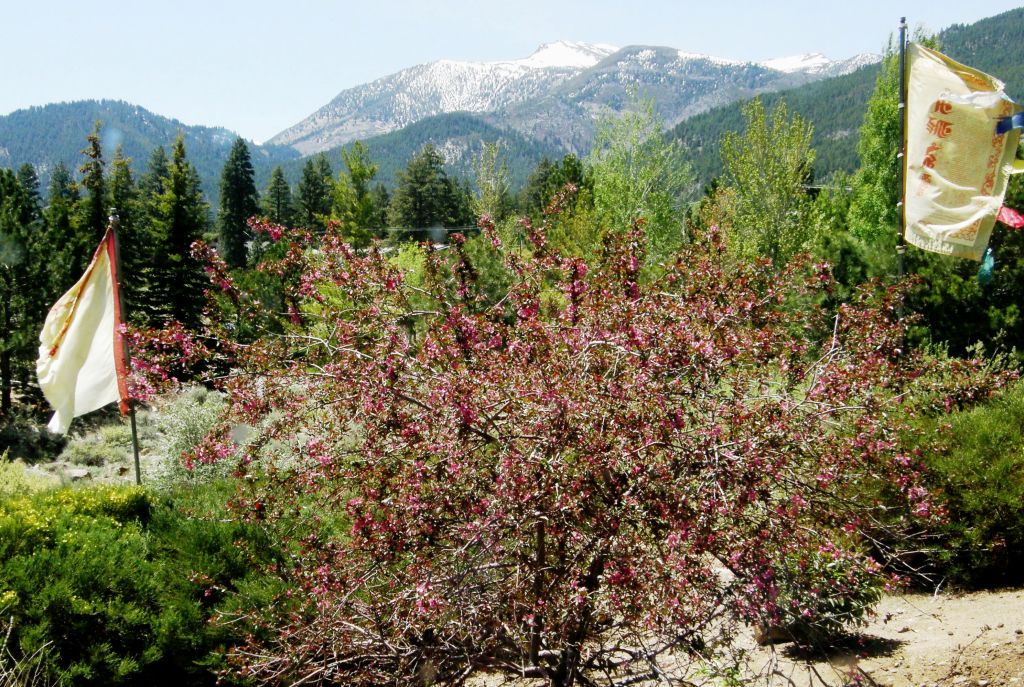
??????????????????????While all that was happening outside and I tried to stuff all my gear back into the massive bags that I lug about with me on these trips, Jen and Eizabeth calmly wove on their backstrap looms and worked on the Andean Pebble Weave pieces we had started together.

??????????????????????I am thinking that those looms in the background might be left to gather dust for a while!

This is what Jen was weaving…her own adaptation of a Tarahumara pattern…

??????????????????????Elizaebth wove as far as she possibly could so that she could squeeze in the last parts of her design and have a matching start and finish…

??????????????????????I will be seeing these ladies back at the Lake for another gathering in the fall…yay!

From there I headed northwest to stay with my friend Betty. We had two gatherings there…one for beginners and another for learning all kinds of pretty finishing techniques. We used handwoven pieces of fabric which had been made by my Bolivian weaving teacher Maxima and other ladies in her co-op. One piece was used for sampling the new techniques while the other was to become a wee pouch. The pouch could be dressed up with the embellishments that we had practiced together.

linda's nawi awapa bandsLinda really took to the tubular band weaving and came  on the second day with  two finished “eye” bands.

finishing touches class backstrap weavingSharon’s sample cloth has a sewn tubular band and cross knit looped edging. She also applied coil stitches to one end which is the embellishment that Bolivian weavers sometimes use to decorate the bottom edge of their chuspas.

???????????????????????????????Here are some of the ladies weaving and sewing accompanied by snoozing  Trouble, the cat.

Weaving in Betty’s studio is the closest thing you can get to being outdoors with its floor-to-ceiling windows and skylight.

betty's studio for backstrap classDuring my stay a group of us went to the meeting of the Portland Handweavers Guild where Rosalie Nielson presented A Cacophony of Kumihimo….a talk on the history of these braids in Japan and her own personal explorations with the techniques.

???????????????????????????????Dozens of Rosalie’s gorgeous braids were displayed amidst her stunning rep weave work.

Next stop… Seattle…. to re-connect with people I had met at ANWG in 2013 and Braids 2012 as well as to meet new weavers. A talented group of tablet weavers came who slid very easily into the basics of backstrap loom operation and basic patterning techniques. John, a skilled braider and ply-splitter, decided to try his hands at weaving. His wife Stacey quickly settled into it and both she and Lynn found themselves very much at home on the floor while the others were happy to stay in chairs.

Lynn at home on floor backstrap weavingSeattle was glorious in pre-summer warmth…gardens in full bloom and vistas of the Cascades at every bend. It is little wonder that my planned weekend stay in Seattle back in 1992 turned into three weeks!

Annie brought in an old exquisite hair sash from Jaceltenango, Guatemala which had been sold to her by a weaver from Laos many years ago in  midwest USA…how these wonderful weavings get around! John brought some of his ply-split work to show as well. I haven’t been able to find John’s website but he has some Youtube videos on his Takadai work….it’s a lovely process to watch.

I can just imagine Braids 2016 in this corner of the US. It’s going to be HUGE!!

hair sash and ply split braidsHere is the next stop…

??????????????????????Did you guess Austin, Texas? And that was not the only display at the airport. The Weavers and Spinners Society of Austin had an exhibit there too aptly entitled ”Flying Shuttles”. I had met seven of the weavers who had things on display ranging from felted sculptures to basketry to wall hangings to wearable fabrics to ply-split braided jewelry. Three of these talented ladies later wove with me.

I wove Complementary-Warp Pick-Up with some new faces as well as returning weavers. It s my third visit to Austin and third stay with Eileen and Guy. Eight weavers came aged from 18 to 79 producing sweet bands decorated with pick-up patterns. Eileen and Guy’s park-like back yard perched above a pretty creek along with a Saturday evening symphony concert made this a perfect venue in which to wind down at the end of my trip.


And then it was…..Hello Sydney!!

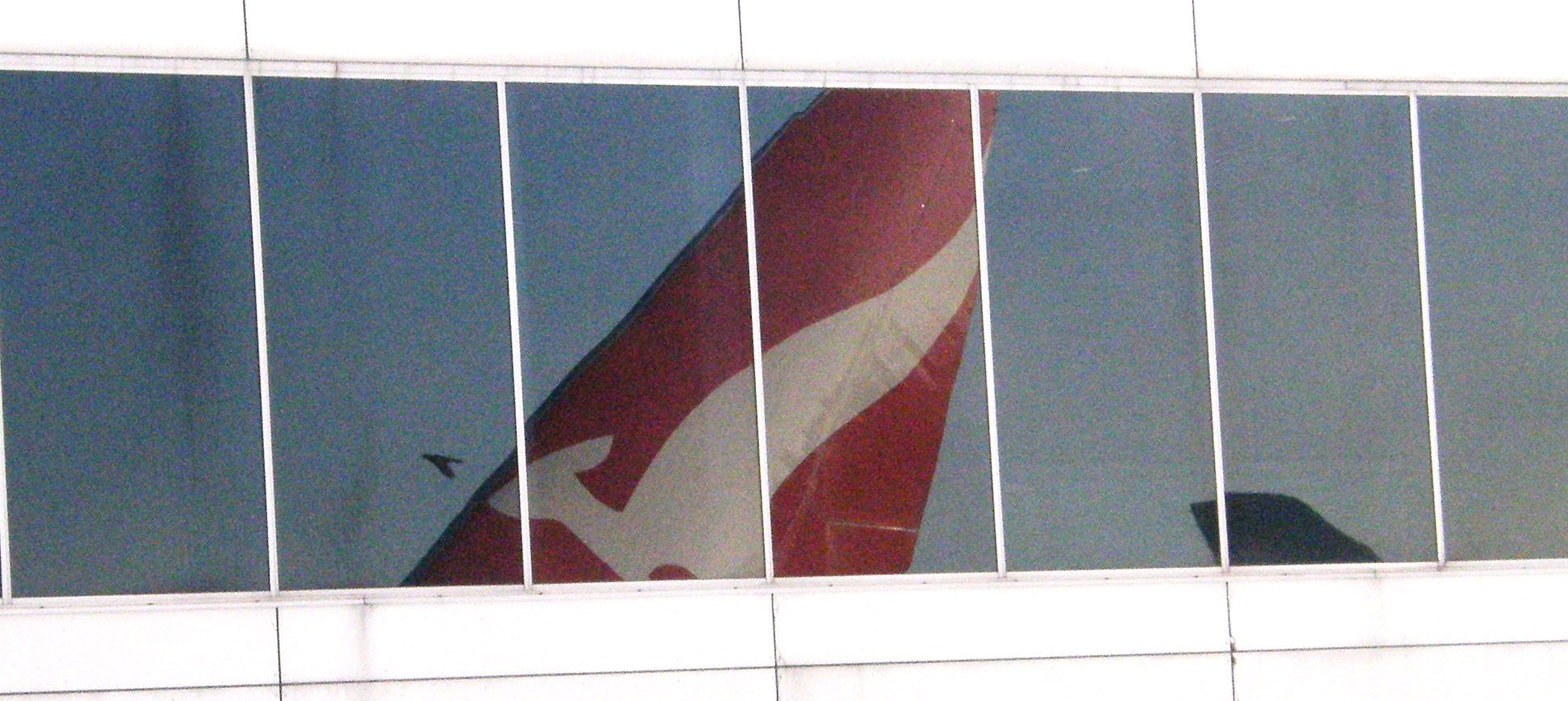
??????????????????????The Flying Kangaroo comes to rest at Sydney airport…
??????????????????????

A couple of weeks to recharge with family and then I shall be doing some weaving here. It is strange to have the days getting shorter, see the fallen leaves and feel the slide into winter after the lengthening days and blooming gardens in the US. Still, the garden is full of color and sound with visits from flocks of raucous lorikeets every evening!

See you next week….

???????????????????????????????


Backstrap Weaving – The View from the Other Side

CNCH 2010 001The Conference of Northern California Handweavers (CNCH) will always have a special place in my heart. At the suggestion of my friend Janet Finch, I came to it as a registered participant  in 2010 in Santa Clara, California. It was my first ever weaving conference and I had a ball!

I took classes with Robyn Spady and Syne Mitchell. Syne had agreed to sell my first book, Andean Pebble Weave, and gave me so much support on her website WeaveZine. It was our first chance to meet after much online contact. I met online weaving buddy Franco in Syne’s class and hope to see him again this fall when I visit Sacramento. Franco has been an online friend for almost five years now! and I look forward to his Facebook posts with his special sense of humor everyday.

In 2010 I thought it would be fun to enter three sashes in the wall hanging section of the gallery. They won a blue ribbon!

Kathe Todd Hooker and Pat Sparks shared with me their experiences with weavers in communities of Russian Old Believers in Oregon and Kathe showed me her collection of Old Believer sashes. Those Old Believer sashes have taken me places. They appear in my second book and have led me to other online friendships. I am now a part of a nice online Ukranian weaving group as a result.

Friendships started at CNCH 2010 that have lasted all these years.
Friendships started and made as a result of CNCH 2010 that have lasted all these years.

I met and hung out in the Vendor Hall with a group of people on the Santa Cruz guild’s Education Booth. I was backstrap weaving there while they were inkle weaving and loop braiding and these folks would become my very good friends…Yonat, Annie and Ingrid. I shared my room with Janet, Sandra and Linda, all from Humboldt County and met Becky and Connie. Many friendships started and  many great things were born at that conference.

So, it was quite a thrill to be back at CNCH in 2014, as an instructor this time.

I would get to enjoy the view from “the other side” It was fun to have my name on this list at the Marriott in Oakland California amongst the other very familiar instructor names in the last half of the alphabet…

???????????????????????????????Below, you can see organizers Elaine Gray and Connie Anderholm (at the computer keyboard).Connie has woven with me many a time on my visits up to Humboldt County. They are checking-in instructor Tracy Shapiro (with whom I have also woven up in Humboldt!). Tracy taught a basket-making workshop. It was so much fun running into my on and off-line weaving friends with familiar faces all over the place. I had a whole new group of backstrap weaving friends that I had just sent time with weaving with whom to mingle.

teacher check in cnch 2014Linda Hartshorn, with whom I had shared that room back in 2010, was there instructing,  as was Ingrid Crickmore who had been loop braiding at the Education booth just for fun in 2010. Ingrid and I have backstrap woven together in Santa Cruz , California many times and we taught together at Braids 2012 in Manchester UK.

I shared my room with Jennifer Moore. We had met in Santa Fe prior to Jennifer’s trip to Tinkuy 2013 in Cusco, Peru and it was fun to catch up with her post-trip and hear about her experience there. So much catching up to do in such a short space of time…a mere two and a half days.

The theme of the conference was Branch Out with Fibers. The center pieces on the tables at the Friday night banquet reflected that. Keynote speaker Robyn Spady had us in stitches with her highly entertaining and clever presentation on her Top Ten Reasons for Branching out with Fiber.

??????????????????????I am sure that I arrived on time for the banquet but it seemed that everyone else had arrived there early. The Humboldt table was full and so I swung around and begged a seat at the very next table. There were friendly faces everywhere.  I got to meet a group of Raverly fiber folk there. It is always nice to put faces to those Ravelry names and discover mutual friends and acquaintances.

I spent Friday afternoon and Saturday morning on on Andean Tubular Bands. Some of the people I had met before and it was nice to see them again. We worked hard and wove the ñawi awapa.

I walked into the room and found this on the table…

balanced double weave bag mexico…a balanced double weave bag from Mexico. Weavers always bring the coolest things along to show me. I have been studying this pick-up techique as practiced by the Cora, Huichol and Otomi people of Mexico and have woven my own pieces. I hadn’t run across this particular motif.

chinchero textile

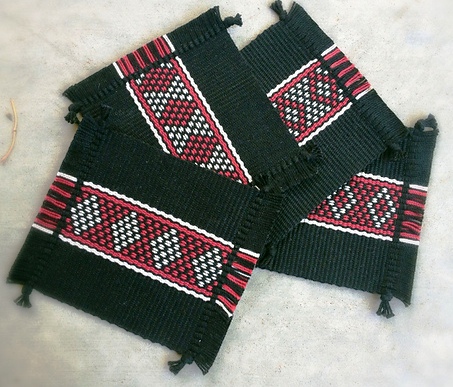
??????????????????????Many of my weaving friends had already discovered the stand in the Vendor Hall that was selling products of the CTTC (Centro de Textiles Tradicionales de Cusco). Many of the pieces were edged with the same tubular band that we were about to weave. That’s a placemat you can see above.

Abigail Killey is selling these pieces at her Organic Cotton Fabric Shop in Bodega, California and she had her stand right at the entrance of the Vendor Hall. It was difficult not to stop there for a LONG time examining all the beautiful Peuvian weavings. My weaving friends bought pieces and brought showed them to me and we were able to examine the way in which the weavers had cleverly disguised the ends of their tubular bands.

I hung out with Abigail in my free time and showed her some basic backstrap weaving techniques using the little jakima beginner kits she was selling.

Here are some of the large pieces that Abigail had amongst the smaller purses, placemats and table runners….

bodega cttc textiles

I love the colors and the large and jolly joining stitches on this large piece from Chahuaytire…

??????????????????????I run into CTTC pieces all over the place. Friends I stay with in my travels show them to me, I saw them in Santa Fe NM at the Folk Art Festival, they were at Convergence, in Cusco of course, on my many visits there and at CNCH. I never tire of seeing them, fondling and photographing them and yes, I finally bought my first piece at CNCH.

I did some other shopping…

fine reed from laosI got this wonderful super fine reed from the stand that was selling textiles and implements from Laos and other SE Asian countries. This is even finer than the reed I got from the Chinese minorities stand at Convergence. When I get to Australia I will see if my brother can remove the rather heavy frame that it is in so I can use it on my backstrap loom…maybe with silk! Excited!

fine reed laos

And, speaking of silk….

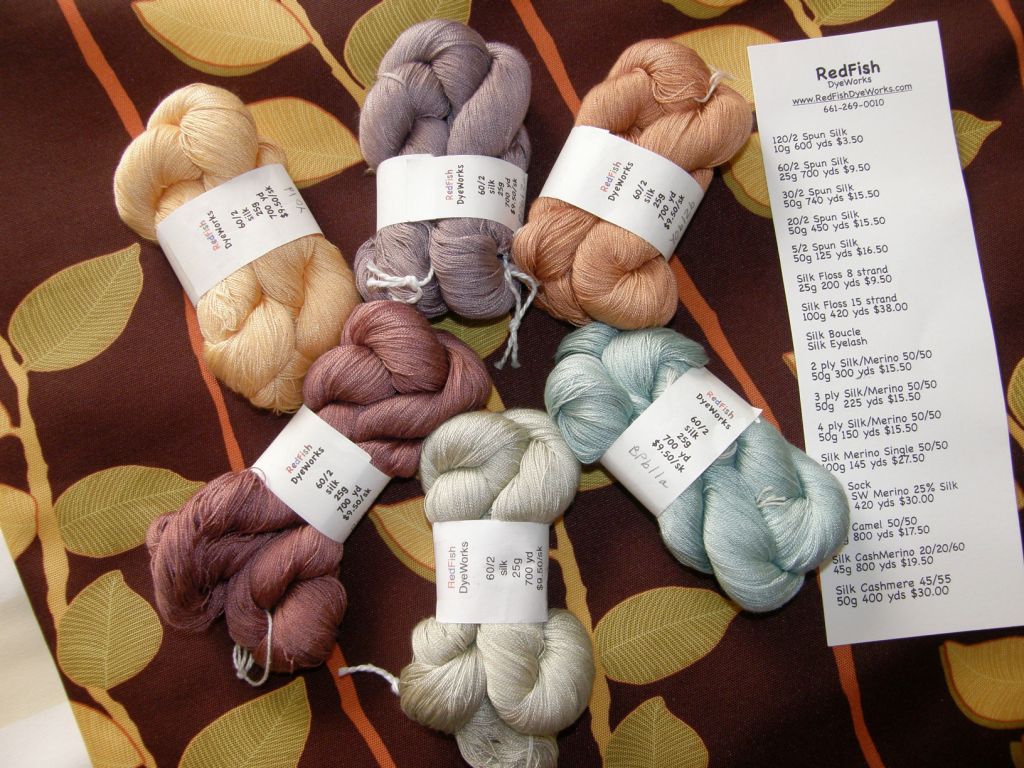
redfish silk

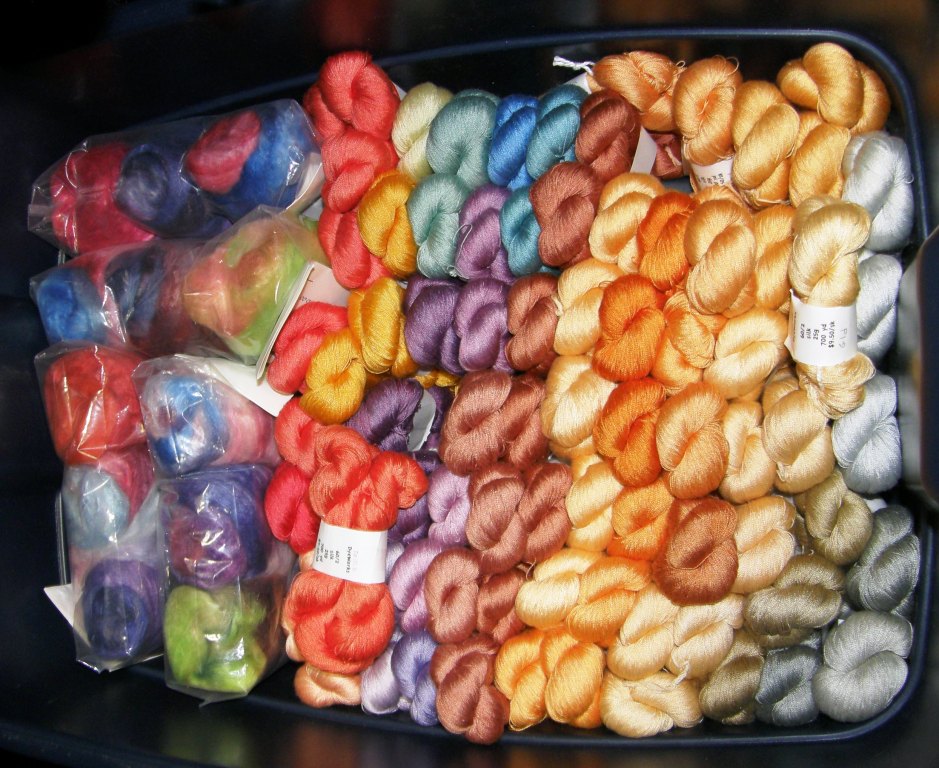
supplementary weft patterned scarf backstrap loomI got these small, very affordable skeins of 60/2 silk from Redfish Dyeworks.

I had bought tiny spools of 60/2 silk from a bargain basket in a yarn store when I was in the UK in 2012. I got olive green, shades of terracotta, purple, brown, deep reds…mainly darkish tones.

I found how lovely it was to use as supplementary weft on a ground weave of fine Guatemalan cotton (see the scarf at left) and lamented not having bought some paler colors.

Well, now I have them and know where to get more when I need and so do you now!

A box of luscious Redfish Dueworks silk.
A box of luscious Redfish Dyeworks silk.

So, that  is what I bought. There were many cool things to look at. See, below, the wooden rigid heddles and clasp for band weaving from Glimakra and plastic rigid heddle segments from Village Spinning and Weaving…perfect for getting kids into a bit of band weaving on a simple backstrap loom.

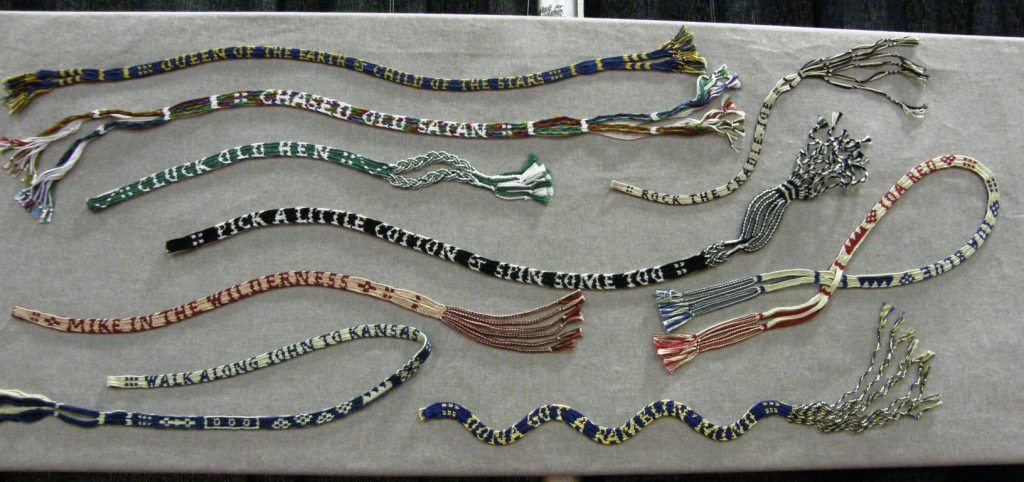
rigid heddles and segmentsI took a quick run through the galleries. I loved Ingrid Crickmore’s display of loop braids in the Instructors’ Gallery. She managed to combine two of her loves,…braiding and fiddle tunes. The words on the braids are lines and titles of fiddle tunes.

??????????????????????

Cookie and blending boardThere was a Spinning Corral where I ran into my friend, Cookie. Cookie has woven with me up in Humboldt as well as down in Pala Alto. She is one very creative lady. Here she is showing the blending board she made and decorated with Zentangles.

My friend, Autumn, was asked to wear a dress made from plastic newspaper wrappers and shopping bags at the Fashion Show on Saturday night. She had been hesitant about accepting and named me as a possible candidate for the role…I wanted to slap her when she told me that! Phew…she went ahead and did it with everyone’s encouragement! I so wish I had been able to photograph her modeling it…she looked stunning. Here is the dress on display in the Vendor Hall. It was surprisingly soft, was made by Sandy Drobny, and is entitled “Evening News”.

??????????????????????Sheila O’Hara was in the Vendor Hall working for Vllage Spinning and Weaving and had a display of some of her famous jacquard-woven tapestries. Sheila and I had chatted at CNCH 2010 and she remembered every word of thst conversation as did I. She is such an energetic person! She took my arm when I entered the Vendor Hall. It was the warmest welcome ever.

I love her four season “flockettes” ….

sheila ohara flockettesShe makes the most beautiful tapestry versions of Edward S Curtis photographs of Native Americans. This is a piece that she recently finished that depicts South America at top as a condor and North America as an eagle…

sheila ohara jacquardSunday was all about accepting invitations that I had been receiving to visit various instructors’ classrooms. It was impossible to visit all! I also wanted to meet up with my Santa Cruz friends who were driving up for the day to visit the Vendor Hall and hang out. And, it was also the time for saying goodbyes as some friends hit the road early for long drives home. Plus I needed to meet with Suzanne who would take me on to my next weaving gathering leaving at noon…so little time!

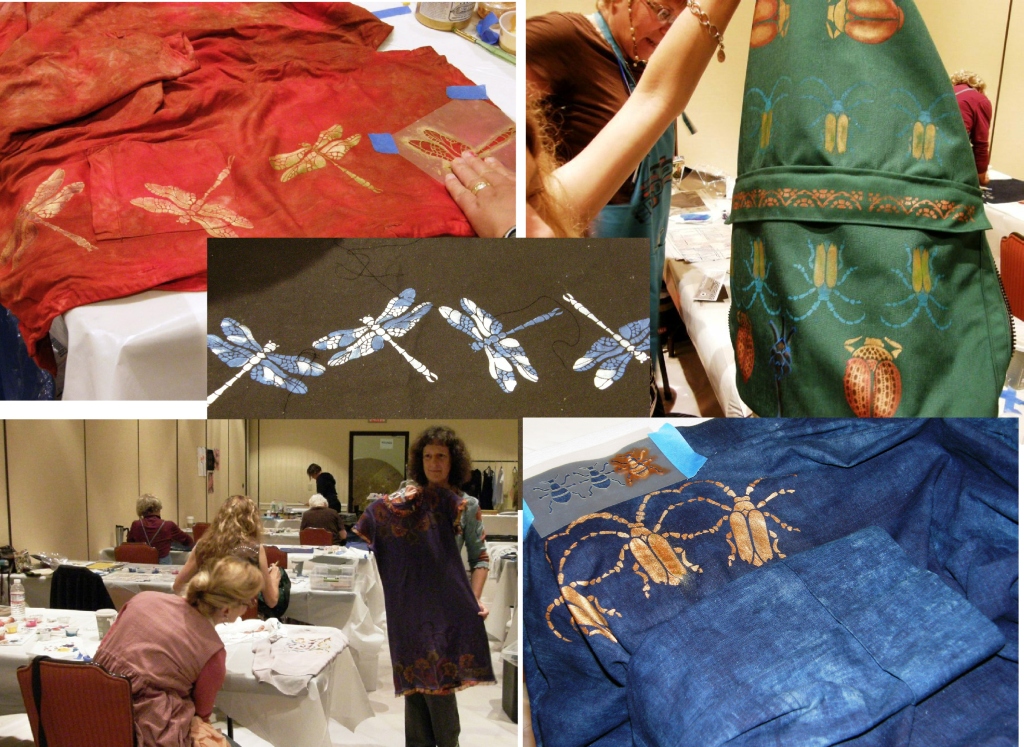
Stenciling on Fabric with April Sproule. This class looked like a lot of fun. There seemed to be alot of "bug" stecils and each studnet used in them in so many differnet ways. Some studets brought in a piece of fabric on which to practce while others brougt in bags, item sof clothing or hand dyed fabric on which to stencil motifs. I loved the green spinning wheel bag that had been spruced up with stenciled patterns. Tien had brought a red shirt. She said that she had not been pleased with the results of her dyeing of this artucular shirt but that the dragonfly stenciling had now converted this shirt into a favorite.
Stenciling on Fabric with April Sproule. This class looked like a lot of fun. There seemed to be a lot of “bug” stencils and each students used in them in so many different ways. Some students brought in a piece of fabric on which to practice while others brought in bags, items of clothing or hand dyed fabric on which to stencil motifs. I loved the green spinning wheel bag that had been spruced up with stenciled patterns. Tien had brought a red shirt. She said that she had not been pleased with the results of her dyeing of this particular shirt but that the dragonfly stenciling had now converted it into a favorite.
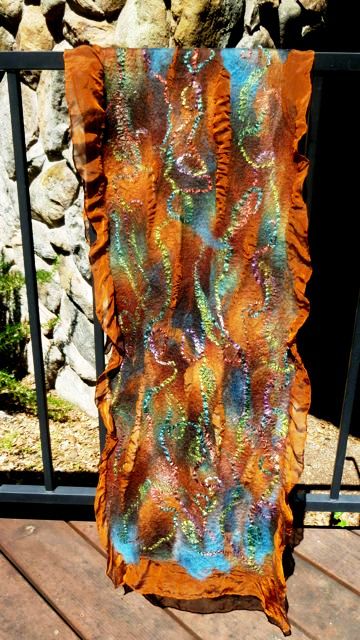
Advanced nuno felting workshop with Carin Engen. I walked in on a lot of students hard at work rolling and thumping as wool was made to felt and adhere to silk. It was very hard to picture the finished project looking at the pieces of wool placed on the cloth before the feting process. The fun part was seeing the pattern revealed as the pieces were unrolled. Carin inspected each piece for sufficient adhesion and advised each student on the next steo for their particular piece.
Advanced nuno felting workshop with Carin Engen. I walked in on a lot of students hard at work rolling and thumping as wool was made to felt and adhere to silk. It was very hard to picture the finished project looking at the pieces of wool placed on the cloth before the felting process. The fun part was seeing the pattern revealed as the pieces were unrolled. Carin inspected each piece for sufficient adhesion and advised each student on the next step for their particular piece.

My friend, Diane, took this class. This was her first ever CNCH and I know that she must have felt as excited as I had felt back in 2010. Here she is inspecting her piece after her first session of rolling….

??????????????????????

I was lucky as Diane sent me a picture of her finished piece after she got home from the conference. She had just gotten into backstrap weaving and now I know that she will have problems deciding where to go next after all the exciting things she has learned lately. Last I heard she was back at her backstrap weaving finishing off the bands we wove together…yay.

Diane's finished nuno scarf.
Diane’s finished nuno scarf.
Tapestry Expressions with Tricia Goldberg. Students were invited to bring in a picture of a face and capure the expression in tapestry. The weaving was done looking at the "wrong" side of the fabric and a small mirror was positioned so that the weavers could see what they were producing. The little faces that were emerging were fascinating!
Tapestry: Expressions with Tricia Goldberg. Students were invited to bring in a picture of a face and capture the expression in tapestry. The weaving was done looking at the “wrong” side of the fabric and a small mirror was positioned so that the weavers could see what they were producing on the “right” side. The little faces that were emerging were fascinating!
Robyn Spady's classroom wher she taught Exploring Weave Structures on a Single Warp was electric...a lot of looms, weavers and action! My friend Gina caught me pering in at the door and ttok y hand and brought me in to excitedly show me what she had been weaving.
Robyn Spady’s classroom, where she taught Exploring Weave Structures on a Single Warp, was electric…a lot of looms, weavers and action! My friend Gina, above, caught me peering in at the door and took my hand and brought me in to excitedly show me what she had been weaving.

I saw my friend Ruth in Linda Hartshorn’s class on Shadow Weave and got to see her weaving as part of the ”round robin” style of sampling…

I love shadow weave! I have done a four-shaft version on my backstrap loom amd would ove to try an eight-shaft version one of these days. This is one of the many shadow weave samples that the weavers created. Each one will take home an example of all the sahdwo weave patterns studied in the class.
Secrets of Shadow Weave…Linda Hartshorn. I love shadow weave! I have done a four-shaft version on my backstrap loom and would love to try an eight-shaft version one of these days. This is one of the many shadow weave samples that the weavers created. Each one will take home an example of all the shadow weave patterns studied in the class.
Sara Lamb's Contemporary Cut Pile Rug. Familiar faces from banquet night welcomed me into Sara Lamb's class where partcipants worked on copper pipe and rigid heddle looms to create a sampler of colored squares before starting on a project. Peggy, from my Santa Cruz backstrap weaving group, was there. She said that it was nice to be able to chat and practice this technique. Pick-up weaving on backstrap looms ofetn requires a high level of concentration and SILENCE! It was surprising to see how much the color of the cut pile ends differed from the color of the yarn. The cut ends were darker, richer and more luscious and the sampler then helped weavers make good choices about the colors they would use in their project and the amount of contrast they would achieve. Sara had brought a dazzling range of pieces as samples. No two bags were alike in construction or finishing techiques. She showed how she recorded and planned her projects in a notebook of charted patterns and yarn samples.
Sara Lamb’s Contemporary Cut Pile Rug. Familiar faces from my banquet night table welcomed me into Sara Lamb’s class where partcipants worked on copper pipe and rigid heddle looms to create a sampler of colored squares before starting on a project. Peggy, a backstrap weaving friend, was there. She said that it was nice to be able to chat and practice this technique. Pick-up weaving on backstrap looms often requires a high level of concentration and SILENCE! It was surprising to see how much the color of the cut pile ends differed from the color of the yarn. The cut ends were darker, richer and more luscious and the sampler then helped weavers make good decisions about the colors they would use in their project knowing better the amount of contrast they would achieve. Sara had brought a dazzling range of pieces as samples. No two bags were alike in construction or finishing techiques. She showed how she recorded and planned her projects in a notebook of charted patterns and yarn samples.

As I said, it was impossible to stop in at every workshop. When I got to Sara’s I was already a half hour late for my Santa Cruz weaving buddies meet-up. And then at noon, I was whisked away by Suzanne. There were quick goodbyes, hugs and expressions of congratulations and gratitude to the organizers.

So, I have seen CNCH from both sides now… Both sides were equally exciting and fun. This experience in 2014, I guess, was different because I knew a lot more people. 2010 was great because it was my first ever conference and EVERYTHING was fresh and interesting.

I had planned to write about the Lake Tahoe weave-along here but I think this is enough for this week. Lake Tahoe was heavenly! I stayed at Truckee near Donner Lake, then South Lake Tahoe and finished just outside Reno. Now I am in Washington state. I am excited beacuse I get to go to the Portland guild’s meeting tomorrow night where Rosalie Nielson will be presenting. I have not had the chance to hear another weaver speak at one of these meetings. And there is bound to be Show and Tell….my favorite part.

I will leave you with two very different faces of Tahoe and Reno…

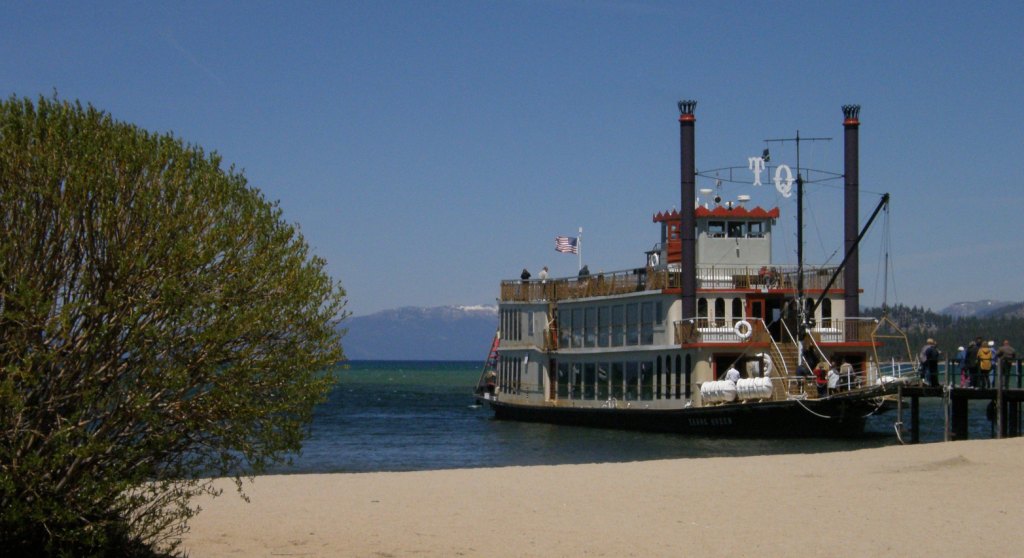
Virginia took me on a boat trip on Lake Tahoe to Emerald Bay.
Virginia took me on a boat trip on Lake Tahoe to Emerald Bay….a perfect day! I think I got  a bit sunburned!

Slot machines at the airport…not something you see every day…no, I wasn’t tempted.

??????????????????????See you next week from….who knows where?


Backstrap Weaving – Venturing Outside the Comfort Zone

Venturing Outside the Comfort Zone

???????????????????????????????It’s always nice in my travels to return to known places. There is something very comforting in the midst of all the “what-ifs” and unknowns of travel to meet once again familiar faces and landscapes.

However, there are always new people and places to add and I have enjoyed visiting new guilds and new US states on this trip. This was my first time visiting New Jersey, for example, and now I am about to venture into Nevada for my first ever visit there. There are new experiences, like trying to navigate the New York Port Authority with loads of luggage for the first time, going flying in a Cessna over Cape Cod on a perfect spring day, and being made very much aware of the rather “shaky” nature of the California coastline! (see picture above).

The mysteries and trepidation of going to new places are always short-lived. The new landscapes are exciting and the new weaving groups without exception are warm and welcoming.

The western part of this trip has take me through a variety of landscapes….from the beaches of lovely Santa Cruz to the big cityscape of Oakland and the forested high passes and lakes of the Sierra Nevada range.

Walking the paths of West Cliff Santa Cruz was a wonderful way to unwind after a day of teaching. We watched surfers, pelicans and sea otters at play in the light of the setting sun.
Walking the paths of West Cliff Santa Cruz was a wonderful way to unwind after a day on the move. We watched surfers, pelicans and sea otters at play in the light of the setting sun.
The view from the 19th floor room that I shared with Jennifer Moore at CNCH 2014.
This is the view from my 19th floor bedroom at CNCH 2014 last weekend. It was fun sharing with Jennifer Moore whom I had met and spent time with backstrap weaving and at the opera in Santa Fe last year.
One of the beautiful peaks on the way to Truckee California.
One of the beautiful peaks of the Sierra Nevada on the way to Truckee California.
Yonat weaving amongst the Redwoods in my Santa Cruz class.
Yonat weaving among the Redwoods in Santa Cruz.
A new venue and new faces in Grass Valley California...backstraps in position and ready for action!
A new place and new faces in Grass Valley California…backstraps in position and ready for action!

I like to call my Santa Cruz group my “firsties and besties”. As it was my fifth time visiting and weaving with them, I decided that it was time to push ourselves outside our comfort zones. The challenge was to take one of the structures that we had woven together on the last four visits and use it in something wide and/or fine. Some group members warped up something much wider than anything they had attempted before while others used much finer thread than they had ever used on a backstrap loom. The results were wonderful!

First we tried different ways to set up warps for wider projects, for example, using multiple swords for creating picking crosses instead of fingers.

Jane uses a mulitple sword technique to pick up a pattern for her backstrap project.
Jane uses a multiple sword technique to pick up a pattern for her backstrap project.

Jane is not actually one of the original “firstie-bestie” group but she has put in so much time and effort since her very first time weaving with us, that she was able to fit in perfectly with the skill level of this group. She has woven an impressive array of Andean Pebble Weave bands since we met only six months ago.

Jane makes exquisite baskets and brought along one of her creatios filled wih her Andean Pebble Weave bands. Ripples the cat had to get in on the act.
Jane makes exquisite baskets and brought along one of her creations filled with her Andean Pebble Weave bands. Ripples the cat had to get in on the act.

Here’s a closer look at the pretty bands and Jane’s basket without the giant cat-head distraction!….

Jane Milner's basket and pebble weave bands.
Jane Milner’s basket and pebble weave bands.

Jane has tried patterns from both my first and second books…

Andean Pebble Weave bands woven by Jane using Omega Sinfonia yarn.

The upper band is an adaptation of a pattern that was woven by Louise Ström using tablets. Many tablet weaving motifs can be easily adapted to the Andean Pebble Weave structure and I have charted some of these in my second book. The lower motif is a doodle I made in the second book where I am showing how people can go about creating their own pebble weave patterns. The hook motifs placed in various diagonal arrangements are, of course, classic Andean patterning.

On the first day at Yonat’s place, I found myself just “hanging out” as my weaving friends wove and planned their projects with increasing independence.

weaving at yonats place

In the afternoon, we did a little “round robin” activity on my prepared warps to brush up on structures and techniques that we seen in other gatherings and help in the decision making and planning process for the next days’ projects…

round robin backstrap weaving

Dorothy's wode project included three columns of Anean Pebble Weave motifs. As she was only able to take two of the three-day workshop, she had to leave with her heddles installed and just a handful of picks in place. As she is heading to Peru to study with tapestry master Maximo Laura this summer, I am wondering when she will find time to sit and finish her project.
Dorothy’s wide project included three columns of Andean Pebble Weave motifs using Tahki Cotton Classic yarn. As she was only able to weave with us for two days, she had to leave with her heddles installed and just a handful of picks in place. As she is heading to Peru to study with tapestry master Maximo Laura this summer which will lead to a whole new world of weaving, I am hoping that she will find time to sit and finish her project soon.
Peggy used Reynold's Saucy yarn (now discontinued) to create a warp for a backstrap . She liked my "Rolls Royce" backstrap...the thick and cushy one and so, chpse a pebble weave motif along with the intermesh structure to produce thick fabric.
Peggy used Reynold’s Saucy yarn (now discontinued) to create a warp for a backstrap. She liked my “Rolls Royce” backstrap…the thick and cushy one…. and so, chose a pebble weave motif along with the intermesh structure to produce thick fabric. Anne went the other way and used fine thread to make a cell phone pouch. She will use two sets of string heddles to make the process partly loom-controlled and decorate the pouch with an Andean Pebble Weave motif.
Here is Yonat's backstrap warp rolled up at the end of the day with just a couple of inches left to go. Yonat found taht weaving outdoors seated on the ground with her warp angled steeply was much more comfortable for her.
Here is Yonat’s backstrap warp rolled up at the end of the day with just a couple of inches left to go. Yonat found that weaving outdoors seated on the ground with her warp angled steeply was much more comfortable for her.
Barbara's challenge involved weaving her favorite "viscacha" motif in fine thread (Aunt Lydia's #10) and swapping the colors for the motif and background while creating beautifully straight edges.
Barbara’s challenge involved weaving her favorite “viscacha” motif in fine thread (Aunt Lydia’s #10) and swapping the colors for the motif and background while creating beautifully straight edges.

The following day, after having looked at images and watched online videos of the cute Andean viscacha, Barbara brought in a tapestry piece  which had been woven on a backstrap loom in Pitumarca, Peru. She had just realized that the critter at the bottom of the piece was the same as the one which she was weaving into her fine backstrap band.

??????????????????????

When not weaving, there was also lots of fun to be had. Yonat and I looked at experiments that the late Nora Rogers, former member of the Santa Cruz guild,  had been performing on backstrap looms. Here is another kindred spirit and it was amazing and almost eerie to see how closely my backstrap weaving experiments have been following the path of her own carried out years before I came to be involved in this.

Here is Nora's experiment in the white-on-white patterning technique using supplementary weft on a light, open cotton ground cloth. I bought a piece like this at the Santa Fe International Folk Art Market last year in the hope of studying and trying to replicate it myself.
Here is Nora’s experiment in the white-on-white Guatemalan patterning technique using supplementary weft on a light, open cotton ground cloth. I bought a piece like this at the Santa Fe International Folk Art Market last year in the hope of studying and trying to replicate it myself.

And then there were various beauties to be examined created by Yonat’s own hands…from tapestries to handmade beads to Ravenstail twining. I saw one of this set of Ravenstail leggings finished on my last visit. This time I got to see the completed pair….

???????????????????????????????Yonat and I also went to a local store that buys and sells ethnic textiles from around the world. We had a super time digging through loads of pieces to find some special treasures. Some pieces were long and large and required no digging at all….

It seems so long agao now since my friend Lisa sent me a picture of a yurt band she had bought and I becane fascintaed with the simple warp-float technique thathad been used to create it. Here in the store was a gorgeous example in those lovely sun bleached reds and blues that I adore!
It seems so long ago now that my friend Lisa sent me a picture of a yurt band she had bought and I became fascinated with the simple warp-float technique that had been used to create it. Here in the store was a gorgeous example in those lovely sun bleached reds and blues that I adore! This technique produces a pattern of warp-floats on one face and areas of exposed weft on the other.

The warp-substitution technique is another one on which I have spent some time experimenting. We had to resist completely unrolling this band to see how the motifs changed along its enormous length. The designs are crisp on the upper face in warp-faced plain weave. Colors are warped doubled and the weaver simply substitutes one for the other to create the patterns. The unused colored warps float on the reverse side of the textile until they are once again called into use.

???????????????????????????????

Here are three bands from across the globe….from Bhutan patterned with supplementary weft….a three-color double weave belt from Bolivia and a supplemental-warp patterned band from Mexico.

???????????????????????????????

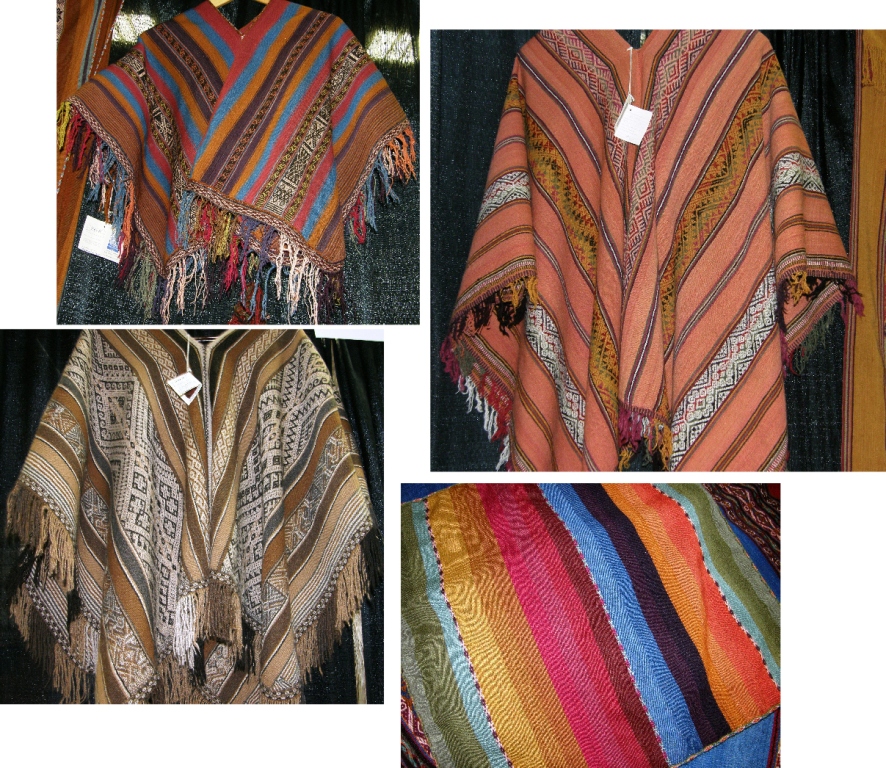
But the jaw-dropper as far as I was concerned was this poncho from Bolivia (see below) patterned with strips of warp-faced double weave. Yonat uncovered this one at the bottom of a pile of mixed textiles on a shelf.

I call this technique “embedded” double weave as the strips of double weave with pick-up patterning are flanked by warp faced plain weave. The yarn is very fine synthetic thread and the weaving was superb! It is a beautifully finished four-selvedged poncho. I know from experience how maddeningly difficult it is to finish a double weave piece with four selvedges and the thread used in this piece does not have the advantage of the springiness of wool which can make the task somewhat less difficult. How I would love to sit by the weaver who created this!!!

???????????????????????????????


???????????????????????????????The visit to Santa Cruz also included a few get-togethers with my dear friend Annie.

If you are a regular reader of this blog, you will know Annie as creator of guitar straps and custom bands and sashes on inkle looms. She gave me the lovely strap, at left, to use on my camera bag.  It is as much fun seeing what wonderful combination of colors she has come up with for her one-of-a-kind pieces as hearing the personal and inspiring stories behind her custom projects.

One of her latest challenges is to create a sash similar to one used by Johnny Depp in the Lone Ranger movie!

I shall leave you here for now. I am in Truckee now and grateful to my friends Suzanne and David for their patience while I bury my head in photo editing and blog writing. I’ll be weaving by the shores of Lake Tahoe in a couple of days and can’t wait to see it!

I shall probably write from Portland, Oregon next with further tales of  the Grass Valley group, the CNCH conference in Oakland and weaving at Lake Tahoe. Bye for now!


Backstrap Weaving – Scattered Drops in the Ocean

Sometimes I am fooled into thinking that just because I am in several online weaving groups, whose forums I read, contribute to, or simply lurk in on a fairly regular basis, I am seeing a good representation of what is going on in weaving in the USA , Europe and other regions of the developed world. Of course, what I am seeing online are mere drops in the ocean. Consider this blog post a peek at a scattering of drops in the ocean as I try to gather the bits and pieces that have come my way, both online and off, whilst on the road.

Let me first show you some pictures of beautiful textures of ocean currents and sand alongside quilt-like patches of color in the Massachusetts landscape. I went flying with my friend Pam’s husband in his Cessna to Cape Cod, over Nantucket and Martha’s Vineyard on a perfect spring day. We had hoped to do such a flight on my visits in previous years but the weather had always been against us.

massachusetts sea and landDrops in the ocean….a corridor of  islands stretch along a bed of blue and green ocean. Those patches of deep red are the cranberry bogs amongst the various tones of green in forests, lakes and fields.

river and ocean and sandSquiggly lines on the ocean floor and across the land make me think of my “Shipibo songs” woven piece at home on my backstrap loom which is awaiting  my return.

???????????????????????????????I have managed to visit three fiber guilds so far on this trip. Some are devoted to all kinds of fiber arts while others are exclusively about weaving. I see the items in the Show and Tell sessions and am astounded by the variety and beauty of the cloth and the humility of their creators.
Many of the weavers simply do not use the internet as a way to connect with other weavers. Their guilds provide a wealth of kindred spirits with whom they can share their projects, ask questions and supply answers. …more drops in the vast sea of weaving.
I like to hear the personal stories behind the woven items from people who are more at ease with sharing within a small group of people with whom they have become well acquainted over many years rather than posting things online for all the world of friends and complete strangers to see. And, of course, the added bonus at  the guild meetings is that we all get to touch and examine the pieces.
We heard the story of Pam’s wool/silk  tallit, or should I say, tallits. You can see two being passed around in the picture. It was only after having twisted the fringe and completed the piece that she realized, on folding it, that the stripes didn’t match on the two halves. One colored band had been woven slightly differently and had, therefore, thrown all the others off. I can imagine that sinking feeling in her gut as she discovered the error. It was back to the warping board to start all over again. She told us of the kindness of the person for whom she had woven the piece and why it was so important to her to have the piece come out just right. He received it in its handwoven bag in tears and says that it wll now be a family heirloom.
??????????????????????
At the same Show and Tell session I was pleased to see a piece of warp and weft ikat from Thailand that a  member had brought along just after I had mentioned this technique in a blog post.
???????????????????????????????
Again, I wonder how many lifetimes I will need to try out these techniques. I may perhaps try weft ikat one day when I am done with experimenting with the warp version and then, if I have a decade to spare, I might get to try warp and weft ikat!
It was nice to see another kindred spirit of mine, Ute, at the Springfield meeting. Ute is part of a group with whom I have woven in Northampton and her sharing of  her collection of Bhutanese textiles and her encounter with Bhutanese backstrap weaver Leki Wangmo were great sources of inspiration to me.
Meanwhile, back in the internet world, with its blogs and weaving forums, my friends Claudia and Janet  showed off their latest custom designed handwoven baby wrap, the colors of which were based on a photograph of a Hawaiian sunrise supplied by the mom. Unlike most internet encounters with beautiful cloth, I have been able to touch this piece ansd heard the story about its creation from concept to fulfillment when I visited with Claudia a couple of weeks ago. Janet took the picture. I think that yardage is difficult to photograph and Janet has found a very effective way to show off the cloth.
lots aknots
Ravelry friends have been at their backstrap looms. Kim is currrently exploring the world of the Bedouin weavers using their striking red, black and white al’ouerjan patterns for a set of mini rugs. These designs are traditionally woven using a warp-substitution technique which means that the back of the cloth will have very long warp floats. One of our group members, Tracy Hudson, showed us Bedouin examples where the weavers had cleverly used an extra weft to tie down the excessively long floats and create a much neater, more attractive and practical “wrong” side. I have tutorials on the technique and these kinds of patterns here and here on this blog.
kim
And, while on the subject of red black and white, from which I never seem to stray too far, I got to see once again the stunning looped bag made by the Ayoreo people of lowland Bolivia that I had given to Pam some years ago. I often visit the co-operative store which sells the work of the various indigenous artisans in the region of Santa Cruz where I live and I have yet to find another example of the looped bags where the work is quite as fine as this one. Perhaps the best pieces are being taken to the International Folk Art Market in Santa Fe (although, I have to say that I don’t remember seeing pieces this fine there either). I am hoping that the quality of the work is not deteriorating as older more skilled artisans die and younger ones sacrifice a little quality as they strive to produce pieces quickly for international markets.
???????????????????????????????
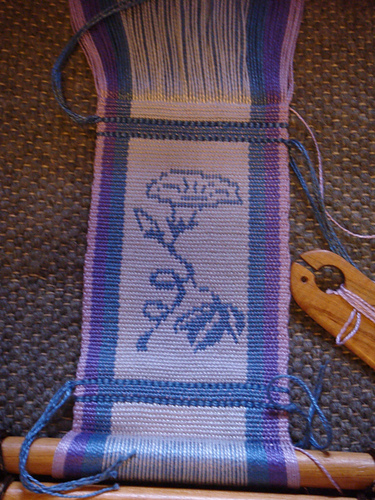
More from the Ravelry group…Julia is celebrating the arrival of spring (although rumor has it that it will snow here tomorrow as I make my way to California) with a double weave piece inspired by her blossoming garden.
DSC04534_medium
She has framed the flower with vertical stripes and weft twining and I can’t wait to see where she goes from here. I am wondering if she will create a series of flowers, each within a little frame.
Here in Pennsylvania, the daffodils are in full bloom. It got warmer and warmer as I traveled from Massachusetts to Pennsylvania, staying with Susan, then Beth along the way and now with Ron and Carol.. It was interesting to attend the guild meeting in Boston….more like a mini conference than a guild meeting with four well attended workshops running side by side in the morning followed by a guest speaker after lunch.
Founded in 1922, it is the oldest guild in the USA and the book that they published to celebrate their 90th anniversary is a treasure. The meeting was the largest I have attended with a surprising amount of familiar faces…online backstrap weavers and people I have met at other guilds. It was nice to see Laurie Autio again and meet Deb Watson.
On the way to the Mannings I spent an evening in Beth’s home accompanied by the work of Jason Collingwood….well, what do you know….red and black! (with some white wall space between to complete the favorite color combo)….
??????????????????????
I had a fun weekend with a group of backstrap weavers…
???????????????????????????????
Laura is a natural and quickly found that “sweet spot” where the sword would sit up nicely in the shed without constantly clattering to the floor. You can see how she is practicing controlling the edge warps to make nice even edges.
Julia was back for a second time. Jeanne, whom I had met at the Spinning Seminar last year, was there too as was Karthika..
Julia has a lovely collection of old Guatemalan textiles that she collected in the 1970s. It was very nice to have these textiles on hand to look at. They show examples of both single and double-faced techniques.
??????????????????????
This panel from a huipil of San Antonio Aguas Calientes is well used and very faded. The bird motifs were executed in the double-faced technique and the colors on the reverse are bold and bright.
??????????????????????
This piece, which is covered in double-faced motifs, would have been a baby’ cap. A string along the top would have been drawn to close the top. What is most likely the baby’s name has been worked in. It is so incredibly fine!
??????????????????????
This hair sash is a lovely example of single-faced techniques. The back of the sash is solid red with a  few very fine stripes. We don’t know the exact origin of this sash.
I had two days to wander the Mannings store, see what’s new and catch up with staff including resident weaving instructors Tom Knisely and Sara Bixler. The ladies from Just Our Yarns came in to give a two-day class on weaving with their fabulous hand painted tencel.
??????????????????????
I have been using one of their handpainted varieties as supplementary weft for years…a little goes a long, long way… and now I have several more of their color combinations to add to my stash. The first was given to me by my friend Lisa before I even knew what tencel was. Using it for weft inlay creates motifs that look as if they were made from mother of pearl.
There was also work to be seen by other past instructors and I discovered that rug hooking is not the same as latch hooking…
??????????????????????
Debra Smith, editor of Rug Hooker’s magazine teaches at the Mannings and has created a small gallery of her work amongst the tools and other supplies for this craft that the Mannings sells.
??????????????????????
This last piece ,with its colored vertical lines on black, reminds me of the reverse applique molas of Panama and Colombia…
??????????????????????
nawi awapa tubular bandsSo, I am off to California tomorrow. It has been a wonderful visit meeting new people and old on this east side of the US. It is always sad to leave the Mannings. This visit was too short.
I got to play around with some of my tubular bands trying to devise ways to finish the ends. I found that I could make a neat blunt finish on the blue band and I could also finish the end with a sizeable knob, as on the gold band,which could be used along with a loop to close the band into a bracelet. I am still working on making that as neat and compact as possible. I need to keep practicing.
I will leave you here with a beautiful video that showed up in my Facebook newsfeed. I mentioned this to Karthika, who was born in India like me, and she knew straight away about the famed Jamdani weaving of Bangladesh. The incredibly fine and almost transparent fabric is woven on traditional looms with two weavers seated side by side. It is decorated with supplementary wefts. Watch as they prepare the yarn, warp, thread the fine yarn through the reed and then watch the speed with which they create string heddles!

See you next time from California.


Backstrap Weaving – Yards of Deserts and Dreamlands

Great width and great length are two things that I cannot hope to comfortably achieve on my backstrap loom and so it was nice to be able to spend time with my friend Claudia and be there just in time to see her pull yards and yards of  soft Hawaiian sunrise fabric off her floor loom. Claudia and Janet, who together form Lotsaknots Studio, have been weaving baby wraps….yards and yards of custom baby wraps. It seems that many new moms out there in the Western world like to “wear” their babies these days and put a lot of thought into the color of their custom-made baby-carrying fabric. Claudia cut the fabric off the loom and then pulled and pulled out over 8 yards of fabric for two wraps. It tumbled onto the floor in a pile of  luscious soft sunrise tones.

Of course, mothers in Asia, Africa, Central and South America  and many other regions around the world have always carried their babies either in front or back wrapped in fabric so that baby can accompany them in every aspect of their daily lives…on a trip to market, working bent over in the fields or at the stove, carting water from the well…

One of my weaving teachers in Guatemala shows me her nephew which she carries in a woven sling. His little cap is a woven piece which has been decorated with a double faced supplementary-weft technique. Therectabgle of fabric has a draw string through the top which is pulled to the form the cap.
One of my weaving teachers in Guatemala shows me her nephew which she carries in a woven sling. His little hat is a woven piece which has been decorated with a double faced supplementary-weft technique. The rectangle of fabric has a draw string along the top which is pulled to close the top of the hat
A lady in Bolivia carries her randchild on her back leaving her hands free to spin yarn on a drop spindle. The carrrying cloth is traditionally hand woven although this lady is using a synthetic factory-made piece. These cloths are used tocarry any kind of load...goods being taken to and from market or "luggage" on a trip.
A lady in Bolivia carries her grandchild on her back leaving her hands free to spin yarn on a drop spindle. The carrying cloth is traditionally hand woven although this lady is using a synthetic factory-made piece. These cloths are used to carry any kind of load…goods being taken to and from market or “luggage” on a trip.

When I went to the Tinkuy in Cusco in 2010, I accompanied a group of weavers from Cochabamaba. We had quite a trek to make from the bus stop to our lodgings and I was very envious of the ladies as they wrapped their duffel bags in their carrying cloths, tossed them on their back and headed off down the dusty road. I lugged mine, handles over my forearm and with bag clumsily bumping along against my hip. Guess who made better progress.

My Vietnamese weaving tecaher Ju Nie showed us how she wraps a baby sling. The Montagnard baby slings are woven on backstrap looms and often decorated with motifs in supplementary weft. made
My Vietnamese weaving teacher Ju Nie showed us how she wraps a baby sling. The Montagnard baby slings are woven on backstrap looms and often decorated with motifs in supplementary weft. Using a circular warp on a backstrap loom make these kinds of lengths more manageable. They are usually woven as two separate panels which are then sewn together.

I enjoyed learning about the whole process involved in the creation of one of the Lotsaknots custom wraps. First, the mother will describe her needs and  usually provides a picture which contains the kinds of colors that she would like to have in her wrap.

dreamland inspirationThis is the picture that was used for the latest wrap on Claudia’s loom which has been entitled Dreamland. The yarn is ordered and Janet wraps colors around card to help determine the final layout. She has amazing talent for this and I think that she has captured the tones and mood of the picture beautifully. As I stick to red, black and white for my entire series of wall hangings, this talent for combining colors is one that I envy.

IMG_0460


Then comes the job of winding all those yards of warp. One half will be the custom wrap made to the mother’s specified length. The second wrap will have a different weft color which will give it quite a different look and this “sister wrap” can be sold online.

I loved seeing these chained sections of warp sitting on the floor ready to go on the loom. They reminded me of snakes of berry-flavored soft serve icecream oozing out of a machine.

??????????????????????I am often mystified by the way people gasp at all that is involved in setting up for backtrap weaving. People roll their eyes when they look at all the string heddles I have to make. I don’t get it.  I have to say that that is nothing compared to the process of getting this kind of warp onto a floor loom! Now I know what rough sleying is and understand the need for a trapeze when warping. Then there are all those heddles to thread and then the reed. Some of it seems really hard for one person to do all alone.

??????????????????????Here are all the threads on the apron rod after having been rough-sleyed. Doesn’t that look gorgeous! I learned a lot watching Claudia do all this and I was even able to lend a hand now and then. I was sorry not to have been around long enough to witness the entire process.

We could have finished it but Clauda wanted to take advantage of my being there to get in a little backstrap weaving so we spent some time on that. She has been wanting to do rep weave and, as she has never done it before, I was happy to be able to get a sample project set up and started on her loom.

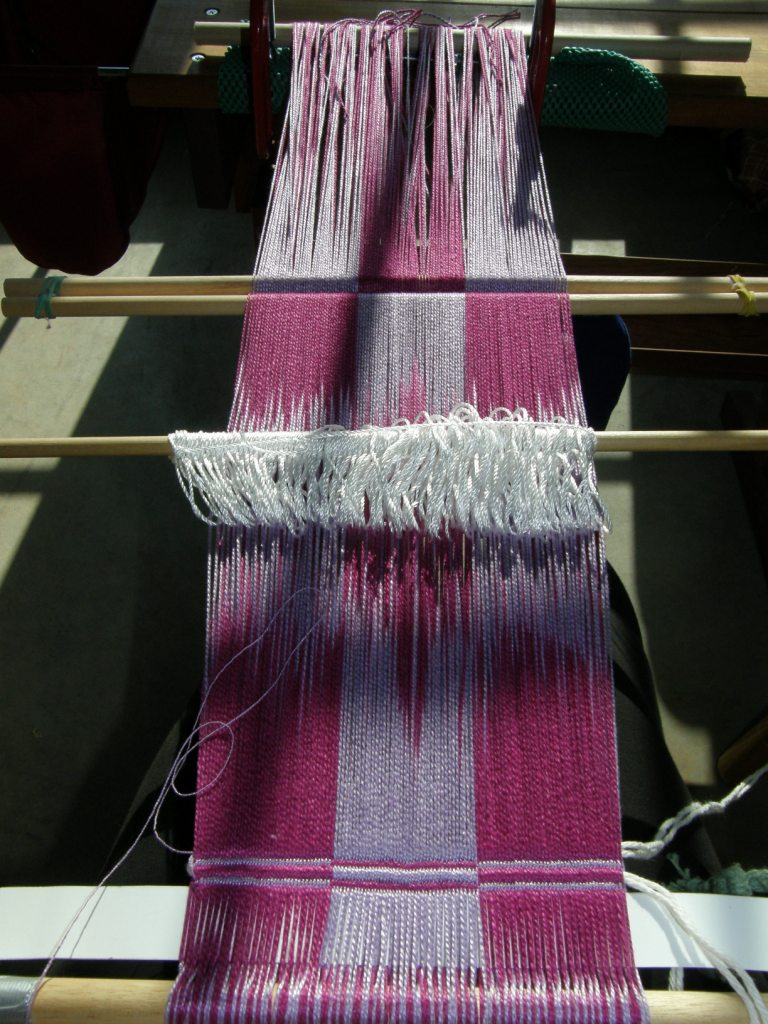
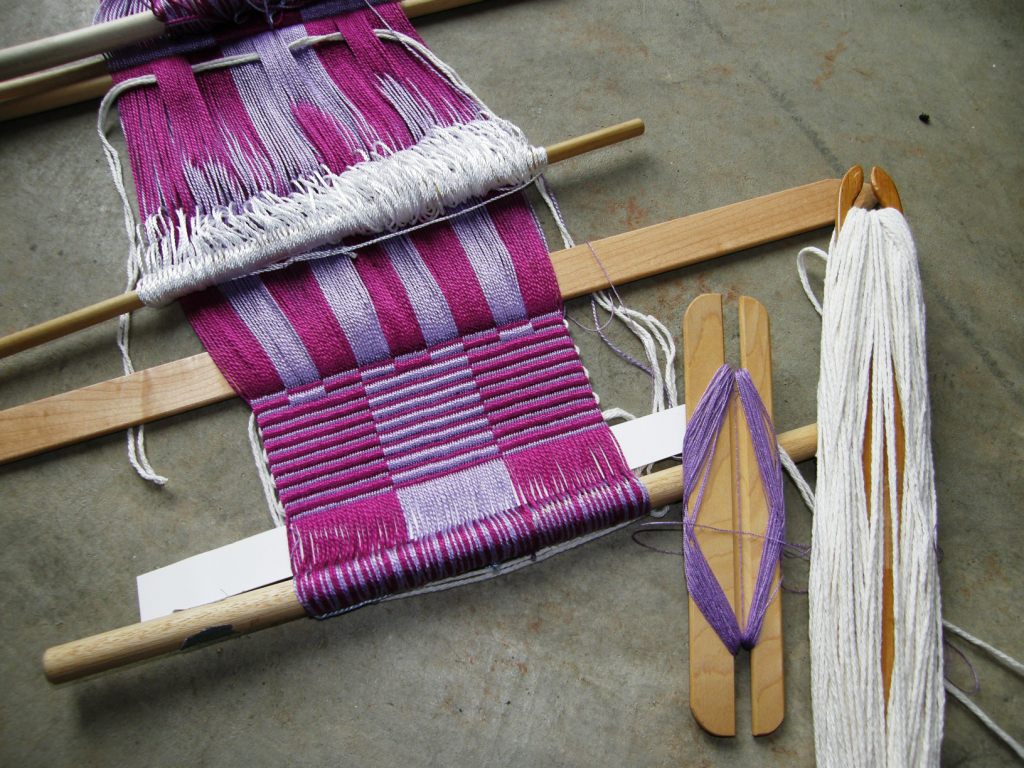
???????????????????????????????Here’s the start of a pink and lavender rep weave. I love the kind of ikat effect that appears in the warp threads as you are in the process of changing sheds. Rep weave is a piece of cake for me as I am used to doing warp-faced weaves and rep weave simply involves alternating a thick and thin weft.  The effect is lovely and it weaves up so very fast with that thick weft. Claudia would like to make a set of four placemats in repweave on her backstrap loom and will use a circular warp to get the desired length for all four pieces. The width is one that is easily manageable on a backstrap loom.

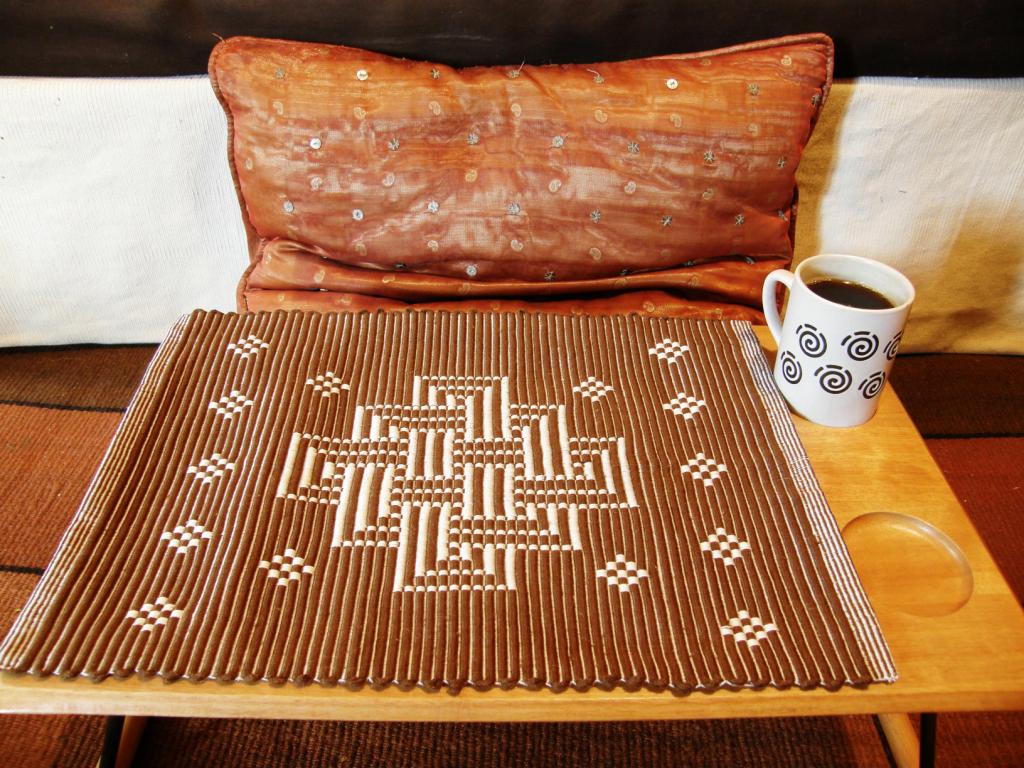
rep runner on tray tableHere’s the rep weave piece that I made some time ago for my tray table. It is decorated with complementary-warp pick up pattern.

??????????????????????Here’s Claudia’s piece underway. I was having fun with it and had to try not to go too far before letting Claudia take over. She was busy hemming her just completed pair of wraps while I worked on this. Above you can see where I have just started making a change of dominant color by swapping the sheds into which I place the thick and thin wefts.

??????????????????????Claudia does some backstrap weaving every time I visit and goes back to her floor loom when she finishes her project. Therefore, it takes her a little time to get back into the swing of things after having had a long break. Above, you can see that she is well underway. We used a pick-up stick to make that small block of color change and now she is back into the original sequence.  It is just a short warp for sampling. Now she has a nice width sample which will help her calculate how much warp she needs to wind for her placemat project. She is using 3/2 perle cotton.

This was a nice break for Claudia between baby wraps. The baby wrap business is never ending with 47 people on the custom order waitlist!

Here’s one of the earlier wraps which was called Sedona. I love this one!

The color arrangement was inpired by this painting…

sedona inspiration

And here is the fabric….it is a wonderful representation of the painting, don’t you think?

??????????????????????

This next one was entered in a Facebook wrap challenge which had a theme of Wizard of Oz…

wizard of oz swirlThe metallic red threads, which I think are such a nice touch, represent Dorothy’s ruby red slippers.

Unfortunately, I didn’t photograph the Hawaiian sunrise beauties when they came off the loom but, no doubt, they will be on the Lotsaknots blog page soon. Doing custom-made pieces is quite a challenge, I think. With only phone calls, email correspondece and maybe a photo, a major piece like this has to be designed and constructed to match what the mom envisions as being perfect for her baby.  I really believe that Janet and Claudia are a good team for this. Janet doesn’t weave but is so good at putting the colors together while Claudia has years of experience at the loom and sewing machine. I can’t wait to see Dreamland when it comes off the loom.

snow2Last Saturday I wove at Terri’s place. Some of you may know Terri as Magical Moons on Etsy. Terri makes beautiful swords for backstrap weaving as well as spindles, pick-up sticks and other tools for fiber artists.

She weaves with me whenever I am in the Maryland area. Laritza joined us. Stephanie, who has never woven fabric before, (she studies basket weaving with Terri) came to have her first-ever try at backstrap weaving.

It was a spring day…a REAL spring day… and we all felt guilty for being indoors in Terri’s workskop while the sun poured down and warmed the air outside. For everyone who had endured the long long winter it was a truly unique day.

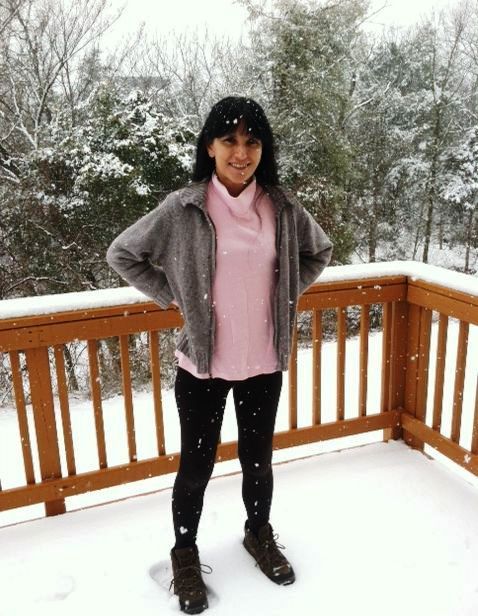
It didn’t last long as you can see at left. That was the following Tuesday. I felt guilty about being so pleased with it when everyone just rolled their eyes and said “not AGAIN!”. I didn’t want so much snow that my travel plans would be disrupted…just enough to make things pretty.

We didn’t have to be out in it. We were weaving away warm and snuggly in the studio looking out and watching it accumulate.

Stephanie backstrap weavingHere’s Stephanie making her first patterned band using what I like to call the “barefoot method”…no sticks… just string and fingers.

Laritza and Terri wove intermesh. This technique was taught to me  in Peru with two sets of string heddles. This gave the ladies some good heddle making practice as a warm-up before they could get into the weaving. This is one of the patterning techniques that I teach in my second book.

Laritza backstrap weavingLaritza’s warp goes well with her sweater. Inside it was sweater weather…outside, it was almost warm enough to shed them.

Terri backstrap weavingThat’s Terri working on her intermesh warp.You may remember from previous posts that Terri spends a good part of the year living on Nantucket Island where she has studied basket making with the master weavers there. Below you can see an example of one of her friendship baskets. The little dog figure was contributed by another artisan but the basket is Terri’s. Everything she does including her woodwork is impeccable. I love using her swords.

Sam on friendship basket N Chase T SackettHere is a gorgeous keyfob that she gave me after our time together. It has a piece of whale tooth which Terri shaped and polished. It is a “worry” piece, Terri tells me, as the piece of tooth is just the pefect shape for holding in your hand and rubbing with your thumb when you are feeling agitated. The smooth polished surface really does have a soothing feel.

whale tooth keyfob Terri Sacketttrisha and april at the mannings spinning seminarSo, now I am in South Jersey ready to weave with a group tomorrow..

I met Trisha and April from this group at the annual Spinning Seminar at the Mannings last summer and the idea for this gathering was born. How time flies! I had known Trisha for a long time as part of the Backstrap Weaving Group on Weavolution from way back in 2009. Now we finally get to weave together.

I just received one of my new books from the printer. It looks very handsome with its new red coil binding in place of the black comb that I have been using. I love it.

See you next week from Massachusetts.